
15 Signs of Anxious Attachment (And How to Heal)

Anxious attachment signs include intense fear of abandonment, having a deep fear of abandonment, requiring regular reassurance, overthinking your partner’s actions, being emotionally clingy, and you have trouble trusting that love is secure. These tendencies are generally caused by unbalanced caring in childhood and keep your nervous system hyper-alert. Identifying these signals is the first step towards healing and developing more secure, harmonious relationships.
If you’re continuously worried about losing people you love, need frequent reassurance, and become emotionally overwhelmed when someone pulls away, these are anxious attachment signs. Often, these behaviours stem from a genuine fear of abandonment rather than from extreme neediness.
According to attachment theory, our early experiences of caregiving shape how we relate to people throughout our lives. The nervous system may learn to be on the lookout for rejection when love seems unpredictable in childhood. Even in stable relationships, this can cause emotional overthinking, relationship anxiety, and trouble feeling secure as adults1.
Anxious attachment is usually recognised by patterns rather than by one behaviour. It’s normal to have some occasional reassurance-seeking behaviour except when these behaviours remain persistent, like constant fear of abandonment, emotional insecurity, and hypervigilance to signs of distance in relationships.
To a person with anxious attachment, these thoughts do not seem illogical. They feel genuine because their nervous system perceives emotional distance as a potential threat.
Many people wrongly feel these behaviours mean that they are “too emotional,” “too needy” or “broken.” What’s anxious attachment is an adaptive survival technique that helped someone stay connected in relationships where love felt inconsistent and emotionally unavailable.
In my years of working with relationship anxiety and emotional dysregulation clients, one pattern has emerged continuously: people do not always feel fear of being alone. Instead, they fear emotional abandonment. Realising this root cause starts the pathway to healing. This matches scientific studies on attachment experiences that shape our relationship safety and intimacy2.
Research also shows that anxious attachment style can change through stable relationships, self-awareness, and therapy3. However, attachment styles are not permanent personality traits. They are learned patterns that can change through self-awareness, emotional healing, and healthy relationships.
What Are Anxious Attachment Signs?
Indeed, repeated emotional and behavioural patterns such as relationship instability and fear of abandonment are signs of anxious attachment. Reassurance-seeking, emotional hypervigilance, difficulty trusting, and increased sensitivity to perceived rejection are common examples. Although these reactions may seem overwhelming, they are not indicative of character faults but rather of learned ways to survive.
Emotional, cognitive, and behavioural reactions that happen when a person fears losing emotional ties to significant people in their life are known as anxious attachment signs. Instead of feeling secure by nature, they could be on the lookout for signs that anything is wrong with the connection.
According to Attachment Theory, developed by John Bowlby and expanded through Mary Ainsworth’s research, children develop internal expectations about relationships based on how consistently caregivers respond to their emotional needs. These early experiences become mental models that shape adult relationships.
When caregivers are loving at times but emotionally unavailable or unpredictable at others, children may learn that love is uncertain. In adults, this uncertainty often appears as an anxious attachment sign.
Instead of believing:
“People usually stay.”
The anxious mind believes:
“People leave eventually, so I need to prevent that from happening.”
15 Common Signs of Anxious Attachment
Patterns rather than behaviours are identified as anxious attachment signs.
1. You Constantly Fear Being Abandoned
One of the most significant signs of anxious attachment is fear of abandonment. Your mind constantly looks for signs that someone will leave, even in stable partnerships.
Often, this fear is unrelated to what your partner is truly doing. Rather, your neurological system has been accustomed to the sudden loss of emotional intimacy.
Emotional Mechanism
Your brain perceives ambiguity as a threat. It gets ready for loss before it actually occurs, rather than waiting for proof.
You may notice yourself:
- Feeling anxious when someone becomes busy
- Worrying they love you less than before
- Imagining breakups after small disagreements
Because they use more energy to get ready for abandonment than to enjoy the relationship, many clients report feeling emotionally spent.
2. You Need Constant Reassurance
Seeking reassurance regularly typically indicates a lack of emotional security. Anxiety is temporarily reduced by reassurance, but in the absence of deeper healing, the relief wanes fast, and the cycle is repeated. Everyone enjoys a little reassurance from time to time. The difference is frequency and emotional dependence.
Someone with anxious attachment may repeatedly ask:
- “Are you okay?”
- “Do you still love me?”
- “Are we okay?”
- “You’re not leaving me, right?”
While reassurance can temporarily reduce anxiety, this relief is not long-lasting.
Another doubt soon emerges. This results in what psychologists refer to as the “reassurance cycle.”
Emotional Cycle
Trigger → Anxiety → Reassurance → Relief → New Doubt → Anxiety Again
Reassurance becomes a short-term fix rather than long-term security because the underlying concern remains unresolved.
3. You Overthink Every Conversation
One delayed reply. One short message. One unusual facial expression. Suddenly, your mind begins analyzing everything. You replay conversations repeatedly, searching for hidden meanings.
You ask yourself:
- Did I say something wrong?
- Why were they quieter today?
- Are they upset with me?
- Did I offend them?
This constant mental scanning is called hypervigilance.
Hypervigilance means your brain continuously monitors the environment for possible emotional threats. Although exhausting, it was originally developed to help predict rejection before it happened.
Clients often tell me,
“I don’t even realize I’m doing it until I’ve spent two hours replaying the same conversation.”
Awareness is often the first breakthrough.
4. Small Changes Feel Like Major Threats
When someone has anxious attachment, minor relationship changes can activate a strong nervous system response because the brain interprets uncertainty as potential abandonment.
Healthy relationships naturally include changes. People get tired, get busy, and need space. Yet an anxious attachment system experiences these normal fluctuations as evidence that something is wrong.
Examples include:
- A shorter text message
- Less affection for one evening
- Cancelled plans
- Slower replies
- Needing personal space
While these situations are usually harmless, the nervous system reacts as though the connection is disappearing.
5. You Prioritize Their Needs Over Your Own
People with anxious attachment believe relationships survive only if they constantly keep the other person happy.
As a result, they may:
- Ignore their own needs
- Avoid expressing disappointment
- Say yes when they mean no
- Over-give emotionally
- Become a chronic people-pleaser
Emotional Belief
“If they stay happy, they’ll stay with me.”
Unfortunately, this often leads to burnout and loss of personal identity. Healthy relationships allow both people’s needs to be heard and matter.
6. You Have Difficulty Trusting Love
Anxious attachment behaviour makes love feel uncertain even when someone consistently shows care. Instead of relaxing into the relationship, the mind searches for reasons why the love might disappear.
You may hear compliments…
Yet wonder whether they’re genuine.
You may receive affection…
Yet question how long it will last.
This pattern develops because your past experiences taught your brain that love can be inconsistent. It becomes hard to trust people because uncertainty seems normal, not because you wish to distrust them.
7. Conflict Feels Like the End of the Relationship
Healthy couples disagree. Conflicts are normal. For someone with anxious attachment, however, conflict feels catastrophic. Instead of viewing disagreements as problems to solve, the nervous system interprets them as signs of its ending.
Common reactions include:
- Panic
- Crying
- Apologizing excessively
- Begging to fix things immediately
- Difficulty sleeping after arguments
Emotional Mechanism
Conflict activates the original fear: “If they’re upset with me, they’ll leave.”
As a result, resolving the disagreement becomes less important to you than preventing abandonment.
8. You Lose Yourself in Relationships
Many people with anxious attachment slowly stop asking:
“What do I want?”
Instead, they focus almost entirely on:
“What does my partner want?”
Over time, they may:
- Change opinions
- Give up hobbies
- Distance themselves from friends
- Avoid personal goals
- Base happiness entirely on the relationship
This gradual loss of identity makes relationships feel even more frightening because leaving would feel like losing everything.
One of the most healing moments occurs when clients rediscover parts of themselves they abandoned to maintain closeness. Building a secure attachment begins with rebuilding your relationship with yourself.
9. Emotional Highs and Lows Depend on the Relationship
When attachment anxiety is high, your emotions fluctuate dramatically depending on how connected you feel to someone else. A single interaction can shape your mood for the entire day.
For example, your partner sends an affectionate message in the morning. You feel calm.
Afternoon: they don’t respond for several hours. Your anxiety rises.
Evening: They explain they were busy. You immediately feel relieved.
Notice that your emotional state changed several times, not because of major events, but because your sense of safety depended on the relationship. This emotional dependency can become exhausting.
10. You Stay in Unhealthy Relationships Because Being Alone Feels Worse
Fear of abandonment sometimes becomes so powerful that people remain in relationships that repeatedly hurt them.
They may tolerate:
- Emotional neglect
- Inconsistent communication
- Broken promises
- Manipulation
- Disrespect
The fear isn’t necessarily the relationship itself. The greater fear is being abandoned.
Research has shown that attachment anxiety is linked with difficulty ending unsatisfying relationships because emotional separation feels threatening.
Healing requires you to understand that emotional safety should never mean abandoning your own well-being.
11. You Believe You Must Earn Love
Perhaps the deepest sign of anxious attachment belief is:
“I’m only lovable if I perform well.”
This belief may sound like:
- I have to be perfect.
- I shouldn’t make mistakes.
- I must always be available.
- I need to fix everyone’s problems.
- I have to prove I’m worth loving.
Over time, relationships become performances instead of places where you can be yourself.
Secure attachment, however, rests on a different belief:
“I am worthy of love even when I am imperfect.”
That shift, from earning love to receiving it, is one of the most meaningful changes people experience during healing.
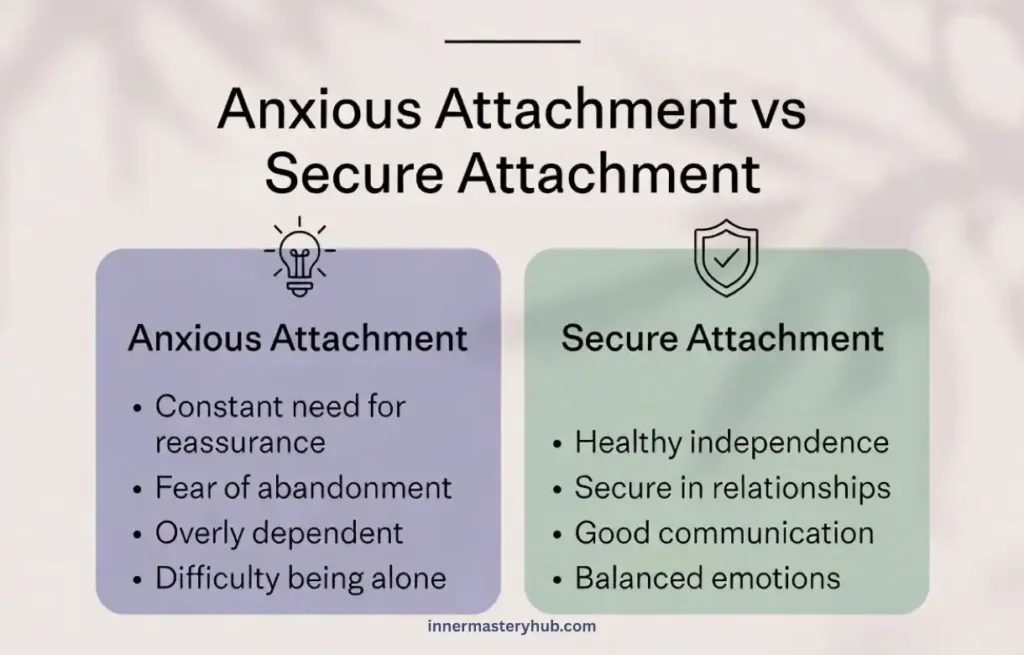
Anxious Attachment vs Secure Attachment
| Characteristic | Anxious Attachment | Secure Attachment |
|---|---|---|
| Trust | Easily threatened | Generally stable |
| Communication | Overthinks silence | Assumes positive intent |
| Conflict | Fears abandonment | Works toward resolution |
| Self-worth | Depends on approval | Comes from within |
| Emotional regulation | Highly reactive | More balanced |
| Boundaries | Often weak | Healthy and flexible |
| Reassurance | Frequently needed | Appreciated but not constantly required |
Why Do People Develop Anxious Attachment?
People are not born fearing abandonment. Instead, these fears emerge through repeated experiences that teach the brain that relationships are unpredictable.
Besides caregiving quality, family stress, temperament, and later life experiences also affect attachment patterns. Childhood interactions are vital, but they don’t shape a person’s entire destiny, whereas healthy relationships, therapy, emotional management, and having personal improvement goals can also make people more secure later in life.
Common experiences due to anxious attachment behaviour include:
- Inconsistent emotional availability from caregivers
- Unpredictable attention
- Emotional neglect
- Frequent criticism
- Parent-child role reversal (parentification)
- Traumatic relationship experiences later in life
From a trauma-informed perspective, these experiences teach your nervous system that connection is uncertain. As a result, emotional closeness feels both deeply desired and constantly at risk.
In counselling, people often think anxious attachment behaviour is caused by “poor parenting.” On the flip side, many loving parents struggled with stress, sickness, finances, or a lack of stable attachment models. Recognising these factors develops compassion without downplaying their impact.
1. Inconsistent Caregiving
Carers may react with warmth at times or with distraction at others. This difference confuses a toddler. The youngster is more sensitive to shifts in emotional connection since they never know when comfort will be accessible. Even as adults, this hypervigilance continues.
2. Emotional Neglect
Emotional neglect does not always include abuse. Sometimes parents provide food, education, and safety but struggle to respond emotionally. Children whose emotional experiences are repeatedly neglected start to believe:
- My feelings are too much.
- I need to work harder to receive love.
- Love must be earned.
These beliefs become their automatic relationship patterns.
3. Childhood Trauma
When the nervous system learns that relationships are dangerous from traumatic events such as emotional abuse, parental conflict, and uncertain environments. Then, protection takes priority over connection in the brain. Though long after the initial threat has passed, this survival reaction continues.
4. Relationship Trauma Later in Life
Attachment patterns can also change during adulthood.
Experiences such as:
- Betrayal
- Infidelity
- Ghosting
- Sudden breakups
- Emotional manipulation
- Narcissistic relationships
Can increase attachment anxiety, especially when they repeatedly reinforce fears of rejection.
5. Nervous System Dysregulation
Attachment is not only psychological, but it is biological.
According to Polyvagal Theory, proposed by Dr. Stephen Porges, the autonomic nervous system constantly evaluates whether relationships feel safe4.
A person’s nervous system continues to be hypervigilant after experiencing long-term emotional instability. This explains why minor changes in a relationship, such as a partner being quieter than normal or cancelled plans, can cause strong emotional reactions. Even in healthy relationships, the body reacts as if abandonment is occurring right now.
How the Anxious Attachment Cycle Works
Understanding this cycle helps explain why these patterns often repeat.
| Trigger | Emotional Meaning | Nervous System Response | Typical Behaviour |
|---|---|---|---|
| Delayed text | They’re losing interest. | Anxiety increases | Multiple messages |
| Partner seems quiet | I did something wrong. | Hypervigilance | Seeking reassurance |
| Minor disagreement | They’re leaving. | Fight-or-flight activation | Pleasing or chasing |
| Less affection | I’m no longer loved. | Emotional panic | Overthinking everything |
| Spending time apart | I’ll be forgotten. | Fear response | Clinging behaviors |
Note that the trigger itself is small. What creates intense emotional pain is the meaning the brain attaches to it.
How Anxious Attachment in Relationships shows
Relationship-building behaviours can sometimes cause strain, which is one of the most common signs of anxious attachment. In which a person wants reassurance by keeping an eye on the relationship, or puts their own needs on the line if they are afraid of losing the connection.
This does not mean that those who experience nervous attachment are “too much.” Instead, their neurological system is attempting to shield them from emotional suffering by using an old survival strategy that no longer works.
Romantic Relationships
Romantic relationships include emotional intimacy; they typically trigger attachment patterns more strongly than any other type of relationship. When a person with anxious attachment signs feels connected, they may feel tremendous delight, but when that connection seems uncertain, they may feel despair.
You may:
- Text repeatedly after not receiving a reply
- Feel anxious when your partner needs space
- Frequently asked whether everything is okay
- Interpret neutral behaviors as threats
- Difficulty expressing your own needs
Although these behaviors come from a desire for closeness, they can leave both partners feeling emotionally exhausted.
Friendships
When the fear of being forgotten or excluded affects how you perceive interactions, friendships can also become emotionally exhausting. Periods of increased and decreased communication are a natural part of friendships. These normal shifts, however, could be interpreted by someone with anxious attachment signs as signs that the friendship is unstable.
For example:
A friend takes several days to reply.
Instead of assuming they’re busy, your mind may think:
- They don’t like me anymore.
- I must have upset them.
- They’re replacing me with someone else.
This leads you to overthinking, people-pleasing, or withdrawing. Healthy friendships allow for flexibility without threatening the relationship.
Family Relationships
Attachment patterns continue within families throughout adulthood.
You might notice:
- Feeling responsible for everyone’s emotions
- Difficulty saying no to family members
- Fear of disappointing parents
- Guilt when setting boundaries
- Seeking approval long into adulthood
For many people, these patterns began in childhood and continued into adult family relationships. Healing sometimes requires redefining what healthy family boundaries look like.
Anxious Attachment in Children vs Adults
| Children | Adults |
|---|---|
| Cry excessively when separated | Fear of abandonment in relationships |
| Cling to caregivers | Become emotionally dependent on partners |
| Need frequent comfort | Seek repeated reassurance |
| Worry caregivers won’t return | Assume loved ones will leave |
| Become distressed by inconsistency | Overreact to perceived rejection |
How to Heal Anxious Attachment Signs and Build More Secure Relationships
If ignored, an anxious attachment can lead to low self-esteem, emotional fatigue, long-term relationship tension, and trouble setting and upholding proper boundaries. These results are not inevitable, and raising awareness opens the door to improvement.
Positive relationships, therapy, mindfulness, and emotional regulation skills can all help you move toward security.
1. Recognize Your Triggers Without Judging Yourself
The first step is awareness. Instead of criticizing yourself for feeling anxious, become curious about what activated the fear.
Ask yourself:
- What happened just before I became anxious?
- What story is my mind telling me?
- What evidence actually supports that story?
- Have I felt this way before in previous relationships?
Often, you’ll notice that the intensity of your reaction is connected to old emotional experiences.
Example
Trigger: My partner hasn’t replied for four hours.
Automatic Thought: They must be losing interest.
Healthier Reframe: They may simply be busy. I don’t have enough evidence to assume rejection.
2. Learn to Regulate Your Nervous System
Healing anxious attachment signs requires both altering one’s thoughts and calming the body. There is more to attachment anxiety than just cognitive problems. It’s also a physical response.
When the neurological system detects possible rejection, it initiates the fight-or-flight response, which increases heart rate, tense muscles, racing thoughts, and emotional urgency.
Helpful regulation strategies include:
- Slow diaphragmatic breathing
- Progressive muscle relaxation
- Mindfulness meditation
- Grounding exercises (5-4-3-2-1 technique)
- Gentle physical movement, such as walking or stretching
These practices help your body recognize that the current situation is not the same as past emotional danger.
3. Build Security Within Yourself
Many people with anxious attachment signs unconsciously believe:
“My worth depends on whether someone chooses me.”
Healing needs replacing that belief with:
“My worth exists regardless of another person’s behavior.”
Ways to strengthen internal security include:
- Keeping promises to yourself
- Developing hobbies outside relationships
- Spending time with supportive friends
- Celebrating personal achievements
- Practicing self-compassion
A secure relationship with yourself makes external relationships feel less threatening.
4. Challenge Catastrophic Thinking
Anxious attachment leads to catastrophizing, which means imagining the worst possible outcome from limited information. For example:
Situation: Your partner seems quiet.
Catastrophic Thought: They’re about to end the relationship.
Balanced Thought: They may be tired or distracted. I need more information before reaching conclusions.
Cognitive Behavioral Therapy (CBT) uses exercises like this to help people evaluate thoughts logically.
5. Communicate Your Needs Clearly
Healthy communication reduces attachment anxiety by replacing assumptions with honest and positive conversations. Express your needs respectfully to develop trust and emotional safety.
Instead of saying:
“You never care about me.”
Try saying:
“I feel anxious when communication changes suddenly. Could we talk about what happened?”
This approach focuses on your feelings rather than blaming the other person.
Healthy communication includes:
- Using “I” statements
- Being specific
- Asking instead of assuming
- Listening without interrupting
- Respecting each other’s perspectives
6. Strengthen Healthy Boundaries
People with anxious attachment fear that their boundaries will push others away. In reality, people respect your boundaries.
Examples include:
- Saying no without excessive guilt
- Respecting your own emotional limits
- Allowing others to have personal space
- Protecting your time and energy
- Maintaining friendships and interests outside the relationship
Boundaries communicate self-respect, not rejection.
7. Choose Relationships That Feel Safe
Healing becomes easy when the people around you are emotionally consistent.
Look for people who:
- Communicate openly
- Follow through on commitments
- Respect your feelings
- Take responsibility for mistakes
- Value mutual trust
Consistency helps your nervous system gradually learn that closeness does not always lead to abandonment.
Daily Habits That Support Healing
Small, consistent actions often create greater long-term change than dramatic efforts.
Consider practicing:
- Spend 10 minutes journaling each day.
- Practice mindful breathing for five minutes.
- Limit checking your phone when feeling anxious.
- Engage in regular physical activity.
- Adopt hobbies independent of your relationship.
- Express appreciation rather than seeking constant reassurance.
- Practice one act of self-care every day.
The Pause Before Reacting Exercise
The next time you feel triggered:
- Pause for 60–90 seconds.
- Take five slow breaths.
- Name the emotion you’re experiencing.
- Ask yourself, “What evidence do I actually have?”
- Consider at least two alternative explanations.
- Decide/reframe how you want to respond rather than reacting automatically.
This exercise helps shift your brain from emotional survival mode to thoughtful decision-making.
Reflection Journal Prompts
Take time to reflect on these questions:
- What situations trigger my fear of abandonment most often?
- What did I learn about love growing up?
- When do I feel safest in relationships?
- Which anxious behaviors protect me temporarily but hurt me later?
- How would I behave if I truly believed I was worthy of love?
- What does a secure relationship look like to me?
Self-Check Questions
Ask yourself:
- Do I often feel rejection without clear evidence?
- Do I rely on others to feel emotionally secure?
- Am I afraid to express my own needs?
- Do I lose my identity in relationships?
- Do I feel responsible for other people’s emotions?
If you answered “yes” to several questions, it may be helpful to continue learning about attachment patterns or discuss them with a qualified mental health professional.
Key Takeaways
- Anxious attachment behaviour develops from past experiences
- Fear of abandonment demands reassurance seeking and emotional hypervigilance.
- Your nervous system reacts to perceived danger rather than actual danger.
- Healing means building awareness, emotional regulation, healthy relationships, and self-compassion.
- Attachment styles can become more secure over time through helpful practices and safe experiences.
Final Encouragement
If you identified with these signs of anxious attachment, keep in mind that awareness is just a beginning. It makes sense that these patterns developed, usually as a means of shielding you from emotional suffering in the past. They don’t reflect your worth or your capacity for healthy relationships.
It is feasible to shift toward a more stable attachment pattern with self-compassion, patience, supportive connections, and evidence-based techniques. Healing begins by teaching your mind and neurological system that connection can be secure and long-lasting when you don’t try to change into someone else.
Can anxious attachment behaviour be healed?
Yes. Research shows that attachment styles can become more secure through corrective emotional experiences, therapy, healthy relationships, and self-awareness. Healing is gradual.
Is anxious attachment behaviour caused by childhood?
Often, but not always. Inconsistent caregiving, emotional neglect, trauma, or unpredictable relationships during childhood are common reasons. However, adult experiences such as betrayal or repeated rejection can also increase attachment anxiety.
Can someone with anxious attachment have a healthy relationship?
Absolutely. Many people with anxious attachment build fulfilling, secure relationships by working on emotional regulation, communication, boundaries, and self-worth while choosing emotionally consistent partners.
What’s the difference between anxious attachment and being emotionally needy?
Emotional neediness is a broad description, whereas anxious attachment is a specific attachment pattern driven by fear of abandonment and uncertainty in close relationships.
Can anxious attachment become secure attachment?
Yes. This process is called earned secure attachment when people repeatedly experience safe, reliable relationships while developing healthier emotional skills.
Is anxious attachment behaviour linked to trauma?
Sometimes. Childhood trauma, emotional neglect, inconsistent caregiving, and later relationship trauma can all be the reasons for attachment anxiety, although not everyone with anxious attachment has experienced major trauma.
How long does healing take?
Healing changes from person to person. Factors such as personal history, support systems, therapy, and consistent practice all impact progress. The goal is gradual improvement, not perfection.
- Bowlby, J. (1969). Attachment and Loss: Vol. 1. Attachment. Basic Books. ↩︎
- Mikulincer, M., & Shaver, P. R. (2016). Attachment in Adulthood: Structure, Dynamics, and Change (2nd ed.). Guilford Press. ↩︎
- Ainsworth, M. D. S., Blehar, M. C., Waters, E., & Wall, S. (1978). Patterns of attachment: A psychological study of the strange situation. Lawrence Erlbaum. ↩︎
- Porges, S. W. (2011). The Polyvagal Theory: Neurophysiological Foundations of Emotions, Attachment, Communication, and Self-Regulation. W. W. Norton & Company. ↩︎
Written By Mehwish Qurayshi
Mehwish Qurayshi is a Trauma-Informed Emotional Wellness Counsellor trained through NICABM’s Treating Trauma Master Series, which includes NBCC-approved education in Trauma Treatment and Emotional Wellness & Emotional Intelligence – Sourcecode Academia. She has over five years of experience providing emotional wellness counselling, helping individuals heal from trauma, regulate emotions, and build healthy relationships.