
What Is Playing Dumb Manipulation? Signs and Examples

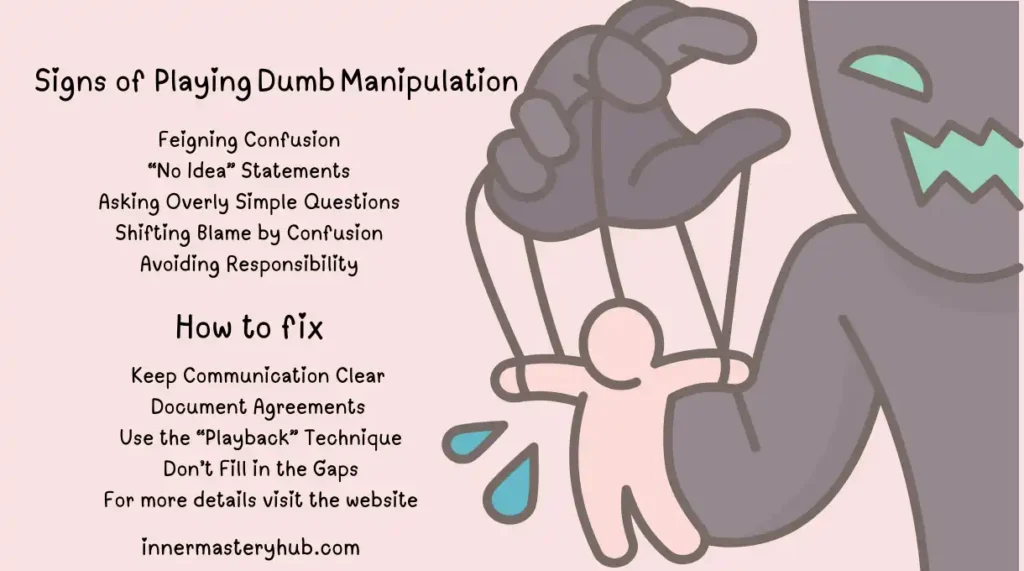
Playing dumb manipulation is a repeated pattern in which someone appears not to understand, remember, or know something, and that confusion repeatedly leaves you carrying more responsibility, having to explain yourself again, or questioning what was agreed.
Sometimes that behaviour may be deliberate. Other times, avoidance, anxiety, inexperience, poor communication, or learned dependence may also be involved.
The important clue is not one confusing moment. It is the pattern, the context, and what repeatedly happens afterwards.
What Does Playing Dumb Mean?
Playing dumb means acting as though you don’t know, understand, or remember something, even when you may know more than you’re showing.
For example, someone might say, “I didn’t realise that was my responsibility,” even though the task had already been discussed.
Sometimes people do this to avoid an uncomfortable conversation, a difficult task, or accountability. But appearing confused doesn’t automatically mean someone is pretending. They may genuinely have misunderstood or forgotten.
When the same confusion repeatedly leaves someone else doing the work or taking responsibility, it’s worth looking more closely at the pattern.
Playing Dumb Manipulation at a Glance
| Question | Quick answer |
|---|
| What can the pattern look like? | You explain something, the person appears confused or forgetful, and you end up explaining again or taking over. |
| Why can it feel difficult? | Repetition may leave you questioning whether you were clear enough or whether you should keep doing more. |
| Is every confusing interaction manipulative? | No. People genuinely misunderstand, forget, feel anxious, or lack experience. |
| What helps you stay grounded? | Separate what you know happened from what you assume about the person’s motive. |
Why Do Some People Act Confused When Responsibility Comes Up?
In my work, I would be careful not to assign one motive to this behaviour.
One person may act confused because admitting a mistake feels uncomfortable. Another may have learned that saying “I don’t know” leads someone else to step in. Someone else may genuinely be overwhelmed or unclear about what is expected.
So rather than asking only:
“Why are they doing this?”
I would also ask:
“What happens when I clarify the expectation?”
Do they make an effort?
Do they ask useful questions?
Or does responsibility repeatedly return to you?
Their response to clarification may tell you more than trying to guess their intention.
Playing Dumb vs Similar Behaviors
| Behaviour | What you may notice |
|---|---|
| Playing dumb | Someone claims not to know or understand |
| Gaslighting | Repeated distortion or denial makes someone question their understanding of events |
| Stonewalling | Someone withdraws from or refuses to engage in a conversation |
| Deflection | Someone changes the subject instead of addressing the concern |
Playing Dumb vs Weaponized Incompetence
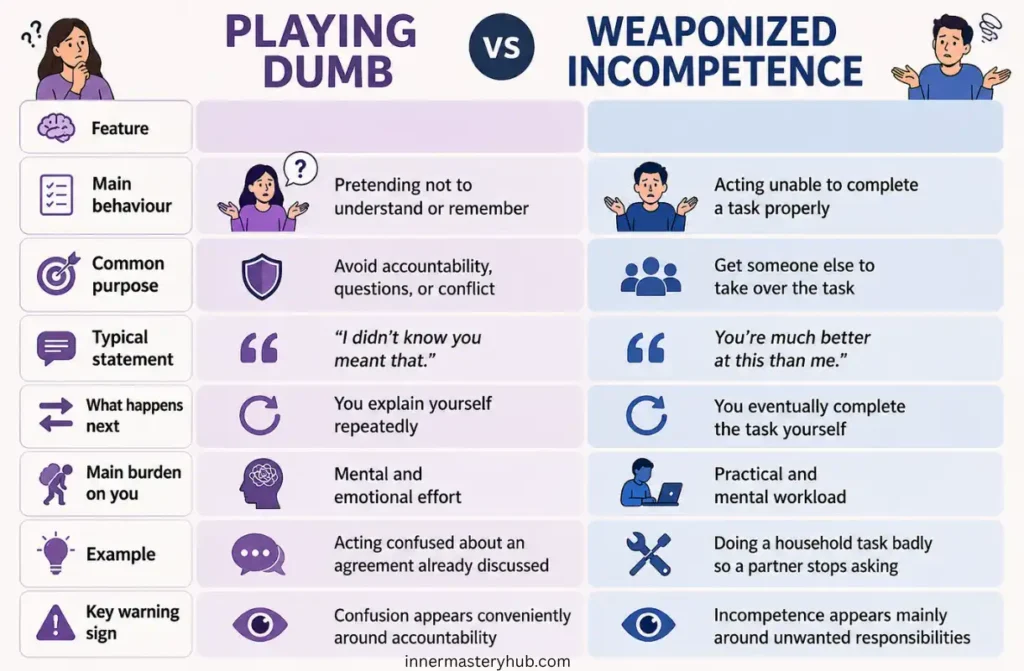
Playing dumb and weaponised incompetence can look similar because both may leave you taking on responsibility that was supposed to be shared.
The difference is usually in the behaviour.
With playing dumb, the person appears not to know, remember, or understand what is expected.
With weaponised incompetence, the person appears unable to complete the task properly, and someone else eventually steps in.
For example:
Playing dumb:
“I didn’t know I was supposed to do that.”
Weaponised incompetence:
“I’m terrible at this. You should probably just do it.”
One mistake or skill gap does not prove either pattern. Pay attention to whether the same behaviour repeatedly appears around tasks the person does not want to handle.
Bareket et al. (2021) found that relationships may have a more unequal division of household work when one partner regularly depends on the other to complete tasks for them. Although this does not prove intentional “weaponised incompetence,” it suggests that repeated dependence can influence how responsibilities are divided.1
| Feature | Playing Dumb | Weaponized Incompetence |
|---|
| Main behaviour | Pretending not to understand or remember | Acting unable to complete a task properly |
| Common purpose | Avoid accountability, questions, or conflict | Get someone else to take over the task |
| Typical statement | “I didn’t know you meant that.” | “You’re much better at this than me.” |
| What happens next | You explain yourself repeatedly | You eventually complete the task yourself |
| Main burden on you | Mental and emotional effort | Practical and mental workload |
| Example | Acting confused about an agreement already discussed | Doing a household task badly so a partner stops asking |
| Key warning sign | Confusion appears conveniently around accountability | Incompetence appears mainly around unwanted responsibilities |
Signs Someone May Be Playing Dumb to Avoid Responsibility
1. Repeatedly Asking the Same Questions After Clarification
Everyone needs reminders sometimes. The pattern becomes worth noticing when you explain something clearly, the person appears to understand, and the same basic questions return the next time responsibility falls on them.
For example, a coworker who has completed the same report several times may repeatedly ask you to walk them through every step again.
Instead of automatically taking over, you can return some of the responsibility:
“You’ve done this before. What do you remember about the next step?”
The important clue is not one question. It is whether repeated confusion consistently leaves you doing more of the thinking or work.
2. Denying What Happened When There Is Clear Information
Another pattern to notice is when someone continues saying they did not know, remember, or understand what happened even after you bring up specific information.
For example, a friend may deny making a comment even though you have the message where it was written.
Rather than arguing about their character, stay with what you can verify:
“This is the message I’m referring to. How do you understand what happened?”
One disagreement about events does not prove manipulation. The concern is when denial repeatedly appears whenever acknowledging the facts would require accountability.
3. Somehow, the Problem Becomes How You Said It
You bring up something they agreed to do.
Instead of talking about the missed responsibility, you end up discussing whether you used the right words, gave enough details, or reminded them enough times.
That can happen genuinely once.
But if every accountability conversation turns into a review of your communication, ask yourself:
“Are we solving the original issue, or am I being asked to prove that I explained it perfectly?”
4. Remembering the Benefits but Forgetting the Responsibility
Sometimes a person appears to remember the enjoyable or beneficial parts of an agreement while repeatedly forgetting what they were expected to contribute.
For example, they may remember the social plan you agreed to but not the task they agreed to complete beforehand.
Memory is imperfect, so one forgotten detail means very little.
What matters is whether the same type of forgetting repeatedly works in the person’s favour.
When something important has been agreed, you can return to the record:
“We agreed on both parts. Here is the message.”
Then focus on what needs to happen next rather than arguing about their memory.
5. Claiming Not to Understand the Impact
Someone may genuinely not realise that a comment or action has hurt you.
The more important question is what happens after you explain it.
For example, they make a harsh joke and say:
“I didn’t know that would bother you.”
The first time, that may be true.
You can respond clearly:
“That comment embarrassed me. Please don’t make jokes like that about me again.”
If the same behaviour continues and every conversation returns to “I didn’t know,” the issue is no longer simply a misunderstanding. You now have a repeated pattern to consider.
6. Turning a Simple Point Into Endless Clarification
Sometimes a conversation gets pulled away from the main issue because the other person keeps focusing on small details, wording, or definitions.
You might say:
“I want to talk about how dismissive that conversation felt.”
and the discussion turns into:
“What exactly do you mean by dismissive?”
Clarifying language can be reasonable.
The concern is when each explanation creates another technical question and the original issue never gets addressed.
You can bring the conversation back by saying:
“We can clarify the wording, but I still want to address what happened.”
7. Using Charm to Soften Accountability
Sometimes a person becomes especially charming, playful, or affectionate just as you raise a concern.
You might explain that a comment crossed a line, and instead of addressing it directly, they laugh, compliment you, or say:
“Come on, you know I was only joking.”
Warmth itself is not a problem.
The concern is when charm repeatedly changes the mood without addressing what happened.
You can bring the conversation back gently:
“I know you may not have meant it badly, but I still want to talk about the comment.”
The useful question is whether the warmth leads to repair or simply helps the issue disappear.

8. Understanding Changes When Responsibility Matters
Someone may seem unsure about a task until it affects something important to them.
For example, a partner repeatedly says they don’t understand how to pay a household bill, even after you’ve shown them. But when a missed payment affects their own account, they manage to work it out.
I wouldn’t assume they’re pretending. Some people learn faster when the consequences affect them directly. Others may need more practice or clearer instructions.
What I’d pay attention to is whether they try after receiving help. Do they remember what you showed them? Do they make an effort the next time? Or do you keep ending up with the same responsibility?
Being capable in one situation doesn’t mean someone knows how to handle everything. But when they’ve been shown how to do a familiar task and repeatedly leave it to you, it’s reasonable to discuss how that responsibility should be shared.
9. Waiting for You to Solve the Problem
Sometimes a person responds to a manageable problem with:
“I don’t know what to do.”
That may be genuine at first.
The pattern becomes worth noticing when they make little effort to think through the problem, try an obvious next step, or ask a specific question. Instead, they wait until you take over.
You can return some of the responsibility by asking:
“What have you tried so far?”
or:
“What do you think your first step could be?”
The issue is not needing help. It is when needing help repeatedly turns into you doing all of the problem-solving.
Komissarouk and Nadler (2014) distinguish between two kinds of help-seeking. Autonomy-oriented help supports a person in solving a problem independently, while dependency-oriented help involves relying on someone else for the answer. This suggests that needing help is not the main issue. The important question is whether the support increases independence or creates repeated dependence on another person.2
When Repeated Confusion Starts Making You Doubt Yourself
In my work, I often notice that the emotional strain does not come from one confusing conversation.
It comes from having to revisit the same issue again and again.
You may start thinking:
“Maybe I need to explain it differently.”
So you add more detail.
Then you clarify again.
Eventually, you may be spending more energy managing the misunderstanding than addressing the original problem.
At that point, I would pause and ask:
“What do I actually know about what was agreed?”
“What have I already explained?”
“Do I need another explanation, or do I need a boundary?”
That shift can help you move from repeatedly proving yourself toward responding to the pattern you can actually observe.
The Biggest Mistake Is Trying to Prove Intent
You may spend a lot of energy asking:
“Are they genuinely confused, or are they doing this on purpose?”
Sometimes you will not know.
The more useful question is:
“What keeps happening after I explain the situation clearly?”
If the same confusion repeatedly leaves you doing more work, carrying responsibility, or revisiting the same issue, you can respond to that pattern without proving what the other person intended.
You do not need certainty about someone’s motive before deciding that a behaviour is becoming unfair or exhausting.
How the Playing Dumb Pattern Keeps Repeating
I would look less at the hidden psychology of the person and more at the interaction between both people.
One person appears confused.
The other becomes more helpful.
More explanation follows.
Then more reminders.
Eventually, the helpful person takes over.
If this keeps happening, both people may fall into predictable roles: one waits, while the other manages.
The useful question is:
“What changes if I stop automatically filling the gap?”
That can show you whether the person is able and willing to take more responsibility.
How to Respond Without Getting Pulled Into the Pattern
In my work, I would focus less on proving whether someone is “playing dumb” and more on changing what happens next.
1. Be clear
Say what was agreed without adding a long defence:
“You agreed to handle this part.”
2. Check understanding
Instead of explaining everything again, ask:
“Tell me what you understand the next step to be.”
That helps distinguish genuine confusion from a pattern where you are expected to do all the thinking.
3. Do not rescue too quickly
If someone says they are stuck, ask what they have already tried before offering a solution.
Support does not have to mean taking over.
4. Keep a record when the issue matters
For important work, money, schedules, or shared responsibilities, a brief written confirmation can reduce arguments about what was said.
5. Set a limit
If the same explanation keeps returning:
“I’ve clarified this before. I’m not going to go through the whole process again.”
6. Watch what changes
I would pay particular attention to what happens after expectations become clear.
If the person begins participating more, the issue may have been confusion or lack of structure.
If nothing changes and responsibility repeatedly returns to you, that gives you useful information about the relationship dynamic.
You Do Not Have to Stay Calm at Your Own Expense
You may think:
“I should be patient.”
So you explain again.
Then again.
Meanwhile, you are getting more tired and irritated.
Being emotionally regulated does not mean acting unbothered.
It can sound like:
“I want to stay respectful, but I’m not going to keep having the same conversation.”
That is calm without pretending the problem does not affect you.
Gross and John (2003) showed that emotional regulation is different from simply hiding feelings. Reappraising a situation in a more helpful way was associated with better relationships, while frequently suppressing emotions was associated with less positive emotional and interpersonal outcomes.3
Is Playing Dumb Manipulation Always Intentional?
No.
Sometimes a person may deliberately act confused because it helps them avoid responsibility.
In other situations, the behaviour may come from avoidance, low confidence, learned dependence, poor communication, or genuine misunderstanding.
That is why intention is not always easy to determine from the behaviour alone.
A more useful question is:
“What happens after the issue is clarified?”
If the person becomes more engaged and responsible, the problem may have been confusion or lack of skill.
If the same pattern continues and responsibility repeatedly shifts back to you, that pattern still matters even if you cannot prove why it is happening.
Passivity is not always a sign of deliberate manipulation. Maier and Seligman explain that experiences of low control can contribute to passive behaviour. Still, learned helplessness should not be used to label ordinary relationship or workplace situations. A better approach is to observe whether clearer expectations and more opportunities to take part result in increased effort.4
Conclusion
Playing dumb behaviour becomes worth paying attention to when apparent confusion repeatedly shifts effort, responsibility, or accountability onto you.
One misunderstanding does not tell you much.
What matters is the pattern: what happens after you clarify the issue, whether the person makes more effort, and whether the same responsibility keeps returning to you.
Stay with what you can observe. Keep important agreements clear, set reasonable limits, and notice whether the behaviour changes.
You do not have to prove someone’s intention before deciding that a repeated pattern is becoming unfair or exhausting.
At the same time, leave room for genuine forgetfulness, anxiety, inexperience, or miscommunication.
Context matters. Repetition matters. And so does what happens after things have been made clear.
Related Articles
If this article resonated with you, you may also find these helpful:
- Circle of Control vs. Circle of Influence – Learn how to focus on what you can control rather than getting trapped in manipulation.
- Am I Being Gaslit? – Signs that someone may be making you question your reality.
- Feeling Personally Attacked? – How to stop internalizing other people’s behaviour.
People Also Ask
What does playing dumb mean?
Playing dumb means pretending not to know, understand, or remember something, even when you may know the answer. For example, someone might say, “I didn’t know I had to do that,” to avoid a task or responsibility. However, not every misunderstanding is intentional or manipulative.
How to spot when a person plays dumb manipulation tricks?
Look for repetition rather than one confusing interaction.
A stronger warning sign is when someone repeatedly appears not to understand, remember, or know what to do around responsibilities, even after the issue has been clearly explained.
Also notice what happens next: do they make an effort to understand and follow through, or do you repeatedly end up explaining, reminding, or taking over?
Confusion alone does not prove manipulation.
Is playing dumb manipulation the same as gaslighting?
No.
Playing dumb usually involves appearing not to understand, remember, or know something.
Gaslighting is a broader pattern in which someone may repeatedly deny, distort, or challenge another person’s experience in ways that can make them question their perception of events.
The two behaviours can overlap, but one instance of forgetfulness or confusion should not automatically be labelled gaslighting.
Can Playing Dumb Be an Avoidance Pattern?
Sometimes. A person may appear confused or helpless when they feel uncomfortable with responsibility, criticism, conflict, or uncertainty. But similar behaviour can also reflect genuine confusion, inexperience, or low confidence. Look at what happens after expectations are made clear rather than assuming a psychological cause.
Is playing dumb manipulation always intentional?
No.
Sometimes someone may deliberately act confused to avoid responsibility.
In other cases, similar behaviour may come from genuine misunderstanding, inexperience, anxiety, avoidance, low confidence, or learned dependence.
The most useful clue is what happens after expectations become clear.
If the person becomes more engaged and responsible, the problem may have been confusion. If responsibility repeatedly shifts back to you, the pattern still deserves attention.
Is playing dumb a form of emotional manipulation?
It can be, especially when apparent confusion is repeatedly used to avoid accountability, redirect the conversation, or leave another person carrying more responsibility.
But the behaviour should not automatically be labelled emotional manipulation from one incident.
Look at repetition, context, what happens after clarification, and whether the same person consistently benefits from not understanding.
Is Playing Dumb a Form of Manipulation?
Yes, playing dumb can be a form of manipulation when someone deliberately acts confused to avoid responsibility or accountability. However, not every misunderstanding is manipulative. Pay attention to whether the same behaviour keeps happening after you’ve clearly explained what needs to be done.
Why Do People Pretend Not to Understand?
Some people pretend not to understand because they want to avoid difficult tasks, criticism, or uncomfortable conversations. Others may lack confidence or have learned to depend on someone else for answers. Sometimes the confusion is genuine, so it’s important not to assume someone’s intentions.
How Can You Tell if Someone Is Playing Dumb?
Notice what happens after you explain something clearly. Does the person try to understand and follow through, or do they keep asking the same questions until you take over? Repeated confusion around familiar responsibilities may be worth addressing, but it doesn’t prove they’re pretending
Is Playing Dumb the Same as Weaponized Incompetence?
Not exactly. Playing dumb involves acting as though you don’t know or understand something. Weaponized incompetence involves deliberately appearing unable to do a task so someone else takes over. Both can shift responsibility onto another person, but genuine confusion or a lack of skill should not be mistaken for manipulation.
How Do You Respond When Someone Keeps Playing Dumb?
Start by explaining what you need clearly and checking whether the person understands. If the same issue keeps returning, ask what they’ve already tried instead of immediately taking over. For important responsibilities, confirm agreements in writing and set reasonable limits on how much you can do for them.
- Bareket, O., Shnabel, N., Kende, A., Knab, N., & Bar-Anan, Y. (2021). Need some help, honey? Dependency-oriented helping relations between women and men in the domestic sphere. Journal of Personality and Social Psychology, 120(5), 1175–1203. doi:10.1037/pspi0000292. ↩︎
- Komissarouk, S., & Nadler, A. (2014). “I” seek autonomy, “we” rely on each other: Self-construal and regulatory focus as determinants of autonomy- and dependency-oriented help-seeking behavior. Personality and Social Psychology Bulletin, 40(6), 726–738. doi:10.1177/0146167214524444. ↩︎
- Gross, J. J., & John, O. P. (2003). Individual differences in two emotion regulation processes: Implications for affect, relationships, and well-being. Journal of Personality and Social Psychology, 85(2), 348–362. doi:10.1037/0022-3514.85.2.348. ↩︎
- Maier, S. F., & Seligman, M. E. P. (2016). Learned helplessness at fifty: Insights from neuroscience. Psychological Review, 123(4), 349–367. doi:10.1037/rev0000033. ↩︎
Written By Mehwish Qurayshi
Mehwish Qurayshi is a Trauma-Informed Emotional Wellness Counsellor trained through NICABM’s Treating Trauma Master Series, which includes NBCC-approved education in Trauma Treatment and Emotional Wellness & Emotional Intelligence – Sourcecode Academia. She has over five years of experience providing emotional wellness counselling, helping individuals heal from trauma, regulate emotions, and build healthy relationships.