
Circle of Control vs. Circle of Influence: Which One Should You Focus On?
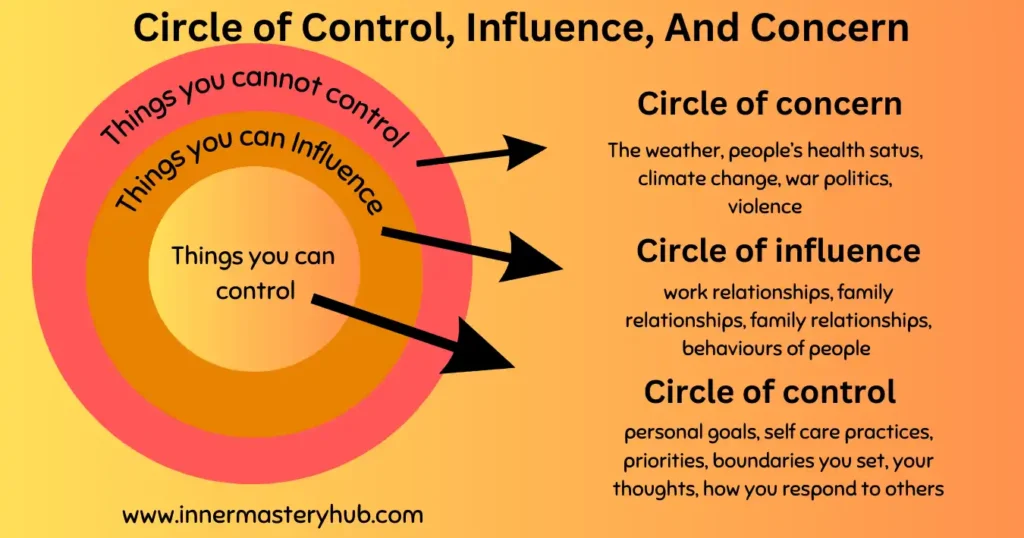
The Circle of Control vs the Circle of Influence is a mental model that separates what you can control from what you can influence. Your thoughts and actions are within your control, while outcomes and others’ reactions are within your Influence. Understand this difference to reduce anxiety and improve emotional regulation.
Circle of Control vs Circle of Influence at a Glance
| Circle | What It Includes |
|---|---|
| Control | Thoughts, actions, decisions, and behaviour |
| Influence | Relationships, communication, teamwork |
| Concern | Economy, weather, world events, and other people’s choices |
I strongly believe in establishing a balance in all spheres of life. I don’t try to control the events of my life; rather, I let everything flow naturally and do my best in every aspect of life. That is what I have learned by going through different challenges in life.
I do whatever is possible in my capacity and let things fall naturally. That’s what is known as a circle of control.
According to psychiatrist Viktor Frankl in Man’s Search for Meaning, although we cannot always control external circumstances, we always retain the freedom to choose our response1.
Anxiety increases with the degree to which you attempt to manage results, responses, and future events. The nervous system focuses on uncertainty and unpredictable results when it is dysregulated.
Confusion between the Circle of Control and the Circle of Influence is the source of this internal conflict. Emotional control becomes challenging when everything seems urgent since you’re attempting to control things that aren’t entirely your own.
To see how this works in real life, read these Circle of Control examples for emotional regulation, which also connect to how your emotional patterns show up in relationships and emotionally immature responses.
What are the Circle of Control, Circle of Influence, and Circle of Concern
Circle of Control
The Circle of control includes factors that you can directly manage with your own actions, such as your attitude, behaviour, effort, and decisions. Focusing here will help you stay productive and get better results because you have more power to make adjustments in this Circle than in the others.
Try filling out a circle of control worksheet to practice separating control, Influence, and concern.
Circle of Control Example
A simple illustration of the Circle of Control is a student preparing for an exam. The student has no control over the grading method or the complex nature of the exam questions. They are still in charge of their own study habits, including how much they study, when they study, how focused they are, and how they prepare.
These activities are covered under the Circle of Control. Students who regularly study and manage their time feel less stress and have better emotional control, rather than worrying about things they cannot change.
Circle of Influence
The Circle of Influence includes factors that you cannot directly control, such as decisions made by your family or team, but that you can affect through relationships, communication, or leadership. Unlike in the Circle of Control, you have less power here because other people are involved in the conclusion.
Circle of Influence example
Consider an employee of a corporation who is concerned about the environmental impact of their employment. This is inside their Circle of Concern since they are unable to change the company’s environmental policy.
However, they might advocate for recycling, paper reduction, and energy efficiency within their department or team, all of which fall under their Circle of Influence.
They can effectively manage their issues and expand their Circle of Influence at work if they concentrate on these attainable, beneficial qualities. It serves as an illustration of how we could handle more general issues inside our Circle of Concern by using our Circle of Influence.
Circle of Concern
The Circle of Concern includes matters that are significant to you but are outside your control or influence, such as historical events, economic conditions, or events. Because it provides less real control than the other two rings, concentrating too much on this area frequently results in tension rather than solutions.
Examples of circles of concern
The Circle of Concern encompasses all the things you care about but can’t always change, including global problems or other people’s viewpoints. For instance, worrying about a friend’s decisions or world famine. Reduce stress and make a difference. Focus on the things you can control, such as your behaviour.
What Psychology Says
Focusing on controlled acts rather than uncontrollable outcomes is backed up by modern psychology. A stronger internal locus of control has been linked to less stress, improved emotional regulation, and increased resilience, according to research on locus of control2.
In a similar vein, cognitive behavioural therapy encourages refocusing your attention from worrying about unpredictable future events to thoughts and behaviours that can be changed.

Circle of Control, Concern, Influence, and Emotional Regulation
Using a combination of the Circles of Control, Influence, and Concern to focus your attention and energy, you may improve emotional control. Determine which circle the circumstance falls under when you are feeling anxious or overburdened.
Because these are the things you can change right away, concentrate primarily on your Circle of Control by controlling your thoughts, feelings, and behaviors.
Next, communicate, mentor, or help others improve the situation within your Circle of Influence without attempting to impose results.
Lastly, since you have no control over or influence over concerns that fall inside the Circle of Concern, learn to let go of them. This method helps you make better decisions, reduce tension, and maintain composure under pressure.
Additionally, research indicates that anxiety, sadness, and emotional dysregulation are more common in those who have a lower sense of control over their circumstances (an external locus of control)3. On the other hand, feeling in control of one’s behavior and reactions can boost emotional resilience and shape the capacity to control emotions under pressure.
“I am not a product of my circumstances. I am a product of my decisions.”
– Dr Stephen Covey
Famous educator, author, and speaker Stephen R. Covey observed, “I am not my circumstances. Voices shape me.” The state emphasizes our choices and the ability to shape our destiny. Your path is shaped by the choices you make and the circumstances you encounter.
7 Insights for Emotional Regulation
Research by Julian Rotter introduced the concept of locus of control, showing that people who believe they can influence their own actions generally cope better with stress than those who feel controlled by external events4.
1. Anxiety grows when you try to control outcomes
When you concentrate on results, your mind looks for certainty. However, a number of things affect the outcome. This ambiguity leads to tension. Your emotional regulation gets better when you focus on your response rather than trying to control what happens next.
2. Emotional pressure comes from misplaced responsibility
You start to feel like you have to manage other people’s feelings. You repeat conversations and change what you do. The Circle of Influence, however, includes the reactions of others. Letting go of that responsibility reduces emotional stress.
3. Overthinking happens outside the Circle of control
People who live in survival mode frequently experience this. Your thoughts return, attempting to put things right. You make an effort to look at tone, words, and expressions. Instead of being under control, these are under the influence. As you return to your objectives and actions, mental noise decreases.
4. Emotional regulation begins with focus, not control
It’s simple to concentrate on what you can control when you stay within your window of tolerance. You can’t immediately control your emotions. You are in charge of your attention, though. When you focus on what you did instead of what might happen, emotional intensity automatically decreases.
5. Trying to control others increases anxiety
You could try to anticipate reactions or steer clear of misunderstandings. This results in continuous monitoring. Emotional control is developed by letting people react freely while concentrating on your clarity.
6. Acceptance reduces emotional resistance
When you embrace ambiguity, your mind is unable to fight results. Acceptance is not the same as giving up. It is identifying what is Influence’s. This lessens anxiety and improves emotional stability.
7. Clarity between control and Influence creates calm
Emotional energy becomes concentrated when you are aware of what is really yours. You cease controlling things and react rather than react. Emotional awareness is improved by this internal change.
Proactive Mindset vs Reactive Mindset
Proactive mindset
The Circle of Influence’s values are reflected in proactive people. They concentrate on areas where they can have an impact, creating empowerment and control. They understand how their actions and attitudes might impact their surroundings and experiences.
You can fix issues and turn obstacles into opportunities when you are proactive. Instead of reacting, they anticipate issues and find solutions. Over time, leaders who remained inside their Circle of Influence were able to exercise greater control over many facets of human nature.
Reactive mindset
Proactive people concentrate on their Circle of Influence, while reactive people concentrate on their Circle of Concern. Instead of taking responsibility for their actions, people tend to be impacted by outside forces.
Their situation has an impact on their mood; they feel helpless, overwhelmed, and frustrated. Responders are concerned about outside occurrences, such as other people’s behaviour or worldwide catastrophes. Instead of changing reality, they react to it in a protective manner.
They feel trapped because they think that other people, rather than their own activities, determine their success and pleasure. Their Circle of Influence was restricted by this misdirected negativity, which kept them in their Circle of Concern.
Assume that, like the proactive person, the reactive person is worried about their company’s new venture or the effects of government legislation on the environment. They might contest workplace regulations or feel powerless in these situations.
They worry, feeling helpless and frustrated, rather than acting in their Circle of Influence.
Knowing how the three circles of Concern, Influence, and Control interact will help us better control our proactive focus and responses. We can take on life’s obstacles, seize chances, and ultimately mould our path if we work hard and devote our time and attention to things we can control.
The Power of Choice
Stephen Covey articulated this point well in his book “The Seven Habits of Highly Effective People” by using the concepts of proactive and reactive focus, as well as the different circles between our Circle of Concern and our Circle of Influence.
“I am not a product of my circumstances. I am a product of my decisions.”
– Stephen Covey
This idea highlights the importance of personal responsibility and choice. While circumstances may shape our lives, our decisions determine how we respond to them.
Instead of becoming victims of circumstances, we can shape our experiences through the daily choices we make.
There is no need to be worried about the outcomes of your job or the Circle outside your Circle of Influence or control. It only triggers anxiety and distracts you from your job of proactive focus.
Stoic Philosophy Behind Circle of Control
Certain things are under our control, while others are not, according to Stoic philosophers like Epictetus. While reputation, results, and outside events do not belong to us, our thoughts, desires, and actions do.
This way of thinking helps control emotions as well. Emotional resistance fades when you acknowledge what is beyond your control. When faced with uncertainty, you react more calmly.
Ryan Holiday highlights this point as well, noting that although we
How to apply the Circle of Control in daily life?
It’s natural to care about big concerns, but we should also focus on what we can control. Thoughts, actions, and decisions shape lives. In this Circle of Control, taking responsibility improves us.
Our entirely autonomous behaviors, attitudes, and choices are shown in the Circle of Control. Direct power over these elements shapes our lives. Consider its entire Circle of Influence: it creates opportunities and maximizes its potential. Personal growth and fulfillment depend on our Circle of Control, which develops a sense of responsibility and proactive living.
The concept of locus of control, which concerns how firmly people believe they can influence outcomes in their lives, is used in psychological studies to support this idea5. Similar to concentrating on the Circle of Control, those with a stronger internal locus of control typically show better self-control, healthier coping mechanisms, and improved mental health.
Why People Confuse the Circle of Control and the Circle of Influence
Anxiety grows when you try to control things in your Circle of Influence.
You start asking:
- Did I say something wrong?
- What are they thinking?
- How will this turn out?
- Should I fix this?
These questions move your attention outside your control. Your brain searches for certainty but cannot find it. This increases emotional tension.
When you shift back to your Circle of control, your focus changes:
- I communicated clearly
- I acted honestly
- I did my part
This reduces mental pressure and improves emotional regulation.
Common Mistakes People Make
People often:
- try to control others’ reactions
- predict outcomes
- over-explain to prevent misunderstanding
- seek reassurance repeatedly
- assume responsibility for others’ emotions
These behaviors move attention outside the Circle of control and increase emotional stress.
Related Articles
- Circle of Control Examples – Real-life examples of control, influence, and concern.
- Circle of Control Worksheet – A practical exercise to apply the framework.
- Locus of Control – The psychology behind feeling empowered or powerless.
Quick Summary
- Circle of Control includes your thoughts, actions, and decisions.
- Circle of Influence includes people and situations you can affect but not control.
- Circle of Concern includes events completely outside your control.
- Focusing on your Circle of Control reduces stress and improves emotional regulation.
Conclusion
The difference between the circle of control and the circle of influence may seem small, but it can have a powerful impact on your emotional well-being. When you focus on what you can control, your thoughts, choices, and actions, you reduce unnecessary stress and anxiety.
As Stephen Covey and Stoic philosophers such as Epictetus taught, peace comes from letting go of what is outside your control and focusing your energy where it can make a difference.
People Also Ask
How do the Circle of Control and Circle of Influence differ?
The Circle of Impact includes areas that you can indirectly impact, such as other people’s decisions, whereas the Circle of Control includes direct activities, such as your behaviour. Control is immediate and intimate, whereas influence necessitates conversation and persuasion and has wider effects.
How can the Circle of Control reduce stress?
Stress can be decreased by focusing on feasible acts and the Circle of Control, such as controlling your time or reactions. Releasing mental energy from uncontrollable worries, such as those about other people’s opinions, promotes resilience and a sense of empowerment.
How can I expand my Circle of Influence?
Develop your Circle of Influence abilities through better communication, relationship-building, and growth. You can progressively move issues into areas where you can have an impact on other people’s decisions by taking proactive measures like networking or exchanging ideas.
Why should people limit their focus to the Circle of Concern?
Because you have little influence over the Circle of Concern, worrying about it excessively can lead to increased tension, anxiety, and dissatisfaction. You can keep your emotions in check by focusing on what you can control.
How does the Circle of Control help emotional regulation?
By emphasising personal responses over results, the Circle of Control helps with emotional regulation. Emotional strain lessens when you give up attempting to control everything. This lessens overthinking and allows for calm responses.
Why is the Circle of Influence important?
The Circle of Influence illustrates the indirect effects you can have. You can help, mentor, and communicate with others, but you have no control over outcomes. Recognising this lessens one’s emotional attachment to results.
Can the Circle of Control reduce anxiety?
Indeed. Uncertainty is decreased by concentrating on acts that can be controlled. This enhances emotional control and calms the mind. When attempting to control unknown consequences, anxiety increases.
- Frankl, V. E. (2006). Man’s Search for Meaning. Beacon Press. (Original work published 1946) ↩︎
- Rotter, J. B. (19Generalizedlized expectancies for internal versus external control of reinforcement. Psychological Monographs: General and Applied, 80(1), 1–28. https://doi.org/10.1037/h0092976 ↩︎
- Couto, L. M. F., & Baptista, M. N. (2023). Locus of control and emotional dysregulation. ↩︎
- Rotter, J. B. (1966). Generalized expectancies for internal versus external control of reinforcement. Psychological Monographs: General and Applied, 80(1), 1–28. https://doi.org/10.1037/h0092976 ↩︎
- Botha, F. (2023). Locus of control, self-control, and health outcomes. ↩︎
Written By Mehwish Qurayshi
Mehwish Qurayshi is a Trauma-Informed Emotional Wellness Counsellor trained through NICABM’s Treating Trauma Master Series, which includes NBCC-approved education in Trauma Treatment and Emotional Wellness & Emotional Intelligence – Sourcecode Academia. She has over five years of experience providing emotional wellness counselling, helping individuals heal from trauma, regulate emotions, and build healthy relationships.