
Emotional Frequency Chart: Meaning, Science, Limits and How to Use It


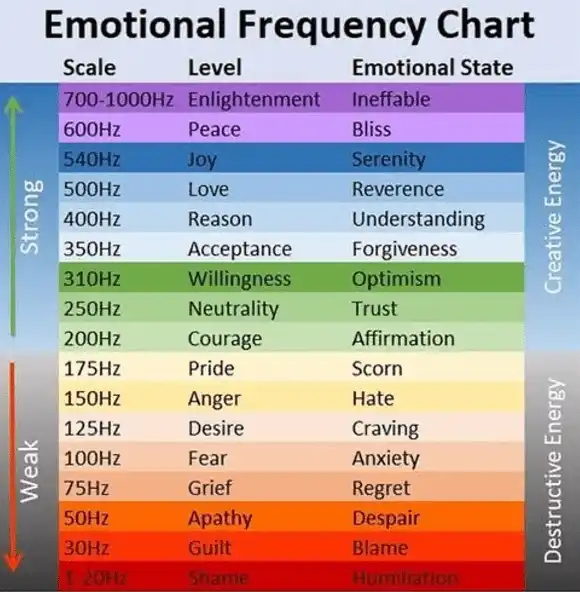
The Emotional Frequency Chart is a symbolic way of organising emotions, from difficult states such as fear and shame to experiences such as acceptance, love, and peace. You can use it as a self-reflection tool to notice what you are feeling, what may be influencing that feeling, and what you might need next. The levels are not scientifically established emotional frequencies.
You can use it as a self-reflection tool to build emotional awareness and notice what may be influencing what you feel.
What Is the Emotional Frequency Chart?
The Emotional Frequency Chart is one way of organising different emotional experiences.
Feelings such as shame, fear, and anger appear toward one end of the chart, while courage, acceptance, love, and peace appear further up. The model is most often linked to David R. Hawkins and Power vs. Force. Hawkins described a broader “Map of Consciousness” in which different emotions and states were assigned positions on a numerical scale.[1]
This scale should not be confused with an established psychological or physiological measurement. Hawkins’ system was based partly on muscle-testing “calibrations,” while research on applied-kinesiology testing has not established that this type of testing can reliably measure emotional states or levels of consciousness.[2][3]
You do not need to treat these levels as literal frequencies. Instead, the chart can simply help you name what you are feeling and reflect on how you want to respond.
Is the Emotional Frequency Chart Scientifically Valid?
The chart can be useful for reflection, but its emotional “frequencies” should not be taken literally.
Scientists study emotions through things such as thoughts, appraisal, behaviour, bodily responses, and brain activity.[4] They have not established a universal frequency number for fear, anger, love, joy, or other individual emotions.
Research does, however, tell us something useful about emotional wellbeing. Long-term stress can place strain on both the mind and body, while studies have linked positive emotional experiences with coping and resilience during stressful situations.[5]
This means you can use the chart to become more aware of your emotional state without treating its numbers or hierarchy as a medical or scientific measurement.
What Science Supports and What It Does Not
| Supported broadly | Not established |
|---|---|
| Emotions affect cognition and physiology | Each emotion has a fixed vibration |
| Appraisal influences emotional reactions | A numerical scale measures consciousness |
| Chronic stress can affect health | “High-frequency” emotion cures illness |
| Regulation skills can support wellbeing | Difficult emotions should be eliminated |
How Emotions, Interpretation, and the Nervous System Interact
Emotional regulation starts with noticing both your feelings and your physical state.
A difficult situation can affect your thoughts, attention, bodily arousal, and urge to respond. How you interpret what is happening also matters.[6]
For example, if someone does not reply to your message, you might notice tension and worry. Someone else might feel irritated, while another person may not feel strongly about it at all.
Strong emotional reactions can sometimes include fight, flight, or freeze responses, but these patterns do not map neatly onto one specific emotion.
Polyvagal Theory is often used to describe shifts between defensive responses and states that support social connection.[7] It can offer useful language for reflection, but it should not be treated as a precise emotional map, and some of its biological claims remain under debate.[8]
When you notice yourself becoming activated or withdrawn, try asking:
What happened? What meaning did I give it? What am I feeling in my body? What would help me feel more grounded right now?
If you notice that your first interpretation is making a situation feel more threatening or hopeless, reframing your thoughts may help you consider another perspective.
Emotional Frequency Chart Levels
The traditional Emotional Frequency Chart places feelings such as shame, fear, anger, acceptance, love, and peace at different levels.
These levels are symbolic, not biological measurements. There are no scientifically established frequencies in hertz for individual emotions.
Instead of treating the chart as a ranking of “bad” and “good” feelings, you can use the table below to notice what an emotion feels like, consider what may be contributing to it, and choose a supportive response.
The suggestions are possibilities rather than fixed meanings. The same emotion can show up differently from one person or situation to another.
In a single day, a person may experience multiple emotional states. You may move through several emotions in one day. The aim is not to stay in a “higher” state, but to notice what you are feeling and decide how you want to respond.
| Emotion | What you might notice | What you could explore | What may help |
|---|---|---|---|
| Shame | Wanting to hide, feeling not good enough, or being hard on yourself | Where the feeling came from and whether you are judging yourself too harshly | Speak to yourself more kindly and talk to someone you trust |
| Guilt | Regret about something you did or did not do | Whether something needs to be repaired, changed, or accepted | Apologise or make things right where possible, then learn from it |
| Apathy | Low energy, little interest, or feeling disconnected | Whether you need rest, support, space, or something meaningful to focus on | Start with one small task and give yourself time |
| Grief | Sadness, emptiness, longing, or missing someone or something | What you have lost and what kind of support feels helpful | Give yourself space to grieve and stay connected with supportive people |
| Fear | Worry, tension, alertness, or wanting to avoid something | Whether there is a real concern, uncertainty, or need for more information | Slow down, check the situation, and focus on what you can do now |
| Desire | Strong wanting, restlessness, or feeling unsatisfied | What you are really hoping to gain or experience | Ask yourself what matters most and look for a balanced way to meet that need |
| Anger | Irritation, tension, frustration, or an urge to react | Whether a boundary, expectation, or sense of fairness is involved | Pause before responding and say clearly what is bothering you |
| Pride | Feeling confident, pleased, defensive, or wanting recognition | Whether you want appreciation, respect, or reassurance | Value what you have done well while staying open to feedback |
| Courage | Feeling nervous but willing to move forward | What matters enough for you to take the next step | Choose one manageable action rather than trying to do everything at once |
| Neutrality | Feeling calmer, less reactive, or more flexible | Whether you can look at the situation from more than one angle | Give yourself space before deciding what to do |
| Willingness | Feeling ready to try, learn, or take part | What small change or opportunity feels realistic | Choose a clear next step and begin there |
| Acceptance | Seeing the situation more clearly without fighting every part of it | What you can influence and what may need to be acknowledged | Put your energy into what you can change |
| Reason | Wanting facts, clarity, and a sensible way forward | What information is useful and whether feelings also need attention | Look at the facts without dismissing your emotional experience |
| Love | Warmth, care, closeness, or compassion | How you want to give or receive connection | Listen, show care, and keep healthy boundaries |
| Joy | Lightness, enjoyment, gratitude, or energy | What feels meaningful or enjoyable in the moment | Let yourself enjoy it without needing to hold on to it |
| Peace | Calm, ease, presence, or feeling settled | What is helping you feel steady right now | Stay with what supports that sense of balance |
How Interpretation Shapes Emotional Responses
The way you understand a situation can influence how you feel about it.
For example, imagine two people lose the same job.
One person thinks:
“This proves I’m a failure.”
Another thinks:
“This is difficult, but I can work out what to do next.”
The event is the same, but the meaning each person gives it is different. That can shape the emotions that follow.
Psychologists often describe this process as cognitive appraisal: how you interpret and evaluate what is happening.
Your thoughts are not the only thing that matters. Past experiences, stress, relationships, physical state, and the situation itself can also influence how you respond.9
What Research Says About Positive Emotions and Coping
Feeling good does not mean you have to feel good all the time.
Research suggests that moments of joy, interest, connection, or gratitude may give you more room to think, connect with others, and cope with stress.[10][11]
Barbara Fredrickson’s Broaden-and-Build Theory describes positive emotions as experiences that may broaden your immediate options for thinking and acting. Over time, these experiences may contribute to useful personal resources.
The point is not to push away anger, fear, or sadness. Positive and difficult emotions can both be part of a healthy emotional life.
How Triggers Become Emotional Reactions
A trigger is something that brings up a noticeable emotional or physical reaction. It might be a conversation, memory, tone of voice, situation, thought, or something happening around you.
Your response may involve thoughts, body sensations, emotions, and an urge to act. These do not always happen in the same order, and different people can respond differently to the same situation.
You might think of the process like this:
Something happens → you notice or interpret it → emotions and body reactions arise → you feel an urge to respond → you choose what to do
Learning to notice your emotional triggers can make it easier to recognise patterns before you respond automatically.
A Simple Way to Work Through a Trigger
- Name what you are feeling, if you can.
- Notice what is happening in your body.
- Ask what seemed to bring the reaction up.
- Notice the meaning you are giving the situation.
- Choose one response that helps you slow down or feel steadier.
- Check in with yourself again before deciding what to do next.
You do not need to get rid of the feeling first. The aim is to understand what is happening well enough to respond rather than react automatically.
How to Use the Emotional Frequency Chart in Daily Life
You do not need to look at the chart and immediately try to move yourself from fear to peace or from anger to joy.
A better starting point is simply to notice where you are.
1. Check In With Yourself
Ask:
“What am I feeling right now?”
Maybe you are irritated. Maybe you are worried. Maybe you feel flat and cannot quite explain why.
Start there.
2. Ask: What Is Going On Around the Feeling
Instead of trying to get rid of it, get curious.
- What happened before you felt this way?
- What thoughts are running through your mind?
- Do you need space, reassurance, rest, information, or a conversation?
You may not know straight away, and that is fine.
3. Do Something That Supports You
Choose one small response.
That might be stepping outside, slowing your breathing, writing down your thoughts, talking to someone, moving your body, or simply giving yourself a little time.
If gratitude, meditation, or affirmations genuinely help you, you can use them too. They should support what you are feeling, not cover it up.
If you are unsure what to do next, it may help to separate what you can control from what you cannot.
Over time, practising this kind of pause can help you build emotional agility, the ability to notice emotions without letting every feeling decide your next action.
Limitations and When to Seek Support
The Emotional Frequency Chart is a self-awareness tool, not a medical or psychological assessment. It cannot diagnose anxiety, depression, PTSD, or other mental-health conditions, and fixed numerical frequencies for individual emotions have not been scientifically established.
You can use the chart to notice feelings and patterns, but try not to judge yourself for experiencing fear, sadness, anger, grief, or shame. Difficult emotions can be understandable responses to what you are going through.
If distress continues, becomes difficult to manage, or starts affecting your sleep, relationships, work, or daily life, consider speaking with a qualified mental-health professional.
If you feel unable to keep yourself or someone else safe, seek urgent professional or emergency support.
Conclusion
You do not have to climb the Emotional Frequency Chart every time you feel something difficult.
If the chart helps you name an emotion or notice a pattern, use it for that. Then get curious about what is happening instead of judging yourself for being in the “wrong” emotional state.
Some days you may feel calm and connected. Other days may bring anger, fear, sadness, or uncertainty. All of those experiences can be part of being human.
Use the chart as a starting point for reflection, not as a score for how well you are doing emotionally.
Frequently Asked Questions
What is an Emotional Frequency Chart?
An Emotional Frequency Chart is a symbolic framework that places emotions such as shame, fear, anger, acceptance, love, and peace along a scale. It can be used for self-reflection, but the levels are not scientifically established emotional frequencies.
How can I use the Emotional Frequency Chart in daily life?
You can use the chart as a simple emotional check-in.
Notice what you are feeling, what may have happened before the feeling appeared, and what kind of response might help you feel more supported or steady.
The aim is not to force yourself into a “higher” emotion.
What are examples of “lower” and “higher” emotional states?
Traditional versions of the chart place emotions such as shame, guilt, fear, grief, and anger toward the “lower” end, while acceptance, love, joy, and peace appear toward the “higher” end.
These labels belong to the symbolic model. They should not be taken as a scientific ranking of healthy and unhealthy emotions.
Are emotional frequencies scientifically proven?
No fixed numerical frequency has been scientifically established for individual emotions such as fear, anger, love, or joy.
Research does show that emotions involve changes in interpretation, attention, behaviour, bodily responses, and conscious experience, but that is different from assigning each emotion a measurable vibrational frequency.
Can the chart help emotional regulation?
It may help with emotional regulation by giving you language for noticing and naming what you feel.
You can then explore what may be influencing the emotion and choose a response that fits the situation.
The chart itself is not a treatment, and it should not be used to judge difficult emotions as “bad” or unhealthy.
Can the Emotional Frequency Chart diagnose mental-health conditions?
No. The Emotional Frequency Chart cannot diagnose anxiety, depression, PTSD, or any other mental-health condition.
It is a reflection tool, not a medical or psychological assessment. If emotional distress is ongoing or affecting your daily life, consider speaking with a qualified mental-health professional.
- Hawkins, D. R. (2014). Power vs. Force: The Hidden Determinants of Human Behavior. Hay House. ↩︎
- Soares, J. R., Stieven, F. F., Rocha, C. S. S., & Miranda, I. F. (2025). Reliability of manual muscle testing in applied kinesiology: A systematic review. Journal of Manipulative & Physiological Therapeutics, 48(6–9), 862–870. https://doi.org/10.1016/j.jmpt.2025.10.007 ↩︎
- Hall, S., Lewith, G., Brien, S., & Little, P. (2008). A review of the literature in applied and specialised kinesiology. Forschende Komplementärmedizin, 15(1), 40–46. https://doi.org/10.1159/000112820 ↩︎
- Scherer, K. R., & Moors, A. (2019). The emotion process: Event appraisal and component differentiation. Annual Review of Psychology, 70, 719–745. https://doi.org/10.1146/annurev-psych-122216-011854 ↩︎
- Tugade, M. M., & Fredrickson, B. L. (2004). Resilient individuals use positive emotions to bounce back from negative emotional experiences. Journal of Personality and Social Psychology, 86(2), 320–333. https://doi.org/10.1037/0022-3514.86.2.320 ↩︎
- Scherer, K. R., & Moors, A. (2019). The emotion process: Event appraisal and component differentiation. Annual Review of Psychology, 70, 719–745. https://doi.org/10.1146/annurev-psych-122216-011854 ↩︎
- Porges, S. W. (2022). Polyvagal Theory: A science of safety. Frontiers in Integrative Neuroscience, 16, 871227. https://doi.org/10.3389/fnint.2022.871227 ↩︎
- Grossman, P., et al. (2026). Why The Polyvagal Theory Is Untenable: An international expert evaluation of the polyvagal theory... ↩︎
- Scherer, K. R., & Moors, A. (2019). The Emotion Process: Event Appraisal and Component Differentiation. Annual Review of Psychology, 70, 719–745. https://doi.org/10.1146/annurev-psych-122216-011854 ↩︎
- Fredrickson, B. L. (2001). The role of positive emotions in positive psychology: The broaden-and-build theory of positive emotions. American Psychologist, 56(3), 218–226. https://doi.org/10.1037/0003-066X.56.3.218 ↩︎
- Tugade, M. M., & Fredrickson, B. L. (2004). Resilient individuals use positive emotions to bounce back from negative emotional experiences. Journal of Personality and Social Psychology, 86(2), 320–333. https://doi.org/10.1037/0022-3514.86.2.320. ↩︎
Written By Mehwish Qurayshi
Mehwish Qurayshi is a Trauma-Informed Emotional Wellness Counsellor trained through NICABM’s Treating Trauma Master Series, which includes NBCC-approved education in Trauma Treatment and Emotional Wellness & Emotional Intelligence – Sourcecode Academia. She has over five years of experience providing emotional wellness counselling, helping individuals heal from trauma, regulate emotions, and build healthy relationships.