
11 Emotional Awareness Exercises for Adults


Instead of reacting impulsively, emotional awareness exercises help adults understand and manage their emotions. According to research, emotional awareness improves emotional control, reduces stress, strengthens relationships, and boosts mental health.
Emotional Awareness Exercises at a Glance
| Exercise | Helps You |
|---|---|
| Name Your Emotion | Recognize your feelings accurately |
| Body Scan | Notice where emotions appear in your body |
| Pause Before Reacting | Respond thoughtfully instead of impulsively |
| Emotion Journal | Understand emotional patterns |
| Emotion Wheel | Expand your emotional vocabulary |
| Identify Emotional Triggers | Recognize what activates strong emotions |
| Practice Self-Compassion | Respond to yourself with kindness |
| Notice Emotional Patterns | Discover recurring emotional habits |
| Mindful Breathing | Observe emotions without judgment |
| Ask “What Do I Need?” | Identify the need behind the emotion |
| Daily Reflection | Learn from your emotional experiences |
What Are Emotional Awareness Exercises?
Have you ever experienced irritation or stress without knowing why? Perhaps you put off an important assignment or ended the day feeling emotionally spent.
We frequently experience these moments as a result of reacting to our feelings before fully acknowledging them.
Simple exercises for emotional awareness help you in recognising and accepting your feelings as they emerge. These activities educate you to observe your inner feelings with interest rather than suppressing them.
Being emotionally aware doesn’t require you to analyse every emotion. It just means being conscious of your emotional experiences so you may make deliberate decisions rather than impulsive ones.
Emotional awareness develops with practice, just like any other talent.
According to psychologist James J. Gross, recognising emotions is the first step to regulating them. Being conscious of your feelings lets you pick healthy responses instead of automatic ones1.
Emotional Awareness vs. Emotional Regulation
Despite their frequent usage together, these phrases are distinct from one another.
To be emotionally aware is to be able to identify and understand your feelings.
Controlling how you react to those feelings is known as emotional regulation.
Consider emotional management as choosing whether to bring an umbrella, and emotional awareness as observing the weather. Before you can choose how to react, you must first understand how you’re feeling.
Lisa Feldman Barrett also found that identifying emotions improves stress response. The brain can predict and manage emotions better with a larger emotional vocabulary2.
For example:
- You notice you’re feeling anxious before an important meeting. (Emotional awareness)
- You take a few slow breaths instead of panicking. (Emotional regulation)
Without awareness, your emotions can influence your thoughts and behaviors without you realizing it.
Why Do Adults Lose Emotional Awareness?
Many adults grow up believing they should hide or ignore their emotions. They may have heard messages like:
- “Don’t cry.”
- “Be strong.”
- “You’re overreacting.”
- “Just get over it.”
People may eventually lose touch with their emotional environment as a result of these experiences. They only notice the tension that follows, instead of identifying emotions at an early stage.
Emotional detachment is also a result of hectic lifestyles. There isn’t much time to stop and think about how we’re feeling because of the constant notifications, work obligations, and daily stressors.
As a result, emotions show up indirectly through:
- Overthinking
- Irritability
- Emotional numbness
- Procrastination
- Difficulty making decisions
- Trouble setting boundaries
Emotional awareness exercises help you rebuild this connection by encouraging regular self-reflection.
Benefits of Emotional Awareness Exercises
Practicing emotional awareness exercises can improve many areas of your life.
These exercises may help you:
- Gain a deep understanding of your feelings.
- Minimise emotional overload.
- Boost emotional control.
- Bolster interpersonal communication.
- Identify unhealthy emotional patterns.
- Minimise rumination and overthinking.
- Make deliberate choices.
Emotional awareness exercises allow you to deal with challenging emotions instead of trying to eradicate them. Over time, this increases your emotional adaptability and gives you confidence.
Why Emotional Awareness Matters
Why Emotional Awareness Matters
Emotions affect most decisions without your awareness. They affect your communication, problem-solving, stress management, and relationships. Without your awareness, emotions can influence your daily actions.
You may think you’re mad at a friend, but really feel sad or lonely. Avoiding a chore may make you feel lethargic, but it’s actually the fear of failing. Emotional awareness shows hidden sentiments so you may address the real issue.
Research shows that people who can identify and understand their emotions cope with stress, establish, and have superior psychological well-being. Early emotional recognition helps manage them before they overwhelm3.
Importantly, emotional awareness helps you:
- Slow down before acting.
- Know emotional triggers.
- Understand your emotional needs.
- Improve your emotional communication.
- Create better limits.
- Decrease emotional reaction.
- Build resilience in tough conditions.
11 Emotional Awareness Exercises for Adults
Emotional awareness exercises improve your awareness, understanding, and response to emotions. These easy routines help you pause, identify your feelings, and make more deliberate choices.
Name Your Emotion
One of the simplest emotional awareness exercises is to name your emotion. Instead of saying, “I feel bad,” try to be more specific.
Ask yourself:
- Am I anxious?
- Am I disappointed?
- Am I frustrated?
- Am I hurt?
- Am I lonely?
Research suggests that labeling emotions helps reduce their intensity and makes them easy to manage4.
Try this: Complete the sentence, “Right now I feel ______ because ______.”
2. Practice a Body Scan
You feel emotions in your body too. Focusing on physical sensations helps you recognise emotions before they overwhelm.
Close your eyes for a minute and notice your:
- Jaw
- Shoulders
- Chest
- Stomach
- Hands
- Breathing
Ask yourself, “Where do I feel this emotion in my body?”
3. Pause Before Reacting
Strong emotions cause fast reactions. A little pause lets your brain respond instead of reacting automatically.
Breathe slowly before responding to a message or arguing.
Ask yourself:
- What am I feeling?
- What triggered this emotion?
- How do I want to respond?
Even a 10-second pause can make a big difference.
4. Keep an Emotion Journal
Writing down your emotions helps you notice patterns that are easy to miss during a busy day.
At the end of each day, write:
- What happened?
- What emotion did I feel?
- What triggered it?
- How did I respond?
- What did I need at that moment?
Over time, you’ll begin to understand yourself more clearly.
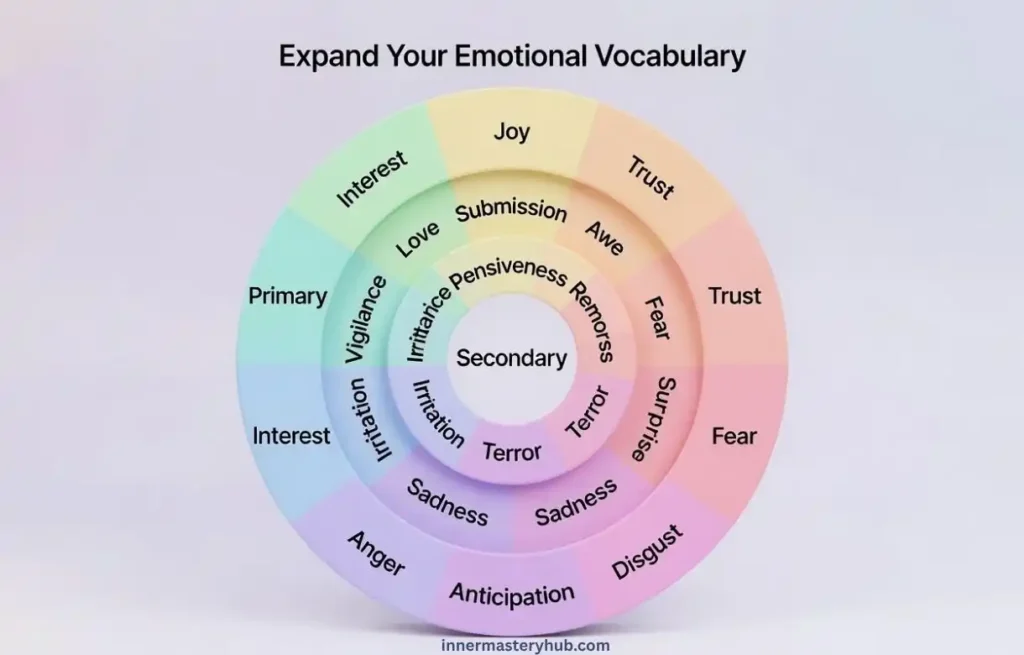
5. Use an Emotion Wheel
Sometimes we know we’re upset but can’t explain why. An emotion wheel helps expand your emotional vocabulary.
Instead of simply saying “angry,” you may discover you’re actually feeling:
- Disappointed
- Embarrassed
- Rejected
- Overwhelmed
- Frustrated
The more accurately you identify your emotions, the easier they become to manage.
6. Identify Your Emotional Triggers
Everyone faces emotional problems. Knowing about them lets you prepare rather than react.
Ask yourself:
- What situations upset me repeatedly?
- Who triggers strong emotional reactions?
- What thoughts usually appear first?
Recognizing your triggers is the first step toward changing your response.
7. Practice Self-Compassion
Many people judge themselves for having difficult emotions. This often increases emotional distress.
Instead of saying,
“I shouldn’t feel this way.”
Try saying,
“It’s okay to feel this. My emotions are giving me information.”
Responding with kindness makes difficult emotions easier to process. Kirsten Neff’s self-compassion studies show that kindness during tough emotions improves emotional resilience, anxiety, and mental health5.
8. Notice Emotional Patterns
Your emotions follow patterns. Certain situations, people, or times of day may trigger similar feelings.
Pay attention to questions like:
- When do I usually feel anxious?
- What situations leave me emotionally drained?
- What helps me feel calm?
Recognizing these patterns helps you make healthier choices.
9. Practice Mindful Breathing
Mindful breathing creates space between your emotions and your reactions.
Sit quietly for one or two minutes and focus on your breathing.
When emotions arise, don’t judge them. Simply notice them and gently return your attention to your breath.
This exercise builds emotional awareness without trying to change how you feel.
10. Ask Yourself, “What Do I Need Right Now?”
Every emotion points to a need.
When you notice a strong emotion, pause and ask yourself:
- Do I need rest?
- Do I need support?
- Do I need better boundaries?
- Do I need reassurance?
- Do I need a break?
Meeting the need behind the emotion reduces emotional distress.
11. Reflect Before Going to Bed
Spend a few minutes reflecting on your day.
Ask yourself:
- What emotion showed up most today?
- How did I respond?
- What helped me feel better?
- What would I do differently tomorrow?
This simple habit strengthens emotional awareness and helps you learn from your daily experiences.
Common Mistakes That Reduce Emotional Awareness
Developing emotional awareness takes time. Unknowingly, many people develop behaviours that make emotions harder to grasp.
Avoid these typical blunders.
Ignoring Feelings
Many people ignore their emotions because they’re busy. However, ignored feelings remain. They cause stress, anger, worry, or emotional fatigue.
Evaluating Feelings
There are no “good” or “bad” feelings. Every emotion exposes your wants, boundaries, and experiences.
Instead of thinking “I shouldn’t feel this way,” ask “What is this emotion trying to teach me?”
Action Too Soon
Strong emotions might cause rash decisions or regrettable statements.
Deep breaths before replying allow you to choose a better response.
Confusing Thoughts with Emotions
Many people describe thoughts instead of emotions.
For example:
I feel like nobody respects me.
This is a thought.
Instead, identify the emotion behind it.
- I feel hurt.
- I feel rejected.
- I feel disappointed.
Naming the actual emotion makes it easier to understand and regulate6.
Expecting Emotions to Disappear Immediately
Emotional awareness isn’t about making difficult emotions go away.
It’s about noticing, accepting, and understanding them without letting them control your actions.
Conclusion
Emotional well-being starts with awareness. Understanding your emotions helps you handle stress, speak openly, and make healthier choices.
Emotional awareness is a talent you may develop through practice. Even minor behaviours like recognising your emotions, journaling, or pausing before reacting might add up.
Start with one or two daily emotional awareness exercises. Being aware of your emotional patterns will help you regulate your emotions, strengthen relationships, and face life’s problems with confidence and clarity.
People Also Ask
What are emotional awareness exercises?
Emotional awareness exercises are simple ways to understand and manage your emotions. They improve self-awareness and emotional management.
Can emotional awareness exercises reduce anxiety?
Yes. You can spot worried thoughts and feelings before they overtake you using emotional awareness exercises. This lets you respond calmly instead of automatically.
How often should I practice emotional awareness exercises?
Just 5–10 minutes of daily practice can help. Regular practice enhances emotional awareness, like any ability.
Are emotional awareness exercises helpful after trauma?
Yes. Because it helps people recognise emotional triggers and respond safely, many trauma-informed approaches promote emotional awareness. You should do these exercises with a mental health professional if trauma symptoms are overwhelming.
What’s the difference between emotional awareness and emotional intelligence?
Recognising and understanding your feelings is emotional awareness. Communication, empathy, emotional regulation, and awareness are all part of emotional intelligence.
- Gross, J. J. (1998). The emerging field of emotion regulation: An integrative review. Review of General Psychology, 2(3), 271–299. https://doi.org/10.1037/1089-2680.2.3.271
↩︎ - Barrett, L. F. (2017). How Emotions Are Made: The Secret Life of the Brain. Houghton Mifflin Harcourt. ↩︎
- Gross, J. J. (1998). The emerging field of emotion regulation: An integrative review. Review of General Psychology, 2(3), 271–299. https://doi.org/10.1037/1089-2680.2.3.271 ↩︎
- Lieberman, M. D., Eisenberger, N. I., Crockett, M. J., Tom, S. M., Pfeifer, J. H., & Way, B. M. (2007). Putting feelings into words: Affect labeling disrupts amygdala activity in response to affective stimuli. Psychological Science, 18(5), 421–428. https://doi.org/10.1111/j.1467-9280.2007.01916.x ↩︎
- Neff, K. D. (2003). Self-compassion: An alternative conceptualization of a healthy attitude toward oneself. Self and Identity, 2(2), 85–101. https://doi.org/10.1080/15298860309032 ↩︎
- Lieberman, M. D., Eisenberger, N. I., Crockett, M. J., Tom, S. M., Pfeifer, J. H., & Way, B. M. (2007). Putting feelings into words: Affect labeling disrupts amygdala activity in response to affective stimuli. Psychological Science, 18(5), 421–428. https://doi.org/10.1111/j.1467-9280.2007.01916.x ↩︎
Written By Mehwish Qurayshi
Mehwish Qurayshi is a Trauma-Informed Emotional Wellness Counsellor trained through NICABM’s Treating Trauma Master Series, which includes NBCC-approved education in Trauma Treatment and Emotional Wellness & Emotional Intelligence – Sourcecode Academia. She has over five years of experience providing emotional wellness counselling, helping individuals heal from trauma, regulate emotions, and build healthy relationships.