
11 Reasons Integrity Is Not About Honesty Alone & Why It Matters for Emotional Healing

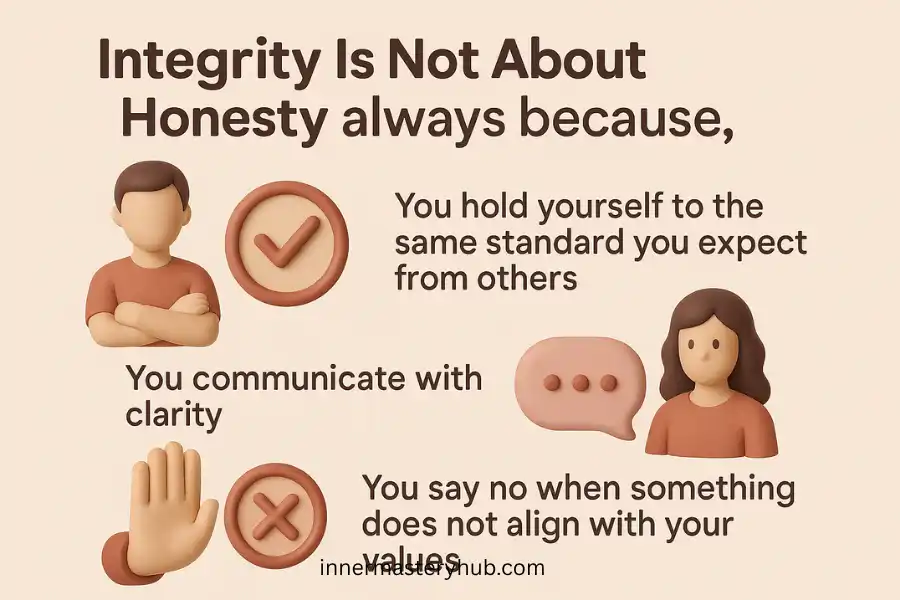
Integrity is not about honesty alone. Honesty means telling the truth, while integrity means consistently aligning your values, actions, decisions, and behaviour, even when nobody is watching. A person can be honest in words but still lack integrity if their actions contradict their principles.
The term “integrity” is frequently used in leadership instruction, workplace settings, and literature on personal growth. Most people think it just means being honest. However, integrity is not about honesty; it’s far more significant, profound, and challenging than that. In reality, people and organisations often fail to understand what true integrity entails when it is reduced to honesty alone.
You were likely taught as a child that integrity is the cornerstone of moral character. But as you progress through your career, relationships, obligations, and challenges, you start to realise that integrity is much more than just speaking the truth. You might even realise that some of the times you feel bad about yourself are entirely irrelevant to honesty.
They stem from experiences in which your behaviour did not wholly align with your principles. It is difficult to ignore the discomfort you feel when there is a disconnect between your desired and actual behaviour. The primary signal that motivates you to pursue a higher degree of integrity is that discomfort.
When integrity is missing, people experience guilt, confusion, emotional exhaustion, relationship problems, and self-doubt. Not because they are lying, but because what they say, what they value, and what they do are not fully aligned.
What Is Integrity Really?
Integrity is the alignment between values, beliefs, words, and actions. It means being whole and consistent rather than simply being truthful.
Integrity comes from the Latin word integritas, meaning wholeness. To have integrity means:
A person with integrity:
- Acts according to their values
- Takes responsibility for their choices
- Maintains consistency across situations
- Keeps commitments whenever possible
- Behaves ethically even without external pressure
Integrity develops through self-awareness, accountability, and value-based decision-making.
People with integrity often experience:
- Greater self-respect
- Stronger relationships
- Increased trustworthiness
- Better emotional stability
A manager admits making a mistake and actively works to fix it. Their honesty matters, but their willingness to take responsibility demonstrates integrity.
What Is Honesty?
Honesty means telling the truth and avoiding deception. It focuses on accurate communication rather than overall character alignment.
Honesty involves:
- Truthful statements
- Transparency
- Avoiding lies
- Accurate representation of facts
Honesty is guided by moral values, social norms, and personal ethics.
Honesty helps create trust and clear communication.
Someone admits they missed a deadline because they procrastinated. That is honesty.
But if they continue to miss deadlines without changing their behaviour, integrity is still lacking.
Why Is Integrity Not the Same as Honesty?
Integrity includes honesty, but honesty alone does not create integrity. Integrity requires consistency between what you believe, what you say, and how you behave.
Many people think truth automatically equals character.
It doesn’t.
You can tell the truth while avoiding accountability.
You can tell the truth while acting against your values.
You can tell the truth while repeatedly harming relationships.
This distinction matters because trust is built not only from words but also from behaviour.
A Simple Framework
Integrity = Values + Actions + Accountability + Honesty
Honesty = Truthful Communication
Integrity is the larger framework.
Honesty is one component within it.
Why Do People Confuse Integrity With Honesty?
People confuse integrity with honesty because honesty is visible, while integrity is revealed through long-term patterns of behaviour.
Honesty is easy to observe.
Integrity requires observing consistency over time.
Modern culture rewards transparency more than consistency.
Someone can publicly admit flaws and appear authentic.
But authentic words without aligned actions create confusion.
People may trust too quickly based on verbal honesty.
Later, they feel betrayed when actions fail to match promises.
Example
A friend openly admits they are unreliable.
Their honesty is admirable.
But continued unreliability still damages trust.
How Does Integrity Affect Emotional Health?
Integrity supports emotional well-being by reducing internal conflict. When actions contradict values, emotional stress often increases.
Research suggests that cognitive dissonance creates psychological discomfort when beliefs and behaviours conflict1.
Cognitive dissonance is the tension experienced when behaviour and values do not match.
The process often unfolds naturally:
- You face a situation.
- You interpret it through personal values.
- You act against those values.
- Emotional discomfort appears.
This may create:
- Guilt
- Shame
- Anxiety
- Self-criticism
- Emotional exhaustion
Example
Someone values healthy boundaries but continually says yes to everyone.
Over time, they feel resentful and drained.
The issue is not honesty.
The issue is a lack of integrity with their own needs.
What Happens When Honesty Exists Without Integrity?
Honesty without integrity can create confusion, broken trust, and emotional instability because truthful words are not supported by consistent actions.
Common Signs
- Repeated broken promises
- Lack of accountability
- Value inconsistency
- Ethical shortcuts
- Self-betrayal
Example
A partner honestly admits they repeatedly violate relationship agreements.
Their honesty is real.
But integrity requires behavioural change.
Without that change, trust continues to decline.
Why Does Integrity Matter More Than Honesty in Relationships?
Relationships depend more on consistency than occasional truth-telling. Integrity creates emotional safety because people know what to expect.
Research published by the American Psychological Association shows that trust and reliability are fundamental components of healthy relationships2.
Relational integrity means behaving consistently with stated commitments.
Trust develops through repeated experiences.
People feel:
- Safe
- Respected
- Valued
- Secure
Example
A parent consistently follows through on promises.
The child learns reliability.
This creates deeper trust than words alone.
What Is the Psychology Behind Integrity?
Integrity reflects psychological congruence, the alignment between inner values and external behaviour.
Psychologist Carl Rogers emphasised congruence as an important aspect of psychological well-being.
People feel more grounded when their actions match their authentic beliefs.
The Inner Process
A trigger occurs.
You interpret the situation.
An emotion arises.
Then a decision follows.
When the decision aligns with values, internal stability grows.
When it conflicts with values, emotional tension grows.
Over time, this tension affects self-esteem and confidence.
This explains why many people feel disconnected from themselves even when they are being honest.
The problem is not truth. The problem is misalignment.
What Common Mistakes Do People Make About Integrity?
Most people focus on truth-telling while ignoring value alignment, accountability, and behavioural consistency.
Mistake 1: Believing Honesty Is Enough
Truth matters.
But integrity requires action.
Mistake 2: Ignoring Self-Betrayal
Many people break promises to themselves.
This damages self-trust.
Mistake 3: Confusing Transparency With Growth
Admitting problems is important.
Repeating them endlessly is not integrity.
Mistake 4: Prioritising Appearance Over Values
External approval replaces internal alignment.
This creates emotional conflict.
When Honesty Failed to Build Trust
A recurring pattern I have observed over my five years working with clients is that individuals pride themselves on being brutally honest.
One client believed honesty made him trustworthy.
He openly admitted mistakes. He shared every thought. He considered himself authentic.
But his actions rarely matched his commitments.
Promises were frequently broken. Boundaries were ignored. Responsibilities were postponed.
Relationships deteriorated despite high levels of honesty.
Once he focused on consistency rather than confession, trust slowly returned.
People responded differently because behaviour finally matched values.
That is integrity.
How Does Integrity Support Nervous System Healing?
Integrity reduces internal conflict, helping create psychological safety and emotional regulation.
When actions consistently match values:
- Stress decreases
- Self-trust increases
- Emotional regulation improves
- Decision fatigue reduces
Trauma-informed healing often involves rebuilding self-trust.
Integrity becomes an important foundation because each aligned choice reinforces safety within the nervous system.
According to Harvard Medical School, chronic stress and internal conflict can contribute to emotional and physical strain3.
Integrity helps reduce this ongoing tension.
11 Behaviours To Seek If You Are a Person of Integrity
Identifying the behaviours that define integrity makes it easier to live by. You feel more confident when making decisions that align with your values when you are more conscious of these behaviours. The behaviours listed below show that you are a person of integrity. As you read them, take note of the parts where you feel challenged and where you recognise yourself.
1. You do what you said you would do, even when the excitement wears off
When you commit to something, your motivation can be temporary, but your purpose is typically sincere. According to research by the American Psychological Association, people overestimate their future feelings, which can lead to unfulfilled promises as excitement fades4.
You are undoubtedly familiar with the emotion that arises when a chore that you were looking forward to last week turns out to be challenging. At the same time, you choose to show yourself as a person of integrity if you persevere even when no one would blame you for giving up. This act is about keeping your word, not merely how you’re feeling.
2. You take responsibility instead of giving excuses
Everyone makes mistakes. How you react makes a difference. When you accept responsibility, you don’t place the blame on people, events, or timing. You decide to take your role, which increases respect and credibility.
Admitting your mistakes may not be appealing, but it demonstrates that you value progress over ego. Accepting accountability also prevents issues from worsening as you seek to protect the relationship or the result rather than your reputation.
3. You stay consistent with your values across different situations
When the situation changes, your integrity is put to the test. When someone treats you nicely or when the day is peaceful, it’s easy to be patient. However, integrity can be most accurately evaluated under pressure. When you feel hasty, ashamed, or condemned, you can behave differently.
You can prove it anyway; your principles take precedence over your feelings when you maintain consistency in the face of these demands. People start to trust you because they know what to expect from you.
4. You say no when something does not align with your values
Many people find it difficult to say no because they are afraid of upsetting other people. However, compromising your morals to gain acceptance leads to internal strife. According to social psychology research, people who are unable to say no feel guilty and resentful. Setting limits is an imperative ability for protecting your integrity.
Rejecting other people outright is not necessary. You can decide that self-honesty is more critical than temporary comfort when you know that each “yes” should be a reflection of your priorities rather than compulsion.
5. You treat people fairly, even when there’s nothing to gain
How you treat those who are unable to return the favour is one of the most obvious indicators that integrity is not about honesty. A study has linked high emotional intelligence to the moral habit of fairness.
Genuine character is demonstrated by listening to others, respecting their needs, and making deliberate choices even in the absence of a reward. You don’t do it because you want something; instead, you do it because it represents who you are. This behaviour indicates your principles are more important than your ability to act.
6. You respect your commitments even in private moments
Your actions when no one is around tell more about your integrity than any gesture you make in public. People who behave consistently in both private and public contexts report higher levels of psychological well-being and self-respect, according to studies on self-regulation. Perhaps you pursue goals even if they go unseen unless you notice.
Maybe you steer clear of shortcuts even when they would simplify things. You gain your own confidence when you behave honourably in private. That trust is the basis for the inner confidence that comes with a strong sense of integrity.
7. You communicate with clarity instead of leaving people guessing
You might think that being honest means speaking the truth, but integrity requires greater clarity. Clear communication helps avoid disappointment and eliminates misunderstandings. You prevent misunderstandings in relationships by being clear about what you mean, setting reasonable expectations, and outlining your goals.
One of the main reasons for conflict is confusing messages. Although it may require more work, being unambiguous helps you avoid future issues and builds your credibility.
8. You hold yourself to the same standard you expect from others
It’s simple to criticise others for flaws you don’t see in yourself. When you have integrity, you examine your own behaviour critically. You become aware of your shortcomings. You think without justification. Before you point fingers, you correct your own behaviour.
People who hold themselves accountable have better relationships, make better judgments, and experience less internal conflict. Your behaviour aligns with your beliefs when you live up to the standards you demand of others.
9. You protect confidential information and respect trust
Your handling of information demonstrates you are a person of integrity. People trust you to protect their sensitive information when they disclose it. Confidentiality is one of the best measures of moral dependability. By refraining from gossip, sharing just what you are entitled to communicate, and protecting sensitive data, you uphold that trust. This behaviour strengthens relationships by letting people know that they can be vulnerable with you.

10. You choose long-term respect over short-term reward
Integrity sometimes calls for you to give up chances, comfort, or even convenience.
But since you recognise the importance of lasting self-respect, you make decisions consistent with your values. Even when the immediate result is challenging, psychological research indicates that people are happier when their behaviour aligns with their values.
You develop discipline and mould your personality when you choose what is right rather than what is convenient. Instead of pursuing fleeting victories, you are proud of the person you are becoming.
11. You reflect on your actions and adjust when necessary
Perfection is not the same as integrity. It is the continuous exercise of introspection. You can identify patterns you need to change by taking the time to reflect on your behaviour. You can wonder if your actions were motivated by alignment, habit, fear, or pressure.
You can develop through reflection, and research on self-awareness shows that people who routinely reflect make more moral choices. Awareness, not control, is the source of integrity. You prove that your character is constantly changing when you consider self-assessment and make necessary adjustments.
Can Someone Have Integrity Without Being Perfect?
Yes. Integrity is not perfection. It is the willingness to align with values, acknowledge mistakes, and make corrections.
Integrity involves responsibility, not flawlessness.
Humans inevitably make mistakes.
People with integrity repair rather than defend.
Example
A leader makes an error.
Instead of hiding it, they acknowledge it, take responsibility, and adjust their actions.
That demonstrates integrity.
Why Integrity Is Not About Honesty
Integrity isn’t about being perfect. It’s about being aligned. When your values, actions, and choices align, life becomes simpler, relationships become deeper, and success becomes more sustainable.
Honesty is what you say.
Integrity is what you live by.
Since honesty is merely one aspect of a larger picture, a close examination of these practices shows that integrity is not about honesty. Alignment, accountability, justice, and the guts to uphold your principles even in the face of discomfort are all components of integrity.
You might become aware of how frequently you are put to the test as you go through your daily decisions, not by big circumstances, but rather by minor choices that expose your actual nature. Being a person of integrity does not require you to be flawless. All you have to do is continue making decisions that align with your ideal self.
People Also Ask
What does “Integrity Is Not About Honesty” really mean?
It means integrity is much more than telling the truth. It requires acting in line with your values, even when no one is watching. You stay consistent in your decisions, keep promises, treat people fairly, and choose what’s right over what’s easy, not just avoid lying.
How is integrity different from honesty?
Honesty is about telling the truth. Integrity is about living the truth. You match your actions with your values, stay consistent across situations, take responsibility for mistakes, and act ethically even under pressure. Integrity includes honesty but goes far beyond it.
Can someone be honest but lack integrity?
Yes. A person might speak truthfully yet break commitments, behave unfairly, or act against their values when convenient. Integrity demands reliability, fairness, and alignment between words and actions, not just telling the truth.
Why is integrity important in daily life?
Integrity builds trust, strengthens relationships, increases self-respect, and guides your decisions. People rely on you because your actions match your words. Living with integrity also reduces stress because you’re not juggling conflicting behaviours or hiding behind excuses.
What behaviours show that someone has integrity?
Common signs include keeping promises, respecting boundaries, admitting mistakes, avoiding gossip, treating everyone fairly, communicating clearly, following through on commitments, and staying consistent even under pressure. These actions reflect strong moral character.
Is integrity something you are born with or learn over time?
Integrity is learned and practised. You build it through self-awareness, reflection, consistent behaviours, and aligning choices with your values. The more intentional you are, the stronger your integrity becomes.
How can I improve my integrity?
You strengthen integrity by honouring commitments, saying no when needed, taking responsibility, reflecting on your actions, and acting in accordance with your values. Small daily choices help you build alignment and reliability.
Why do people confuse honesty with integrity?
People equate truth-telling with moral behaviour, but honesty is only one part of it. Integrity requires ethical decision-making, fairness, consistency, and accountability. Many confuse the two because honesty is more straightforward to measure than overall character.
Can integrity exist without honesty?
Not fully. Honesty is a component of integrity, so you cannot live with complete integrity while lying or deceiving others. Integrity requires truthfulness, but it also requires responsibility, fairness, and alignment between beliefs and behaviour.
How does integrity affect relationships?
Integrity creates trust and emotional safety. People feel secure knowing you mean what you say, follow through, and act pretty. Relationships grow stronger because your behaviour is reliable and consistent, not conditional or unpredictable.
What does the phrase “Integrity Is Not About Honesty” mean?
It means that integrity goes beyond simply telling the truth. Integrity includes consistency, character, accountability, and doing what’s right even when no one is watching, not just being honest.
How is integrity different from honesty?
Honesty is about truthfulness.
Integrity is about wholeness, alignment between values and actions, moral courage, and reliability.
What are examples that show integrity is not about honesty?
Keeping commitments even when it’s inconvenient.
Admitting mistakes without being forced to.
Treating others respectfully, even in private.
Doing the right thing without seeking credit.
How can “Integrity Is Not About Honesty” be used in a speech or article?
It can serve as a theme emphasising that true character involves:
consistency
ethical choices
keeping commitments
moral courage
alignment of words and actions
Why do some people say “Integrity Is Not About Honesty” in leadership?
They mean that leadership requires more than truthful speech; it requires consistent behaviour, ethical decisions, and accountability, all of which go beyond honesty.
How can I explain “Integrity Is Not About Honesty” in simple terms?
It means you can be honest but still lack integrity; integrity is about aligning your actions with your values, not just telling the truth.
How does the phrase “Integrity Is Not About Honesty” apply to personal growth?
It suggests focusing on building character, honouring commitments, and being consistent, rather than limiting morality to honesty alone.
Is the statement “Integrity Is Not About Honesty” accurate?
Yes, because integrity includes honesty but extends to accountability, consistency, fairness, and ethical behaviour.
How does “Integrity Is Not About Honesty” relate to trust?
Trust is built through consistent actions and character, not just truthful words. Integrity earns long-term trust; honesty alone does not.
Can “Integrity Is Not About Honesty” apply to relationships?
Yes. Healthy relationships require loyalty, dependability, and respect, not just honesty. Integrity ensures actions match words.
- Festinger, L. (1957). Cognitive Dissonance Theory.
https://psycnet.apa.org/record/1957-06653-000 ↩︎ - American Psychological Association (APA) – Trust and Healthy Relationships.
https://www.apa.org ↩︎ - Harvard Medical School – Stress and Emotional Health.
https://www.health.harvard.edu ↩︎ - American Psychological Association (APA) – Trust and Healthy Relationships.
https://www.apa.org ↩︎
Written By Mehwish Qurayshi
Mehwish Qurayshi is a Trauma-Informed Emotional Wellness Counsellor trained through NICABM’s Treating Trauma Master Series, which includes NBCC-approved education in Trauma Treatment and Emotional Wellness & Emotional Intelligence – Sourcecode Academia. She has over five years of experience providing emotional wellness counselling, helping individuals heal from trauma, regulate emotions, and build healthy relationships.