
20 Emotional Trigger Examples: Why They Happen and How to Respond

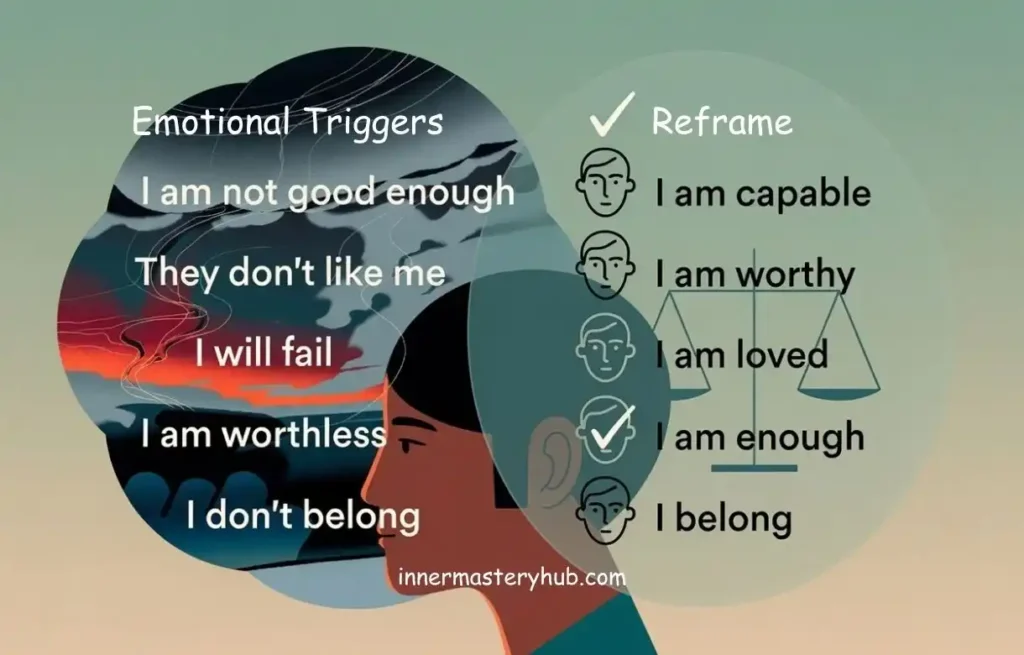
emotional triggers examples are something that brings up a strong emotional reaction in you.
It might be criticism, being ignored, a change in someone’s tone, an unexpected message, a memory, or even a thought you have about yourself.
Sometimes you understand immediately why something affected you.
Other times, you may find yourself thinking:
“Why did that hit me so hard?”
Examples of Emotional Triggers: External vs Internal Triggers
Emotional triggers can come from something happening around you or from something happening within you.
External triggers are situations, interactions, words, or sensory cues in your environment.
Internal triggers are thoughts, memories, expectations, or interpretations that bring up a strong emotional response.
| External triggers | Internal triggers |
|---|
| Criticism or negative feedback | Self-critical thoughts |
| Being ignored or left out | Memories of an earlier difficult experience |
| Conflict or disagreement | Expecting rejection |
| A change in someone’s tone | Thinking you have disappointed someone |
| Social rejection | Comparing yourself with others |
| Unexpected changes to plans | Imagining a negative outcome |
| Feeling controlled or pressured | Remembering something embarrassing |
| Loud voices or certain sensory cues | Interpreting a situation as personal criticism |
A trigger is not always a sign that something unresolved from your past has been activated. Sometimes the present situation is upsetting for you, while stress, expectations, memories, or previous experiences may add to its emotional impact.
What Is an Emotional Trigger?
An emotional trigger is something that brings up a noticeable emotional reaction in you.
It might be something another person says, a situation you experience, a memory, a thought, or even a particular sound or tone of voice.
You might notice anger, sadness, anxiety, embarrassment, defensiveness, or an urge to withdraw.
What makes something a trigger is not that everyone reacts to it in the same way.
It is that the situation carries emotional meaning for you.
Research on emotion appraisal supports this idea. Scherer’s work describes emotional responses as being shaped partly by how a person evaluates the meaning and significance of an event, rather than by the event alone.1
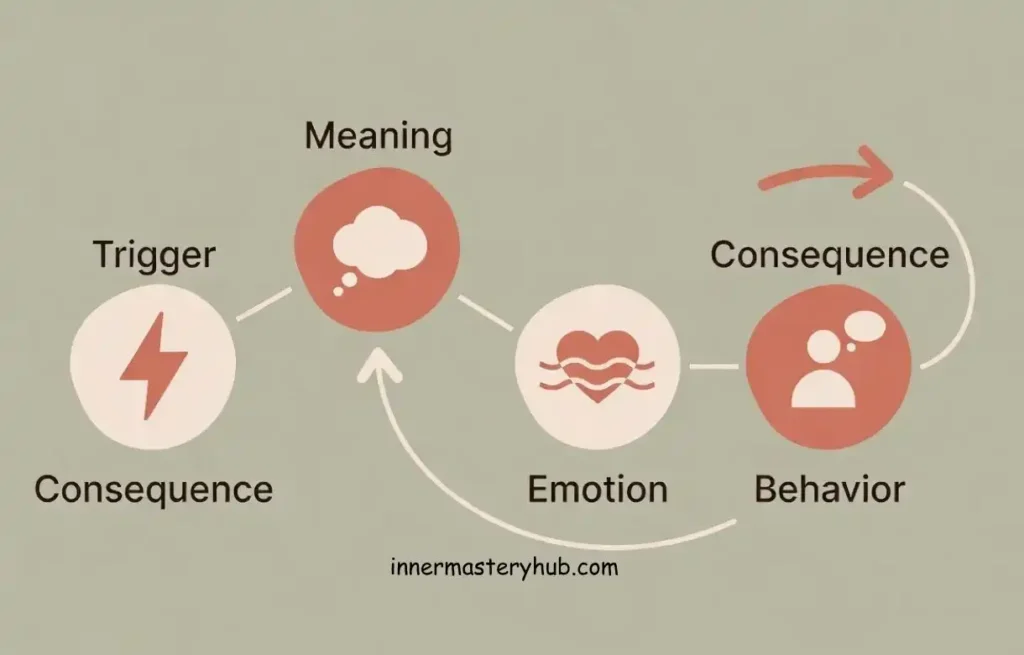
Sometimes that meaning comes from what is happening right now. Sometimes stress, expectations, relationship patterns, or earlier experiences may add to the reaction.
A trigger is therefore better understood as a clue to explore, not proof that you have unresolved trauma or a psychological problem.
20 Common Emotional Trigger Examples
Knowing your triggers is not about avoiding every uncomfortable feeling.
It is about recognising the moments when your emotional intensity starts to rise.
1. Criticism
Criticism can be hard to hear, especially when it is about something you have already been worrying about.
You may feel defensive, embarrassed, or start doubting yourself.
Sometimes the problem is not the feedback itself, but the way it is given.
Example:
Your manager asks you to change part of your work, and your first thought is that you have done a bad job.
Try to focus on what they actually asked you to change instead of treating the feedback as a judgment of your ability.
2. Rejection
Rejection can hurt, especially when you care about the person or the opportunity.
It can leave you wondering what went wrong or whether something is wrong with you.
Example:
Your friends make plans without inviting you, and you start wondering whether they still want you around.
Maybe there is a reason you do not know about. Before assuming the worst, give yourself a chance to find out what actually happened.
3. Being Ignored
Being ignored can feel especially difficult when you do not know why the other person has gone quiet.
You might feel hurt, frustrated, anxious, or start wondering whether you have done something wrong.
Sometimes the hardest part is the uncertainty.
Example:
Someone important to you repeatedly leaves your messages unanswered, and you begin to think:
“Are they upset with me?”
Before assuming what their silence means, ask:
“What do I actually know, and what am I filling in for myself?”
That can help you separate the lack of response from the meaning you are giving it.
4. Abandonment
It can be hard when someone you care about starts pulling away.
Maybe your partner asks for space, a friend stops checking in as often, or someone close to you feels more distant than usual.
You may start thinking:
“Are they leaving me?”
Example:
Your partner says they need some time alone, and you begin worrying that the relationship is ending.
Try not to decide what their distance means before you know more. Sometimes a person needs space without wanting to leave.
5. Feeling Controlled
When someone tells me that control is a major trigger, I would want to understand what “control” means in that particular situation.
Is someone repeatedly crossing your boundaries?
Are they making decisions for you?
Or does being advised, questioned, or disagreed with quickly feel like control?
Those are different situations and may need different responses.
Example:
A family member repeatedly tells you how to make an important personal decision, and you notice an immediate urge to argue or shut the conversation down.
I would ask:
“What choice do you feel is being taken away from you here?”
That question often gets closer to what actually matters.
6. Betrayal
Being betrayed by someone you trust can hurt deeply.
If you have been lied to or let down before, it may make a new betrayal harder to deal with.
Example:
Someone close to you lies about something important.
You may feel angry, hurt, or start wondering whether you can trust them again.
At that point, it may be more useful to think about what was broken between you and what you need before deciding what happens next.
7. Conflict
Conflict can make it harder to slow down and choose your response.
You may interrupt, defend yourself, go quiet, or want to leave.
When you notice that shift, pause and ask:
“Can I still listen?”
“Can I still explain myself clearly?”
“Do I need a short break?”
Example:
A disagreement starts becoming more emotionally intense, and you realise you are no longer taking in what the other person is saying.
Instead of pushing through the conversation, you can say:
“I want to continue this, but I need a little time to settle first.”
8. Unfair Treatment
Being treated unfairly can get under your skin quickly.
Maybe someone blames you for something you did not do.
Maybe the rules seem different for you than for everyone else.
Maybe you feel judged before anyone has heard your side.
You may immediately want to argue or defend yourself.
Example:
Someone accuses you of making a mistake, even though you know you were not responsible.
Before reacting, ask:
“What do I need to clarify here?”
That can move you from anger toward a more useful response.
9. Public Embarrassment
Making a mistake in front of other people can bring up embarrassment, shame, anxiety, or a strong desire to disappear from the situation.
Often, the difficult part is not only what happened but what you imagine other people are thinking about you.
Example:
You lose your train of thought during a presentation and immediately think:
“Everyone must think I’m incompetent.”
A useful question is:
“What actually happened, and what am I assuming other people think about me?”
That can help you separate an uncomfortable moment from a much bigger judgment about yourself.
10. Comparison
Comparison can catch you off guard.
You might feel fine about your own progress, then see someone your age getting promoted, buying a home, getting married, or reaching a goal you want for yourself.
Suddenly, your own life can feel behind.
Example:
You see someone celebrating a career milestone on social media and think:
“I should be further ahead by now.”
When that happens, notice what you are comparing.
Are you looking at their achievement and turning it into a judgment about where you should be?
Their progress may remind you of something you want, but it does not have to become proof that you are failing.
11. Failure
Failure can hit harder when you really cared about the outcome.
You might spend weeks preparing for an exam, interview, project, or opportunity and then not get the result you wanted.
The disappointment is real. But sometimes another thought gets mixed in with it:
“Maybe I’m just not good at this.”
That is worth noticing.
Not getting one job does not tell you whether you are capable of doing that kind of work. Failing one exam does not tell you that you cannot learn the subject.
You can look at what went wrong, change what needs changing, and still be disappointed without making the result a judgment about yourself.
12. Criticism of Parenting
Parenting criticism can carry extra weight if you already worry about getting things wrong.
For some people, previous experiences of being criticised or judged may make these comments harder to hear.
But sometimes the present situation is enough.
Unwanted advice can be intrusive, and harsh criticism can simply hurt.
Example:
Someone tells you how you should be raising your child, and you notice anger or self-doubt coming up quickly.
You do not have to decide immediately whether the comment is useful.
You can take what helps and leave what does not.
13. Feeling Disrespected
It can hurt when someone talks down to you or makes you feel that what you are saying does not matter.
Example:
You are trying to explain something important, but the other person laughs, rolls their eyes, or keeps talking over you.
You may feel angry, embarrassed, or simply stop wanting to continue the conversation.
Think about what upset you most. Was it what they said, the way they said it, or the fact that they did not seem willing to listen?
If this keeps happening, you may need to tell them clearly how you expect to be spoken to.
14. Being Interrupted
It is frustrating when someone keeps cutting you off, especially when you are trying to say something important.
Example:
You are halfway through explaining your point and the other person starts talking before you have finished.
After a while, you may get annoyed or stop trying to explain yourself.
You can simply say:
“Let me finish what I was saying.”
Sometimes being direct is enough.
15. Loss of Control
Things do not always go the way you planned.
A meeting gets cancelled, someone changes the plan at the last minute, or something you were relying on suddenly stops working.
Example:
You have organised your whole day, but an unexpected delay throws everything off.
You feel irritated because now you have to change your plans.
Instead of trying to force the day back to how you wanted it, focus on what you can do from here.
Maybe you need to rearrange something, let one task go, or simply accept that today will look different.
16. Feeling Trapped
It is hard when you feel like you have no way out of a situation.
Maybe someone wants an answer immediately, you are stuck in an uncomfortable conversation, or every option seems difficult.
Example:
Someone keeps asking you to make a decision before you feel ready.
You may feel tense and want to get away from the situation.
If you can, give yourself more time instead of choosing something just to end the pressure.
17. Social Judgment
You may sometimes worry about what other people think of you, even when they have not said anything negative.
Maybe you wonder whether you sounded awkward, said too much, or did not fit in.
Example:
After meeting a new group of people, you think back to something you said and wonder:
“Why did I say that?”
There may be no sign that anyone judged you badly, but the thought can still stay with you for a while.
18. Reminders of a Difficult or Traumatic Experience
Certain things can bring back memories of a painful time.
It could be a place, smell, song, date, or even someone’s tone of voice.
Example:
You hear a song that reminds you of a difficult time in your life, and your mood suddenly changes.
You might know straight away why the song affected you. Other times, it may take a while to realise what it reminded you of.
19. Loneliness
Loneliness can hit harder at certain times.
Maybe your friends are busy, you have moved somewhere new, or you just do not feel close to anyone right now.
Example:
Something important happens and you realise there is no one you really want to call or tell.
That can make the loneliness feel stronger.
20. Uncertainty
Waiting without knowing what will happen can be stressful.
Example:
You are waiting to hear back after a job interview and keep checking your phone.
As the days pass, you start wondering why they have not replied and what it might mean.
Sometimes you just have to wait until you know more.
Why Can Emotional Triggers Feel So Intense?
Sometimes a small event feels bigger because of what is already going on for you.
Maybe you are stressed, already unsure about a relationship, or the situation reminds you of something that has happened before.
For example, your friend cancels plans at the last minute.
On another day, you might just feel disappointed and move on.
But if you have already been wondering whether they are pulling away, you might think:
“Maybe they don’t really want to spend time with me.”
That can leave you feeling hurt or annoyed, and you may react differently than you normally would.
Someone else might get the same message and not think much of it.
So when a reaction feels stronger than expected, it can be useful to ask what else was going on for you at the time.
How Childhood Experiences May Influence Emotional Triggers
What happens in childhood can sometimes affect how you respond to people later in life.
Attachment theory suggests that children learn what to expect from relationships through repeated experiences with caregivers. Those early experiences can matter, but they do not decide how you will relate to people forever.
A 2026 longitudinal study by Dugan and colleagues followed 705 people and their families from infancy to around age 30. The researchers found links between early caregiver relationships, childhood friendships, and attachment anxiety and avoidance in adulthood.[2]
Some earlier experiences may make certain situations harder to deal with later.
| Earlier experience | What may feel difficult later |
|---|---|
| Being criticised often | Receiving criticism or feedback |
| Often feeling overlooked | Feeling ignored or left out |
| Unpredictable relationships | Not knowing where you stand with someone |
| Having little say in decisions | Feeling pressured or controlled |
| Being bullied or excluded | Feeling judged or rejected socially |
These are not fixed outcomes.
Two people can go through similar things as children and react very differently as adults. And if something affects you strongly now, it does not automatically mean the reason comes from childhood.
Sometimes the past is part of the picture. Sometimes the situation in front of you is enough to explain how you feel.
What Happens in the Brain and Body During an Emotional Trigger?
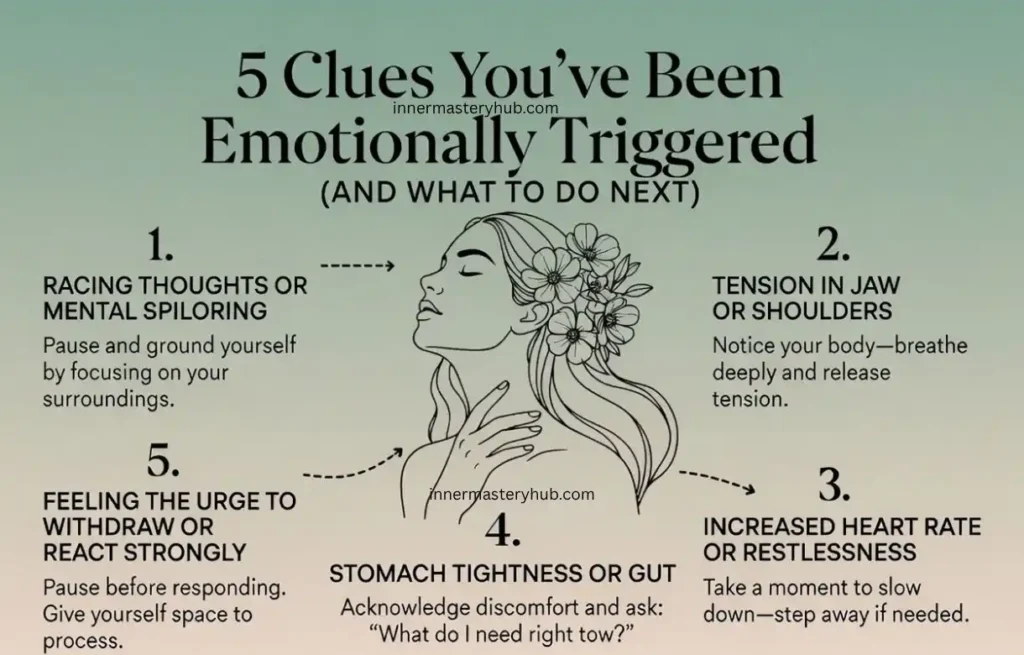
When something feels threatening or stressful, you may notice the reaction in your body quite quickly.
Harvard Health explains that the amygdala can send a signal to the hypothalamus, which activates the sympathetic nervous system. This can lead to the release of adrenaline, making your heart beat faster, your breathing quicken, and your muscles tense.[3]
If the stress continues, the body may also release cortisol through the HPA axis.[3]
You might notice:
- A faster heartbeat
- Quicker breathing
- Tight or tense muscles
- Sweating
- Feeling restless
- Wanting to leave the situation
These reactions are not exactly the same for everyone.
You might notice the physical feeling first and only later realise what upset you.
Emotional Triggers in Relationships
Emotions can feel stronger in close relationships because you care about the person and what happens between you.
For example:
- Your partner makes a decision that affects both of you without asking you first.
- They forget something important that you have already talked about more than once.
- They make a joke about something private in front of other people.
- They keep pushing an argument when you need a little time to calm down and think.
A 2024 study by Mosannenzadeh and colleagues looked at attachment and emotion regulation in romantic relationships. Part of the study followed 124 people for seven days and found links between attachment anxiety or avoidance and the way people managed stress in their relationships.[4]
This does not mean attachment is behind every difficult reaction.
Sometimes something your partner says or does is upsetting on its own. Poor communication, broken promises, or feeling left out can all affect how you respond.
When something hits you hard, start with what actually happened. Then look at why that moment mattered so much to you.
How to Identify Your Emotional Triggers
Triggers are not always obvious at first. You may notice them only after the same kind of situation has upset you more than once.
1. What keeps setting me off?
Pay attention to situations that seem to get a strong reaction from you.
It could be criticism, being interrupted, waiting for a reply, feeling left out, or having plans changed suddenly.
2. What am I feeling?
Keep it simple.
You might feel angry, anxious, embarrassed, sad, frustrated, or left out.
You do not need the perfect word. Just get as close as you can.
3. What did I think was happening?
Notice the first thought that came up.
Maybe it was:
- “They don’t respect me.”
- “I’ve messed this up.”
- “They don’t want me there.”
- “Something is going wrong.”
That first thought can tell you a lot about why the moment felt so important.
4. Have I felt this way before?
Sometimes the same feeling shows up in very different situations.
Being left out by friends and not hearing back from someone you care about may bring up a similar reaction.
You do not have to force a connection with the past. Just notice if one is there.
5. What do I need right now?
Maybe you need an answer, some space, a clearer conversation, reassurance, or simply time to settle down.
Once you know that, it becomes easier to decide what to do next.
How to Respond to Emotional Triggers
Getting triggered does not mean you have to react straight away. Sometimes a little time is enough to stop the situation from getting worse.
1. Wait Before You Respond
If you are angry or upset, avoid replying immediately if you can.
Put the phone down, leave the room for a few minutes, or give yourself time to think before continuing the conversation.
2. Calm Down Physically
Strong emotions can make your body feel tense or restless.
You could try:
- Breathing more slowly
- Taking a short walk
- Stretching
- Sitting somewhere quiet
- Stepping outside for a few minutes
Research on breathing exercises has found that they may help reduce stress, although the results are not the same for everyone.[5]
3. Look at What Happened
Try to separate what actually happened from what you first thought it meant.
For example, someone has not replied to your message.
That is what you know.
“They are angry with me” is one possible explanation, but there could be others.
Waiting for more information can stop you from reacting to an assumption.
4. Do Not Be Too Hard on Yourself
You may not always handle a difficult moment the way you wanted to.
You can admit that without spending hours blaming yourself.
Research on self-compassion interventions has found reductions in anxiety and stress in some studies.[6]
Think about what you would do differently next time and leave it there.
5. Be Clear About What Bothered You
If someone else is involved, tell them what happened instead of making a general accusation.
Instead of:
“You never listen to me.”
Try:
“You interrupted me before I finished. I want to finish what I was saying.”
Clear language usually makes the problem easier to discuss.
6. Ask for Help if It Becomes Hard to Manage
If the same reactions keep affecting your relationships, work, or daily life, talking to a mental health professional may help.
This can be especially important if certain situations bring back distress connected with a traumatic experience.
For PTSD, current treatment guidance includes several CBT-based therapies and EMDR.[7]
Can Emotional Triggers Be Healed?
I would not measure progress by whether you still get triggered.
A better question is what happens after the trigger appears.
Do you notice it sooner?
Can you stay in the conversation instead of walking away immediately?
Can you check what happened before assuming the worst?
Those small changes usually matter more than trying to reach a point where nothing bothers you.
Key Takeaways
- Emotional triggers are situations, words, memories, or events that affect you strongly.
- Common examples include criticism, rejection, conflict, feeling ignored, uncertainty, and disrespect.
- The same situation will not affect everyone in the same way.
- Sometimes the situation itself is upsetting. Stress or past experiences can make it feel even harder.
- Childhood experiences can matter later in life, but they do not decide how you will always react.
- Strong emotions can also show up physically, such as a racing heart, tense muscles, or restlessness.
- Knowing what usually affects you can make it easier to slow down before reacting.
- The aim is not to stop feeling difficult emotions. It is to understand what is happening and respond in a way that helps.
Conclusion
Emotional triggers are part of everyday life, and everyone reacts differently.
Sometimes a situation is genuinely upsetting. Other times, stress or something you have been through before can make it harder to deal with.
Paying attention to the situations that affect you can help you understand your reactions better.
You may still get upset, angry, anxious, or defensive at times. The difference is that you can learn to notice it sooner and avoid reacting in ways you later regret.
People Also Ask
What are examples of emotional triggers?
Examples include criticism, rejection, being ignored, betrayal, conflict, abandonment, social judgment, loud voices, unfair treatment, and reminders of past trauma. What affects one person strongly may not affect someone else in the same way.
Why do I get emotionally triggered easily?
There can be different reasons.
You may already be stressed, tired, worried about something, or dealing with a situation that matters a lot to you. Past experiences can sometimes play a part too.
If your reactions feel unusually strong or keep causing problems in daily life, it may help to look at when they happen and what seems to set them off.
Can trauma cause emotional triggers?
Yes, reminders of a traumatic experience can sometimes bring back strong emotions or physical reactions.
But not every emotional trigger comes from trauma. Everyday stress, difficult relationships, painful memories, or worries about what is happening now can also affect how you react.
Can emotional triggers become less intense?
Yes, they can become easier to deal with over time.
You may still feel upset when something happens, but you can get better at noticing the reaction sooner and avoiding an immediate response.
The aim does not have to be getting rid of every trigger.
Why can triggers feel stronger in relationships?
What happens in a close relationship often matters more because you care about the person and the relationship.
A change in tone, a broken promise, being left out of a decision, or an argument may therefore affect you more than the same behaviour from someone you barely know.
Past relationship experiences can sometimes make certain situations harder as well.
How do I know what my emotional triggers are?
Start by noticing situations that repeatedly leave you angry, anxious, embarrassed, hurt, or overwhelmed.
Then think about what happened just before the feeling appeared and what you thought was happening at the time.
After a while, you may start seeing patterns in the situations that affect you most.
- Scherer, K. R. (2019). Studying appraisal-driven emotion processes: Taking stock and moving to the future. Cognition and Emotion, 33(1), 31–40. DOI: 10.1080/02699931.2018.1510380. ↩︎
- Dugan, K. A., Kunkel, J. J., Fraley, R. C., Simpson, J. A., McCormick, E. M., Bleil, M. E., Booth-LaForce, C., & Roisman, G. I. (2026). A prospective longitudinal study of the associations between childhood and adolescent interpersonal experiences and adult attachment orientations. Journal of Personality and Social Psychology, 130(2), 260–290. https://doi.org/10.1037/pspi0000502 ↩︎
- Harvard Health Publishing. (2024, April 3). Understanding the stress response. Reviewed by Howard E. LeWine, MD. ↩︎
- Mosannenzadeh, F., Luijten, M., Maciejewski, D. F., Wiewel, G. V., & Karremans, J. C. (2024). Adult Attachment and Emotion Regulation Flexibility in Romantic Relationships. Behavioral Sciences, 14(9), 758. https://doi.org/10.3390/bs14090758 ↩︎
- Fincham, G. W., Strauss, C., Montero-Marin, J., & Cavanagh, K. (2023). Effect of breathwork on stress and mental health: A meta-analysis of randomised-controlled trials. Scientific Reports, 13, 432. https://doi.org/10.1038/s41598-022-27247-y ↩︎
- Han, A., & Kim, T. H. (2023). Effects of self-compassion interventions on reducing depressive symptoms, anxiety, and stress: A meta-analysis. Mindfulness, 14, 1553–1581. https://doi.org/10.1007/s12671-023-02148-x ↩︎
- American Psychological Association. (2025). Clinical Practice Guideline for the Treatment of Posttraumatic Stress Disorder (PTSD) in Adults. ↩︎
Written By Mehwish Qurayshi
Mehwish Qurayshi is a Trauma-Informed Emotional Wellness Counsellor trained through NICABM’s Treating Trauma Master Series, which includes NBCC-approved education in Trauma Treatment and Emotional Wellness & Emotional Intelligence – Sourcecode Academia. She has over five years of experience providing emotional wellness counselling, helping individuals heal from trauma, regulate emotions, and build healthy relationships.