
15 Emotional Reasoning Examples: When Feelings Start to Feel Like Facts


Emotional reasoning happens when you believe something is true mainly because it feels true.
For example, if you feel rejected, you might start thinking, “Nobody likes me,” even when you do not have much evidence for that conclusion. This kind of thinking can show up during anxiety, difficult past experiences, low moods, or relationship conflict, when strong emotions influence how you understand what is happening.
What Is Emotional Reasoning?
Emotional reasoning is when you assume something is true because it feels true.
For example:
- “I feel incompetent, so I must be incompetent.”
- “I feel unsafe, so I must be in danger.”
- “I feel unattractive, so nobody could love me.”
Your feelings are real, but they do not always tell you exactly what is happening.
In Cognitive Behavioural Therapy (CBT), emotional reasoning is described as a thinking pattern where feelings are treated as evidence. Research describes emotional reasoning as a thinking pattern in which you use how you feel as evidence for what is true, rather than relying only on the information available.[1]
This can happen more easily when you are stressed, upset, tired, or dealing with something that already feels sensitive to you. Past experiences can also affect how you read a situation.
The goal is not to ignore your feelings. It is to notice the difference between what you feel and what you know about the situation.
| Feeling | What you may think | Another way to look at it |
|---|---|---|
| Anxiety | “Something bad will happen.” | “I feel anxious, but I do not know what will happen yet.” |
| Shame | “I am a bad person.” | “I feel bad about something that happened.” |
| Loneliness | “Nobody cares about me.” | “I feel lonely right now, but that does not mean nobody cares.” |
Emotional Reasoning vs. Emotional Awareness
Emotional awareness means noticing what you feel without assuming the feeling tells you the whole story.
For example, you might feel anxious and still ask yourself, “Do I have evidence that something is wrong, or am I reacting to uncertainty?”
You are not ignoring the emotion. You are giving yourself a little space to understand it.
You can ask:
- What am I feeling right now?
- What happened just before I felt this way?
- What am I assuming this feeling means?
- What facts support that thought?
- Could there be another explanation?
| Emotional awareness | Emotional reasoning |
|---|---|
| “I feel anxious.” | “I feel anxious, so something bad must happen.” |
| “I feel rejected.” | “I feel rejected, so nobody likes me.” |
| “I feel guilty.” | “I feel guilty, so I must have done something wrong.” |
| “I feel insecure.” | “I feel insecure, so I must not be good enough.” |
| “This feeling tells me something matters to me.” | “This feeling proves my conclusion is true.” |
The difference is not whether you have strong emotions. It is whether the feeling becomes the only evidence you use to understand what is happening.
Why Emotional Reasoning Happens
Emotional reasoning can happen when a strong feeling starts to shape the way you understand a situation.
For example, if you already feel anxious, uncertainty may seem more threatening. Research with people experiencing anxiety has found that some participants used their anxious feelings as part of their judgment about whether a situation was dangerous.[2]
Past experiences can matter too.
If you were often criticised for mistakes growing up, you may be more likely to attach a lot of meaning to getting something wrong now. A small mistake at work might bring up thoughts such as:
“Maybe I’m not good enough at this.”
That does not mean your past determines how you will react. It simply means old expectations can sometimes influence how you interpret a new situation.
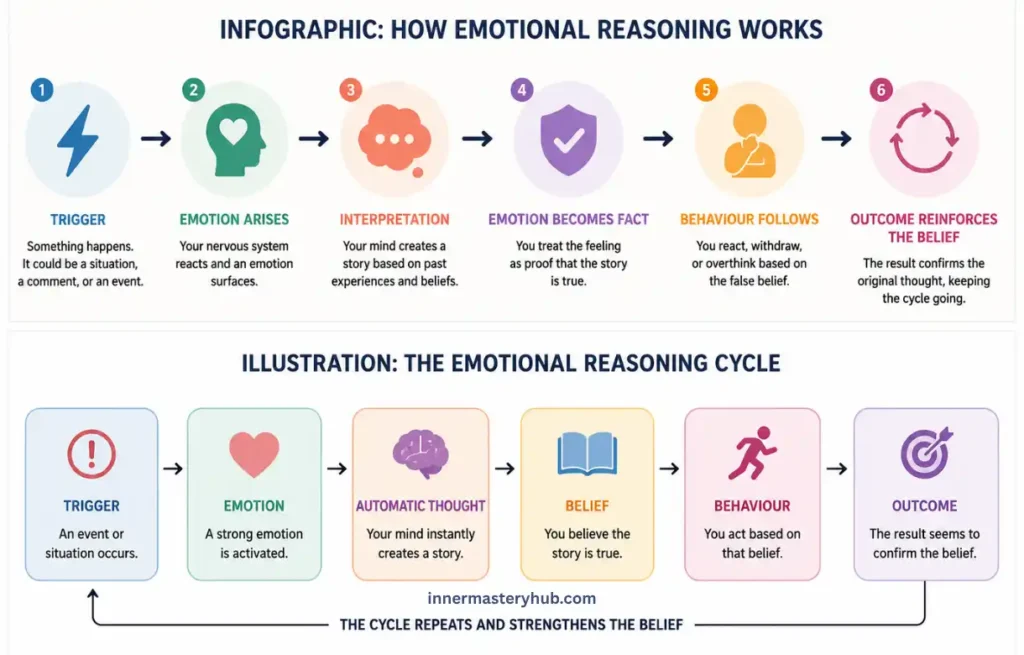
A pattern might look like this:
- Something happens.
- You have an emotional reaction.
- A familiar thought or assumption comes up.
- The feeling starts to make that thought seem more believable.
- You respond based on that interpretation.
Noticing this pattern gives you a chance to ask whether the feeling and the facts are telling you the same thing.
15 Emotional Reasoning Examples
Here are some common ways emotional reasoning can show up in everyday life.
1. “I Feel Like a Failure, So I Must Be One”
You make a mistake during a presentation and think:
“I completely failed.”
You may feel embarrassed or disappointed, but one bad moment does not describe everything you are capable of.
2. “I Feel Anxious, So Something Bad Will Happen”
You feel nervous before getting on a plane and think:
“Something must be wrong.”
Anxiety can make a situation feel more dangerous than it is. Research has found that some people with anxiety disorders use their anxious feelings when judging whether something is dangerous.[3]
Feeling nervous, though, does not tell you what will actually happen.
3. “I Feel Guilty, So I Must Have Done Something Wrong”
You say no to someone and feel guilty afterward.
Then you start wondering:
“Was I selfish?”
Sometimes guilt follows a choice simply because the choice felt uncomfortable or unfamiliar. It does not always mean you did something wrong.
It can help to ask: “Did I hurt someone, or do I just feel uncomfortable saying no?”
4. “I Feel Rejected, So Nobody Likes Me”
A friend cancels plans, and you immediately think:
“They don’t want to see me anymore.”
You may genuinely feel rejected, but you still do not know why they cancelled.
There may be other reasons you have not heard yet.
5. “I Feel Jealous, So My Partner Must Be Unfaithful”
You notice your partner talking closely with someone and jealousy comes up.
Your mind may jump to:
“There must be something going on.”
Jealousy tells you that something feels uncomfortable. It does not, by itself, tell you what your partner is doing.
6. “I Feel Embarrassed, So Everyone Is Judging Me”
You say something awkward in a meeting and spend the next hour thinking everyone noticed.
Most people know this feeling.
Research on the spotlight effect suggests that we can overestimate how much other people notice our mistakes or appearance.[4]
The moment may feel huge to you without being equally important to everyone else.
7. “I Feel Incompetent, So I Shouldn’t Apply”
You find a job you like, but doubt shows up:
“I’m probably not good enough.”
Feeling unsure does not tell you whether you are qualified.
Look at the actual requirements before letting that feeling make the decision for you.
8. “I Feel Unsafe, So This Person Must Be Dangerous”
If someone makes you uncomfortable, it is worth paying attention to that feeling.
But you can still ask what is making you uneasy.
Did they say something threatening? Ignore a boundary? Act unpredictably? Or is the situation reminding you of something difficult from the past?
You do not have to dismiss the feeling or immediately decide what it means.
9. “I Feel Angry, So They Must Have Hurt Me on Purpose”
Someone says something that upsets you, and you think:
“They knew exactly what they were doing.”
Your anger may tell you that something felt hurtful or unfair.
It cannot tell you the other person’s intention without more information.
10. “I Feel Ashamed, So There Must Be Something Wrong With Me”
After making a mistake, you may think:
“I’m such a bad person.”
That is different from saying:
“I did something I regret.”
One mistake does not have to become a judgment about your whole character.
11. “I Feel Lonely, So Nobody Cares About Me”
Loneliness can quickly turn into:
“Nobody really cares.”
But feeling lonely and being uncared for are not always the same thing.
You can have people who love you and still go through periods when you feel disconnected.
12. “I Feel Hopeless, So Nothing Will Ever Change”
When life has been difficult for a while, it can become hard to imagine things being different.
You may think:
“This is never going to get better.”
That thought can feel completely true in the moment, but you still cannot know the future from how today feels.
If hopelessness keeps showing up or becomes difficult to manage, talking with a qualified mental health professional can help.
13. “I Feel Overwhelmed, So I Cannot Cope”
You look at everything you have to do and think:
“I can’t handle this.”
Sometimes feeling overwhelmed simply means too many things need your attention at the same time.
Instead of deciding you cannot cope at all, ask:
“What is the next thing I need to deal with?”
14. “I Feel Unworthy, So I Don’t Deserve Love”
You feel insecure and think:
“Why would anyone want me?”
Feeling unworthy can be painful, but it is still a feeling about yourself, not proof of what you deserve.
Notice the difference between “I feel unworthy” and “I am unworthy.”
15. “I Feel Certain, So I Must Be Right”
Emotional reasoning is not always about fear or insecurity.
Sometimes it sounds like:
“I just know I’m right.”
You can feel very sure about something and still be missing part of the picture.
Certainty is a feeling too. It is not the same as evidence.
Emotional Reasoning in Relationships
Emotional reasoning can make relationship situations feel more certain than they really are.
For example, you might:
- read silence as rejection,
- assume an argument means the relationship is in trouble,
- take insecurity as proof that your partner no longer cares, or
- treat jealousy as evidence of betrayal.
The feeling may be real even when you do not yet know what the other person’s behaviour means.
Attachment can also play a part in how some people respond when relationships feel uncertain or stressful. Research suggests that attachment anxiety and avoidance are associated with different ways of responding to closeness, distance, and relationship stress.[5]
But attachment style is not a fixed explanation for every reaction.
If you notice yourself jumping from “I feel rejected” to “they are rejecting me,” it may help to slow down and ask what you actually know before filling in the missing information.
Emotional Reasoning and Trauma
Past experiences can sometimes affect how you read a situation in the present.
For someone who has lived through frightening, unpredictable, or deeply hurtful experiences, certain situations may carry more emotional weight than they do for someone else.
For example:
- uncertainty may feel especially uncomfortable,
- criticism may bring up a stronger reaction than expected, or
- distance in a relationship may bring up fears of being left.
That does not mean every strong reaction is a trauma response, and it does not mean the feeling is irrational.
Research involving people with PTSD has found that some participants show broader generalization of learned threat to situations or cues that resemble an earlier danger.[6] Those findings are specific to studied PTSD populations and should not be used to explain every difficult emotional reaction.
A trauma-informed approach is less about arguing with the feeling and more about getting curious about it:
“What am I noticing right now, and what does the present situation actually tell me?”
You can take your reaction seriously without assuming that your first interpretation is the only possible one.
How to Check an Emotional Reasoning Thought
You do not need to argue with yourself or pretend the feeling is not there.
Instead, try separating the feeling from the conclusion you are making about it.
1. What am I feeling right now?
Be as specific as you can.
You might feel:
- hurt,
- afraid,
- ashamed,
- sad, or
- lonely.
2. What happened just before I felt this way?
Think about the actual moment.
Was it something someone said? A message that went unanswered? A mistake? An uncomfortable conversation?
3. What am I assuming?
For example:
- “Nobody likes me.”
- “I’m failing.”
- “I’m not safe.”
Try to notice the difference between the feeling and the meaning you have given it.
4. What do I know?
Look at the information you actually have.
Which parts are facts, and which parts are your interpretation?
5. Is there another possible explanation?
Ask yourself:
“What else could be true?”
You do not have to force yourself to believe the most positive explanation. You are simply making room for more than one possibility.
6. What would I say to someone I care about?
Sometimes you speak to yourself much more harshly than you would speak to someone else in the same situation.
Thinking about what you would say to them can help you look at the situation from another angle.
Quick Self-Reflection Questions
- Which feelings am I most likely to treat as proof?
- When do I notice this happening most often?
- What do I usually assume in those moments?
- Have I felt this way in similar situations before?
- What information might I be missing?
- What else could be true?
Key Takeaways
- Emotional reasoning happens when a feeling starts being treated as evidence that something is true.
- A feeling can be real and important without giving you the full picture of what is happening.
- Stress, relationship uncertainty, and past experiences may sometimes influence how you interpret a situation.
- For some people with PTSD, research has found broader generalization of threat, but this should not be used to explain every strong emotional reaction.
- You do not need to dismiss your feelings to question the conclusion attached to them.
- Asking “What do I feel, what do I know, and what else could be true?” can help you separate the emotion from the assumption.
FAQs About Emotional Reasoning
Is emotional reasoning a cognitive distortion?
Yes. In Cognitive Behavioural Therapy (CBT), emotional reasoning is commonly described as a thinking pattern in which you treat how you feel as evidence that something is true.
For example, “I feel inadequate, so I must be inadequate.”
The feeling is real. The conclusion may still need evidence.
What is an example of emotional reasoning?
A simple example is:
“I feel anxious, so something bad must be about to happen.”
You are using the feeling of anxiety as evidence about what will happen next, even though you may not have other information pointing to danger.
Why does emotional reasoning happen?
Sometimes a strong feeling becomes part of how you judge a situation.
If you already feel anxious, rejected, ashamed, or uncertain, one explanation may seem more believable than the others.
Past experiences and the situation you are in may also influence how you interpret what you feel.
Can trauma affect emotional reasoning?
It may for some people, but trauma should not be assumed whenever someone has a strong emotional reaction.
Research involving people with PTSD has found differences in how some participants respond to and generalise learned threat. That does not mean every fear, assumption, or emotional reaction is a trauma response.
A useful question is:
“Is something in the present situation concerning me, or could an earlier experience also be affecting how this feels?”
How can I stop emotional reasoning?
You may not be able to stop an emotional conclusion from appearing immediately, but you can learn to check it before treating it as fact.
Try asking:
“What am I feeling?”
“What do I actually know?”
“What else could explain this?”
You are not trying to get rid of the emotion. You are checking whether the conclusion matches the information you have.
Is emotional reasoning the same as intuition?
Not exactly.
Emotional reasoning means using a feeling itself as evidence that a conclusion is true.
Intuition is a broader idea. It can involve quick judgments based on experience, learned patterns, context, and sometimes emotion.
There is no reliable rule that intuition always feels calm while emotional reasoning feels anxious or intense. When the decision matters, it can help to check both your impression and the available evidence.
Does emotional reasoning affect relationships?
It can influence how you interpret uncertain moments in a relationship.
For example, you may read silence as rejection, jealousy as proof of betrayal, or an argument as evidence that the relationship is ending.
Before deciding what another person’s behaviour means, it can help to separate what happened from what you fear it means.
Is emotional reasoning a symptom of anxiety?
Emotional reasoning is not, by itself, a diagnostic symptom of an anxiety disorder.
However, it has been studied in people with anxiety disorders. Research has found that some people experiencing anxiety may use anxious feelings when judging whether a situation is dangerous.
You can also use emotional reasoning without having an anxiety disorder.
What is the difference between emotional reasoning and catastrophizing?
Emotional reasoning uses a feeling as evidence:
“I feel afraid, so I must be in danger.”
Catastrophizing moves toward an extreme negative outcome:
“Something terrible is going to happen, and I won’t be able to handle it.”
The two can occur together, but they describe different thinking patterns.
- Berle, D., & Moulds, M. L. (2013). Emotional reasoning processes and dysphoric mood: Cross-sectional and prospective relationships. PLOS ONE, 8(6), e67359. https://doi.org/10.1371/journal.pone.0067359 ↩︎
- Arntz, A., Rauner, M., & van den Hout, M. (1995). “If I feel anxious, there must be danger”: Ex-consequentia reasoning in inferring danger in anxiety disorders. Behaviour Research and Therapy, 33(8), 917–925. https://doi.org/10.1016/0005-7967(95)00032-S ↩︎
- Gilovich, T., Medvec, V. H., & Savitsky, K. (2000). The spotlight effect in social judgment: An egocentric bias in estimates of the salience of one’s own actions and appearance. Journal of Personality and Social Psychology, 78(2), 211–222. DOI: 10.1037/0022-3514.78.2.211. ↩︎
- Arntz, A., Rauner, M., & van den Hout, M. (1995). “If I feel anxious, there must be danger”: Ex-consequentia reasoning in inferring danger in anxiety disorders. Behaviour Research and Therapy, 33(8), 917–925. DOI: 10.1016/0005-7967(95)00032-S. ↩︎
- Simpson, J. A., & Rholes, W. S. (2017). Adult attachment, stress, and romantic relationships. Current Opinion in Psychology, 13, 19–24. DOI: 10.1016/j.copsyc.2016.04.006. ↩︎
- Morey, R. A., Dunsmoor, J. E., Haswell, C. C., Brown, V. M., Vora, A., Weiner, J., Stjepanovic, D., Wagner, H. R., III, VA Mid-Atlantic MIRECC Workgroup, & LaBar, K. S. (2015). Fear learning circuitry is biased toward generalization of fear associations in posttraumatic stress disorder. Translational Psychiatry, 5(12), e700. https://doi.org/10.1038/tp.2015.196 ↩︎
Written By Mehwish Qurayshi
Mehwish Qurayshi is a Trauma-Informed Emotional Wellness Counsellor trained through NICABM’s Treating Trauma Master Series, which includes NBCC-approved education in Trauma Treatment and Emotional Wellness & Emotional Intelligence – Sourcecode Academia. She has over five years of experience providing emotional wellness counselling, helping individuals heal from trauma, regulate emotions, and build healthy relationships.