
12 Phrases To Defend Yourself Without Sounding Defensive
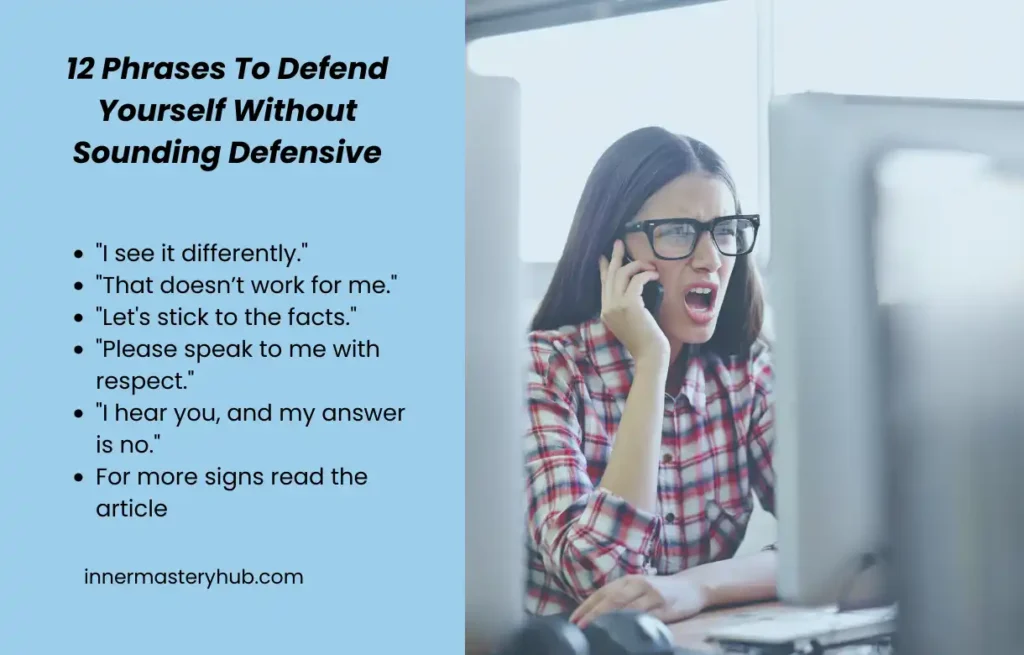
Phrases to defend yourself are short, clear responses you can use when someone pressures you, speaks disrespectfully, twists your words, or crosses a boundary. You do not need a perfect comeback. Often, a simple sentence such as “I’m not comfortable with that” or “Please let me finish” is enough to make your position clear. It is also normal if the right words do not come to you straight away. Difficult conversations can catch you off guard, especially when the comment feels personal or unexpected. You can pause, answer later, or leave the conversation if that feels more appropriate.
| Situation | You could say |
|---|---|
| Someone speaks disrespectfully | “Please speak to me with respect.” |
| Someone pressures you | “That doesn’t work for me.” |
| Someone interrupts you | “Please let me finish.” |
| Someone misrepresents what you said | “That’s not what I said. Let me clarify.” |
| Someone keeps pushing after you said no | “I’ve already given you my answer.” |
| The conversation becomes too heated | “I’m going to pause this conversation for now.” |
What Does It Mean to Defend Yourself Without Sounding Defensive?
Defending yourself does not always mean proving the other person wrong.
Sometimes you just need to correct what they said, ask them to speak to you properly, say no, or stop the conversation if it is going nowhere.
You can say things like:
- “That’s not what I said.”
- “Please let me finish.”
- “I’m not okay with that.”
- “I need some time to think before I answer.”
- “I don’t want to continue this conversation right now.”
You do not need to explain everything in detail. Try to say what you need to say without insulting the other person or making the situation worse.
You also do not have to wait until you feel completely calm. If something needs to be said, you can say it clearly and simply.
And if you are not ready to answer, you can take some time and respond later.
Why Is It Hard to Defend Yourself in the Moment?
Speaking up is not always easy, especially if arguments have felt upsetting or difficult for you in the past.
You may stay quiet because you do not want to make things worse, or you may need a little space before you know what you want to say.
That does not necessarily mean something deeper is going on. Sometimes the conversation simply catches you off guard.
It is okay to slow things down.
You can say:
- “I need some time to think.”
- “Can we talk about this later?”
- “I’m not ready to answer that right now.”
You do not have to answer straight away. It is fine to take some time and come back to the conversation later.
Some research may help explain why this can happen. Studies of social-evaluative stress suggest that feeling judged or under pressure can make certain working-memory tasks harder, which may make it more difficult to organise your thoughts quickly.[1]
Not every difficult conversation will affect you the same way. Sometimes you just need time to understand what happened or decide if it is even worth saying something. Sometimes the words come after the conversation has ended.
Rather than criticising yourself for not replying sooner, think about what feels useful now. You can bring it up later, explain what bothered you, or decide that you do not want to continue the conversation.
What Does Research Say About Assertive Communication?
You do not have to think of the perfect comeback every time. Assertive communication is something you can practise.
A review of assertiveness training found that people can improve these skills with practice across a range of settings.[2]
The way you word a disagreement can matter too. In one study, people rated statements using I-language and acknowledging the other person’s point of view as less hostile than more confrontational responses.[3]
That does not mean the other person will always respond well.
But a short, clear phrase can make it easier to say no, correct something, ask for respect, or pause the conversation without adding another argument.
What If You Think of the Right Words Afterwards?
Sometimes the conversation ends before you know what you wanted to say.
Later, you may find yourself replaying the conversation afterwards and thinking of a clearer response.
You may feel annoyed with yourself, but you have not missed your only chance to speak up.
If the issue still matters, you can return to it:
“I’ve been thinking about what happened earlier, and I want to clear something up.”
Or you may decide that the conversation is not worth reopening.
Both are options.
12 Phrases To Defend Yourself
The phrases below give you short ways to disagree, set a limit, ask for time, or end a conversation.
1. No.
You do not always need the perfect explanation.
If you already know your answer, a simple “no” can be clear enough.
For example:
“Can you come over tonight?”
“No, I can’t.”
If they ask why, you can decide whether you want to explain.
You are allowed to keep your answer short.
2. “I’m not comfortable with that.”
Use this when someone asks something too personal, makes a joke you do not like, or expects you to share something you would rather keep private.
For example:
“Tell us exactly what your manager said.”
“I’m not comfortable sharing that.”
You do not need a big reason.
If they keep asking, you can say:
“I’d rather not talk about it.”
3. “That doesn’t work for me.”
This is useful when someone suggests a plan, deadline, favour, or arrangement that does not suit you.
For example:
“Let’s move the deadline to tomorrow morning.”
“That doesn’t work for me. Can we keep Friday?”
You can suggest another option if you want to.
If not, a simple answer is enough.
4. “I hear you, and my answer is still no.”
Use this when you have already said no and the person keeps asking.
For example:
“But I really need you to come.”
“I hear you, and my answer is still no.”
You can understand what they are saying without changing your answer.
If they ask again, you do not need to come up with a new explanation.
5. “Please speak to me with respect.”
Use this when someone starts insulting you, talking down to you, or becoming rude.
For example:
“That idea is ridiculous.”
“I’m happy to talk about the idea, but please speak to me with respect.”
You can disagree with someone without accepting insults.
If they carry on, you can end the conversation.
6. “Let’s stick to what actually happened.”
This can help when someone starts exaggerating or saying things that do not match what happened.
For example:
“You never help with anything.”
“Let’s stick to what actually happened. I handled Tuesday and Thursday this week.”
You do not have to answer every accusation.
Correct the part that matters and leave the rest.
7. “I see it differently.”
Sometimes you simply disagree.
You do not always need a long argument to explain why.
For example:
“This plan is going to fail.”
“I see it differently. I think we should give it a week and see how it goes.”
You can explain more if the other person is willing to have a reasonable conversation.
8. “That’s your view. Mine is different.”
Use this when someone talks as if their opinion is the only possible one.
For example:
“Working from home is lazy.”
“That’s your view. Mine is different. It works well for our team.”
You do not have to change their mind.
Sometimes you only need to say that you do not agree.
9. “I don’t want to discuss this right now.”
You do not have to continue a conversation just because someone wants an answer immediately.
You may need time to think, calm down, or work out what you want to say.
For example:
“We need to sort this out right now.”
“I don’t want to discuss this right now. Can we talk this afternoon?”
If you need time to understand what you are feeling, building more emotional awareness can help you notice what actually needs a response.
10. “I understand you’re upset, but my decision is the same.”
Use this when someone is unhappy with your decision and keeps trying to change it.
For example:
“If you cared about me, you would come.”
“I understand you’re upset, but my decision is the same.”
You can care about how someone feels without saying yes to something you do not want to do.
11. “What exactly do you mean by that?”
Use this when someone says something vague or makes a comment that feels pointed.
For example:
“Well, that’s very typical of you.”
“What exactly do you mean by that?”
Instead of guessing what they meant, ask them to explain.
Then you can decide whether you want to answer.
12. “If this continues, I’m ending the conversation.”
Use this when you have already asked someone to stop and they keep going.
For example:
“You’re being ridiculous.”
“I’m willing to talk, but if the insults continue, I’m ending the conversation.”
Then do what you said you would do.
You can leave, end the call, or stop replying.
You do not have to stay in a conversation where someone keeps insulting you.

Common Mistakes When Trying to Defend Yourself
It can be harder to speak up when you are trying to explain too much or answer before you know what you want to say.
Here are a few things that can make the conversation harder.
1. Explaining too much
You may keep adding reasons because you want the other person to understand you.
But if you have already given a clear answer, you may not need to keep explaining.
“No, I’m not available” can be enough.
2. Making it personal
When you are annoyed, it is easy to say things like “You always…” or “You never…”
That can turn one problem into a bigger argument.
Try to stay with what happened this time.
3. Answering too quickly
You do not have to reply the moment someone challenges you.
If you are not sure what you want to say, give yourself a little time.
4. Staying quiet when you wanted to say something
Sometimes you choose not to respond.
Other times, you leave the conversation wishing you had said something.
If it still matters to you, you can bring it up later.
Give Yourself a Little Space Before You Answer
You do not have to reply straight away.
A short pause can give you time to work out what you want to say.
Maybe you want to correct something.
Maybe you want to say no.
Maybe you want them to change their tone.
Or maybe you are ready to end the conversation.
You do not need to work through everything you are feeling before you speak.
Just give yourself enough time to find the next sentence.
If you need longer, say:
“I need to think about this before I answer.”
You can come back to the conversation when you are ready.
How to Remember What to Say in the Moment
A phrase is more useful when it sounds like something you would actually say.
Pick two or three from the list and practise them in your own words.
For example:
“I need a minute.”
“I don’t agree.”
“Please let me finish.”
You do not need to memorise all 12.
The aim is simply to make a few responses feel familiar enough that they are easier to reach for when you are caught off guard.
If the conversation becomes insulting or threatening, you do not have to keep practising your communication skills in that moment. You can leave, end the call, or get support.
Start With Easier Situations
You do not have to practise speaking up in your hardest relationship first.
Start somewhere smaller.
Say no to a minor request.
Ask someone to let you finish.
Tell someone you need more time before answering.
Practising in ordinary situations can help the words feel less unfamiliar when a harder conversation comes up.
Does It Get Easier to Speak Up?
Sometimes, yes.
The first time you say, “I’m not okay with that,” you might feel awkward.
The fifth time may still feel uncomfortable, but at least the sentence is familiar.
You know what it sounds like in your own voice.
You know you can say it without giving a ten-minute explanation.
That is often what practice gives you: not perfect confidence, just more familiarity.
Key Takeaways
- You do not need a clever comeback to speak up.
- A short, clear answer is often enough.
- You can explain your decision, but you do not always need a long justification.
- If you need more time, you can answer later.
- Feeling upset does not stop you from communicating clearly.
- Choose phrases that sound natural in your own voice.
FAQs About Defending Yourself Without Sounding Defensive
What can I say to defend myself without sounding rude?
Keep it short and talk about what is happening.
You might say:
“I see it differently.”
“Please let me finish.”
“I’m not comfortable with that.”
“I need some time to think.”
You do not need to insult the other person or prove them wrong to make your position clear.
Do I have to explain why I said no?
Not always.
Sometimes “No, I can’t” or “That doesn’t work for me” is enough.
You can explain more if you want to, especially when the relationship or situation calls for it. But you do not have to keep adding reasons simply because someone continues asking.
What should I say if someone keeps pushing after I say no?
You can repeat your answer instead of making up a new explanation.
For example:
“I hear you, but my answer is still no.”
If they continue pushing, you can decide whether you want to end the conversation or step away.
What if I think of the right response later?
You can still bring it up.
Try:
“I’ve been thinking about what happened earlier, and I want to clear something up.”
You do not lose your chance to speak just because you did not respond immediately.
You can also decide that the issue is not worth reopening.
What can I say if someone twists my words?
Correct the specific point without trying to defend everything at once.
For example:
“That’s not what I said. What I said was…”
If the same argument keeps repeating, you can stop explaining and decide whether continuing the conversation is useful.
What should I say when someone becomes disrespectful?
You can address the way they are speaking without attacking them back.
For example:
“Please speak to me with respect.”
“I’m willing to talk, but not if the insults continue.”
If the behaviour continues, you can leave or end the conversation.
Is it okay to walk away instead of defending myself?
Yes. You do not have to stay in every argument.
Sometimes you may want to pause and return later. Other times, especially if the conversation becomes threatening or unsafe, creating distance or getting support may be more important than finding the perfect words.
- Haucke, M., Golde, S., & Heinzel, S. (2025). Development and validation of the socio-evaluative N-back task to investigate the impact of acute social stress on working memory. Scientific Reports, 15, 35408. https://doi.org/10.1038/s41598-025-22611-0 ↩︎
- Speed, B. C., Goldstein, B. L., & Goldfried, M. R. (2018). Assertiveness training: A forgotten evidence-based treatment. Clinical Psychology: Science and Practice, 25(1), e12216. https://doi.org/10.1111/cpsp.12216 ↩︎
- Rogers, S. L., Howieson, J., & Neame, C. (2018). I understand you feel that way, but I feel this way: The benefits of I-language and communicating perspective during conflict. PeerJ, 6, e4831. https://doi.org/10.7717/peerj.4831 ↩︎
Written By Mehwish Qurayshi
Mehwish Qurayshi is a Trauma-Informed Emotional Wellness Counsellor trained through NICABM’s Treating Trauma Master Series, which includes NBCC-approved education in Trauma Treatment and Emotional Wellness & Emotional Intelligence – Sourcecode Academia. She has over five years of experience providing emotional wellness counselling, helping individuals heal from trauma, regulate emotions, and build healthy relationships.