
11 Manipulative Apology Patterns and What They Sound Like

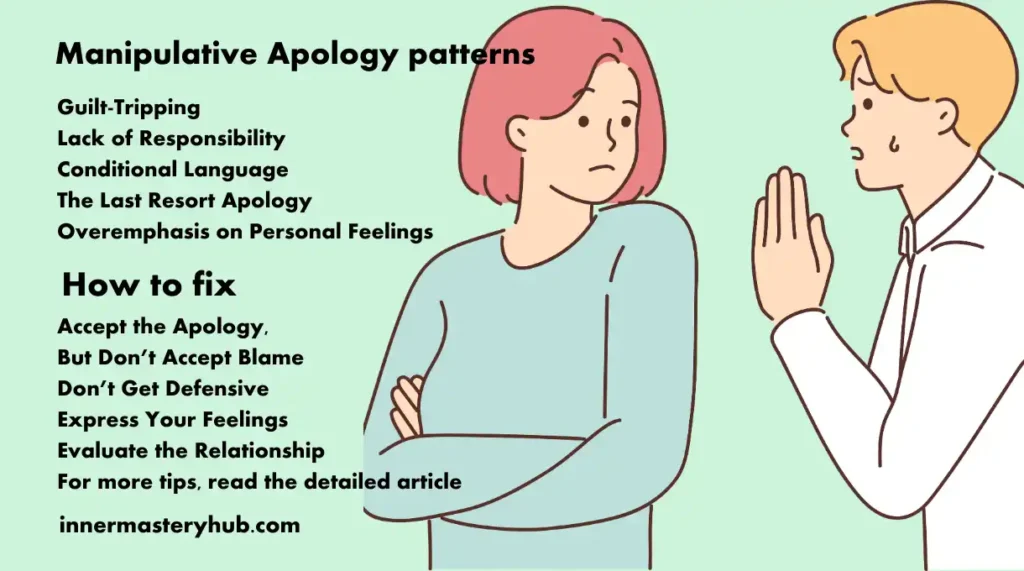
Manipulative apology patterns happen when someone says “sorry” but avoids taking responsibility for what they did. They may blame you, minimise what happened, add an excuse, or turn the conversation toward your reaction instead. The words sound like an apology, but the original problem is left unresolved.
Manipulative apology at a Glance
| Question | Short answer |
|---|---|
| What is a manipulative apology? | An apology that says “sorry” while shifting responsibility away from what happened |
| Common signs | Blame after “sorry,” excuses, minimising, pressure to forgive, or repeated promises without change |
| What does a better apology sound like? | The person names what they did without making your reaction the main problem |
| What should you notice afterward? | Whether the same behaviour happens again |
| How can you respond? | Keep the conversation on the behaviour you originally raised |
What Are Manipulative Apology Patterns?
Not every clumsy apology is manipulative. Someone may become defensive, choose their words badly, and still come back to address what they did.
The difference often shows up in where the conversation goes.
You say:
“That comment hurt me.”
They answer:
“I’m sorry, but you were being difficult too.”
A few minutes later, you’re explaining your tone, what you said earlier, or why you became upset. The comment you originally raised is no longer being discussed.
Or you hear:
“I’m sorry you took it that way.”
Here, the apology focuses on how you received the comment rather than what was actually said.
Research on effective apologies has examined features such as acknowledging the offence, accepting responsibility, expressing regret, and offering repair.[1] In everyday conversation, you can see the difference by noticing whether the person stays with the issue you raised or repeatedly turns it back onto you.
Why Do Manipulative Apologies Feel So Confusing?
A genuine apology usually names the specific behaviour.
Instead of:
“Sorry about everything.”
you might hear:
“I’m sorry I raised my voice at you yesterday. That wasn’t okay.”
If you explain why it hurt, you can finish what you’re saying without immediately hearing:
“But you did it too.”
The person may explain why they were angry or frustrated, but they don’t use that explanation to make you responsible for their choice.
The next conversation matters as well. If they promised not to shout during arguments, what happens during the next disagreement? If they said they would stop making jokes about something you asked them not to mention, do the jokes stop?
Research on effective apologies has identified several elements that may strengthen an apology, including acknowledging the offence, accepting responsibility, expressing regret, and offering to make amends.[1]
You also don’t have to feel better the moment someone apologises. You may still be angry, cautious, or need time before deciding what you want to do next.
| Genuine apology | Manipulative apology |
|---|---|
| Names what happened | Uses vague language |
| Accepts responsibility | Adds excuses or blame |
| Redirects the conversation | Stays with the behaviour being discussed |
| Pressures them to forgive or move on | Allows the other person to respond |
| Offers repair | Tries to end the conversation |
| Changes behaviour | Repeats the same pattern |
Why Do Manipulative Apologies Feel So Confusing?
A manipulative apology can begin with words you expected to hear and then turn the conversation back onto you.
You say:
“I was hurt when you made that joke about me in front of everyone.”
They reply:
“I’m sorry I embarrassed you, but you know how sensitive you get about these things.”
You started by talking about the joke. Now you’re explaining why you were hurt.
Or you hear:
“I’m sorry I shouted, but you wouldn’t listen to me.”
The shouting is acknowledged, but responsibility is immediately shared with you.
Research on effective apologies helps explain why this distinction matters. In two studies, Lewicki, Polin, and Lount found that acknowledgment of responsibility was one of the most important components affecting how effective an apology was perceived to be.[1] Their research examined apology effectiveness after trust violations; it did not test “manipulative apologies” as a clinical or psychological category.
So when “sorry” is followed by blame, pay attention to what happens in the conversation. Did the person stand by what they did, or did you end up defending your tone, reaction, memory, or behaviour?

What Are the Most Common Manipulative Apology Patterns?
Manipulative apology patterns can be easy to miss because the person may actually say “I’m sorry.” What matters is what comes with those words. Blame, excuses, pressure to forgive, or repeated promises without change can leave the person who raised the problem carrying the conversation.
Research on apologies has also looked at what people do when they become defensive after hurting someone. In a 2014 study, psychologist Karina Schumann examined defensive responses such as excuses, justifications, blaming the other person, minimising the harm, and denial.[2] These behaviours overlap with several of the apology patterns below, although the study did not define them as “manipulative apology patterns.”
1. The Conditional Apology
“I’m sorry if I hurt you.”
The “if” leaves the hurt open for debate.
You say, “What you said embarrassed me.”
Instead of addressing the comment, the conversation can turn into whether you should have been embarrassed.
A more direct apology would be:
“I’m sorry for making that comment about you in front of everyone.”
2. The Blame-Shift Apology
“I’m sorry I shouted, but you pushed me too far.”
The person admits to shouting and then gives you part of the responsibility for it.
You may have things to answer for too, but they don’t have to be bundled into the same apology.
“I was angry, but shouting at you was my choice. I’m sorry.”
That keeps responsibility for the shouting with the person who shouted.
3. The Minimising Apology
“I already said sorry. Why are you still upset?”
Now the conversation is no longer about what happened. It is about why you haven’t moved on yet.
You might still want an answer to a question, need something corrected, or simply not be ready to act as though everything is fine.
A different response sounds like:
“I know I apologised, but I can see you’re still bothered by what happened. What do you still need me to hear?”
4. The “You Misunderstood Me” Apology
“I’m sorry you misunderstood me.”
You raise the words that hurt you. The response focuses on what the person meant rather than what they actually said.
For example:
“I didn’t mean to embarrass you.”
Can be followed by:
“But I can see that making that joke in front of everyone did embarrass you. I shouldn’t have done it.”
Intent is explained without using it to erase the behaviour.
5. The Justification Apology
“I’m sorry I insulted you, but I only did it because you made me angry.”
There is a difference between explaining an argument and using the argument to excuse a choice.
“I was angry about what happened. I still shouldn’t have called you names.”
The anger remains part of the story, but it doesn’t become permission for the insult.
6. The Role-Reversal Apology
You say:
“It hurt when you told other people something I shared with you privately.”
They respond:
“I can’t believe you think I’d deliberately betray you.”
Soon you’re saying:
“I’m not calling you a bad person.”
The conversation has changed. You’re now reassuring them instead of discussing why your private information was shared.
A response that stays with the issue would be:
“I shouldn’t have shared that. You trusted me with it.”
7. The Self-Pity Apology
“Fine. I’m obviously a horrible person.”
You brought up one behaviour. Now the discussion is about the person’s entire character.
You may end up replying:
“That’s not what I said. I don’t think you’re horrible.”
Your complaint has disappeared while you reassure them.
A specific apology avoids that detour:
“What I said to you was disrespectful. I’m sorry.”
8. The Forced-Forgiveness Apology
“I’ve apologised. What more do you want?”
The apology is treated as proof that the conversation should be over.
But you may still need an answer, a returned item, a corrected statement, some space, or evidence that the behaviour has stopped.
9. The Vague Apology
“Sorry about everything.”
Suppose someone read your private messages after you asked them not to.
You ask:
“Are you apologising for reading my messages?”
They answer:
“I said I’m sorry. What else do you want?”
They still haven’t said what they are sorry for.
A direct apology would be:
“I’m sorry I read your messages without asking. I shouldn’t have done that.”
10. The Public Apology That Changes in Private
In front of other people, someone says:
“What I said was wrong. I apologise.”
Later, you bring up the same comment privately.
They answer:
“I already apologised in front of everyone. Why are you still talking about it?”
Or:
“Everyone was upset, so what else was I supposed to say?”
A public apology can be appropriate when the original behaviour was public. The question is whether the person still acknowledges what they did when you speak to them privately.
11. The Repeated Apology Without Change
After an argument:
“I’m sorry I shouted. It won’t happen again.”
During the next argument, they shout again.
Then you hear:
“I know I said that last time. I’m sorry. I really mean it now.”
If this keeps happening, you don’t have to judge the apology only by how sincere it sounds. You already know what followed the earlier promises.
A different response would be:
“I’ve promised this before and then shouted again. Next time I’m getting that angry, I’m going to stop the conversation before I start yelling.”
The next disagreement shows whether that change actually happens.
Is Every Bad Apology Manipulative?
No. A bad apology can simply be a bad apology.
Someone might respond in the moment:
“I’m sorry, but I was really angry.”
Later, they come back:
“I blamed my anger for how I spoke to you. That wasn’t fair. I shouldn’t have shouted.”
They don’t argue about whether you were “too sensitive.” They don’t demand that you forgive them. And when another disagreement happens, they make an effort not to shout again.
A repeated pattern looks different. You bring up the same behaviour and keep hearing a new version of:
“You made me do it.”
“It wasn’t that serious.”
“I already said sorry.”
One awkward apology gives you one conversation to consider. Repeated words followed by the same behaviour give you more information.
How Repeated Manipulative Apologies Can Affect Trust
Repeated manipulative apologies can make it harder to know what will happen when you bring up a problem.
Imagine that your partner shouts during an argument.
The first time, you hear:
“I’m sorry, but you wouldn’t stop arguing with me.”
It happens again.
This time:
“Why are you bringing this up? I apologised before.”
By the next argument, you may hesitate before saying anything. You might rewrite a message several times so it doesn’t sound “accusing,” wait until the other person is in a better mood, or drop the subject because you expect another argument about your reaction.
That is where trust can become relevant. Trust isn’t only about believing an apology. It can also involve knowing that you can raise a problem without the conversation repeatedly being turned back onto you.
This doesn’t mean everyone exposed to a manipulative apology will doubt themselves or lose confidence. It shows why the pattern after the apology matters as much as the words used during it.
Why Do Some Apologies Become Defensive?
An apology can become defensive within a single sentence:
“I’m sorry I shouted, but you weren’t listening.”
Or the person may move from one behaviour to their whole identity:
“Fine. I’m a terrible person. Nothing I do is ever good enough for you.”
Now you’re no longer talking about the shouting. You may find yourself explaining that you don’t think they’re terrible, listing things you appreciate about them, or defending yourself against the claim that you are impossible to please.
People can become defensive for different reasons. They may feel embarrassed, criticised, ashamed of what they did, or worried about how you see them. Those possibilities are not something you can confirm from the apology alone.
What you can see is what happens next. Do they come back to the behaviour you raised? Can they say, “I was angry, but I shouldn’t have shouted”? Or does every attempt to discuss it end with you explaining, comforting, or apologising instead?
How to Respond to Manipulative Apology Patterns
When an apology turns into blame, you don’t have to answer every accusation that comes with it. Stay with the event you brought up.
1. Keep One Issue on the Table
You say:
“You shouted at me in front of everyone.”
They answer:
“I’m sorry, but you embarrassed me first.”
Now there are two complaints.
You can separate them:
“We can talk about what I did next. First, I want to finish talking about the shouting.”
That lets you finish one issue before starting another.”
2. Don’t Spend the Conversation Defending Your Reaction
You say:
“That joke about me was embarrassing.”
They reply:
“I’m sorry, but you take everything so seriously.”
You could spend the rest of the conversation arguing about whether you’re too sensitive. Or you can say:
“You may see my reaction differently. I’m talking about the joke you made in front of everyone.”
Whether you’re ‘too sensitive’ doesn’t answer the question of what was said.
3. Be Specific About What You Won’t Accept
“Respect my boundaries” can mean different things to different people.
Say what you mean:
“Don’t read my messages without asking.”
“Don’t joke about my body in front of other people.”
“If you start calling me names, I’m ending the conversation.”
The other person now knows exactly what behaviour you’re referring to and what you will do if it happens again.
4. Notice When You End Up Comforting the Person Who Apologised
You say:
“What you said really hurt me.”
They answer:
“I know. I’m awful. I ruin everything.”
A few minutes later, you may find yourself saying:
“You’re not awful. That’s not what I meant.”
The conversation has changed.
You can bring it back:
“I’m not saying you’re an awful person. I’m talking about what you said to me.”
You can care about someone’s feelings without dropping the conversation you were trying to have.
5. Ask About the Next Time
You’ve heard:
“I’m sorry. It won’t happen again.”
before.
This time, ask:
“What are you going to do differently when you’re angry next time?”
A specific answer might be:
“If I’m getting too angry to talk without shouting, I’ll stop the conversation and come back when I can speak normally.”
Then you have something you can actually compare with what happens during the next disagreement.
If the conversation turns into insults, threats, repeated accusations, or pressure to forgive immediately, you don’t have to keep arguing until the other person understands your point. You can stop the conversation and decide later whether, when, and how you want to continue it.
The REPAIR Test for an Apology
R — Responsibility: Do they clearly own what they did?
E — Empathy: Do they acknowledge the impact?
P — Precision: Do they name the actual behavior?
A — Amends: Do they offer to repair it?
I — Improvement: Is there a concrete plan to change?
R — Repetition: Does the behavior actually stop?
The strongest evidence of a sincere apology is not how emotional it sounds, but what happens afterward.
What Can You Miss When You Want the Argument to End?
Sometimes you accept “I’m sorry” because you’re tired of arguing, not because the problem has been addressed.
You might say “It’s fine” even though you still have a question. You might apologise for your reaction after the conversation turns toward your tone. Or you might agree to move on before discussing what needs to change.
None of those responses proves that you were manipulated. They simply make it worth looking back at the conversation: What did I originally bring up, and did we ever actually talk about it?
Conclusion
The word “sorry” doesn’t tell you everything about an apology. Pay attention to the conversation around it.
You say:
“You embarrassed me when you told everyone what I shared with you.”
One response is:
“I’m sorry, but you shouldn’t have told me if it was that private.”
Another is:
“I shouldn’t have shared it. You told me that in confidence, and I broke that trust.”
Both conversations contain an apology. Only one keeps responsibility with the person who shared the information.
The same applies when apologies happen more than once. If someone says “It won’t happen again,” you can compare that promise with what they do the next time the same situation comes up.
One defensive or badly worded apology doesn’t automatically establish a manipulative apology pattern. Repeated blame, minimising, pressure to forgive, or apologies followed by the same behaviour give you more specific information to work with.
People Also Ask
What is a manipulative apology pattern?
A manipulative apology pattern is an apology that avoids responsibility for what happened. For example:
“I’m sorry I shouted, but you made me angry.”
The person admits to shouting, then makes your behaviour part of the reason they did it. If this happens repeatedly, the apology can become another place where blame is passed back to you.
How can you tell whether an apology is sincere?
A sincere apology names the behaviour without adding an excuse.
Compare:
“I’m sorry about what happened.”
with:
“I’m sorry I told them something you asked me to keep private. I shouldn’t have shared it.”
The second apology tells you exactly what the person is taking responsibility for. If they also stop sharing your private information, their later behaviour matches what they apologised for.
How should I respond to a manipulative apology?
Keep the original issue in the conversation.
If you say:
“You shouted at me.”
and hear:
“I’m sorry, but you weren’t listening.”
you can reply:
“We can talk about my part separately. Right now, I’m asking about the shouting.”
You don’t have to defend every accusation added to an apology before finishing the issue you raised.
Is “I’m sorry you feel that way” a real apology?
“I’m sorry you feel that way” doesn’t say what the speaker did.
For example:
“I’m sorry you felt embarrassed.”
focuses on your reaction.
“I’m sorry I made that joke about you in front of everyone.”
names the person’s own behaviour.
That difference makes it clear what, if anything, the person is taking responsibility for.
- Lewicki, R. J., Polin, B., & Lount, R. B. Jr. (2016). An Exploration of the Structure of Effective Apologies. Negotiation and Conflict Management Research, 9(2), 177–196. ↩︎
- Schumann, K. (2014). An affirmed self and a better apology: The effect of self-affirmation on transgressors’ responses to victims. Journal of Experimental Social Psychology, 54, 89–96. DOI: 10.1016/j.jesp.2014.04.013. ↩︎
Written By Mehwish Qurayshi
Mehwish Qurayshi is a Trauma-Informed Emotional Wellness Counsellor trained through NICABM’s Treating Trauma Master Series, which includes NBCC-approved education in Trauma Treatment and Emotional Wellness & Emotional Intelligence – Sourcecode Academia. She has over five years of experience providing emotional wellness counselling, helping individuals heal from trauma, regulate emotions, and build healthy relationships.