
11 Things You Can Fix Today for Saving a Failing Relationship

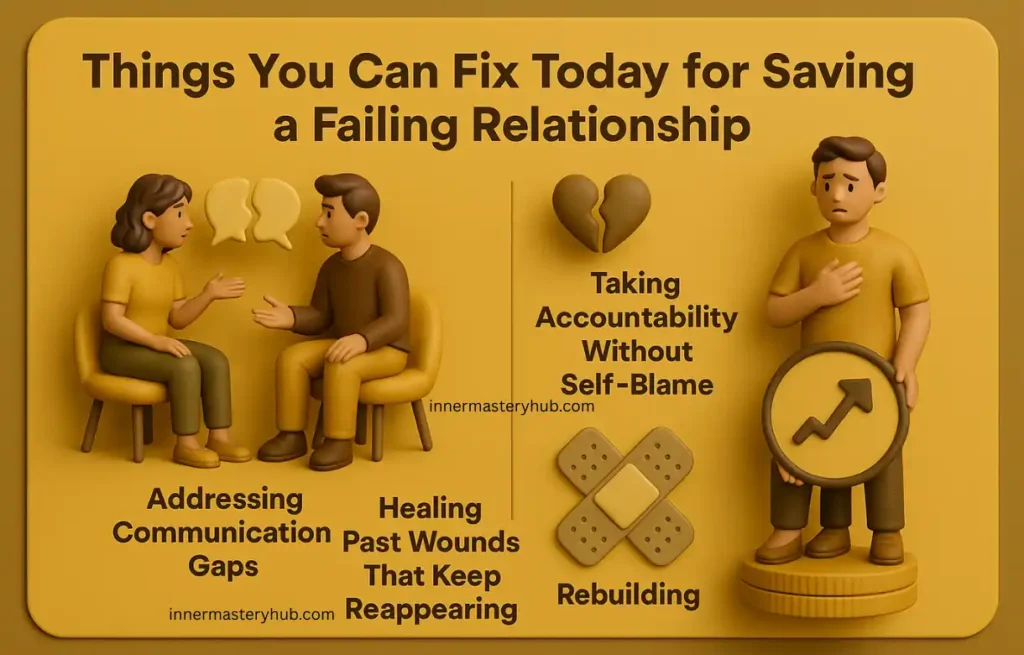
Saving a failing relationship is not about fixing your partner. It’s about understanding how emotional reactions, past wounds, and unmet needs shape your connection. When you shift your internal responses, the relationship dynamic naturally changes.
“Can saving a failing
The struggle isn’t just external. It’s inside you. One part wants to fix everything, while another part feels tired, hurt, and misunderstood. Even when you try harder, the distance grows.
This is where emotional regulation becomes central. Because what looks like “relationship problems” is a pattern of underlying emotional reactions.
Psychologist John Gottman explains that relationships don’t fail because of conflict, but because of how partners respond to emotional bids for connection1.
You think the problem is what your partner is doing, but often, it’s how both of you interpret and react emotionally.
Why Does a Relationship Start Failing Even When Love Exists?
A relationship starts failing not because love disappears, but because emotional disconnection grows. Misunderstood feelings, repeated conflicts, and unspoken needs create distance over time.
Love doesn’t vanish suddenly. It gets buried under repeated emotional experiences.
At first, a small trigger happens. Maybe your partner forgets something important. You interpret it as “they don’t care.” That thought creates hurt. That hurt turns into withdrawal or anger. And that reaction creates more distance.
Psychologist Sue Johnson explains that humans are wired for emotional bonding. When that bond feels threatened, we react defensively2.
What Is the Real Problem Behind a Failing Relationship?
The real problem is not the visible conflict. It’s the emotional meaning you attach to your partner’s actions, which shapes your reactions and creates cycles of disconnection.
Most people focus on surface issues:
- Communication problems
- Lack of time
- Frequent arguments
But underneath, something deeper is happening.
You are constantly interpreting your partner’s behavior.
Internal Process
- A trigger happens
- You assign meaning
- You feel an emotion
- You react
For example:
Your partner stays silent → You think they don’t care → You feel rejected → You withdraw or criticise.
This becomes a loop.
Author Esther Perel highlights that modern relationships struggle because partners expect both emotional security and excitement, creating tension3.
How Does Emotional Regulation Affect Saving a Failing Relationship?
Emotional regulation helps you respond thoughtfully rather than react impulsively. This reduces the intensity of conflict and creates space for understanding.
When emotions take over, logic disappears. You say things you don’t mean. You react defensively and eventually shut down.
But when you regulate emotions:
- You pause before reacting
- You understand your feelings
- You respond instead of attacking
This changes everything, because your partner is not just reacting to your words. They are reacting to your emotional state.
What Are the Most Common Mistakes People Make?
People try to fix the relationship externally while ignoring internal emotional patterns. This leads to repeated conflict without real change.
Most common mistakes include:
- Trying to “win” arguments
- Expecting your partner to change first
- Avoiding difficult conversations
- Over-communicating without emotional awareness
- Suppressing feelings until they explode
These actions feel logical, but they reinforce the same emotional loop.
Because the issue isn’t just communication, it’s the emotional meaning behind it.
How can you fix today to save a Failing Relationship?
1. Rebuilding Emotional Safety
Emotional safety is one of the first things to vanish from a relationship that’s falling apart. You might notice that discussions quickly turn into disputes, or that you suppress your genuine emotions for fear of being misinterpreted or condemned. This gradually distances people, making it more challenging to be vulnerable.
Emotional safety is a better predictor of long-term stability than compatibility alone. You can begin to approach talks with less defensiveness and more curiosity once you recognize how important this is. Instead of just responding to your partner’s emotions, you might show them that you are genuinely attempting to understand them. Walls that have built up over time may begin to fall with just that change.
2. Addressing Communication Gaps Before They Grow
Relationship breakdown is rarely the result of a single dispute; instead, it occurs when a pattern of misunderstanding builds. Because previous traumas have influenced how each of you listens, even if you may believe you are being clear, your partner may be hearing something entirely different. You might also decide to keep quiet because you don’t want another disagreement, but doing so only leads to more serious confusion.
Early conversation resolution significantly increases a couple’s chances of remaining together, according to research from The Gottman Institute4. The emotional spiral can be slowed down by making little clarifications, such as asking your partner what they meant rather than assuming. To ensure that you both understand each other, practice slowing down conversations and checking in.
3. Reducing Hidden Resentment
Every relationship has minor setbacks, but if they go unaddressed for too long, they can turn into resentment. You may be clinging to times when you experienced criticism, neglect, or lack of support, and those emotions arise during fresh disagreements.
Even when something is harmless, resentment filters out neutral behaviors, making them feel personal and leaving you disappointed. Resentment is one of the best indicators of emotional disengagement. You must identify the areas in which you and your partner may harbor resentment if you hope to keep the relationship intact.
4. Reevaluating Expectations Together
Misaligned expectations exacerbate tension in a relationship. While your partner might anticipate more space, you could expect more emotional support. While your partner feels that effort is the foundation, you may think that love should feel effortless. According to studies on marital expectations, couples who openly discuss expectations rather than assume them tend to report greater happiness and fewer conflicts.
Asking yourself what you want from your spouse now and whether you’ve ever made it clear is helpful. Then think about whether their expectations have evolved. Rethinking expectations doesn’t mean lowering your standards; instead, it means establishing a mutual understanding so that neither of you is continually let down.
5. Repairing Trust by Showing Instead of Telling
Unless there was a profound betrayal, trust doesn’t suddenly fade. Usually, it wears down gradually due to emotional instability. Your partner may start to doubt your motives or your promises when trust is lacking. You may even feel the need to defend yourself more frequently. That’s where Actions repair trust considerably more successfully than apologies.
Rather than using words to reassure your spouse, you can start showing your dependability in everyday ways, such as keeping your word on tasks, being open about your intentions, and speaking honestly when things change. These steps eventually restore predictability, the cornerstone of trust.
6. Reigniting Interest and Curiosity About Each Other
It often seems like every talk is about issues, obligations, or miscommunications when a relationship starts to fall apart. This depletes emotional energy, leaving little room for happiness and curiosity. Relationship science, however, continues to show that shared positive experiences help correct unfavorable behavioral patterns. Because the brain reacts more strongly to novel experiences than to familiar ones, engaging in novel activities together can renew feelings of closeness.
You might begin by asking your partner questions you haven’t asked in a while, such as how they’ve changed, what they value today, and what is causing them stress right now. A genuine inquiry serves as a reminder to your partner that you still see them as a person, not just a collection of troubles.

7. Managing Conflict More Gently
Whether a relationship succeeds or fails can often be determined by how conflict is handled. Both of you may feel attacked by harsh language, criticism, or bringing up past problems during fresh disputes. A push-pull cycle happens when one spouse grows more aggressive while the other shuts down when the conflict feels unsafe.
Couples who start conversations gently have considerably fewer arguments that escalate. You can work on handling arguments more composedly and on being prepared to take a break when your feelings become too intense. This doesn’t imply avoiding disagreement; instead, it means picking a pace that doesn’t weaken emotional bonds.
8. Taking Accountability Without Self-Blame
Admitting your personal contributions to the dynamic is one of the trickiest aspects of saving a failed relationship. Seeing instances where you avoided communicating or reacted inappropriately may make you uneasy. However, because it shows emotional maturity, accountability improves the connection. However, accepting responsibility does not entail placing all the blame on oneself.
Healthy patterns are produced by balanced accountability, in which each individual reflects honestly rather than either self-blame or defensiveness. You can start by deciding which behavior you wish to modify and being honest about it. Your partner may feel more comfortable reflecting on their own behavior just because of this.
9. Rebuilding Physical Affection Gradually
Physical intimacy generally declines when a relationship is tense. As a result, you become emotionally distant from your partner and eventually find it more challenging to communicate with them, even when you want to. Physical contact releases oxytocin, which lowers stress and strengthens bonds, according to attachment studies.
However, affection must be gradually and politely restored when tension is high. Small gestures, like a gentle touch, a closer seat, or a quick handshake, can serve as a starting point. These brief moments re-establish comfort and serve as a reminder to both of you that your connection exists despite the dispute.
10. Healing Past Wounds That Keep Reappearing
Past traumas can reappear when a relationship is failing. Something small may prompt you to respond violently because it stirs memories of an old wound. When habits continue unaltered, emotional triggers emerge.
Finding triggers helps you keep the past and present apart, which dramatically lowers conflict. You can start by asking yourself which fear or memory is connected to your emotional response when it seems more intense than the circumstances warrant. Telling your spouse about this can make it easier for them to connect with your feelings and react more sympathetically. It takes time to heal past scars, but knowledge is the first step.
11. Rebuilding Shared Goals and Vision
When the future seems uncertain, relationships begin to fall apart. You can come to realize that long-term plans have been replaced by daily worry, or that you no longer dream together. According to studies on relationship duration, couples who set common goals are more likely to stay in touch and be motivated to work through issues.
Talking about your shared desires, whether they be practical (like travel, financial security, or creating a home) or emotional (like greater serenity and intimacy), helps rekindle optimism. Establishing common objectives gives your relationship that’s falling apart something worthwhile to strive for.
Can Communication Alone Save a Failing Relationship?
No, communication alone is not enough. Without emotional awareness, communication can actually increase conflict.
People often say:
“We just need better communication.” But communication without emotional safety leads to:
- Defensiveness
- Misinterpretation
- Escalation
Healthy communication happens when:
- You feel safe
- You feel heard
- You feel understood
Without that, even the right words can feel wrong.
What Role Does Inner Awareness Play?
Inner awareness helps you understand your emotional triggers and reactions, reducing conflict and increasing connection.
When you become aware of your inner state, you notice:
- Why certain things hurt more
- Why do you react strongly
- What you truly need
This awareness creates a change.
Instead of blaming your partner, you start understanding yourself.
Spiritual teacher Eckhart Tolle suggests that unconscious emotional patterns drive most human conflict5.
Is It Ever Too Late to Save a Failing Relationship?
It’s not too late if both partners are willing to understand their emotional patterns and reconnect. But if emotional disconnection becomes permanent, recovery becomes difficult.
Timing matters, but willingness matters more.
If both partners:
- Still care
- Are open to change
- Can reflect honestly
Then there is a possibility. But if one partner has emotionally checked out, the challenge becomes deeper.
How Do Emotional Needs Shape Relationships?
Unmet emotional needs create frustration, distance, and conflict. Recognizing and expressing these needs improves connection.
Common emotional needs include:
- Feeling valued
- Feeling heard
- Feeling safe
- Feeling respected
When these needs are unmet, you don’t just feel upset; you feel disconnected.
And that disconnection shows up as conflict.
What Shift Actually Saves a Relationship?
The real shift is moving from blaming your partner to understanding your emotional responses and patterns.
You stop asking:
“Why are they doing this?”
And start asking:
“What am I feeling, and why?”
This shift changes your entire approach.
Because relationships don’t improve through control, they improve through awareness.
Saving a Failing Relationship Is Possible When You Approach It Intentionally
It requires work, integrity, and a readiness to examine yourself as much as you examine your spouse to save a failing relationship. Even though you feel overburdened, small, steady changes over time can transform the whole situation. Restore emotional safety by improving communication, controlling resentment, re-establishing trust, rekindling curiosity, and setting common objectives.
You allow your relationship, which is falling apart, to flourish once again rather than stay mired in the past. Initially, this process could be unpleasant, but proper repair is rarely straightforward. The important thing is that you make decisions that strengthen the relationship that’s falling apart. Saving a failed relationship becomes not only possible but also incredibly important if you approach each day with patience and intention.
FAQs
Can you save a relationship that’s falling apart?
Yes, if both parties are dedicated to communication, accountability, and emotional healing, they can save a failing relationship. Dramatic gestures are not as important as small, steady changes. You may strengthen your relationship that’s falling apart by addressing the underlying problems, re-establishing trust, and forming new routines.
What are the signs of a relationship that’s falling apart?
Emotional distance, regular fights, a lack of affection, defensiveness, and a lack of desire to spend time together are common indicators. Additionally, you may feel misunderstood, alienated, or under constant stress. Early detection of these issues enables you to resolve them before the relationship becomes more difficult to mend.
How do I fix a relationship that’s falling apart?
Start by improving your communication skills, showing empathy, and accepting accountability for your actions. Create a feeling of emotional safety, restore trust by acting consistently, and re-establish connections through shared interests. Refrain from assigning blame and focus on practical actions that can help you get closer. Small everyday efforts lead to progress.
How long does it take to save a failing relationship?
The severity of the problems and each partner’s willingness to change determine how long it takes to heal. While some couples get results in a matter of weeks, others require months. Rather than hurrying the process, the secret is consistent work, patience, and open communication.
Can love come back once it’s gone?
Yes, after the fundamental problems are resolved, the emotional connection can resume. Love is not lost forever; instead, it is often buried under hardship or hatred. Feelings might become stronger than before when you re-establish trust, increase intimacy, and make happy memories.
What should you not do when trying to save a failing relationship?
Steer clear of assigning blame, shouting, disregarding problems, or keeping score. Avoid putting pressure on your partner, controlling their feelings, or bringing up prior transgressions regularly. These actions create more distance. Instead, concentrate on empathy, integrity, and persistent behavior that demonstrates your desire for genuine change.
Can space help save a failing relationship?
When used purposefully, space can be beneficial. Taking brief pauses allows both parties to think, decompress, and get clarity. But rather than avoiding space, it should be accompanied by communication about expectations. An emotional reset, not a permanent disconnection, is the aim.
How do you rebuild trust after it’s broken?
Rebuilding trust requires time, openness, and consistent behavior. Apologies alone are insufficient; your words and deeds must be consistent every day. Be dependable, communicate honestly, and refrain from withholding facts. Emotional safety is eventually restored by consistency and honesty.
What if only one person wants to save a failing relationship?
One person can initiate positive change, but long-term success requires cooperation between both partners. You can take responsibility for your actions and improve communication, but you cannot impose a connection. The relationship that’s falling apart might not totally recover if your partner doesn’t participate at all.
When should you seek therapy to save a failing relationship?
Seek counseling when emotions intensify rapidly, communication breaks down frequently, or past traumas recur often. A therapist brings resources, organization, and objectivity. Early counselinghelps both partners better understand one another and spreventsntsproblems froworsening
- Gottman, J. (1999). The Seven Principles for Making Marriage Work ↩︎
- Johnson, S. (2008). Hold Me Tight ↩︎
- Perel, E. (2017). The State of Affairs ↩︎
- https://www.gottman.com ↩︎
- Tolle, E. (1997). The Power of Now ↩︎
Written By Mehwish Qurayshi
Mehwish Qurayshi is a Trauma-Informed Emotional Wellness Counsellor trained through NICABM’s Treating Trauma Master Series, which includes NBCC-approved education in Trauma Treatment and Emotional Wellness & Emotional Intelligence – Sourcecode Academia. She has over five years of experience providing emotional wellness counselling, helping individuals heal from trauma, regulate emotions, and build healthy relationships.