
People Who Avoid Taking Responsibility Always Use 12 Phrases
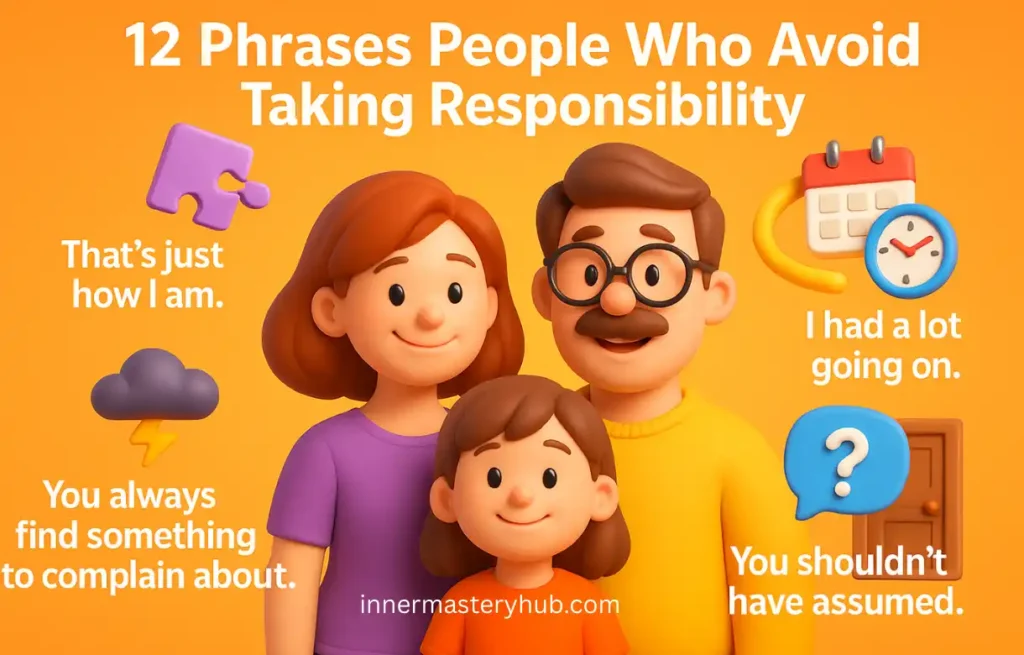
People avoid taking responsibility because admitting mistakes can trigger feelings of shame, failure, criticism, or vulnerability. Instead of acknowledging their role in the problem, they may make excuses, shift blame, minimize the issue, or focus on others’ actions. While these responses can protect self-esteem in the short term, they often damage trust and relationships over time.
Signs Someone Is Avoiding Responsibility
| Common Sign | Example |
|---|---|
| Making excuses | “I had a lot going on.” |
| Blame-shifting | “It’s your fault.” |
| Minimizing feelings | “You’re too sensitive.” |
| Defensiveness | Reacting angrily to feedback |
| Avoiding apologies | “I’m sorry you feel that way.” |
| Denying responsibility | “I didn’t do anything wrong.” |
Some people avoid responsibility by acting confused, forgetful, or unaware. This pattern is seen in playing dumb manipulation, where responsibility is hidden behind apparent innocence.
You begin to see trends when you spend enough time with people who avoid taking responsibility. These statements seem innocuous at first, but as time goes on, you come to realize that they divert responsibility, shift blame, and leave you bearing emotional burdens that were never your own. You’re not alone if you’ve ever left a conversation wondering why you felt guilty, perplexed, or worn out.
Many of these statements are examples of controlling, manipulative language that shifts responsibility and creates confusion or guilt.
Psychological research has extensively documented these patterns, particularly in studies of blame shifting, cognitive dissonance, and defensiveness1. Observe which of the following expressions you’ve heard, which you’ve forgiven, and which you’ve unintentionally accepted as usual as you read them.
What Does It Mean When Someone Avoids Taking Responsibility?
Avoiding responsibility means refusing to acknowledge one’s role in a problem, mistake, decision, or consequence.
Responsible people recognize their actions, learn from errors, and make corrections when necessary. In contrast, accountability-avoidant individuals often focus on external causes while minimizing their own contribution.
Common examples include:
- Blaming coworkers for missed deadlines
- Denying hurtful behavior in relationships
- Making excuses instead of apologizing
- Avoiding difficult conversations
- Refusing to accept constructive criticism
- Shifting fault onto circumstances or other people
Responsibility is not about self-blame. It is about recognizing what is within one’s control and responding appropriately.
Why Do Some People Avoid Taking Responsibility?
In most cases, responsibility avoidance develops as a psychological defense mechanism.
According to George K. Simon, people avoid accountability through subtle tactics that allow them to appear innocent while shifting responsibility elsewhere2.
People avoid responsibility because they consciously want to be dishonest. More often, they are protecting themselves from uncomfortable emotions. Not everyone who avoids responsibility appears hostile. Some people seem warm, helpful, or friendly while quietly avoiding accountability.
Common Psychological Causes
| Cause | How It Influences Behavior |
|---|---|
| Fear of failure | Admitting mistakes feels threatening |
| Shame | Accountability triggers feelings of worthlessness |
| Low self-esteem | Errors are viewed as proof of inadequacy |
| Emotional immaturity | Difficulty tolerating discomfort |
| Perfectionism | Mistakes feel unacceptable |
| Childhood experiences | Accountability may have been punished harshly |
| Trauma | Defensive behaviours developed for protection |
Research in psychology suggests that self-protective biases lead individuals to attribute successes to internal factors while blaming failures on external factors. This tendency is known as the self-serving bias3.
Is Avoiding Responsibility a Sign of Emotional Immaturity?
Yes, emotional immaturity is associated with accountability avoidance.
Emotionally mature individuals can:
- Reflect on their actions
- Accept feedback
- Tolerate criticism
- Repair mistakes
- Apologize sincerely
Emotionally immature individuals may instead:
- Become defensive
- Shift blame
- React impulsively
- Deny reality
- Avoid difficult emotions
Emotional intelligence research consistently shows that self-awareness and self-regulation are essential for accountability.
What Are the Signs of Someone Who Avoids Responsibility?
Accountability avoidance follows recognizable behavioral patterns.
1. Constant Excuse-Making
Every problem has an explanation that removes personal responsibility.
Examples:
- “I was too busy.”
- “Nobody reminded me.”
- “It’s not my fault.”
2. Blame-Shifting
Responsibility is redirected toward others.
Examples:
- Coworkers
- Partners
- Friends
- Family members
- Society
- Circumstances
Understanding common toxic relationship vocabulary can make these patterns easier to recognize.
3. Victim Mentality
The person consistently sees themselves as the injured party.
They may believe:
- Others are always unfair
- They never receive proper treatment
- Problems happen only to them
4. Defensiveness
Even gentle feedback triggers strong reactions.
Responses may include:
- Anger
- Withdrawal
- Rationalization
- Counterattacks
5. Lack of Genuine Apologies
Apologies often sound like:
- “I’m sorry you feel that way.”
- “I’m sorry, but…”
- “If you were offended…”
These statements avoid ownership. This is one of the most common manipulative apology patterns because it sounds apologetic without accepting responsibility.
6. Repeating the Same Mistakes
Without accountability, learning is limited.
The same conflicts occur repeatedly.
How Does Avoiding Responsibility Affect Relationships?
Yes, responsibility avoidance can seriously damage relationships.
Trust depends on accountability.
When someone repeatedly refuses responsibility,
- Problems remain unresolved
- Emotional safety decreases
- Resentment grows
- Communication deteriorates
- Conflicts become repetitive
Over time, constant criticism, defensiveness, and emotional uncertainty can keep the body in a prolonged state of stress. This can affect emotional regulation and contribute to a dysregulated nervous system, making it harder to feel calm, safe, and confident in relationships.
Relationship Example
Imagine a partner consistently forgetting important commitments.
Instead of saying:
“I forgot and I understand why you’re upset.”
They say:
“You’re expecting too much.”
Over time, the issue becomes less about forgetting and more about refusing accountability.
This pattern contributes to relationship dissatisfaction and emotional distance.
Can Childhood Experiences Contribute to Accountability Problems?
Yes, childhood experiences shape how people respond to mistakes.
Children learn accountability from caregivers.
Unhealthy environments may teach:
Harsh Punishment
If mistakes lead to humiliation or severe criticism, children may learn to hide errors.
Excessive Protection
If consequences are constantly removed, accountability skills may never fully develop.
Modeling
Children often imitate adults.
If parents frequently blame others, children may adopt similar patterns.
Attachment research suggests that early emotional experiences influence how people handle responsibility, conflict, and emotion regulation later in life4.
Is Avoiding Responsibility a Narcissistic Trait?
No, but it can appear in narcissistic behavior.
Not everyone who avoids responsibility has narcissistic traits.
However, accountability avoidance is commonly associated with:
- Narcissistic tendencies
- Entitlement
- Fragile self-esteem
- Grandiosity
- Externalization of blame
A key distinction is that many people avoid responsibility due to insecurity rather than superiority.
Mental health professionals evaluate broader patterns rather than a single behavior.
What Is the Difference Between Accountability and Self-Blame?
Accountability is healthy; excessive self-blame is not.
| Accountability | Self-Blame |
|---|---|
| Acknowledges reality | Exaggerates fault |
| Encourages growth | Creates shame |
| Focuses on solutions | Focuses on punishment |
| Supports learning | Supports guilt |
| Builds trust | Damages self-worth |
How Do You Deal With Someone Who Never Takes Responsibility?
In most cases, boundaries and clear communication are more effective than arguments.
Stay Focused on Facts
Discuss observable behaviors rather than character flaws.
Instead of:
- “You’re irresponsible.”
Try:
- “The report was submitted three days late.”
Avoid Endless Debates
Blame-shifting often creates circular conversations.
Stay focused on the issue.
Set Clear Expectations
Specify:
- Responsibilities
- Deadlines
- Consequences
Reinforce Accountability
Recognize when the person accepts responsibility.
Positive reinforcement can encourage growth.
Protect Your Emotional Energy
You cannot force accountability.
You can only manage your responses and boundaries.
People who avoid taking responsibility and rely on phrases like
1. It wasn’t my fault.
Despite its apparent simplicity, this expression is one of the most prevalent signs of avoiding responsibilities. According to social psychology research, people avoid taking responsibility for their actions to preserve their sense of competence5. Hearing this over and over makes it more difficult to find solutions because the discourse never addresses the underlying problem. As the other person protects themselves from discomfort, you wind up avoiding the conflict.
2. You’re taking this too seriously.
By minimizing your sentiments, this dismissive statement helps the other person avoid confronting their behavior. Minimizing someone’s feelings causes embarrassment and perplexity, which adults tend to internalize rather than confront. When you hear this, you might begin to doubt your own responses, thereby facilitating the other person’s avoidance of responsibility. You gradually reduce your needs to avoid confrontation.
3. That’s just how I am.
Although this statement seems sincere, it prevents development. It’s a defensive tactic called “trait excuse,” in which an individual attributes their behavior to an unchangeable personality trait rather than owning up to it. It puts you in a difficult situation because you are suddenly expected to endure hurtful behavior. After all, “that’s who they are.” Characteristics do not excuse wrongdoing in healthy relationships; desire to adapt does.
4. You’re too sensitive.
This remark often signals the start of subtle emotional manipulation. The person implies that you are the issue by focusing on your character rather than addressing your problems. You start to question if you’re overreacting, and if self-doubt takes hold, you won’t need to make any changes. The sad thing is that, in an attempt to keep the peace, you may begin to silence yourself.
When phrases like these repeatedly make you question your feelings, memory, or judgment, they may become part of a broader pattern of gaslighting.
5. I didn’t mean it like that.
Here, intent serves as the shield. Experts in communication often remind us that impact is more important than intention, since effect is felt while intention cannot be quantified or demonstrated. Repeated usage of this phrase teaches you to accept damage as an accident. Because you’re worried about being seen as cruel or merciless, you cease holding people responsible.

6. I had a lot going on.
Everyone experiences stress, and life is complicated, but those who shirk duty use overwhelm as a blanket excuse. Self-regulation research demonstrates that people may recognize harm even when they are under stress. Willingness is the difference. When someone creates a hierarchy where their stress is more important than the effects of their actions on you, they are using busyness as a shield.
7. You shouldn’t have assumed.
This phrase flips the situation, making you feel accountable for deciphering what they never made clear. Uncertain messaging itself is a type of messaging that avoids taking responsibility. If someone leaves you in the dark and you guess incorrectly, the person who withheld the information is still accountable. However, you might accept this blame since it’s simpler than continuing to argue with someone who refuses to take responsibility.
8. You’re making me look bad.
This expression conveys a fear of losing control over one’s image. This relates to impression management in psychology, the desire to appear capable, kind, or admirable. The issue is that their reputation takes precedence over your sentiments. They may persuade you that the real problem is how other people perceive them, so you can find yourself defending them even when the situation is painful.
9. You always find something to complain about.
Such broad generalizations are intended to keep you silent. It’s not a solution; it’s a conversation starter. Those who are afraid of confrontation often exaggerate their concerns to make themselves seem unreasonable. This prevents authentic dialogue and teaches you to put up with more than you ought to. You begin to censor your ideas so you won’t be judged for them.
10. If you weren’t so emotional, we wouldn’t be fighting.
This remark is a classic way of people who avoid taking responsibility, since it shifts the reason for the issue from your behavior to your emotional reaction. According to research on emotional intelligence, accepting responsibility requires control rather than repression. When someone exploits your feelings to justify their actions, they completely avoid thinking about what they have done. You end up feeling bad about responding in a humane way.
11. I thought you already knew.
Although this expression may seem harmless, it effectively avoids responsibility for poor communication. Adults sometimes overestimate how much others comprehend their intentions, a condition known as the “illusion of transparency,” according to research. When employed deliberately, it becomes a means of avoiding acknowledgment of their inability to communicate effectively.
12. You’re blowing things out of proportion.
This is another type of minimization that emphasizes your response rather than the behavior. Conflict experts caution that when someone is repeatedly minimized, trust is damaged since they are made to feel threatened for expressing their suffering. You eventually learn to repress your demands, and the people who avoid taking responsibility discover that avoidance is effective.
Why These Phrases Work on You More Than You Realize
You are shaped by hearing these words, occasionally from the people around you. You begin to lower your limits, control your emotions, and modify your expectations. Growing up with people who avoid responsibility makes this behavior seem normal. Rather than challenging the imbalance, your brain becomes wired to maintain serenity.
People begin to tolerate unhealthy routines because they think their feelings won’t be taken seriously anyway, and they have learnt helplessness and persistent invalidation. Over time, that belief becomes your go-to reaction.
How You Can Respond Without Losing Yourself
You may be upset with yourself for not noticing the patterns sooner, once you do. However, awareness is the pivotal moment. Reclaiming your right to clarity, emotional safety, and equitable communication is all that is required; confronting people violently is not necessary.
Remaining grounded is your strength when people avoid taking responsibility. Reframe the conversation without creating conflict by saying things like “I’m telling you how it affected me” or “I’m not discussing my sensitivity, I’m discussing the behavior.” You quit doing emotional work that was never your own.
As you do this, you start to notice who develops alongside you and who rejects any attempts at clarity. This distinction is crucial because not every relationship can withstand accountability, and not everyone is willing to reflect. However, you also find that the relationships that do improve become more balanced, honest, and healthy.
What Are Common Mistakes People Make When Addressing Accountability Issues?
Yes, certain responses can unintentionally make the problem worse.
Attacking Character
People become more defensive when criticized personally.
Trying to Win
The goal should be resolution, not victory.
Accepting Repeated Excuses
Compassion should not eliminate accountability.
Taking Full Responsibility Yourself
Over-functioning can enable avoidance patterns.
Expecting Immediate Change
Long-standing habits often require time and consistent effort.
How Can You Apply Accountability in Daily Life?
Practice ownership in small situations before major ones.
Daily Accountability Habits
- Admit mistakes quickly.
- Ask for feedback.
- Keep commitments.
- Reflect on conflicts.
- Avoid blame language.
- Track personal goals.
- Make repairs when harm occurs.
Helpful Reflection Questions
- What was my role in this situation?
- What can I learn?
- What would accountability look like here?
- What action can I take next?
Small acts of ownership strengthen emotional intelligence over time.
Real-World Example of Accountability Versus Avoidance
Accountability Response
“I missed the deadline because I underestimated the workload. I’ll revise my planning process and communicate earlier next time.”
Avoidance Response
“The deadline was unrealistic. Nobody helped me. The expectations were unfair.”
The accountable response focuses on learning and improvement.
The avoidant response focuses primarily on external explanations.
Key Takeaways
- People who avoid responsibility often struggle with shame, fear, defensiveness, or emotional immaturity.
- Accountability avoidance commonly appears as blame-shifting, excuse-making, denial, and defensiveness.
- Healthy accountability supports growth, trust, and emotional intelligence.
- Childhood experiences can influence how people respond to mistakes and criticism.
- Accountability differs from self-blame because it focuses on learning rather than punishment.
- Relationships often suffer when responsibility is consistently avoided.
- Clear boundaries and fact-based communication are effective responses.
- Emotional intelligence skills help individuals tolerate accountability.
- Accountability can be learned through self-awareness, practice, and professional support.
- Small acts of ownership create long-term personal growth.
Understanding People Who Avoid Taking Responsibility
It’s normal to feel exhausted about what defines effective communication if you’ve spent years negotiating talks with people who avoid taking responsibility. But you’re clear now. The phrases, the patterns, and the emotional burden that were never yours are all visible. By using subtle language and deflection, awareness restores the control you previously lost.
Nobody needs to be fixed by you. All you need to do is defend your emotional space and react with dignity. Breaking previous cycles gets easier the more you understand these behaviors. You deserve partnerships in which you share accountability, communicate openly, and have your feelings respected.
Avoiding responsibility is only one form of manipulation. Some people also use confusion, denial, selective memory, or apparent helplessness to avoid accountability. Recognizing these patterns can help you respond more clearly and protect your emotional well-being.
People Also Ask
Why do people avoid taking responsibility?
People avoid taking responsibility because it protects their ego and prevents feelings of shame or failure. Psychology research shows that blame-shifting helps them maintain a positive self-image. They fear criticism, so they resort to denial or excuses rather than acknowledging mistakes.
How can you deal with someone who avoids taking responsibility?
Stay calm, set clear boundaries, and focus on facts rather than emotions. Use “I” statements to express impact and avoid arguing about blame. If the pattern continues, limit emotional investment and protect your mental well-being.
What are the signs that people avoid taking responsibility?
Common signs include deflecting blame, minimizing your feelings, making excuses, denying involvement, and using phrases such as “You’re too sensitive.” They often redirect conversations to your behavior rather than acknowledging their own actions.
Are people who avoid taking responsibility aware of their behavior?
Some are aware but unwilling to change. Others lack self-awareness and genuinely believe their excuses. Studies on defensiveness show that acknowledging mistakes threatens their self-image, so they subconsciously protect themselves by avoiding it.
Can someone who avoids responsibility change?
Yes, but only if they’re willing to self-reflect. Change requires emotional maturity, empathy, and accountability. Without personal motivation, the pattern usually remains. Supportive conversations help, but lasting change must come from them.
Is avoiding responsibility a mental health issue?
Avoidance itself isn’t a disorder, but it can be linked to traits like low self-esteem, narcissistic tendencies, or anxiety. It can also develop from childhood environments where admitting mistakes led to punishment or shame.
What phrases do people who avoid responsibility often use?
They commonly say: “It wasn’t my fault,” “You’re too sensitive,” “You’re exaggerating,” or “That’s just how I am.” These phrases minimize your feelings and shift accountability away from you.
How can you stop enabling someone who avoids responsibility?
Stop apologizing for their behavior, clearly state boundaries, and don’t excuse their actions. Allow them to face natural consequences. Focus on your self-respect and avoid taking on emotional labor that isn’t yours.
- Psychology research has extensively documented these patterns, particularly in studies on blame shifting, cognitive dissonance, and defensive self-protection mechanisms (Festinger, 1957; Tavris & Aronson, 2020). ↩︎
- Simon, G. K. (2010). In Sheep’s Clothing: Understanding and Dealing with Manipulative People (2nd ed.) ↩︎
- American Psychological Association (APA). Self-Serving Bias and Attribution Theory. ↩︎
- Mikulincer, M., & Shaver, P. R. (2016). Attachment in Adulthood: Structure, Dynamics, and Change (2nd ed.). Guilford Press. ↩︎
- Miller, D. T., & Ross, M. (1975). Self-serving biases in the attribution of causality: Fact or fiction? Psychological Bulletin, 82(2), 213–225. https://doi.org/10.1037/h0076486 ↩︎
Written By Mehwish Qurayshi
Mehwish Qurayshi is a Trauma-Informed Emotional Wellness Counsellor trained through NICABM’s Treating Trauma Master Series, which includes NBCC-approved education in Trauma Treatment and Emotional Wellness & Emotional Intelligence – Sourcecode Academia. She has over five years of experience providing emotional wellness counselling, helping individuals heal from trauma, regulate emotions, and build healthy relationships.