
Adult Child Estrangement: Emotional Wounds, Family Conflict, and Healing

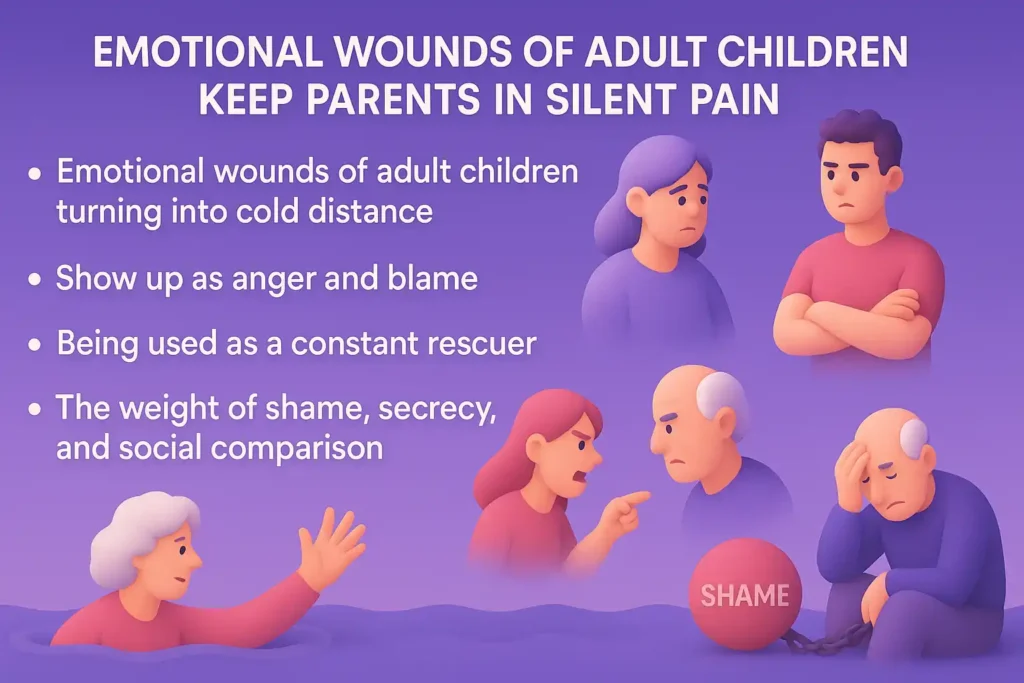
Some Adult children carry the emotional wounds of childhood emotional neglect, family dysfunction, or insecure attachment. These wounds show later as long-term patterns of shame, guilt, emotional dysregulation, people-pleasing, fear of abandonment, and self-blame. Some emotional patterns developed during difficult experiences may continue into adulthood because they once helped a person cope.
You don’t expect to be awake at 2 am. because of your adult child, going over past disagreements, reading and re-reading texts, wondering how the same family that used to celebrate birthdays and take school runs suddenly feels like such a minefield. If left unchecked, unhealed emotional wounds of adult children don’t simply sit quietly in your child’s heart. They also leak into every phone call, every visit, and every lengthy silence. And they keep cutting at you as a parent, too.
Researchers estimate that about 10% of adults are estranged from a parent or a child, totaling tens of millions of people1. Other studies show that about 6% report a period of estrangement from their mothers, beginning in the mid-20s2.
Family alienation is a “silent epidemic,” therapists and experts say, because so many people suffer in silence, thinking they are the only ones. Adult child estrangement and family conflict are complex. Parents may experience grief and confusion, while adult children may be responding to their own memories, needs, boundaries, or unresolved pain. Understanding both perspectives can create space for healthier conversations.
You may already be aware that your adult child has wounds from their early years, family strife, your own errors, or circumstances beyond your control. Adverse childhood experiences are associated with increased risk of anxiety, depression, and relationship difficulties3.
What is discussed less is how the emotional wounds of adult children remain injuring parents even after the children grow up. That internal conflict isn’t a chance. It’s about your early emotional experiences and the ways your mind shields you now.
As John Bowlby argued, our early relationships inform how we feel safe and connected as we grow older.
Your adult child may have learned, “What is wrong with me?
It’s: Why is my emotional world so complex and intense?
Most people believe the problem is their reactions.
But the real reality runs deeper: the reaction is not the problem. It is the outcome of something inside that has been unaddressed for too long.
What are the unhealed emotional wounds of adult children?
Adult children’s emotional wounds are unhealed emotional patterns developed in childhood owing to unfulfilled needs, maltreatment, or inconsistent care. These scars affect your thinking, feeling, and relating to others as an adult.
These wounds may not be the result of visible trauma. Sometimes they stem from emotional neglect.
For example:
- Not being heard
- Being criticized often
- Feeling responsible for others’ emotions
Research reviewed by the APA highlights associations between psychological maltreatment and later emotional and developmental difficulties4.
Your mind learns to make patterns to protect you. These rhythms feel natural, but they restrict your ability to relate and express.
Signs of emotional wounds at a glance
| Emotional Wound | Common Adult Sign |
|---|---|
| Abandonment | Fear people leave |
| Shame | Harsh inner critic |
| Neglect | Emotional numbness |
| Rejection | Low self-worth |
| Parentification | Over-responsibility |
What are the most common emotional wounds adult children carry?
The most common emotional wounds are abandonment, rejection, emotional neglect, shame, and over-responsibility. These tendencies impair self-esteem, relationships, and emotional stability.
Here are the key patterns:
- Abandonment wound: fear that people will leave
- Rejection wound: feeling not good enough
- Neglect wound: feeling unseen or ignored
- Shame wound: believing something is wrong with you
- Control/over-responsibility: trying to manage everything
These are not personality traits; they are learned emotional responses.
11 Ways These Wounds Affect Family Relationships
Below are the ways that might be happening in your life, and what you can gently begin to do about each one.
1. Emotional wounds of adult children turning into cold distance
One of the hardest things for parents is emotional remoteness. Your adult child still texts, sends photographs, and celebrates holidays, but something seems off. Visits are brief, discussions are prudent, and hugs are either absent or stiff.
Distance is often a hindrance. If your child was ignored, mistreated, or endangered as a child, even subtly, closeness is harmful. Uneven care, criticism, or disagreement can affect a person’s attachment style, making adult intimacy awkward and confusing. You’re coping with your child’s current mood and prior injuries.
Instead of trying harder to get close, develop comfort. When you speak, focus on others rather than yourself. “How are things actually feeling for you these days?” is open-ended. Then listen without arguing. Ask yourself, “When did I feel them pulling away today, and what was happening shortly before that?” privately.
2. When emotional wounds of adult children show up as anger and blame
Extreme rage can result from hurt. Your adult child may continuously criticize you or point out past mistakes. They may remark, “You have ruined my life” or “You were never there for me,” even if you have different memories.
Unresolved trauma increases vulnerability to powerful emotions like anger and shame. Parents are the easiest targets when those feelings arise because you were the first, not the worst. The words are still dreadful for you. Irritating messages can feel like new accusations and trials where you can’t defend yourself.
Arguing won’t stop their anger. Presently, distinguishing facts from feelings is crucial. “Their story is not fully genuine, but their pain is real,” you can reply, “I hear that you felt alone and hurt back then.” I’m open to learning, and I recognise that I may not have handled everything perfectly”.
For instance, “I want to talk, but I can’t stay in this conversation if I’m screaming.” Stop now and try later. You can defend yourself while acknowledging their wrath.
3. Rewriting the past so you are the villain
Another way adult emotional scars in adult children damage parents is rewriting the family story. You may be surprised if your youngster calls your home “toxic,” “abusive,” or “emotionally neglected.” Others may focus on disputes or depression, while you may remember birthdays and late-night homework assistance.
People often change their life story as they age, especially after treatment or learning about emotional abuse and neglect. This may be good for them, but it may make you feel like your parenting identity is on trial.
Prioritize understanding their emotional truth over winning the “what really happened” debate. If I looked at our past through their eyes, what might have felt scary, weighty, or lonely? Saying, “I can see that what you went through left deep wounds,” doesn’t mean you agree with every description. I wish I’d known then. Even if it’s hard, tell me more.
4. Silent treatment and estrangement that break your heart
Some parents’ adult children’s emotional traumas cause long-term alienation. No one answers the phone. Blocked numbers. Social media may show they’re doing okay without you.
Parents in this position suffer from sadness, embarrassment, worry, and physical illness. You may keep checking your phone, replaying every conversation before the cut-off, split between hope and sadness.
Forced contact is dangerous. Many estrangement-focused therapists encourage parents to compose a letter that lists regrets without reason, avoids pressure, and provides ongoing, low-demand, safe communication.
Consider joining a club for divorced parents or finding reliable pals who won’t advise you to “move on.” Be honest: “If my child reached out tomorrow, what version of me would they meet?” What would I say about my growth?
5. Boundaries that feel like walls
With fewer visits, topic-specific regulations, no unexpected drop-ins, less time with grandchildren, or a definite pronouncement that “we don’t talk about the past,” your adult child may still be part of your life, but as a punishment. You may wonder, “How can they treat me like an outsider after everything I’ve done?”
Survival strategies for emotional trauma survivors include firm limits. Your youngster may have been taught that their needs are irrelevant. Since they were frightened to speak up, they may now strongly declare their boundaries.

6. Being shut out of your grandchildren’s lives
The greatest sadness is losing grandchildren. Adult children’s emotional wounds usually appear here. Your child may worry that you’ll hurt their kids as you did. They may still be so angry that keeping you from seeing the grandchildren feels like a defense.
Missed birthdays, school plays, and Sunday visits might feel like tragedies. Observing other grandparents in the park may make you choke up and wonder what your grandchildren are doing. “Can I trust my kids with someone who hurt me?” may be on your adult child’s mind.
You can maintain a non-coercive presence here. Discuss trust with your adult child, not rights. You may say, “I realize that you need to feel fully safe about anyone near your kids.” What does that mean to you? Follow through, even with small things.
7. Being used as a constant rescuer
Adult children’s mental traumas also bring parents distress through ongoing dependence rather than isolation. Your adult child may constantly request financial aid, often during crises. You may see them struggle with habits, employment, and relationships and intervene when something goes wrong.
Early suffering may harm self-confidence and emotional management. If they never felt safe, your child may be in Survival Mode as an adult. The problem is that Survival Mode may cause burnout.
Instead of tackling every problem, say, “I can’t fix this for you, but I can sit with you while you build a plan,” or “I’ll help with one payment this month if you also talk to a counselor or financial advisor.” Even when they push back, you maintain that limit.
8. The same fights over and over
It may seem like every talk with your adult child repeats itself. Maybe they always say, “You never listened,” and you answer, “You’re rewriting history.” Maybe every visit ends in snark or silence. The pattern’s stuckness makes the topic irrelevant.
Psychologists call this repeat a “trauma echo“: unresolved emotional wounds recast people as victims, villains, peacekeepers, or invisible ones. Your youngster may unconsciously repeat the conflict to receive a different result. Even though you committed yourself to change, you may react the same way, defending, explaining, or closing off.
The only way out of this cycle is to shift one side, and you control just one. Try to notice when the old script emerges. When they mention school, your chest tightens.
Instead of saying, “That’s not true,” breathe and say, “I can feel us going into our normal pattern. I’m tired of this. I’ll listen to how that time felt before responding.” Later, ask, “What was I protecting then, my good parent image, my fear of guilt, my shame?” Naming your emotions helps you respond rather than react.
9. The weight of shame, secrecy, and social comparison
Adult children’s emotional wounds can spread outside the family. “So, how are the kids?” bothers you, so you avoid talking about your child with friends. You feel guilty when other parents upload cheerful images of their grown kids and grandchildren. Social media and family gatherings may be torturous.
Surveys and qualitative research on divorced families suggest that many parents feel shame and isolation, believing they are especially wrong. Many more parents are in this scenario than you think, but few talk about it. The pain is profound when carried alone.
Selecting one or two trustworthy persons to tell the truth can help heal. You can tell the story gradually. Challenge the concept that a “good parent” has close, thankful adult children. “If I met another parent with my exact background, would I speak to them with the same harshness I use on myself?” Compassionately holding your narrative reduces the weight.
10. Financial strain and postponed dreams
Some parents see adult children’s emotional wounds in money. You may still be paying your child’s expenses, legal fees, rent, or big, unpaid loans. Because you must always be ready for your child’s next emergency, you may delay retirement, neglect medical care, or skip little pleasures.
Being honest about your limitations is healthy. Write down your income, expenses, and savings. You decide beforehand, “I can contribute this fixed amount per year, but no more.” Instead of reacting when your youngster asks for money, refer to that decision. You can help them find community services and employment training without giving money.
11. Feeling like you’ve failed the next generation
Some of the deepest hurt comes from watching older children’s emotional wounds damage grandkids or knowing the pain lives on. Your adult child may shout, shut down, choose risky companions, or cope poorly as you did. You may think, “I initiated this mess, and now my grandchildren will suffer.”
Intergenerational trauma research shows how unresolved pain and stress can impact behavior, emotions, and biology. That may seem hopeless, but evidence shows that healing in one generation protects the next. When even one family member faces their past, learns emotional skills, and builds healthy relationships, the pattern changes.
You cannot re-parent your adult child or preserve future generations alone. You can become a different family elder. Learn new dispute resolution skills or write your adult child a letter saying, “I see more now than then. I really apologize for hurting you, and I will grow till my dying day.”
Ask yourself, “What kind of ancestor do I want to be remembered as, someone who denied everything, or someone who turned toward the truth, even late in the game?”
Responsibility vs Blame
Recognising emotional wounds is not equivalent to placing all the blame on adult children or parents. Numerous elements, such as personality, situations, stress, culture, and communication styles, influence families. When people can acknowledge experiences without categorising everyone into a specific role, healing can begin.
Why do emotional wounds still affect you as an adult?
Emotional scars linger because you were taught Automatic responses to childhood survival needs that persist throughout adulthood, even when the initial situation is no longer present.
Today it’s a minor trigger. Then you layer it with old emotional memories. Then a big feeling comes up. Then your reaction follows.
For instance:
You send a message, and it’s not responded to. You interpret this as rejection. You get anxious, pull back, and obsess. This process is quick, but it is firmly embedded.
Trauma research suggests that stressful experiences can influence emotional responses, memory, and body sensations. However, trauma responses are complex and vary between individuals5.
Why do adult children often blame themselves?
Adult children blame themselves because self-criticism provides a youngster with a false sense of control. If the youngster thinks, “It’s my fault,” then the child can also think, “Maybe I can solve it by being better.”
It hurts, but it makes emotional sense.
It is frightening for a youngster to view their parent as unsafe, immature, addicted, cruel, absent, or emotionally limited. The child is dependent on that parent. Thus the mind condemns itself to safeguard the link.
The youngster does not think “My parent cannot meet me emotionally.” The child thinks:
- “I am hard to love.”
- “I ask for too much.”
- “I make people angry.”
- “I should be easier.”
- “I must become perfect.”
This self-blame can become the adult inner critic.
Pete Walker, known for his writing on complex trauma, describes how adults with developmental trauma carry inner criticism, emotional flashbacks, and Survival responses such as fight, flight, freeze, or fawn6. His work is widely used in self-help trauma communities, though clinical support is still important for diagnosis and treatment.
The inner critic sounds like truth because it’s been practiced for years. But it’s an old protector, typically. It strikes you before anyone else can. It pushes you before somebody says no. It shames you before you venture to see.
You got through on self-blame. But now it may be preventing trust in the self.
How do emotional wounds affect emotional regulation?
Emotional wounds negatively impact emotional control since they cause your nervous system to be more reactive, which results in powerful feelings, mood swings, or emotional shutdown.
You want to be quiet, but your body reacts first.
You want to stay calm, but your body reacts first.
Because in childhood:
- Emotions were not validated
- Feelings were suppressed
- Safety was inconsistent
So your system learned two extremes:
- overreaction
- or numbness
Research from the Harvard Medical School shows that early stress affects brain areas responsible for emotional regulation7. This is why you may feel “too sensitive” or “emotionally distant.”
Why do relationships feel difficult for adult children?
Relationships are hard because emotional traumas affect how you see trust, intimacy, and safety and create a dread of closeness or fear of rejection.
You crave connection, yet you dread it.
This creates patterns like:
- pushing people away
- becoming overly dependent
- overthinking small behaviors
- needing constant reassurance
As Carl Rogers believed, unconditional acceptance is essential for healthy emotional development. Without it, relationships feel unstable8.
What mistakes do people make when dealing with emotional wounds?
Common mistakes are stuffing feelings, self-blame, avoiding vulnerability, or trying to “fix” behavior without recognizing the underlying foundation.
These patterns show up as:
- Ignoring feelings
- Overanalyzing instead of feeling
- Seeking validation constantly
- Avoiding deep connections
But these do not resolve the wound; they only keep the cycle going.
How can you begin understanding your emotional wounds?
Understanding instead of condemning yourself starts with observing patterns that show up in your reactions and linking them to earlier emotional encounters.
Start noticing:
- What triggers you
- What meaning do you assign
- What emotion follows
- What action do you take
This awareness changes how you relate to yourself. As Daniel Goleman highlights, emotional awareness is the first step to emotional intelligence.
Key Takeaways
- Emotional wounds are adaptations, not faults.
- Childhood experiences influence adult relationships.
- Parents can feel sadness and emotional pain, too.
- Healing involves awareness, not blame.
- Compassion and appropriate limits help end the cycle of intergenerational pain.
Conclusion
Moving forward, when the emotional wounds of adult children still inflict pain on their parents
With time, support, and honest self-reflection, patterns can change, even if they never become the picture-perfect reunion you might dream of.
As you read through these eleven ways that adult children’s emotional traumas continue to hurt their parents, you might ask yourself a few silent questions:
“What am I carrying that I don’t have to carry anymore?”
What can I be responsible for without sinking into shame?
“Where do I need support so I’m not trying to get through this on my own?
You cannot rewrite history. You cannot control your adult child’s healing. What you can do is to be a person who meets reality with courage, who holds their own heart with care, who gives their child a steady, respectful presence instead of pressure or denial. That is a great gift to yourself, your child, and the generations watching, whether they know it yet or not.
Healing does not always mean restoring the same level of contact. Sometimes healing means acceptance, boundaries, and healthy interactions.
People Also Ask
What are the emotional wounds of adult children?
Emotional scars of adult children are deep injuries that originated in childhood and continue to influence how your child thinks, feels, and responds to you now. They can arise from criticism, neglect, conflict, addiction, or divorce, even if you never meant to do damage.
How can adult child emotional wounds affect family relationships?
Those wounds can manifest as distance, rage, icy politeness, or total estrangement. You feel blamed, left out, or only utilized in emergencies. This can impact your sense of yourself as a parent, and you may experience persistent sadness, remorse, perplexity, and fear about the future.
What causes emotional wounds in adult children in the first place?
Repeated patterns such as harsh words, emotional neglect, violence, addiction, frequent criticism, parent conflict, or feeling responsible for a parent’s emotions can cause emotional wounds for adult children. Even stress, poverty, or health challenges can make your child feel unsafe, unnoticed, or unloved, even when you were doing your best.
What are the signs your adult child still carries emotional wounds from childhood?
You can see rage over “little” things, frequent blaming, intense reactivity to certain subjects, extended periods of stillness or sudden cut-offs. They don’t want to talk to you, they talk in “therapy language,” or they tell you that they don’t feel comfortable. The hurt is still fresh, evidenced by the recurring disputes about the past.
Why is my adult child distant or estranged from me?
Distance may be a child’s means of feeling safer. If they were judged, ignored, or frightened as a youngster, being near to you may bring up old hurt. This option may also be influenced by partners, therapists, or new views. It’s not usually one single event; it’s normally many little aches.
How can I talk to my adult child about their emotional wounds without making things worse?
Listen more than you speak. Inquire whether they are willing to discuss in a low voice. Say something like ” I want to understand your experience ” and ” I won’t argue with your feelings. At that time, do not protect yourself. You can give your opinion later, after they feel heard.”
Can emotional wounds of adult children ever be healed?
Yes, healing is possible, but it takes time and general help. Your youngster may require treatment, some self-development, and distance to feel safe. You may do this by respecting limits, staying consistent, and building on your own improvement. No guarantees of total reconciliation, yet change is always possible.
How do I protect myself when my adult child’s emotional wounds are hurting me?
It’s okay to limit insults, pleas for money, and incessant calls for help. You could remark, “I love you, but I can’t continue in this conversation if I feel assaulted. Get your own treatment or support group. Looking after yourself doesn’t imply you’ve ceased to love your child.
When should I seek professional help for these emotional wounds in my family?
Get help when you find yourself locked in the same painful patterns, when stress impacts your sleep, health, or career, or when contact with your child leaves you devastated for days. A family therapist, mediator, or your personal counselor can help you get the tools to respond more calmly and wisely.
How do I know if I am an adult child with emotional wounds?
If you tend to take responsibility for other people’s feelings, fear conflict, struggle with boundaries, feel guilty for having needs, or react strongly to rejection, you may have emotional wounds. You could also feel younger emotionally when stressed. The clearest indication is feeling governed by previous concerns in current relationships.
What are the signs of unresolved childhood trauma in adults?
Symptoms include emotional flashbacks, humiliation, anxiety, people pleasing, avoidance, wrath, numbness, low self-worth, problems trusting, and fear of abandonment. Some adults also have sleep problems, bodily tension, perfectionism, and friction in relationships. Everyone experiences different trauma symptoms, and that’s why it’s important to seek expert help if you are struggling with daily life.
Can parents and adult children repair a damaged relationship?
When both parties are prepared to communicate, admit wrongdoing, respect limits, and make adjustments, healing might be achievable. But it’s not always possible to force reconciliation, and each family may experience healing in a different way.
- Pillemer, K. (2020). Fault Lines: Fractured Families and How to Mend Them. Avery.. ↩︎
- Reczek, R., Thomeer, M. B., Kissling, A., & Liu, H. (2022). Parent–adult child estrangement in the United States by gender, race/ethnicity, and sexuality. Journal of Marriage and Family. ↩︎
- Daníelsdóttir, H. B., et al. (2024). Adverse Childhood Experiences and Adult Mental Health Outcomes. JAMA Psychiatry / PMC. ↩︎
- American Psychological Association. (2015). Unseen wounds: The contribution of psychological maltreatment to child and adolescent mental health and risk outcomes. APA Monitor on Psychology. ↩︎
- Brewin, C. R., Andrews, B., & Valentine, J. D. (2000).
Meta-analysis of risk factors for posttraumatic stress disorder in trauma-exposed adults.
Journal of Consulting and Clinical Psychology, 68(5), 748–766.
https://doi.org/10.1037/0022-006X.68.5.748.
↩︎ - Walker, P. (2005). Emotional Flashback Management in the Treatment of Complex PTSD. Reprinted by Healing and CPTSD. (healingandcptsd.com) ↩︎
- National Scientific Council on the Developing Child. (2014). Excessive Stress Disrupts the Architecture of the Developing Brain: Working Paper 3. Harvard Center on the Developing Child. (developingchild.harvard.edu)
↩︎ - Yao, L., Kabir, R., & Person-Centered Therapy. (2023). Person-Centered Therapy (Rogerian Therapy). StatPearls / National Center for Biotechnology Information. ↩︎
Written By Mehwish Qurayshi
Mehwish Qurayshi is a Trauma-Informed Emotional Wellness Counsellor trained through NICABM’s Treating Trauma Master Series, which includes NBCC-approved education in Trauma Treatment and Emotional Wellness & Emotional Intelligence – Sourcecode Academia. She has over five years of experience providing emotional wellness counselling, helping individuals heal from trauma, regulate emotions, and build healthy relationships.