
12 Harsh Truths About Marriage Every Couple Should Know

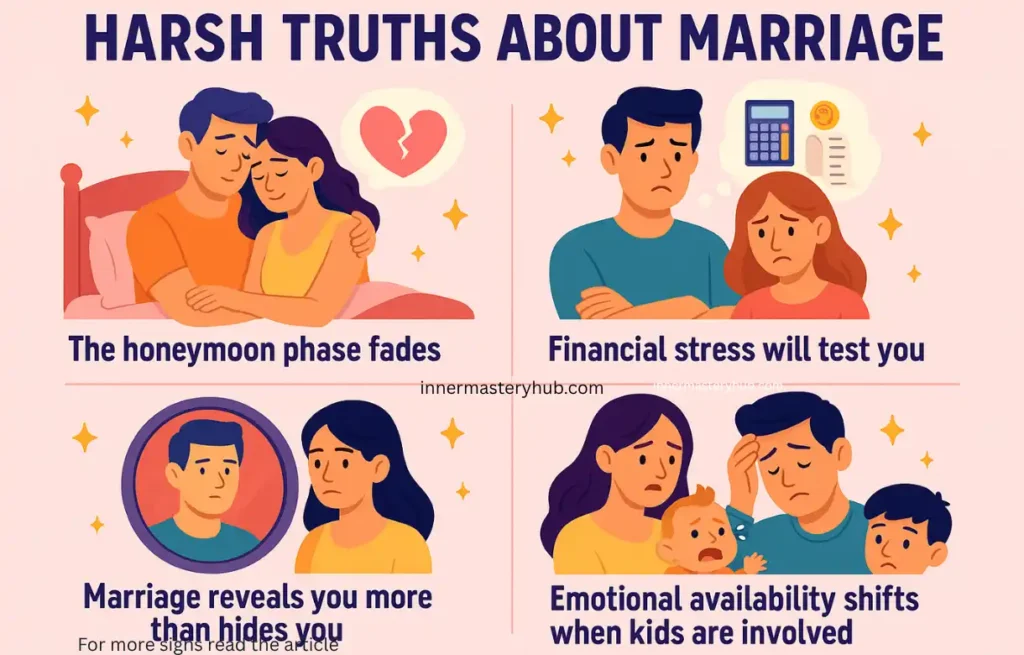
Harsh truths about marriage are the uncomfortable realities couples face after romance meets daily life. Marriage does not fix loneliness, insecurity, poor communication, emotional wounds, or lack of self-awareness. A healthy marriage grows when both partners regulate emotions, repair conflict, accept differences, and choose love as a daily practice, not only a feeling.
You may love your spouse and still feel alone beside them. You may share a home, children, bills, memories, and years, but still wonder, “Why does marriage feel so heavy when love is supposed to make life easier?”
That inner question is the quiet pain behind many marriages. You are not always asking, “Do I love this person?” You are often asking, “Why do I feel unseen by the person who knows me best?”
The common misunderstanding is that marriage problems are only about communication, money, intimacy, chores, or personality differences. Those things matter, but they are just the surface. What is really happening inside is deeper. A trigger happens. Your partner says something sharp, forgets something important, pulls away, or responds coldly. Your mind quickly gives it meaning. “I do not matter.” “They do not care.” “I am alone again.” That meaning creates emotion.
Hurt becomes anger, fear becomes control, and shame becomes silence. Then the consequence follows. You attack, withdraw, defend, overexplain, punish, or shut down.
This is why emotional regulation is not a small marriage skill. It is the bridge between love and damage. Research from a 13-year longitudinal study found that emotion regulation was linked with marital satisfaction, showing that how couples handle negative emotions affects the health of the relationship over time1.
What Are the Harsh Truths About Marriage?
Harsh truths about marriage are the real emotional, psychological, and practical realities that couples do not expect before commitment. They include disappointment, conflict, emotional triggers, changing desire, unequal effort, and the need for daily repair. Marriage becomes healthier when couples stop remaining in fantasies and start building awareness.
Marriage is not just a romantic partnership; it is a mirror, and it shows how you react when you feel ignored. It shows how you speak when you feel powerless, whether your love can survive discomfort, routine, stress, and unmet expectations.
Harsh truths about marriage are uncomfortable relationship realities that expose the gap between romantic expectation and emotional maturity.
Love may bring you together, but emotional maturity keeps you together.
Why Does Marriage Reveal Your Unhealed Wounds?
Marriage reveals unhealed wounds because your spouse becomes the closest witness to your fear, shame, need for safety, and desire to be chosen. Small moments can feel huge because they touch old emotional memories. Your reaction is about the present and the past at the same time.
This is why a simple comment can turn into a fight. Your spouse says, “You always forget this,” and your body hears, “You are not good enough.” Your spouse gets quiet, and your heart hears, “You are being abandoned.” The issue may look small from the outside, but it feels painful inside.
Adult attachment research shows that attachment patterns shape caregiving, support, and romantic relationships2. Insecure attachment can affect how partners seek comfort, respond to closeness, and handle distress.
In marriage, your inner child meets your partner’s inner child. One person protests because they fear distance. The other withdraws because they fear failure. One asks for closeness through anger. The other asks for peace through silence. Both may be hurting, but both may look selfish.
This is the emotional process many couples miss:
- A trigger happens.
- Your mind gives it a personal meaning.
- Your nervous system reacts.
- Your words protect you.
- Your partner feels attacked or rejected.
- The cycle repeats.
A marriage does not become toxic only because two people fight. It becomes painful when neither person understands what their fight is protecting.
Why Is Love Not Enough to Make a Marriage Work?
Love is not enough; marriage also requires self-control, honesty, repair, shared responsibility, respect, and emotional safety. You can love someone deeply and still hurt them through avoidance, criticism, defensiveness, or neglect. Love must become behavior, not only feeling.
This is one of the most painful, harsh truths about marriage. You can love your spouse and still not know how to listen. You can love them and still make them feel alone. You can love them and still repeat patterns that damage trust.
Bell Hooks described love as more than emotion. Her view of love includes care, commitment, knowledge, responsibility, respect, and trust3. That matters because marriage often fails when love is treated only as a feeling instead of a practice.
John Gottman’s work also points to the power of daily patterns. The Gottman Institute’s research highlights how couples’ interactions, conflict style, and emotional habits shape relationship outcomes over time4.
The hard truth is not “love fades.” The deeper truth is this:
Love without skill becomes pain with good intentions.
You may mean well, but your spouse lives with what you do, not only what you meant.
Why Do Couples Fight About Small Things?
Couples fight over small things because they carry a deeper emotional meaning. Dishes, phones, tone, money, or lateness may represent respect, safety, fairness, attention, or love. The visible fight is not the real fight.
A couple may argue about laundry, but the hidden question is, “Do you see how tired I am?” Another couple may fight about texting, but the deeper fear is, “Am I still important to you?” The argument is not always about the object. It is about the interpretation.
Demand-withdraw communication is one common pattern. One partner pushes, complains, or demands closeness, while the other avoids, shuts down, or withdraws. Studies have linked this pattern with marital conflict and lower relationship health5.
What Is the Biggest Misunderstanding About Marriage Problems?
The biggest misunderstanding is that marriage problems mean you chose the wrong person. Sometimes that is true, especially in unsafe or abusive relationships, but many marriage problems come from poor emotional habits, unmet needs, stress, and old wounds. The issue may be the cycle, not only the spouse.
Many people think, “If this were the right marriage, it would not feel this hard.” But a healthy marriage is not a conflict-free marriage. It is a marriage where conflict does not destroy dignity.
The American Psychological Association notes that stress can strain even strong relationships, and it discusses how therapy and relationship interventions can help couples work through serious distress6.
This does not mean you should tolerate betrayal, abuse, cruelty, addiction, chaos, or chronic disrespect. Safety comes first. But it does mean that difficulty alone is not always proof of failure.
The real question is not only, “Are we fighting?” The better question is:
Do we know how to repair after we hurt each other?
Marriage suffers when couples confuse discomfort with incompatibility. It also suffers when couples confuse endurance with love. That makes a difference.
What Are the Most Painful Harsh Truths About Marriage?
The most painful, harsh truths about marriage are that your spouse cannot complete you, attraction changes, resentment grows quietly, conflict is unavoidable, and emotional safety must be rebuilt many times. Marriage asks you to face yourself as much as you face your partner.
Here are 12 harsh truths that many couples only understand after years together.
1. Your spouse cannot heal what you refuse to face.
Your partner can support you, but they cannot become your therapist, parent, savior, and emotional regulator. When you expect them to fix your inner emptiness, you naturally become angry when they act human.
2. Being married does not mean being emotionally connected.
You can live in the same house and still live in separate emotional worlds. Connection needs attention, listening, softness, and presence.
3. Romance changes when life gets practical.
Bills, children, aging parents, health issues, work stress, and routine can reduce passion. Esther Perel’s work points to the tension between security and desire in long-term relationships7.
4. Resentment is built in small moments.
It grows when one partner keeps giving, staying silent, and hoping the other will notice. Unspoken resentment becomes emotional distance.
5. Compatibility does not remove the need for sacrifice.
Even well-matched couples disappoint each other. Marriage includes compromise, but healthy compromise does not mean losing yourself.
6. Your tone can damage trust faster than your words.
Many spouses remember how something was said longer than what was said.
7. Avoiding conflict does not create peace.
Silence may lower noise, but it can raise distance. Peace is not the absence of hard talks. Peace is the presence of safety.
8. Marriage exposes selfishness.
You will see where you want comfort without responsibility, forgiveness without change, and closeness without vulnerability.
9. Forgiveness does not erase consequences.
Forgiveness may free the heart, but trust still needs to be rebuilt through consistent behavior.
10. Intimacy needs emotional safety.
Physical closeness suffers when emotional closeness feels unsafe. The body notices what the heart has not said.
11. Marriage is not always 50/50.
Sometimes one partner carries more because life is uneven. But if it stays one-sided for too long, love turns into exhaustion.
12. A lasting marriage needs repair more than perfection.
Couples who survive do not avoid all wounds. They learn how to return, apologize, listen, and rebuild.

Why Is Emotional Regulation So Important in Marriage?
Emotional regulation matters in marriage because it helps you respond instead of react. When you can calm your body and question your interpretation, you reduce blame, defensiveness, and emotional damage. A regulated partner can still feel hurt but choose words that protect the connection.
A dysregulated spouse not only expresses emotion. They spread it. Anger invites anger. Panic invites control. Shame invites hiding. Coldness invites pursuit. Before long, neither partner is solving the problem. They are surviving each other.
Research by Bloch, Haase, and Levenson found that emotion regulation predicted marital satisfaction across time in long-term couples. The study showed that managing negative emotion is not just a personal skill. It becomes a relationship outcome8.
A simple definition:
Emotional regulation in marriage is the ability to experience strong emotions without letting them control your words, choices, or how you treat your spouse.
This does not mean you become calm all the time. It means you become honest without becoming cruel.
What Common Mistakes Do Married Couples Make?
Common marriage mistakes include expecting mind-reading, avoiding hard conversations, using criticism instead of requests, keeping an emotional score, neglecting intimacy, and treating repair as weakness. Many couples do not fail from one big event. They drift through repeated small disconnections.
The most common mistakes are simple, but they become serious over time.
- You hint instead of asking clearly.
- You complain to others before speaking to your spouse.
- You use silence as punishment.
- You keep bringing up old wounds without naming the current need.
- You confuse being right with being close.
- You expect your partner to know what hurts you.
- You apologize to end the fight, not to understand the wound.
- You treat your spouse better in public than in private.
- You let screens take the place of presence.
- You stop being curious because you think you already know them.
Gary Chapman’s popular “love languages9” idea speaks to how people give and receive love differently. While the framework should not be treated as a complete relationship cure, it can help couples recognize that love often fails when it is expressed in ways the other person does not recognize.
The bigger mistake is this: couples try to fix the argument while ignoring the emotional climate that created it.
How Do Harsh Truths About Marriage Affect Intimacy?
Harsh truths affect intimacy because emotional distance usually enters the body before it enters conversation. When a spouse feels criticized, ignored, unsafe, or unvalued, desire may decline. Intimacy needs trust, play, respect, and emotional warmth, not only physical access.
Many couples panic when intimacy changes. They think desire should stay automatic if love is real. But long-term intimacy is shaped by stress, resentment, hormones, mental load, body image, emotional safety, faith, health, and unresolved conflict.
Esther Perel’s view is useful here. She argues that desire needs space, mystery, and aliveness, while domestic life creates routine and predictability. That does not mean marriage kills desire. It means desire must be protected from emotional laziness and constant pressure.
A spouse who feels used will not feel open. A spouse who feels unwanted will not feel secure. A spouse who feels criticized may protect their body by closing their heart.
Intimacy is not only what happens in bed. It is built in the way you speak during stress, listen during pain, and return after conflict.
What Should You Do With These Harsh Truths About Marriage?
You should use these truths as a mirror, not a weapon. The goal is not to blame your spouse or shame yourself. The goal is to understand the emotional cycle, tell the truth sooner, and choose repair before resentment becomes your normal language.
The next action is not to memorize marriage advice. It is time to pause and ask one honest question:
What do I do when I feel unloved?
Your answer may explain more about your marriage than your spouse’s flaws do.
Maybe you criticize, chase, and shut down. Maybe you test your partner, become cold, overfunction, and then resent them. Maybe you pray but never speak honestly. Maybe you speak honestly but without tenderness.
Start there.
Not with a promise that everything will change. Not with a fantasy that marriage should become easy. Start with awareness.
Because when you understand the inner process, you stop calling every reaction “truth.” You begin to see that some reactions are protective. Some anger is grief, some distance is fear, some control is panic, and some silence is shame.
That shift does not make marriage simple. It makes it more honest.
What Is the Real Lesson Behind Harsh Truths About Marriage?
The real lesson
The harsh truths about marriage are painful because they remove fantasy. Your spouse will disappoint you. You will disappoint them. Love will not always feel warm. Intimacy will need care. Conflict will return. Old wounds will speak. Stress will expose weak places. Forgiveness will be needed more than once.
But there is also a deeper mercy here. Once you stop expecting marriage to save you from yourself, you can let it teach you about yourself. That is where love becomes less dramatic but more real.
Choose one repeated conflict in your marriage and write the hidden question beneath it. Is it “Do I matter?” “Can I trust you?” “Am I safe?” or “Will you show up for me?” Bring that question into your next conversation with honesty and care.
FAQs
What are the most common harsh truths about marriage that couples don’t talk about?
The most prevalent harsh truths about marriage are less affection, regular arguments, unfulfilled expectations, and partners being pulled apart by their own growth. Financial stress and a lack of communication are some issues that many couples face. Couples can better handle these realities together if they acknowledge them early on rather than feeling caught off guard later.
Why does the honeymoon phase of marriage fade so quickly?
One of the harsh truths about marriage is that the honeymoon phase passes because curiosity goes off. Dopamine levels fall as comfort takes the place of excitement, and everyday routines take over. Although it’s normal, couples can intentionally nurture emotional intimacy and introduce novel experiences to reignite their connection.
How can couples handle disagreements that never seem to be resolved?
The harsh reality of marriage is that not all disagreements are settled immediately. There is no one-size-fits-all solution for specific problems; they require ongoing care. The secret is to learn how to respectfully disagree and put understanding before winning. Recurring disagreements can be turned into learning opportunities with the help of active listening, empathy, and compromise.
Does sexual intimacy always decline in marriage, and why?
The hard truth about marriage is that sexual closeness does not always decrease; it constantly changes. Familiarity, stress, and exhaustion can reduce desire. Emotional intimacy, effective communication, and mutual love, however, support the maintenance of a satisfying relationship, even when desire seems to differ.
What financial issues most often cause significant stress in a marriage?
Money exposes underlying principles and vulnerabilities, which is a hard truth about marriage. Tension arises from disagreements over priorities for one’s career, debt, savings, or spending. Instead of concealing issues, couples can reduce stress by creating open and transparent budgets, making plans together, and discussing finances regularly.
How do changes in one partner (or both) impact the marriage long-term?
The harsh reality of marriage is that people change over time. Over time, people’s personalities, opinions, and career ambitions change. Depending on the degree of communication and flexibility, these adjustments may distance or strengthen relationships. Long-term harmony is maintained by couples who develop together rather than resist change.
Is it normal to feel attraction outside your marriage, and what should you do?
The fact that external attraction is common in marriage is another painful reality. How you respond to it is what counts. To restore emotional and physical intimacy, consider what’s lacking in your relationship and discuss it honestly with your partner, rather than acting impulsively.
How can a couple maintain a connection when life gets routine and busy?
Routine can weaken the bond, which is a harsh reality of marriage. Couples must consciously prioritize time together, including small daily check-ins, shared interests, and considerate expressions of gratitude, if they want to stay close. Despite the hustle of life, emotional connection can be maintained by staying curious about one another.
When does marriage stop being “just love” and start being work?
When daily stresses replace excitement, love turns into work. This is a harsh reality of marriage. Genuine dedication entails perseverance, effective communication, and consistent effort. Love serves as the cornerstone, but with constant effort, it becomes a long-lasting alliance that grows stronger over time.
What can we do when one partner’s needs constantly conflict with the other’s?
The harsh reality of marriage is that partners’ needs will not always coincide. Choose mutual understanding over rivalry. Compromise, empathy, and open communication all help balance the two perspectives. Conflict can be transformed from hatred to cooperation when both parties feel heard and understood.
Why do people realize the harsh reality of marriage late?
Many realize the harsh reality of marriage late because the excitement of love blinds them to real-life struggles. After the honeymoon phase, responsibilities, financial issues, and personality differences surface. People often expect constant joy but instead face emotional fatigue, routine, and communication problems. People realize the harsh reality of marriage late because the excitement of love blinds them to the real-life struggles that come with it.
How can couples deal with the harsh reality of marriage?
To handle the harsh reality of marriage, couples must communicate openly, respect boundaries, and share responsibilities. Accept imperfections and grow together. Counseling, empathy, and time apart can help rebuild connection. Success comes when both partners prioritize understanding over control or blame.
Why does the harsh reality of marriage cause disappointment?
The harsh reality of marriage can be disappointing because expectations often differ from reality. People imagine endless love and harmony, but encounter arguments, routine, and emotional disconnect. Unrealistic ideals make normal struggles seem like failures, leading to frustration and loss of excitement.
Is the harsh reality of marriage the same for everyone?
No, the harsh reality of marriage varies. Some couples face financial stress, others emotional incompatibility, or lack of intimacy. Every marriage has challenges, but the intensity depends on communication, maturity, and understanding. How couples handle differences shapes their overall experience.
Can the harsh reality of marriage destroy love?
Yes, the harsh reality of marriage can destroy love if problems go unresolved. Constant arguments, disrespect, and neglect can erode affection. However, honest communication and emotional effort can restore connection. Love survives when both partners choose commitment despite difficulties.
- Bloch, L., Haase, C. M., & Levenson, R. W. (2014). Emotion regulation predicts marital satisfaction: More than a wives’ tale. Emotion, 14(1), 130–144. https://doi.org/10.1037/a0034272 ↩︎
- Mikulincer, M., & Shaver, P. R. (2016). Attachment in adulthood: Structure, dynamics, and change (2nd ed.). Guilford Press. ↩︎
- bell hooks reference via Teaching Community discussion of love ethic ↩︎
- The Gottman Institute. “Marriage and Couples Research.” ↩︎
- Markman, H. J., et al. “The Premarital Communication Roots of Marital Distress and Divorce.” National Library of Medicine / PMC. ↩︎
- American Psychological Association. “Can This Marriage Be Saved?”
↩︎ - Esther Perel, Mating in Captivity: Unlocking Erotic Intelligence. Publisher listing ↩︎
- Bloch, L., Haase, C. M., & Levenson, R. W. “Emotion Regulation Predicts Marital Satisfaction: More Than a Wives’ Tale.” National Library of Medicine / PMC ↩︎
- The 5 Love Languages. “What Are the 5 Love Languages?” ↩︎
Written By Mehwish Qurayshi
Mehwish Qurayshi is a Trauma-Informed Emotional Wellness Counsellor trained through NICABM’s Treating Trauma Master Series, which includes NBCC-approved education in Trauma Treatment and Emotional Wellness & Emotional Intelligence – Sourcecode Academia. She has over five years of experience providing emotional wellness counselling, helping individuals heal from trauma, regulate emotions, and build healthy relationships.