
Having a Tough Child: The Emotional Reality No One Talks About
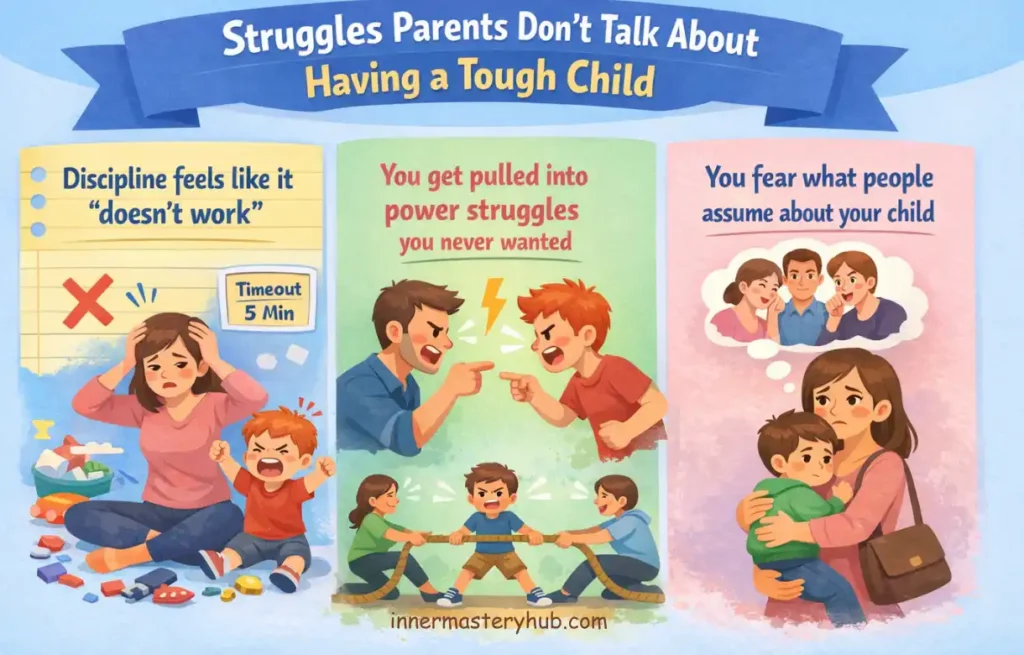
The emotional struggles of having a tough child include constant self-doubt, guilt, exhaustion, and feeling misunderstood. These struggles happen because your child’s emotional regulation challenges trigger your own emotional responses, creating a cycle that feels hard to break.
You love your child.
But some days, you also feel overwhelmed by them. That quiet conflict is where the real struggle lives.
Having a tough child is not just about behaviour. It’s about how their behaviour affects you internally. You try to stay patient, but something inside tightens. You want to respond calmly, but your emotions rise before you can stop them.
And then comes the question you don’t say out loud:
Why does this feel so hard for me?
This is where emotional regulation enters the picture, not just your child’s, but yours. Because their reactions connect directly to your internal state, and when both are overwhelmed, the cycle continues.
As psychiatrist Daniel J. Siegel explains,
“Parenting is as much about understanding your own mind as it is about guiding your child’s”.
What Emotional Struggles Do Parents Face When Having a Tough Child?
Parents of tough children experience emotional exhaustion, guilt, frustration, and isolation. These feelings arise because they are constantly managing intense behaviours while questioning their own parenting.
But these struggles don’t show on the outside. They build quietly, through repeated moments:
- When nothing seems to work
- When small issues turn into big reactions
- When you feel judged by others
Over time, it’s not just your child who feels overwhelmed.
It’s you, too.
Why Do You Feel Like You’re Failing as a Parent?
You feel like you’re failing because repeated challenges create self-doubt, especially when your efforts don’t lead to immediate change. It starts subtly. You try something. It doesn’t work. You try again. Still, nothing changes. And slowly, your mind shifts:
Maybe I’m doing this wrong. But this feeling is not based on truth. It’s based on repetition.
According to research by the American Psychological Association, chronic parenting stress can distort self-perception and increase feelings of inadequacy1.
So the more you struggle, the more you question yourself, even when the situation is complex.
The hidden weight you carry of having a Tough Child
1) You feel like you are always “on”
Your body learns to stay vigilant at all times, and having a tough child is unpredictable, too. You wait for the next yell, the next bump, the next argument. Your mind could be looking for danger even when you’re at peace. Your patience is depleted by this continual state of alertness, which makes minor issues feel like big ones.
Stress increases when behaviour is difficult, and high levels of stress might make it harder to respond kindly. One useful change is to intentionally build small ‘off’ periods into your day, such as a cup of tea before beginning your evening routine, a quick walk after school drop-off, or two minutes of calm breathing in nature.
2) You second-guess every decision
You can decide on a rule and move on after a simple day. You wonder whether every decision you make on a bad day may backfire. Should you disregard it? Get it right? Comfort or consequence? Later on, your memory might replay the scene like an unstoppable movie.
Choosing a straightforward “parenting anchor”, such as “I will be calm and firm,” “I will connect first, then correct,” or “I will keep the limit without being cruel”, is one method to help yourself when you’re feeling lost. Put your anchor on paper. After a difficult moment, consider this in one sentence: “Did I return to my anchor?” That one inquiry helps you go back towards stability and away from a never-ending cycle of self-blame.
3) You grieve the parenting story you expected
You might be grieving in private, but many parents don’t express this verbally. You pictured light weekends, hectic but manageable school mornings, and family meals. Rather, you are negotiating every step, including the word “no,” shoes, homework, screens, and bedtime. Even when loss merges with love, it still causes pain.
Comparing your everyday life to your own progress, rather than to an idealized version, is an effective way to ease grief. “What is one thing that is even 5% better than it was last month?” is a question to ask yourself once a week. Tough behaviour often ends in unequal and poor progress. Appreciating little victories is a decision to let the most difficult times dictate only part of the narrative, not to act as though everything is alright.
4) You feel judged in public
Tantrums in the living room are difficult. It might be devastating to throw a fit at a store. You can hear remarks, see looks, or experience intense discomfort. Your child’s actions may seem to put a spotlight on your parenting at those times.
Having a “public plan” that safeguards your dignity can be helpful when dealing with a difficult child. This plan should include a rapid escape route, a strategy to keep everyone safe, and a calm phrase you say, such as “I’ve got you, we’re leaving.” Ask yourself, “What did my child need, and what did I need?” later on, when you’re by yourself. That question keeps you in learning Mode rather than shame Mode.
5) You and your partner may not be on the same page
Stress affects adults in different ways. Some become harsh, some humble, and still others shut down. You then quarrel over the fighting. Resentment rises quickly when you carry most of the behavioural burden. In the midst of chaos, a straightforward solution that truly works is not a long talk.
Choose two common rules for the week, and one shared responsibility that you both can handle peacefully during the brief weekly check-in when the house is quiet. Children usually push harder when they perceive their parents as split, and they consider consistency more important than intensity.
6) You feel isolated from other parents
You may decide to give up playdates. Even though you may grin during school pickup, you may feel that no one truly gets your real life. You lose your perspective and support when you’re alone, which makes everything heavier.
Here’s where you can show a little bravery: pick a safe individual and say one honest statement to them. “This is a difficult season.” “Mornings at our house are really difficult.” You don’t have to tell everyone. All you have to do is break the stillness long enough to remember that you are not alone in this.

7) Screen time becomes the easiest peace… and then causes new battles
Screens may seem to be your only source of relaxation. And to be honest, you need that break occasionally. However, evidence also points to a complex cycle: children who already suffer use screens as a coping mechanism, and increased screen use may worsen emotional and behavioural issues.
Shame isn’t the solution, but building structure is. Set up two clean screen windows and a straightforward off-ramp to avoid arguing all day: “You can choose Lego, music, or drawing when the timer goes off.” Initially, expect a protest. Making people pleased is not your responsibility; your task is to remain stable. “Am I using screens to prevent my child’s feelings?” is a good self-check. You will at times, and that’s alright.
8) Discipline feels like it “doesn’t work”
Punishments seem pointless when dealing with a tough child who fights or blows up. You might lose stuff and have more intense outbursts. Try time-outs, and you’ll receive pushback. This is where science-supported parent education strategies might be useful. Parent training programs targeted at disruptive behaviour provide minor to moderate benefits, with smaller effects lasting up to a year, according to a comprehensive analysis.
The lesson is encouraging: abilities count. Try a straightforward three-step discipline pattern: identify the rule, give one option, and calmly follow through. Rebuild the connection thereafter. Limits begin to set in when your youngster understands that you mean what you say and do not reduce their value.
9) You get pulled into power struggles you never wanted
Tough behaviour often starts a debate: you want cooperation, your child wants control, and the dispute takes center stage. You may feel stuck, as though you had to “win” or risk losing your power. Ending the conflict swiftly while maintaining the limit is a better strategy. Use fewer words, or say one sentence again. Give people a choice only if you genuinely mean it.
Do a brief body check, such as lowering your voice, dropping your shoulders, and unclenching your jaw, if you feel yourself becoming hooked. Your child’s brain reads your body before your reasoning. You add less fuel the calmer you are.
10) You wonder if you should use harsher punishment
Harsher discipline can seem appealing when you have no other choice, because you want the behaviour to end right away. Strong evidence, however, cautions against the use of physical punishment. Because slapping has been linked to increased aggression and worse behaviour outcomes over time, the American Academy of Pediatrics has warned against it.
You need skill-based management, not fear-based control. If you find yourself thinking, “Nothing else works,” take it as a hint to get help, such as therapy, parent coaching, school meetings, or pediatric check-ins. Stress-relieving tools are what you deserve, not regret-inducing ones.
11) You carry a mental load that nobody sees
You’re not just controlling conduct. To prevent blowups, you are planning around triggers, tracking school notes, and keeping an eye out for warning signals. This unseen labor wears you out. Making some of it accessible and shared is the answer. List the top three “hot spots” of your day, such as bedtime, schoolwork, and mornings.
Next, decide on one minor adjustment for each: get your clothes ready at night, divide your assignments into timed segments, or go to bed fifteen minutes earlier. You’re not attempting to make your life better. Through the most difficult stages, you are creating a more tranquil route.
12) You worry about the future
“Will my child be okay?” is a worry that might keep you up at night. “Are they going to make friends?” “Will they struggle forever?” You might feel scared when you think back to your adolescence. The majority of children’s behaviour is shaped over time by patterns, skills, and support rather than by a single difficult year. The brain of your youngster is still growing.
Your partnership is still developing. Change is also achievable when families learn useful techniques, such as explicit routines, composed follow-through, targeted praise, and dispute resolution. Asking yourself, “What is one skill I can teach this week?” will help you feel more at ease. “What is one skill we practise?” rather than “How do I fix my child?”
Why Does Guilt Stay Constant When Having a Tough Child?
Guilt stays constant because parents feel responsible for both their child’s behaviour and their own reactions, creating a double emotional burden. You feel guilty when you lose patience. But also when you don’t know what to do.
It’s a loop:
- You react
- You regret
- You promise to do better
- It happens again
Author Brené Brown describes,
“Guilt as a signal tied to empathy, but when it becomes constant, it becomes emotional weight rather than guidance”.
And that weight stays with you.
Why Do You Feel Emotionally Exhausted All the Time?
Emotional exhaustion happens because you are constantly managing intense situations without enough time to recover mentally or emotionally. It’s not just physical tiredness. It’s the feeling of always being “on.” Always anticipating the next reaction and always trying to stay ahead of problems. This ongoing tension drains your energy.
Research published in Frontiers in Psychology shows that high emotional demands in parenting can lead to burnout similar to workplace stress2.
So your exhaustion is not weakness. It’s an overload.
Why Does Having a Tough Child Feel So Isolating?
It feels isolating because others don’t understand your daily experience, which can lead to judgment, comparison, or a lack of support. You see other families. Things look easier for them. And when your child struggles in public, the silence around you feels loud.
People may give advice. Or stare. Or stay quiet. But rarely do they understand. This creates distance not just from others, but sometimes from yourself.
Why Do Small Situations Turn Into Big Emotional Reactions?
Small situations escalate because both you and your child may already be emotionally overloaded, leading to faster, more intense reactions. It’s rarely about the moment itself.
A small refusal becomes a big argument, and a simple request turns into frustration. Because underneath that moment, there’s already tension.
Psychologist John Gottman explains that emotional flooding reduces your ability to respond calmly3.
So when both of you are overwhelmed, reactions happen quickly.
Why Do You Sometimes Feel Resentment Toward Your Child?
Resentment can develop when emotional needs are unmet, and stress remains constant, even though love for your child is still strong. This feeling is hard to admit. You love your child deeply, but also feel drained by them. That conflict creates guilt and confusion.
But resentment is not a sign of failure. It’s a signal that something inside you needs attention, too.
Why Does Patience Feel So Hard to Maintain?
Patience feels hard because repeated stress reduces emotional capacity, making it harder to stay calm over time. You start the day with intention. But as challenges repeat, your emotional energy drops. And patience fades.
Not because you don’t care. But because your system is tired.
Why Do You Overthink Every Parenting Decision?
Overthinking happens when uncertainty and repeated challenges make you constantly question your choices.
You replay conversations. Second-guess decisions. Wonder if something small caused something big. This mental loop adds another layer of exhaustion. Because even when things are quiet, your mind is not.
Why Does It Feel Like Nothing Is Working?
It feels like nothing is working because emotional growth is slow and often invisible, making progress hard to recognize. You expect change to be clear. But with emotional regulation, progress is subtle.
It happens in small moments:
- A shorter reaction
- A quicker recovery
- A slight pause
But these are easy to miss.
So it feels like nothing is changing. Even when something is.
Why Do You Feel Triggered by Your Own Child?
You feel triggered because your child’s behaviour activates your own unresolved emotions, stress, or expectations. This is one of the hardest truths. Sometimes your reaction is not just about your child. It’s about you, too.
Your expectations. Your past. Your stress.
As Carl Jung said,
“What irritates us about others can lead us to an understanding of ourselves.”
So your triggers are not random. They are reflections.
What starts to change when you change your approach while having a Tough Child
You may stop living in emergency Mode when you go from reacting to planning. Your child learns what is genuine and what is negotiable when you establish fewer rules and calmly impose them. You provide your child a safer place to land when you choose structure and connection over lectures. Additionally, when you treat your own stress seriously, you safeguard the most important parent your child needs: a stable one who can guide them.
You don’t need to be an ideal parent while dealing with a tough child. You require reproducible parenting, which includes straightforward procedures, unambiguous boundaries, and corrective action when something goes wrong. See a pediatrician or child psychologist if your child exhibits severe behaviour in a variety of contexts, so you can rule out learning difficulties, anxiety, sleep disorders, and attention concerns.
What Changes When You Understand These Emotional Struggles?
Understanding these struggles shifts your perspective from control to awareness, reducing emotional pressure and naturally improving connection.
You stop asking:
“How do I make this easier?”
And start asking:
“What is really happening here?”
That question softens your response, not instantly, but gradually.
And in that shift, something important happens: you begin to feel less alone in your own experience.
Having a Tough Child Is Also an Inner Journey
Having a tough child is not just about raising them. It’s about facing parts of yourself you didn’t expect: the frustration, the guilt, the exhaustion; they are real.
But they are also meaningful because they point to something deeper than behaviour. Not something to fix, but something to understand.
And when that understanding grows, the weight begins to change, not disappear, but shift into something you can carry differently.
FAQs
Why am I having a Tough Child right now?
Often, it’s stress combined with immature self-control rather than “badness.” When children are exhausted, hungry, overstimulated, irritated, or having difficulty adjusting to change, they will act out. Behaviour becomes the loudest form of communication when learning, attention, anxiety, or sensory needs increase the pressure.
Is it normal to deal with a tough child who is acting defiant?
Defiance is common, particularly during periods of significant expansion. Frequency, intensity, and duration are important. If disobedience occurs regularly, is severe, or occurs at both home and school, it may indicate more serious issues, and you may require more help and coping mechanisms.
How do I discipline a tough child without yelling?
Use more follow-through and fewer words. Give a clear decision, state the rule once, and then remain composed. Congratulate whatever little collaboration you observe. If you start to boil, take a 10-second break, speak more quietly, and then go back to the maximum. Your power is calm.
What should I do during a meltdown while dealing with a tough child?
Prioritise safety over education. If your youngster agrees, keep your distance, eliminate any dangers, and speak quietly. Don’t lecture or debate. Once they’ve calmed down, have a quick conversation about what went wrong and what should be done the next time. After the storm has passed, kids learn best.
How can I get my child to listen the first time?
Before correcting, connect. Reach eye level, lightly touch their shoulder, and move in a single, quick direction. Next, wait. Instead of repeating yourself, help them begin the task with you if they ignore you. When you speak clearly and follow through consistently, your listening skills improve.
When should I seek professional help when dealing with a tough child?
If behaviour threatens your safety or others, disrupts school, creates a great deal of stress for your family, or does not improve with regular routines, get help. If necessary, a general practitioner or pediatrician can evaluate triggers and refer you.
How do I handle disrespect and rude talk while dealing with a tough child?
Remain uncomplicated and firm. “You can be upset, but you can’t speak to me like that” is an example of setting a limit. If the discussion goes on, stop it. Teach a “retry later” approach: “Try it again with respectful words.” When you continually demand and model respect, it grows.
What to do when dealing with a tough child whose behaviour is worse in public?
Make a plan in advance and keep things simple. Set expectations before you enter, bring snacks, and limit the length of your outings. Move to a quiet area, repeat one soothing word, and leave if necessary if a meltdown begins. Safety and composure are more important than winning the moment.
Is my child “strong-willed” or is something wrong with having a tough child?
Strong-willed children can still learn boundaries, although they frequently desire control, dispute, and feel strongly. It might be more than temperament if your child also has trouble with sleep, focus, anxiety, learning, or frequent, violent outbursts. An expert examination might provide light on the situation.
How do I cope emotionally when I’m having a Tough Child?
You put less emphasis on perfection and more on fixing. Reset and apologize when you make a mistake. Include brief pauses in your day and seek help as soon as possible. You are not your child’s harsh behaviour. You are also learning.
What does having a Tough Child mean?
Having a Tough Child means raising a child who is strong-willed, emotionally intense, or resistant to authority. These children often challenge rules, express big emotions, and push boundaries, but they are also passionate, determined, and capable of strong leadership when guided with patience.
How can parents cope with having a Tough Child?
Parents coping with having a Tough Child should focus on consistency, calm communication, and clear boundaries. Staying patient, acknowledging emotions, and choosing battles wisely help reduce conflict. Self-care for parents is also important, as raising a tough child can be emotionally demanding.
Can having a Tough Child prove to be a strength later in life?
Absolutely. Having a Tough Child often means raising someone with resilience, confidence, and determination. When guided positively, these traits can become strengths like leadership, creativity, and independence. Proper emotional coaching helps tough children channel their intensity into healthy, productive behaviours.
- American Psychological Association. (2019). Stress in America™ 2019: Stress and current events. American Psychological Association. https://www.apa.org/news/press/releases/stress/2019/stress-america-2019.pdf ↩︎
- Mikolajczak, M., Gross, J. J., & Roskam, I. (2019). Parental burnout: What is it, and why does it matter? Frontiers in Psychology, 10, 886. https://doi.org/10.3389/fpsyg.2019.00886 ↩︎
- Gottman, J. M., & Silver, N. (1999). The seven principles for making marriage work. Crown Publishers. ↩︎
Written By Mehwish Qurayshi
Mehwish Qurayshi is a Trauma-Informed Emotional Wellness Counsellor trained through NICABM’s Treating Trauma Master Series, which includes NBCC-approved education in Trauma Treatment and Emotional Wellness & Emotional Intelligence – Sourcecode Academia. She has over five years of experience providing emotional wellness counselling, helping individuals heal from trauma, regulate emotions, and build healthy relationships.