
12 Little-Known Reasons You Get Triggered by Your Partner

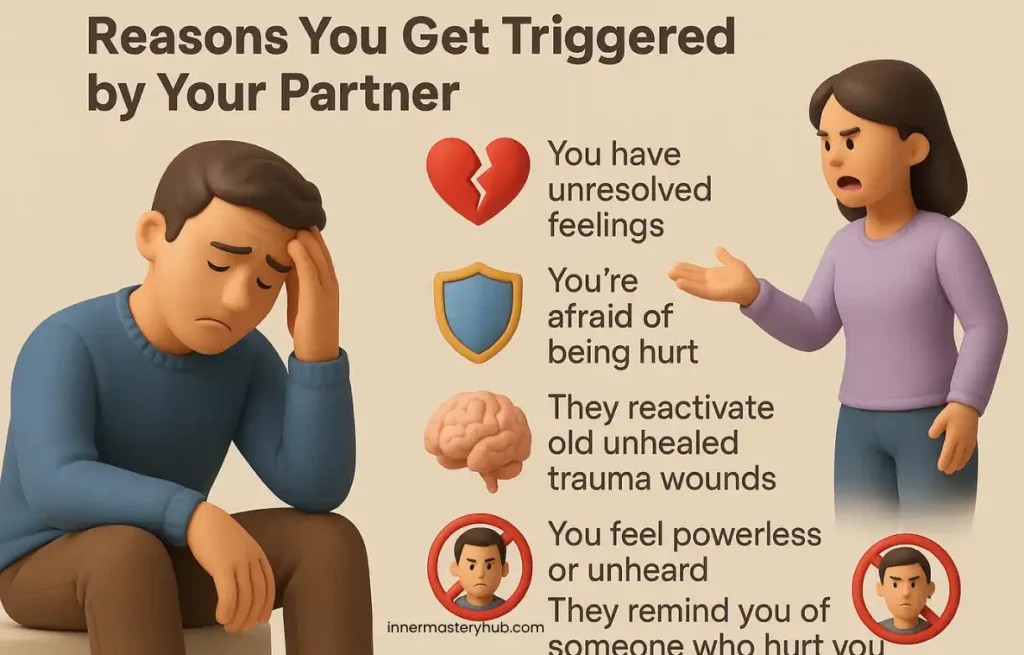
When you get triggered by your partner, your reaction is usually not only about what they just said or did. It is your nervous system, attachment history, emotional interpretation, and fear of disconnection reacting at the same time. The real issue is not that you are “too sensitive,” but that something inside you feels unsafe, unseen, rejected, controlled, or abandoned.
Why Your Partner Sets Off Your Emotions, it’s as though all logic flees when your partner triggers you. You can go from being composed to defensive, annoyed, or hurt in an instant. You can’t stop it, but you know your response feels more significant than the circumstances warrant.
Everyone has experienced that. Because our intimate partners reflect our deepest, most wounded parts, emotional triggers can appear even in good relationships.
This post will explain the triggers and underlying causes of your reactions, and how to shift the pattern with practical, evidence-based techniques.
When Love Meets Old Pain
It is not a sign of brokenness or drama to be triggered by your partner. It indicates that your mind and body are reacting to a perceived threat, which may not always be from the emotional past but rather from the present.
When you get triggered by your partner, you experience:
- Sudden anger, defensiveness, or withdrawal.
- Feeling misunderstood or unseen.
- Racing thoughts or physical sensations like tightness, heat, or panic.
- A desire to fight, flee, or shut down completely.
These responses sometimes appear out of proportion to the actual incident. A forgotten task, a harsh tone, or a missed text shouldn’t seem like betrayal, but occasionally it does. What happened isn’t the issue; it’s what it means to you.
Unresolved memories of past trauma are emotional triggers. Your nervous system responds as though history is being repeated when your spouse unintentionally touches those wounds.
These habits can lead to resentment, ongoing conflict, and emotional estrangement if left unaddressed. Your partner starts to feel attacked or powerless, and you begin to feel ignored.
The cycle is that.
That is where emotional regulation, self-awareness, attachment healing, and inner alignment are so connected. Psychologist James Gross’s emotion regulation model explains that emotions unfold through a process, and people can influence that process at different points, including how they interpret a situation and how they respond to it1.
What Does It Mean When You Get Triggered by Your Partner?
Getting triggered by your partner means your emotional response is stronger than the visible situation seems to explain. Your body and mind react as if there is a threat, even when the threat may be emotional rather than physical.
A trigger is not just “being upset.” It is a fast, inner reaction in which your nervous system, memory, beliefs, and relationship fears meet. Your partner says, “Can we talk later?” and your body hears, “You do not matter.” Your partner forgets something, and your mind hears, “I am not important.” Your partner gets quiet, and your heart hears, “I am being abandoned.”
A relationship trigger is an emotional alarm that turns a present moment into a deeper fear about love, safety, worth, or belonging.
This is why triggers feel so real. They are not fake. But they may not be fully about the present moment.
Research on adult attachment shows that insecure attachment can shape how people think, feel, and behave under relationship stress, especially when closeness feels uncertain or conflict feels threatening2.
Why Do You Get Triggered by Your Partner More Than Anyone Else?
Your partner can trigger you deeply because romantic relationships touch your need for safety, love, trust, and emotional belonging. The closer someone is, the more power they have to activate old fears.
You may stay calm with coworkers, friends, and strangers, but lose balance with your partner. That does not mean your relationship is doomed. It means intimacy reaches places that casual relationships never touch.
Your partner has access to your softest needs:
- the need to feel chosen
- the need to feel heard
- the need to feel emotionally safe
- the need to feel respected
- The need to know conflict will not end the bond
Sue Johnson, the developer of Emotionally Focused Therapy, viewed couple conflict through the lens of attachment. In this view, many fights are not really about dishes, texting, tone, or timing. They are about the deeper question, “Are you there for me?3” EFT is an evidence-based couple therapy grounded in attachment theory.
So when your partner seems distant, your reaction may not only be sadness. It may be fear. When they criticize you, your reaction may not only be anger. It may be shame. When they interrupt you, your reaction may not only be irritation. It may be the old pain of never being heard.
What Is Really Happening Inside When Your Partner Triggers You?
A trigger usually moves through a chain: your partner does something, your mind gives it meaning, your body creates emotion, and your behavior tries to protect you. The reaction feels instant, but there is an inner process behind it.
Imagine your partner checks their phone while you are talking. The visible moment is small. But inside, your mind may say, “They do not care.” Your body tightens. Anger rises. You speak sharply. Your partner defends themselves. Now the conflict is no longer about the phone. It is about feeling unseen.
This is the hidden process:
- Trigger: Your partner’s tone, silence, delay, facial expression, criticism, or distance.
- Interpretation: “I am not loved,” “I am unsafe,” “I am being rejected,” or “I have to fight to matter.”
- Emotion: Anger, fear, shame, sadness, jealousy, panic, or numbness.
- Consequence: Blaming, withdrawing, people-pleasing, overexplaining, shutting down, testing, or chasing.
Cognitive appraisal research shows that emotions are shaped not only by events but by how people evaluate those events in relation to their goals, needs, and coping ability4.
This matters because you may think, “My partner made me feel this.” But more accurately, your partner’s action touched a meaning inside you. That meaning created emotion. The emotion pushed you toward protection.
This is not about excusing hurtful behavior. If your partner is abusive, controlling, cruel, manipulative, or unsafe, your reaction may be a healthy alarm. But in many everyday conflicts, the trigger is a mix of the present moment and old emotional learning.
The Real Reasons You Get Triggered by Your Partner
1. They Remind You of Someone Who Hurt You
Your partner may unintentionally reflect a painful character from your history, such as a parent, sibling, ex, or authoritative figure. Their criticism, emotional detachment, or tone of speech may mirror that person’s actions.
Your mind does not distinguish between “now” and “then.” It responds as if you’re back in the original circumstance. Emotional transference is the process of reliving past traumas in present relationships.
For instance, your body immediately relives the same feeling of rejection if your partner occasionally withdraws, and your parents were erratic or dismissive.
2. You Have Unresolved Feelings About Someone Else
You may still have lingering feelings of resentment, regret, or longing even after you’ve “moved on” from an ex or an old friend. Those suppressed emotions come flooding back when your partner behaves similarly.
Your companion hasn’t done anything particularly wrong; instead, they’ve sparked an unresolved emotion within you.
3. You’re Afraid of Being Hurt, Rejected, or Misunderstood
Most people secretly worry that they won’t be accepted for who they really are. Your brain interprets that fear as a threat when it is provoked.
A neutral remark could be interpreted as criticism, especially when you can easily get triggered by your partner. Space can seem like abandonment to you. Even small arguments can feel like rejection if you were raised feeling invisible or inferior.
Because you care about your mate, this worry is intense. When that link is in danger, it feels more vulnerable the closer you are.
4. They Reactivate Old Unhealed Trauma Wounds
Your neurological system stores memories of any trauma you may have had, no matter how minor. Your body may be reliving that stored terror when your spouse triggers you.
It can have been times of helplessness as a youngster, ongoing criticism, or emotional neglect. Now, it seems like danger all over again when your partner ignores you, raises their voice, or forgets something important, when you get triggered by your partner.
For this reason, body awareness and modulation are emphasised in trauma therapy. You must feel and soothe your way through triggers; you cannot rationalise your way out of them.
5. You Carry Resentment Toward Them
Sometimes your reaction is less about the past and more about built-up frustration. Maybe you’ve felt unheard, unsupported, or underappreciated for a long time.
Even little things become huge when hatred builds up. It feels like evidence of all you’ve been suppressing when you see a firm tone, an unfinished task, or a forgotten chore.
Resentment reduces empathy and patience over time, much like emotional rust. In the absence of resolution, each new dispute builds upon the previous ones.
6. You Struggle to Accept How Different They Are From You
Difference is one powerful trigger source. While your partner wants distance, you may desire emotional intimacy. While they demonstrate love by what they do, you might yearn for words.
Your mind interprets those distinctions as disapproval or rejection when you are unable to accept them. Frequently, though, it’s just a different personality type or love language.
You can develop emotional flexibility and peace by learning to accept differences rather than struggling against them.
Your partner’s actions can occasionally disclose emotional scars you were unaware of. Perhaps the insecurity triggered by your partner stems from a lack of confidence. Possibly their silence makes you feel lonely.
“Why does this bother me so much?” you ask yourself. That discomfort reveals a part of you that seeks healing.
In this way, triggers can be teachers. They point you toward emotional areas that need compassion and attention.
8. You Expect Them to Meet Old Emotional Needs
If you didn’t feel safe, loved, or validated growing up, you might subconsciously expect your partner to fix that for you.
However, no spouse can satisfy every unfulfilled need you had as a child. Deep anguish or rage can appear when you get triggered by your partner or when they unavoidably fall short.
Knowing which wants are from the past and which are part of the current relationship is a necessary part of healing.
9. You’re Tired, Stressed, or Emotionally Depleted
Your emotional threshold is lowered when you’re tired. You feel overwhelmed by even minor stressors when you’re exhausted.
This is why self-care, diet, and sleep are more important than you may believe for both emotional control and overall health.
10. You feel ignored or helpless
When your voice is not valued, triggers increase. Every little dismissal triggers a reaction in you because it strengthens your sense of helplessness. Both parties must feel equal, heard, and respected for their relationship to be healthy. Without it, there is an emotional tug-of-war in the relationship, with one partner vying for power and the other for approval.
11. Your Partner’s Behavior Conflicts With Your Core Values
Sometimes honesty, rather than trauma, is the trigger. Emotional conflict arises when your partner’s decisions run counter to your ideals of kindness, honesty, and respect.
This type of trigger suggests you may need more precise boundaries or that you are compromising too much.
12. You no longer consider them to be human.
After some time together, it’s simple to view your partner as a role model (“my husband,” “my girlfriend”) rather than as a human being with their own anxieties and fears. Their mistakes seem overwhelming when you’re expecting perfection. The edge of reactivity gets reduced when you keep in mind that they are human, just like you.
The Cost of Staying Stuck in Triggers
One of the best indicators of relationship frustration, according to research from the Gottman Institute, is unresolved emotional triggers. Continuously becoming defensive, critical, or withdrawing can cause emotional distance in a couple that might take years to heal.
Regularly getting triggered by your partner can affect your health as well. Long-term relationship stress has been linked to elevated cortisol, weakened immunity, and increased anxiety and depression, according to studies.
However, the real tragedy is emotional: love, curiosity, and empathy become less available the longer you remain trapped in reaction.
What Is the Trigger-to-Truth Framework?
The Trigger-to-Truth Framework helps you move from automatic reaction to deeper understanding. It asks what happened, what you made it mean, what you felt, what you protected, and what truth needs to be spoken.
Use this framework when you get triggered by your partner:
1. What happened?
Name the visible event without drama.
“ My partner did not reply for three hours.”
2. What did I make it mean?
Find the interpretation.
“ They are losing interest.”
“ I am not important.”
“ I am being ignored.”
3. What emotion came up?
Name the feeling under the reaction.
Fear. Shame. Anger. Sadness. Jealousy. Loneliness.
4. What did I do to protect myself?
Notice the behavior.
I accused. I withdrew. I tested. I acted cold. I sent too many messages. I pretended not to care.
5. What is the deeper truth?
Speak from the wound, not the weapon.
“ When I did not hear from you, I felt unimportant. I know that may not be what you meant, but I need reassurance and clearer communication.”
This framework works because it respects both sides of the trigger. It honors your emotion, but it does not let the first story control the relationship.
How Can You Tell If It Is a Trigger or a Real Relationship Problem?
A trigger is an emotional reaction that may be stronger than the moment, while a real relationship problem is a repeated pattern of harm, disrespect, neglect, or broken trust. Often, both can exist together.
Ask yourself:
- Is this a one-time moment or a repeated pattern?
- Did my partner make a mistake, or do they keep dismissing my needs?
- Am I reacting to what happened, or to what I fear it means?
- Can my partner take responsibility?
- Do I feel safe expressing hurt?
- Does this relationship allow repair?
A trigger may sound like:
“ When they were quiet, I felt abandoned.”
A real relationship problem may sound like:
“ They repeatedly stonewall me for days and refuse to discuss anything.”
A trigger may need inner regulation. A relationship problem may need boundaries, repair, therapy, or a serious decision.
This distinction is important because self-help advice can become harmful when it tells people to look only within. Sometimes your nervous system is not overreacting. Sometimes it is accurately noticing disrespect, emotional abuse, manipulation, betrayal, addiction, or chronic neglect.
The wise path includes both inner work and outer truth.
What Should You Avoid Saying When You Are Triggered?
Avoid words that turn pain into attack. Blame, absolutes, insults, and mind-reading usually make your partner defensive and move the conversation away from the real wound.
Try not to lead with:
- “You always do this.”
- “You never care.”
- “You are just like my ex.”
- “You made me feel this way.”
- “I knew I could not trust you.”
- “Forget it, I am fine.”
- “You should already know.”
These phrases come from pain, but they hide the vulnerable truth. Your partner hears the accusation, not hurt.
Say instead:
- “I felt scared when I did not hear from you.”
- “I know I may be reacting strongly, but I need to talk about what came up.”
- “Part of me felt rejected in that moment.”
- “I need reassurance before I can listen well.”
- “I want to understand you, but I am flooded right now.”
This is not soft communication for the sake of being nice. It is accurate communication. It tells the truth without turning your partner into the enemy.
How Do You Repair After You Get Triggered by Your Partner?
Repair begins when you take responsibility for your reaction without denying your hurt. You can name what happened, explain the deeper fear, own your behavior, and invite a better conversation.
Repair does not mean saying, “It was all my fault.” It means saying, “My reaction had a history, and I want to speak from a clearer place.”
A repair might sound like:
“ I got really triggered earlier. When you looked away while I was talking, I told myself you did not care. I reacted by criticizing you. I am sorry for how I said it. The deeper truth is that I felt unimportant, and I need us to talk about that.”
This kind of repair lowers defensiveness because it separates four things:
- what happened
- What did you make it mean
- How you reacted
- What you actually need
Couples research continues to show that emotion regulation is a key part of intimate relationship functioning, because partners influence each other’s emotions during conflict and repair5.
Repair is not a script. It is a return to truth.
What Are the Best Inner Questions to Ask When Your Partner Triggers You?
The best questions help you slow down and understand the meaning under your reaction. They shift you from blame or shame into awareness, which makes emotional regulation easier.
Ask yourself:
- What exactly happened?
- What did I tell myself this means?
- What feeling is under my anger?
- What old pain does this remind me of?
- What am I afraid will happen next?
- What do I need right now: reassurance, space, clarity, respect, or repair?
- Is my partner unsafe, or am I feeling unsafe?
- What would I say if I spoke from hurt instead of defense?
- What boundary, if any, is needed?
- What truth am I avoiding?
These questions are not meant to make you doubt yourself. They are meant to help you hear yourself more clearly.
Mindfulness research suggests that mindfulness-based approaches can support emotion regulation, although outcomes vary by study design and population.
The pause is powerful because it lets you meet the emotion before it becomes behavior.
What Changes When You Understand Why You Get Triggered by Your Partner?
When you get triggered by your partner, the first feeling may tell you that your partner is the whole problem. Then shame may tell you that you are the whole problem. But the deeper truth is usually more human than both.
A trigger is a meeting point. It is where your partner’s behavior touches your interpretation, your attachment history, your body memory, your unmet need, and your fear of losing love.
This does not mean every reaction is justified. It also does not mean every hurt is imagined. It means your emotional life is asking to be understood with more care.
The shift is this:
You are not trying to stop feeling. You are learning to stop turning every feeling into a final verdict.
When you can say, “Something in me is activated,” instead of “You are the enemy,” the relationship has more room to breathe. When you can say, “This touched an old fear,” instead of “I am too much,” your heart becomes less alone. And when you can see both your inner wound and your real relationship need, you move from reaction into truth.
That is where healing starts.
Next time you feel triggered, do not start with blame or self-shame. Write one sentence: “When this happened, I told myself it meant ___, and I felt ___.” That one sentence can become the bridge between emotional reaction and honest repair.
FAQs
Why do you get triggered by your partner for small things?
Even seemingly insignificant things, like a forgotten note, a witty remark, or a specific tone, can cause you to overreact. These little moments feel so huge because they trigger deeper emotional scars from your history. Your nervous system links your partner’s actions to past experiences of fear, neglect, or rejection. Even if everything is safe right now, your body reacts as if it were in danger.
Are emotional triggers always about past trauma?
Many triggers are connected with unresolved emotional suffering, but not all are linked to severe trauma. Unresolved relationships, childhood experiences, and attachment traumas are a few examples. However, there are instances when being anxious, worn out, or mentally exhausted might act as a trigger. It’s not always about the past; sometimes, it’s just about your ability to handle things right now.
How can you tell when you are triggered by your partner versus just upset?
The sense of being provoked differs from that of being usually upset. Your reaction when you’re triggered by your partner is strong and seems out of proportion to the situation. Your heart may race, you may feel overwhelmed with emotion, or you may feel like snapping or disconnecting. It is a quick, uncontrollable, and automatic reaction. You can typically remain in the moment and consider your options while you’re just upset.
What is the first thing you should do when you feel triggered by your partner?
The first thing to do is to wait before responding. Breathe deeply and accept what’s going on inside of you. You may even tell yourself, “Why are you being triggered by your partner right now?” After that, concentrate on relaxing your body by taking deep breaths, feeling your feet on the ground, or, if necessary, taking a brief break. Once you’re grounded, you’ll be able to respond from awareness instead of emotion.
How can I talk to my partner about my triggers without blaming them?
Instead of blaming others, focus on your own experience. Use “I” statements, such as “I feel hurt and afraid when you leave me during a disagreement because it reminds me of being ignored in the past.” This method keeps your partner from feeling attacked while helping them understand what is going on. Allow people into your inner world without blaming.
Can therapy really help with emotional triggers?
Indeed. One of the best methods to identify and address emotional triggers is through therapy. Emotionally Focused Therapy (EFT), Internal Family Systems (IFS), and EMDR are some of the modalities that can help you better understand the causes of your reactions and improve your emotional control. A professional therapist gives you the resources, understanding, and encouragement you need to avoid handling things alone.
Do both partners need to work on their triggers for the relationship to improve?
Yes, ideally. You build a stronger basis for connection when you both identify and control your triggers. The relationship can still get better, though, even if only one person starts the effort. Your partner’s nervous system reflects your increased self-awareness and tranquillity. Naturally, repairing your side of the pattern affects the entire dynamic.
How long does it take to stop being triggered by your partner?
There is no shortcut. Resolving emotional triggers takes time and is a progressive process. Consistent self-awareness and practice will likely yield little change in a few weeks or months, but deeper wounds may take longer to heal. The objective is to identify triggers more quickly and respond with compassion rather than react, not to eliminate them.
Does mindfulness or meditation really help with triggers?
Yes. Meditation and mindfulness can teach your brain to think things through before behaving. These techniques help to quiet the stress response and strengthen the areas of your brain that control emotion. With increased awareness of your feelings, such as stress, a racing heart, and a need to protect, you can better regulate your reactions to triggers.
What if my partner resists talking about triggers or doesn’t take it seriously?
In many cases, one partner is more willing to engage in emotional labour than the other. Try bringing up the subject softly and picking a quiet time to speak if your partner objects. Please describe how you want a healthier relationship rather than placing blame on them. If they continue to avoid the topic, start by concentrating on your own development. Sometimes, one person’s self-awareness and calm presence can gradually inspire change in the relationship.
- Gross, J. J. (1998). The emerging field of emotion regulation: An integrative review. ↩︎
- Simpson, J. A., & Rholes, W. S. (2017). Adult attachment, stress, and romantic relationships.
↩︎ - Wiebe, S. A., & Johnson, S. M. (2016). A review of the research in Emotionally Focused Therapy for couples. Family Process, 55(3), 390–407. https://doi.org/10.1111/famp.12229 ↩︎
- Schmidt, S., Tinti, C., Levine, L. J., & Testa, S. (2010). Appraisals, emotions, and emotion regulation: An integrative approach. Motivation and Emotion, 34, 63–72.
↩︎ - Bloch, L., Haase, C. M., & Levenson, R. W. (2014). Emotion regulation predicts marital satisfaction: More than a wives’ tale. Emotion, 14(1), 130–144. https://doi.org/10.1037/a0034272 ↩︎
Written By Mehwish Qurayshi
Mehwish Qurayshi is a Trauma-Informed Emotional Wellness Counsellor trained through NICABM’s Treating Trauma Master Series, which includes NBCC-approved education in Trauma Treatment and Emotional Wellness & Emotional Intelligence – Sourcecode Academia. She has over five years of experience providing emotional wellness counselling, helping individuals heal from trauma, regulate emotions, and build healthy relationships.