
Boredom in Marriage: 8 Patterns That Weaken Connection

Boredom in marriage is not always a sign that love is gone. It is often a sign that emotional connection and honest expression have gone quiet. Research suggests marital boredom can lower satisfaction years later, largely because couples begin to feel less close over time.
Even when you are sitting next to your spouse, you may feel alone, even though nothing noteworthy has happened. Not a big fight, and no obvious cause for alarm, but you still feel flat inside, though.
You ask yourself, “Is this all we are now?” when you consider your marriage.
Marital boredom does not always appear to be a crisis. Polite routines, predictable discussions, silent discontent, browsing in the same room, and a slight aching of feeling distant can all be signs of it.
Emotional control is important in this situation. Your mind tries to control feelings such as boredom, disappointment, and a sense of invisibility. You can tell yourself that, since your husband is a decent person, you shouldn’t complain. Because you don’t want conflict, you might suppress the emotion. However, the emotion does not go away. It frequently ends up distancing.
The connection is easy, but it hurts. Another silent dinner or another weekend without meaningful interaction is a trigger. “We have lost something,” is how your mind sees it.
The inner struggle is not only, “Am I bored?” The deeper question is, “Why do I feel lonely inside a relationship that is supposed to feel close?”
Emotional control is necessary for marital fulfilment, according to studies on couples. In one study, increased marital happiness over time was predicted by greater downregulation of negative emotions during couple interactions, particularly when partners were able to control their emotional intensity rather than allowing it to dictate the relationship’s dynamics1.
What Is Boredom in Marriage?
Many couples experience boredom in marriage once the early spark wears off. Partners begin to feel disengaged in their relationship during daily interactions.
Research found that married couples report feeling significantly bored after some point in their marriage2.
It can be challenging for couples to maintain the spark that initially brought them together as marriages become routine. Boredom in a marriage can be caused by several things, including routine daily routines, a lack of similar interests, or a decrease in romantic gestures.
The Marriage Boredom Loop
Repeated moment → Negative interpretation → Painful emotion → Withdrawal → Less connection → More boredom
Is boredom in marriage normal?
Boredom in marriage is widespread, especially in long-term relationships where routine, stress, children, work pressure, or emotional avoidance have replaced curiosity. Normal does not mean safe. Hidden comparison may result from ignoring boredom.
Long-term love grows naturally. Early appeal involves novelty, volatility, and excitement. Couples create a rhythm, comfort, and safety with time. Although this transformation may be good, it can be confusing if you mix tranquillity with nothingness.
Due to boredom, a secure marriage may feel less stimulating than an early romance. This does not mean the marriage is over. It means that the partnership may need new emotions and activities.
Research shows that marital boredom is linked to reduced relationship satisfaction over time; therefore, chronic detachment should be addressed rather than dismissed as ordinary3.
When marriage feels meaningful, ordinary days feel easier to carry. When meaning disappears, even peaceful routines can feel heavy.
8 Patterns That Create Boredom in Marriage
1. Living Like Roommates
You manage bills, chores, schedules, and responsibilities well, but emotional closeness fades. The marriage begins to feel practical rather than personal, and connection is replaced by routine.
2. Repeating Surface-Level Conversations
Most conversations revolve around work, children, or daily tasks. When deeper thoughts, feelings, fears, and dreams are rarely discussed, emotional intimacy can slowly become less important.
3. Avoiding Difficult Emotions
Couples may avoid disappointment, resentment, loneliness, or frustration to keep the peace. Over time, unspoken emotions create distance and make the relationship feel emotionally flat.
4. Stopping Curiosity About Each Other
When you assume you already know everything about your spouse, curiosity disappears. Asking fewer meaningful questions can make both partners feel unseen or taken for granted.
5. Letting Screens Replace Connection
Phones, television, and social media can quietly take over shared time. Being physically together does not always create closeness when attention is constantly directed elsewhere.
6. Losing Shared Novelty and Play
Doing the same things repeatedly can make the relationship feel predictable. New experiences, humour, playfulness, and shared interests help keep curiosity and emotional energy alive.
7. Withdrawing After Disappointment
After feeling ignored, rejected, or misunderstood, one partner may stop trying. Repeated withdrawal can create a cycle where both people become quieter, more distant, and less hopeful.
8. Taking Emotional Availability for Granted
Assuming your partner will always be there can reduce everyday effort. Appreciation, affection, listening, and emotional presence still matter, even in long-term relationships.
Signs Your Marriage Is Becoming Emotionally Boring
Signs of boredom in marriage include emotional distance, lack of intimacy, repetitive conversations, low affection, avoidance of quality time, and feeling more alive away from your spouse. The clearest sign is not silence; it is the loss of emotional expectation.
- No longer interested in your partner’s life, feelings, or hobbies.
- You no longer work as hard on each other.
- You feel awkward thinking about your future together.
- You find socialising more stimulating and enjoyable.
- You want your relationship or partner to change.
- You seem to have lost common ground and interests.
- You lack ideas to talk about, and talks are tense.
- You no longer like spending time together.
- Your partner regularly annoys you.
- You’re less attracted to each other.
- You either devalue or feel devalued in your connection.
- You must distinguish between comfort and boredom in a relationship. Being comfortable with your spouse shows that you trust them and can be yourself with them.
The painful part is that boredom can hide under normal life. You may look like a good couple. But inside, the relationship feels like a room with no windows.
The Impact of Boredom on Marital Satisfaction
Boredom in a marriage is not a problem that goes unnoticed. It worsens, impacting emotional intimacy and marital contentment. According to research, boredom in a marriage can increase dissatisfaction and increase the likelihood that people will seek out stimulation outside of their union4.
This dullness causes more anxiety than just a lack of interest. It has to do with feeling isolated in a relationship. When couples start to question their compatibility, it leads to arguments and feelings of loneliness in the marriage.
How Does Boredom Develop Psychologically?
Boredom in marriage develops when routine, emotional distance, and negative interpretations repeat over time. A familiar moment starts to feel disappointing, and that disappointment changes how each partner responds.
The Marriage Boredom Loop
The pattern looks like this: a repeated trigger leads to a negative interpretation, which creates hurt. That emotion leads to withdrawal, criticism, or avoidance, reducing connection even further.
For example, one partner looks at their phone during dinner. The other thinks, “They do not care about me.” Hurt leads to silence; the partner withdraws too, and the belief that the marriage has become disconnected grows stronger.
How Does Emotional Distance Contribute?
Marital boredom sometimes results from emotional distance. When partners don’t share their thoughts, feelings, problems, and dreams, relationships lose depth.
You can know your spouse’s routine but not their inner life. Marriage becomes about tasks over time, not connection. When neither shows their growth, boredom rises. You don’t feel emotionally linked despite living together. Marriage emotional distance is the difference between what partners manage and share. Boredom settles in that space.
Boredom vs Comfort in Marriage
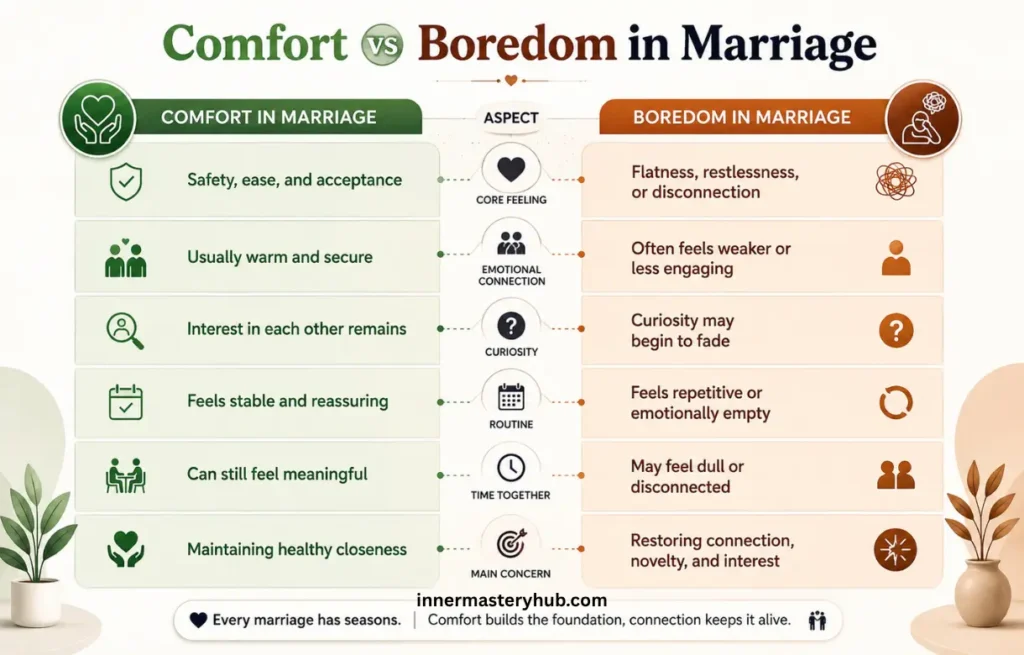
What should you do first when marriage feels boring?
First, determine what boredom is shielding you from. Ask yourself if you’re feeling loneliness, fear, grief, resentment, guilt, or longing before demanding change. The following chat can be more honest as emotion becomes evident.
No long self-improvement checklist here. The goal is to redefine boredom.
Instead of “My marriage is dead,” try:
“Maybe my marriage is unconnected.”
As opposed to “My husband is dull,” try:
“We may have stopped being ourselves here.”
Instead of “I need a new life,” try:
“I need to be honest about feeling alive in my life.”
That change counts because your self-talk affects your actions.
You may disconnect too easily if boredom equates to love gone. Boredom may indicate a missing connection, so you may be curious before deciding.
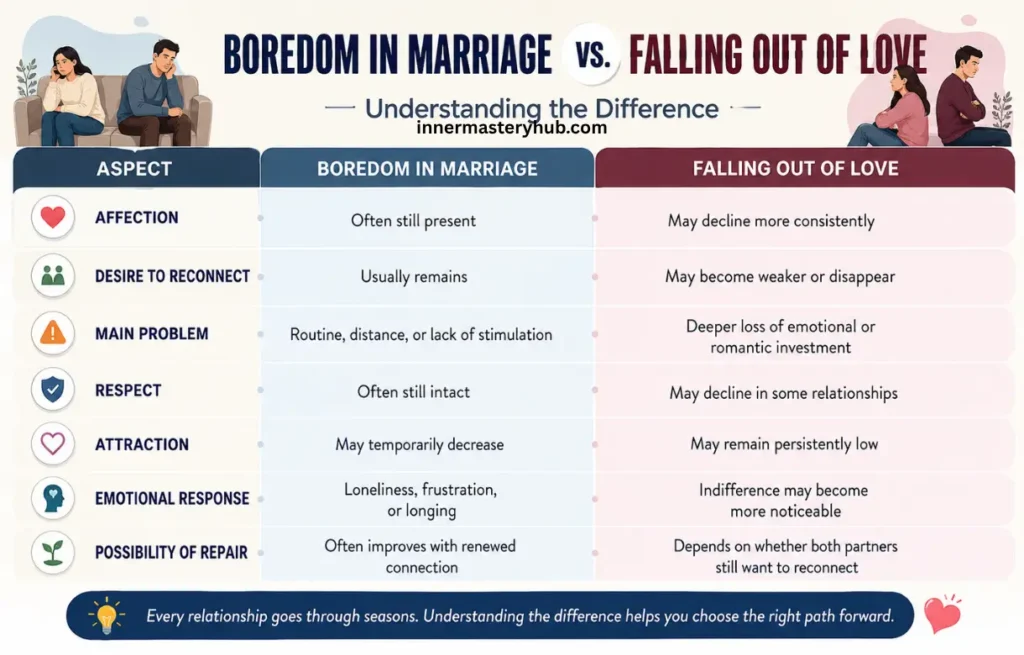
How is boredom in marriage different from falling out of love?
Wedding boredom means an emotionally lifeless relationship. Loss of love often means a deeper loss of affection, respect, desire, and readiness to reconcile. Emotional connection and meaning can reverse boredom.
The difference isn’t always clear.
Boredom may reduce attraction. You may lose patience. You may doubt love. Even if you question love, it may still be there. It may indicate routine-buried love.
Ask yourself:
- Do I still care about their pain?
- Do I want them to understand me?
- Do I miss what we had?
- Do I feel grief, or only indifference?
- Would I feel hope if they became emotionally present?
- Can I imagine rebuilding trust and warmth?
When is boredom in marriage a warning sign?
Boredom becomes a serious warning sign when it turns into chronic avoidance, emotional affairs, and loss of respect. It is also serious when one partner repeatedly asks for connection, and the other dismisses the need.
Not all boredom is equal. Some boredom is seasonal. It appears during stress, parenting, financial pressure, or burnout. This kind may soften when the couple has more emotional room.
But some boredom is a warning that the relationship has become emotionally unsafe or deeply neglected.
Pay attention when:
- You no longer care whether your partner notices you.
- You feel relief when they leave.
- You avoid all emotional or physical closeness.
- You seek validation from someone else and hide it.
- You feel contempt more than sadness.
- Your partner mocks your need for connection.
- You cannot imagine being emotionally honest with them.
- One or both of you refuse repair.
If boredom is mixed with emotional abuse, fear, coercion, humiliation, or control, the issue is not simple relationship boredom; it is safety and support. In that case, trusted professional help matters.
How Can Couples Reconnect?
Start with small, consistent changes rather than trying to transform the marriage overnight.
1. Have Deeper Conversations
Ask about feelings, hopes, worries, memories, and goals instead of discussing only chores, work, or schedules.
2. Create New Experiences
Try a new activity, visit a different place, cook something together, or change your usual weekend routine. Novelty can create opportunities for fresh interaction.
3. Give Each Other Full Attention
Put phones and other distractions aside during important conversations or shared time. Being present can help both partners feel noticed.
4. Express Appreciation
Regularly acknowledge what your spouse does well. Small expressions of gratitude can reduce the feeling of being overlooked or taken for granted.
5. Address Hidden Resentment
Boredom sometimes sits on top of unresolved disappointment. Talk about recurring frustrations calmly instead of allowing them to become emotional distance.
6. Bring Back Playfulness
Everyday life might feel less robotic when there is humour, warmth, teasing, common interests, and spontaneous moments.
7. Maintain Individual Interests
Healthy relationships may not involve doing everything together. Both partners can bring new experiences from their own interests, connections, and objectives back into the relationship.
Is the Relationship Worth Saving?
Periods of boredom or dissatisfaction are inevitable in relationships, and how you handle them can have a significant impact.
Reviving the connection takes time and effort. New and meaningful ways to communicate with your partner may boost your relationship and make you happier.
However, some may feel stuck and suffer through the routine, causing discontent and unhappiness. Some may choose to break up and pursue more gratifying and fulfilling relationships.
If you value your connection, you must actively strengthen it. Tolerating discomfort or ignoring problems can worsen issues and create hostility, damaging the partnership. Instead, work on intimacy and contentment with your relationship.
When Should Couples Consider Therapy?
When boredom persists despite reconnecting, conversations turn into conflicts, intimacy declines, or one or both partners feel hopeless, couples may explore therapy.
Unresolved animosity, betrayal, communication issues, emotional shutdown, or major life changes can also cause distance. Therapy might assist. A trained couples therapist can spot trends and improve communication.
Conclusion
Marriage boredom is a common problem, but it is not inevitable. Couples can revitalise their relationship by recognising the issue, addressing the underlying feelings, and actively seeking answers through various activities, open dialogue, and expert assistance. Every marriage is different, and a long-lasting, satisfying relationship depends on striking the correct balance between excitement and stability.
By focusing on clear communication and addressing common issues that arise in marriage, couples can overcome boredom and reaffirm their commitment to one another. Keep in mind that the answer often lies in being proactive in ensuring the marriage continues to develop and evolve.
People Also Ask
Why do couples get bored in marriage?
Over time, routines, predictable schedules, lack of novelty, poor communication, unmet emotional needs, or fading passion can lead to boredom. The excitement from early romance often gives way to comfort, and if the couple doesn’t work to renew their connection, boredom can settle in.
How can we overcome boredom in marriage?
Try new activities together, schedule “date nights,” explore shared hobbies, improve communication, express appreciation, and make room for spontaneity. Small changes, such as new experiences or deeper conversations, break monotony and renew closeness.
What conversation topics help beat boredom in marriage?
Ask meaningful, open-ended questions: dreams, fears, personal goals, past experiences, childhood memories, values, and plans. These develop deep intimacy and reveal new facets of each person. Avoid only surface talk (weather, chores), which often feels repetitive.
Can therapy or counselling help with marital boredom?
Yes. A therapist can guide you in rediscovering emotional connection, addressing neglected needs, resolving hidden conflicts, and teaching tools for effective communication and renewing intimacy. Professional help accelerates change and rekindles partnership.
How much alone time vs together time is healthy to prevent boredom in marriage?
Balance is key: spending quality time together nourishes the relationship; having space for personal interests, friends, and rest keeps individuals fresh. Too much togetherness can feel suffocating; too much separation erodes connection. Experiment to find what fits both.
When is boredom in marriage a signal to quit?
Boredom alone isn’t a sufficient reason to end a marriage. However, if there’s persistent neglect, a lack of respect, unaddressed conflict, or one partner is no longer committed to change, then it may indicate deeper incompatibility or irreparable issues.
How long does it typically take to break out of boredom in marriage?
It depends on the couple, the effort involved, and the issues at hand. Some might see improvement in weeks if both parties commit to change; for others, it may take months or longer. The process is ongoing; renewing closeness, communication, and novelty is continual work.
How do I tell my spouse I am bored without hurting them?
Speak about your feelings, not their identity. Instead of saying, “You are boring,” say, “I feel distant from us, and I miss feeling connected.” This keeps the conversation safer. Your goal is not to accuse your spouse, but to name the emotional gap and invite repair.
Why do I feel more excited around other people than my spouse?
You may feel more excited around others because novelty, attention, and emotional responsiveness awaken parts of you that have fallen asleep in the marriage. This does not automatically mean you should leave. It may mean your marriage needs more honesty, curiosity, play, and emotional risk.
Does Boredom Mean the Marriage Should End?
Not always. A marriage’s decision to end or continue is not solely based on boredom. Examine whether there is still affection, respect, emotional safety, communication openness, and a shared desire to strengthen the bond.
- Bloch, L., Haase, C. M., & Levenson, R. W. Research on emotion regulation and marital satisfaction shows that regulating negative emotion during couple interaction can predict later marital satisfaction. ↩︎
- Çağlar, A. (2026). Relationship boredom and relationship satisfaction in married couples: The role of meaningful life in marriage. Humanities and Social Sciences Communications. https://www.nature.com/articles/s41599-026-07168-1 ↩︎
- Tsapelas, I., Aron, A., & Orbuch, T. (2009). Marital boredom now predicts less satisfaction 9 years later. Psychological Science, 20(5), 543–545. https://doi.org/10.1111/j.1467-9280.2009.02332.x ↩︎
- Tsapelas, I., Aron, A., & Orbuch, T. (2009). Marital boredom now predicts less satisfaction 9 years later. Psychological Science, 20(5), 543–545. https://doi.org/10.1111/j.1467-9280.2009.02332.x ↩︎
Written By Mehwish Qurayshi
Mehwish Qurayshi is a Trauma-Informed Emotional Wellness Counsellor trained through NICABM’s Treating Trauma Master Series, which includes NBCC-approved education in Trauma Treatment and Emotional Wellness & Emotional Intelligence – Sourcecode Academia. She has over five years of experience providing emotional wellness counselling, helping individuals heal from trauma, regulate emotions, and build healthy relationships.