
9 Circle of Control Examples for Better Emotional Regulation
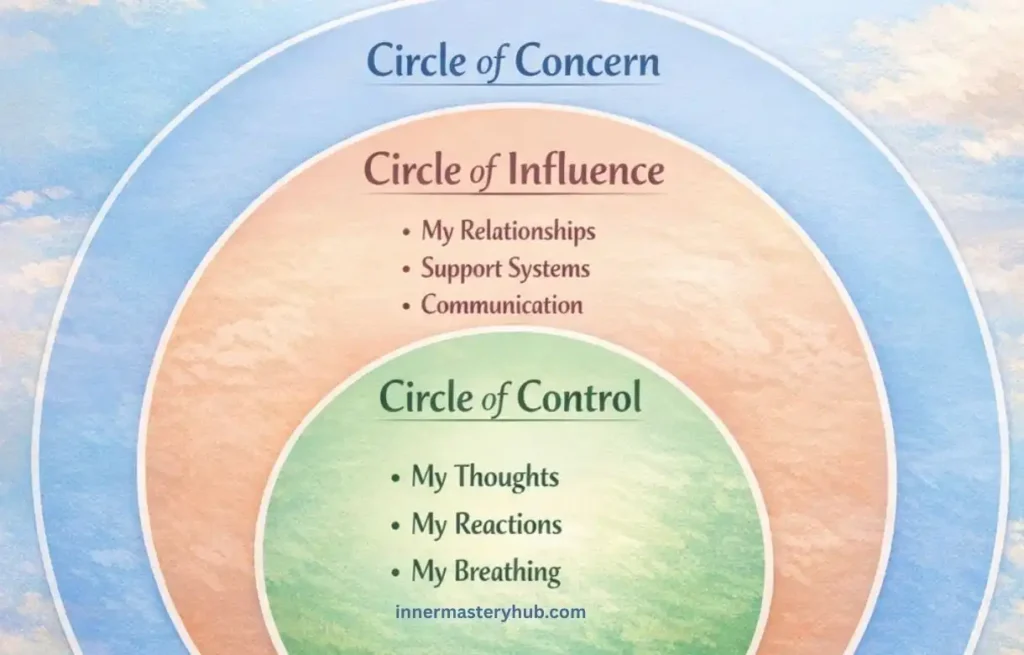
Circle of control examples for emotional regulation show how separating what you can control from what you cannot can make difficult situations easier to manage. Instead of trying to control another person’s reaction or the outcome, you focus on your own response, attention, and next step.
What Are Circle of Control Examples for Emotional Regulation?
Circle of control examples for emotional regulation show what you can actually do when a situation starts to feel out of your hands. You cannot make someone reply, change a decision that has already been made, or control how another person reacts. You can decide whether to follow up, what to say next, whether to keep checking your phone, or when to stop replaying the situation in your head.
This can make anxiety and overthinking easier to manage because it replaces guessing with a specific next step. Instead of asking, “What if this goes badly?” you ask, “What can I do about it right now?”
The examples below show how this works in everyday situations. A circle of control worksheet can also help you sort a situation into what you can control, what you may be able to influence, and what you cannot change.
Research on perceived control supports the basic idea behind this distinction. Chorpita and Barlow (1998) reviewed evidence linking experiences of low control with a greater tendency to interpret later situations as uncontrollable, a pattern associated with vulnerability to anxiety. This does not mean that focusing on controllable actions will remove anxiety, but it helps explain why feeling unable to influence a situation can make uncertainty harder to handle.[1]
Circle of Control Examples From Daily Life
Example 1: Someone Doesn’t Reply to Your Message
You send someone a message in the morning and, several hours later, there is still no reply. At first, you tell yourself they may be busy, but after checking your phone a few more times, your mind starts filling in the gaps. You wonder whether your message sounded wrong, whether they are upset, or whether you should send another text to explain yourself. The more you try to work out what their silence means, the more anxious you become.
This is where the circle of control becomes useful. You cannot control when the other person replies or what they are doing while you wait. You can control whether you send a clear follow-up, whether you keep checking your phone every few minutes, and whether you continue with the rest of your day. If there is no real reason to follow up yet, putting your attention back on something you can actually do prevents you from treating a delayed reply as proof that something has gone wrong.
If this kind of situation regularly sends you into an overthinking loop, a circle of control worksheet can help you separate what you know from what you are assuming.
Example 2: Receiving Criticism at Work
Imagine that your manager reviews a piece of work and says that part of it needs to be redone. Before they even finish explaining, you feel defensive and start thinking, “They think I’m bad at my job,” or “This is unfair because they didn’t give me clear instructions.” You may feel an urge to explain yourself immediately, interrupt, or list all the reasons the problem was not your fault.
The criticism itself is already outside your control. What remains within your control is how you respond to it. You can ask which part needs changing, write down the feedback, decide whether it is useful, and explain your position after you understand the concern. This is where self-awareness matters in a practical way: instead of reacting to the meaning you have attached to the criticism, you respond to what was actually said.
That does not mean accepting every criticism as correct. It means giving yourself enough space to decide whether the feedback needs action, clarification, or disagreement.
The connection between control beliefs and coping has also been examined across multiple studies. A 2019 systematic review and meta-analysis found that maladaptive coping partly explained the relationship between maladaptive locus of control and mental health problems. The meta-analysis included 15 studies and a pooled sample of 3,986 participants. In practice, this supports looking not only at whether a situation feels uncontrollable, but also at what you do next, such as repeatedly checking, avoiding, arguing, or taking a specific action that is still available to you.[2]
Example 3: Relationship Conflict
You and your partner are arguing about something that happened earlier in the week. You explain why you were upset, but they do not respond in the way you hoped. You repeat your point, add more examples, and start speaking more forcefully because you want them to understand exactly why you are right. The conversation becomes longer, but neither of you feels more understood.
The problem is that you are trying to control two things at once: your own communication and the other person’s reaction. You can control whether you explain your position clearly, whether you stay respectful, and whether you continue a conversation that has become insulting or unproductive. You cannot control whether the other person agrees with you, apologises in the way you want, or sees the event exactly as you do.
A more useful response may be, “I want to explain why this bothered me, but I don’t want us to keep repeating the same argument,” or, “I’m willing to continue this when we’re both calmer.” That keeps your attention on what you can actually do instead of trying to force the emotional outcome of the conversation.
Example 4: Overthinking a Past Conversation
You get home after meeting someone and start replaying one part of the conversation. You remember a joke you made and suddenly wonder whether it sounded rude. Then you think about their facial expression, the pause before they answered, and the way they said goodbye. Within a few minutes, you are mentally rewriting the conversation and imagining what you should have said instead.
At that point, the conversation itself is over. You cannot go back and change your wording, tone, or timing. What you can control is whether there is something useful to do now. If you genuinely think you were unclear or hurtful, you can send a simple message such as, “I’ve been thinking about what I said earlier, and I don’t think I explained myself well.” If there is no clear misunderstanding to fix, continuing to replay the interaction does not give you more control. It only keeps you trying to solve something that has already happened.
This pattern is closely related to replaying past conversations in your head, especially when the mind keeps returning to the same details without reaching any new conclusion.
Example 5: Waiting for Results
You finish a job interview on Monday and are told you will hear back later in the week. By Tuesday afternoon, you are checking your email every hour. On Wednesday, you start replaying your answers and deciding which ones sounded weak. By Thursday, you are imagining both rejection and acceptance, even though no new information has arrived.
The final decision is outside your control once the interview is finished. Your preparation, follow-up, and next steps are not. You can send a polite follow-up if appropriate, continue applying for other roles, and note anything you want to improve for your next interview. What usually increases anxiety is trying to produce certainty while you wait for an outcome that depends on other people.
The circle of control does not remove uncertainty. It gives you somewhere more useful to put your attention while uncertainty is still there.
Example 6: Social Anxiety Situation
You arrive at a social event where you know only one person. As soon as you walk in, you begin monitoring yourself. You wonder whether you look awkward, whether people are noticing that you are quiet, and whether the person you just spoke to seemed uninterested. Because so much of your attention is on other people’s reactions, every small expression starts to feel important.
Other people’s opinions are not something you can control. What you can control is your own participation. You might decide to introduce yourself to one person, ask one follow-up question, or stay for thirty minutes before deciding whether you want to leave. These are concrete actions you can complete without needing everyone in the room to approve of you.
The difference is small but important. Instead of asking, “Do they like me?” you ask, “What do I want to do in this situation?” That keeps the focus on behavior you can choose rather than reactions you cannot read accurately.
Example 7: Unexpected Change
You plan your day around an important meeting, but an hour before it starts, the meeting is cancelled. You immediately feel frustrated because you moved other tasks around to make time for it. Your first thoughts may be, “This has ruined my whole day,” or, “Why couldn’t they tell me earlier?”
You cannot undo the cancellation. What you can control is what happens next. You can ask when the meeting will be rescheduled, use the freed time for another task, move an appointment back into the space, or decide that you need a short break before reorganising your day.
Adaptability here does not mean pretending you are not annoyed. It means allowing the frustration to be there without spending the rest of the day arguing mentally with something that has already happened.
Example 8: Feeling Rejected
You apply for a role you really wanted and receive an email saying another candidate was selected. For a few minutes, you are disappointed. Then your thoughts begin to expand beyond the actual event. “I wasn’t chosen” becomes “I’m not good enough,” and that quickly becomes “I’ll probably keep failing at this.”
The rejection itself is outside your control. The meaning you build around it is not fixed. You can look at what happened, decide whether there is useful feedback to request, and consider whether anything in your application can be improved. What you do not have to do is turn one outcome into a judgment about your entire ability or future.
The same pattern can happen after romantic rejection, friendship changes, or being left out of an opportunity. The event may still hurt, but separating the event from the conclusion prevents one disappointment from becoming a much larger story about your worth.
Example 9: Future Worry
You start thinking about a problem that may happen several months from now. Perhaps you are worried about losing your job, failing an exam, or having to make a difficult financial decision. At first, the concern is reasonable. Then your mind begins building one possible outcome after another until you are worrying about problems that have not actually happened.
At that point, ask whether there is something you can do today. If you are worried about work, you might update your CV or review your savings. If you are worried about an exam, you can make a study plan. If you are worried about a conversation you need to have, you can decide when and how to start it.
If there is no useful action available yet, continuing to rehearse possible future problems does not make you more prepared. It only keeps your attention on uncertainty without giving you anything new to do.
Common Mistakes People Make
One common mistake is treating another person’s reaction as if it were something you can manage with enough explaining. You may keep repeating yourself because you want to prevent misunderstanding, or change your behavior repeatedly because you are trying to produce a specific response from someone else. Another common pattern is replaying past conversations, predicting outcomes before enough information is available, or taking responsibility for emotions that belong to another person.
These behaviors often feel active because your mind is busy, but they do not always lead to action. A useful check is to ask, “Is there something I can actually do here, or am I trying to control another person’s reaction, the past, or an outcome that has not happened yet?”
Conclusion
Circle of control examples for emotional regulation become most useful when the idea is applied to real situations rather than treated as a general mindset.
If someone does not reply, you can decide whether to follow up, but you cannot decide when they answer. If you receive criticism, you can ask questions and decide what to do with the feedback, but you cannot stop another person from having an opinion. During conflict, you can choose your tone and boundaries, but you cannot force agreement. While waiting for results, you can prepare for your next step, but you cannot produce the final decision yourself.
That is the practical purpose of the circle of control: it helps you identify the part of a difficult situation where your behavior can still make a difference.
For the full framework, read the Circle of Control vs. Circle of Influence guide.
People also ask
What are examples of the circle of control for emotional regulation?
Circle of control examples include waiting for someone to reply, receiving criticism, handling an argument, preparing for an exam, or waiting for a decision. In each case, the useful distinction is between what you can act on and what you cannot control. You cannot make someone respond, change another person’s opinion, or guarantee an outcome, but you can decide what to say, whether to follow up, how to prepare, and what to do next.
Why are examples of the circle of control important?
Circle of control examples make the idea easier to use in real situations. They help you notice when you are spending time trying to predict an outcome, change another person’s reaction, or replay something that has already happened. Once you identify that, you can return to the part of the situation where an action is still possible.
Can the circle of control examples help with overthinking?
Yes. It can help interrupt overthinking by separating a problem you can act on from one you can only speculate about. For example, if someone has not replied to your message, you can decide whether a follow-up is appropriate. What you cannot do is work out exactly what their silence means without more information.
How do I apply the Circle of Control?
Start by asking, “What can I actually do here?” If you are waiting for a result, that may mean preparing for the next step instead of checking for updates every few minutes. If you are in an argument, it may mean choosing your words and setting a boundary instead of trying to force the other person to agree with you.
What are everyday Circle of Control examples?
Everyday examples include managing your own spending instead of worrying about the economy, preparing for a test instead of trying to predict the final mark, speaking clearly during an argument instead of trying to control the other person’s reaction, and deciding whether to follow up on a delayed message instead of repeatedly checking your phone.
How do I teach the Circle of Control to children?
Use a situation they already understand, such as losing a game, getting a lower mark than expected, or arguing with a friend. Ask them what they could choose in that situation. They might not be able to control the score, the teacher’s decision, or what their friend says, but they can control whether they practise again, apologise, ask a question, or walk away from an argument.
- Chorpita, B. F., & Barlow, D. H. (1998). The development of anxiety: The role of control in the early environment. Psychological Bulletin, 124(1), 3–21. https://doi.org/10.1037/0033-2909.124.1.3 ↩︎
- Groth, N., et al. (2019). Coping as a mediator between locus of control, competence beliefs, and mental health: A systematic review and structural equation modelling meta-analysis. Behaviour Research and Therapy, 121, 103442. https://doi.org/10.1016/j.brat.2019.103442 ↩︎
Written By Mehwish Qurayshi
Mehwish Qurayshi is a Trauma-Informed Emotional Wellness Counsellor trained through NICABM’s Treating Trauma Master Series, which includes NBCC-approved education in Trauma Treatment and Emotional Wellness & Emotional Intelligence – Sourcecode Academia. She has over five years of experience providing emotional wellness counselling, helping individuals heal from trauma, regulate emotions, and build healthy relationships.