
Love is an Illusion or Is It Real? The Psychology of Love

Love is real, but our perception of love can be idealized. Attraction, attachment, expectations, past experiences, and projection can shape how you see a partner. Healthy love becomes more grounded when it is supported by trust, respect, realistic expectations, consistent behavior, and mutual care.
Grounded Love vs Idealized Love
| Grounded Love | Idealized Love |
|---|---|
| Sees the person realistically | Sees the person through fantasy or projection |
| Grows through trust and consistency | Depends heavily on intensity or excitement |
| Allows flaws and differences | Minimizes red flags or incompatibilities |
| Supports boundaries and individuality | May involve overdependence or loss of self |
| Handles conflict with communication | Treats conflict as proof the relationship is failing |
| Is based on repeated behavior | Is based more on hopes, assumptions, or potential |
| Can deepen as novelty fades | May weaken when reality challenges the fantasy |
Love can contain both reality and idealization. The important question is whether your view of the relationship becomes more accurate and grounded over time.
What Does “Love Is an Illusion” Actually Mean?
Love is not completely an illusion, but psychology, emotional needs, attachment patterns, memory, hormones, and personal wounds can shape your experience of love. What feels like “love” is often a mix of emotional connection, fear of Loss, validation, longing, and interpretation. That is why love can feel real while also becoming emotionally confusing.
Many people do not struggle with love itself. They struggle with what love awakens inside them.
Why Can Love Feel Like an Illusion?
1. Strong Chemistry Is Like Evidence of Love
Strong reward, motivation, and bonding systems in the brain may be involved in early love desire. Strong chemistry does not always imply long-term compatibility, even while this intensity may seem like evidence that someone is just right for you.
Whether trust, respect, common ideals, and emotional consistency persist when the initial passion subsides is a more pertinent question.
2. You romanticize the individual and ignore contradicting facts
It is possible for people to have a good perception of their romantic relationships while yet being fairly accurate about many of their characteristics. When idealization gets so intense that you consistently downplay incompatibilities, red flags, or significant differences, problems occur.
Research suggests that partner perceptions contain a mix of accuracy, projection, and bias, rather than being completely objective1. Instead of focusing on the person’s consistent behaviour in real life, you could grow connected to your perception of them.
3. You project your desires and needs onto the partnership
There are moments when you want a partner to become the person you need them to be: a source of self-worth, a healer. Disappointment can feel like evidence that love itself was false when reality does not live up to that expectation. However, sometimes the projected narrative is the one that has collapsed.
4. Attachment Issues Influence Your Relationship Interpretation
You may interpret intimacy, distance, rejection, and ambiguity differently depending on your past experiences and attachment insecurity. A delayed response could come across as abandonment. It could feel like betrayal to disagree. On the other hand, emotional intimacy could lead to withdrawal.
In these circumstances, attachment-related expectations play a role in the relationship’s experience, alongside current events.
5. You Anticipate Love to Begin with the Ideal Romance
Beliefs in soulmates, quick certainty, seamless compatibility, or a lasting “spark” can be shaped by movies, social media, cultural notions, and familial expectations.
Disagreement, stress, adjustment, and shifting emotions are all common in real partnerships. Normal relationship development may seem like proof that love has vanished if you anticipate early intensity to stay the same.
6. When reality is uncomfortable, your perception becomes selective.
Perception and memory are not entirely objective. After disappointment, you might only recall the good times, ignore the warning signs, or subsequently concentrate only on the unpleasant aspects.
Your initial perception of the relationship may be incomplete due to conflict, betrayal, financial strain, familial expectations, or evolving circumstances.
That does not imply that the love was fictitious. It can indicate that you now have a more realistic understanding of the connection.
Love vs Idealization: How Can You Tell the Difference?
| Grounded Love | Idealization |
|---|---|
| Sees the person realistically | Focuses on an imagined version |
| Accepts strengths and flaws | Minimizes flaws or red flags |
| Trust develops over time | Intensity feels like instant certainty |
| Respects boundaries | May overlook personal boundaries |
| Handles disagreement realistically | Conflict threatens the fantasy |
| Values consistent behavior | Focuses on potential or promises |
| Allows both people to be themselves | Projects expectations onto the partner |
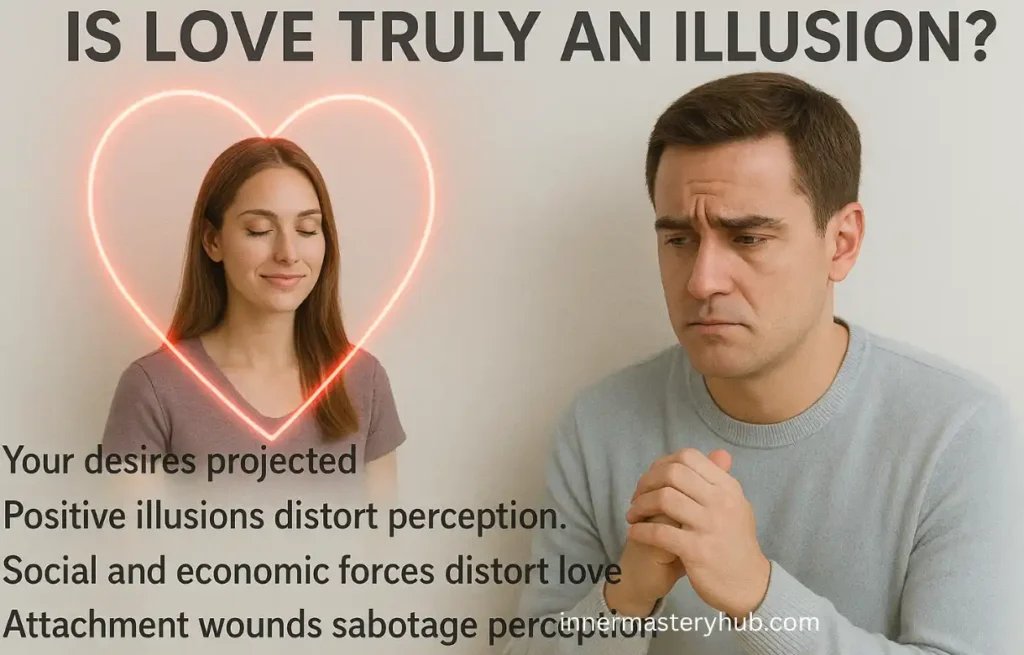
What Happens in the Brain When We Fall in Love?
Romantic love involves powerful brain chemicals like dopamine, oxytocin, serotonin, and vasopressin. These chemicals create attachment, pleasure, emotional focus, and bonding. When someone gives you emotional attention, validation, affection, or intimacy, your brain rewards the experience.
Romantic attraction and bonding involve several interacting brain systems and neurochemicals, including dopamine, oxytocin, and vasopressin. Dopamine is particularly involved in reward and motivation, while oxytocin and vasopressin have been studied for their roles in social bonding.
This explains why:
- Emotional distance feels painful
- Rejection feels physically distressing
- Attachment becomes psychologically intense
But chemistry alone cannot explain emotional depth. Two people can experience the same hormones while feeling completely different levels of emotional safety. One feels secure, and the other feels emotionally dependent.
How Attachment Can Shape the Way We Experience Love
In romantic relationships, attachment styles can affect how we perceive intimacy, trust, and uncertainty. Attachment anxiety and attachment avoidance are the two characteristics that adult attachment research typically uses to characterize insecurity.
Attachment Anxiety
People with higher levels of attachment anxiety may be concerned about their partner’s availability, rejection, or abandonment. When the relationship seems uncertain, they could become more perceptive of behavioural shifts in a partner and look for assurance.
Attachment Avoidance
People with higher attachment avoidance may find it difficult to rely on other people or to become emotionally vulnerable. They may separate themselves, repress their connection needs, or become overly self-reliant under stress. Without predicting the success of a relationship, these patterns can influence the sensation of intimacy and love2.
How Past Trauma Can Influence Romantic Relationships
Past trauma can shape how you experience trust, vulnerability, closeness, and relationship uncertainty. Depending on the person and their experiences, reminders of past harm may contribute to heightened vigilance, avoidance, difficulty trusting others, or stronger emotional reactions in close relationships. However, trauma affects people differently and does not determine someone’s relationship patterns.
People with unresolved emotional wounds may struggle to believe love is stable because past experiences taught them that closeness leads to pain.
How Trauma Changes Love
Trauma affects:
- Emotional regulation
- Nervous system responses
- Trust formation
- Conflict interpretation
- Self-worth perception
Because the neurological system is accustomed to emotional turmoil, a healthy relationship may seem “boring” at times. On the other hand, because uncertainty triggers well-known emotional patterns, emotionally unavailable partnerships might feel thrilling. For this reason, many people repeat unpleasant relationship patterns without realizing it.
According to research from the American Psychological Association, emotional trauma affects both cognitive interpretation and interpersonal attachment behaviors3.
You are not simply reacting to the present relationship. You are reacting to emotional memory.
Is Love Real If It Changes Over Time?
Indeed. Because people change over time on an emotional, psychological, and biological level, true love also changes. Stable love frequently becomes less chemically intense, more profound. A common misconception is that fading intensity indicates the end of love. However, emotional calm does not equate to emotional absence.
At the beginning of relationships:
- Novelty is high
- Dopamine spikes
- Emotional anticipation increases
- Fantasy projection happens naturally
Later, reality enters:
- Habits become visible
- Emotional differences appear
- Personal insecurities surface
- Emotional regulation matters more
Romantic feelings can change as relationships develop. The intense novelty and preoccupation common in early romance may decrease over time, while some long-term relationships develop more familiarity, companionship, trust, and commitment.
How to Love Without Idealizing Your Partner
- Pay attention to consistent behavior, not just words or potential.
- Accept that your partner has both strengths and flaws.
- Notice when you are making excuses for concerning behavior.
- Separate what you know from what you hope is true.
- Keep your own interests, friendships, and boundaries.
- Communicate openly instead of making assumptions.
- Allow disagreements without seeing them as proof love is failing.
- Let trust develop gradually through respect, honesty, and consistency.
Why People Question Love?
You ask yourself, “Is love an illusion?” usually after disappointment, emotional confusion, rejection, betrayal, or emotional exhaustion. Something inside you starts questioning whether love was ever real or whether your mind created a story you desperately wanted to believe.
That internal struggle starts when emotional regulation breaks down. You replay conversations and analyze mixed signals. You feel emotionally attached while also feeling emotionally unsafe. Part of you wants closeness, but another part wants protection. That conflict creates emotional chaos naturally. Emotional uncertainty can increase stress or attachment-related anxiety, particularly when someone is sensitive to rejection or abandonment.
Most people think the pain means love was fake. But often, the pain reveals unresolved emotional patterns underneath the relationship. Love itself may not be an illusion. But the version of love you created through unmet needs, fear of abandonment, emotional dependency, trauma bonding, fantasy attachment, or validation-seeking can absolutely feel like one.
Childhood maltreatment has been associated with greater adult attachment anxiety and avoidance, although these associations do not mean trauma determines later relationships4.
Neuroscience research also shows that romantic love activates reward systems in the brain, similar to those involved in addictive behaviors5. This explains why emotional attachment can feel overwhelming and difficult to separate from identity. Because of this fact, many people confuse emotional intensity with love.
What Does Healthy Love Actually Feel Like?
Healthy love feels emotionally safe, emotionally honest, and psychologically grounding. It may feel less dramatic, but it creates stability rather than emotional chaos.
Healthy Love Usually Includes
- Emotional consistency
- Honest communication
- Secure attachment
- Respect for boundaries
- Emotional accountability
- Psychological safety
Healthy love does not completely eradicate fear. However, it reduces emotional ambiguity. Because emotional trust outweighs emotional speculation, you no longer continuously analyze every interaction. At first, such emotional stability is frequently strange. particularly to those whose nervous systems have been accustomed to unpredictable emotions.
How to Love Without Illusions
Loving without illusions does not mean becoming cynical or expecting the worst. It means seeing another person as they truly are rather than as you wish them to be. Healthy love grows when you accept that nobody is perfect, including yourself.
Take relationships slowly, especially in the beginning. Strong feelings can make it easy to overlook red flags or imagine qualities that are not really there. Give yourself time to learn who the person truly is through their actions, not just their words.
Pay attention to your own emotional patterns as well. Sometimes we expect a partner to heal old wounds, provide constant reassurance, or fill our emotional emptiness. Becoming aware of these needs can help you build healthy and real relationships.
It is also important to balance feelings with reality. Ask yourself whether your values, goals, and communication styles are compatible. Love needs emotional connection, but it also needs trust, respect, honesty, and shared values.
Finally, accept that love changes over time. The intense excitement of early romance naturally settles. Lasting love often becomes quieter, deeper, and more stable. Real love is not about perfection. It is about choosing to know someone fully, including their flaws, and to continue growing together.
Key Takeaways
- Love is not completely an illusion, but emotions, attachment patterns, and personal experiences shape how we experience it.
- Brain chemicals like dopamine and oxytocin can intensify feelings, especially in the early stages of love.
- Emotional intensity does not always mean genuine love. Sometimes it reflects attachment wounds, fear, or unmet emotional needs.
- Trauma, insecurity, and past relationship experiences can shape how we perceive love and emotional safety.
- Healthy relationships generally involve trust, respect, honest communication, appropriate boundaries, and mutual care.
- Love often becomes quieter and deeper over time as relationships move beyond idealization and fantasy.
- Understanding your own emotional patterns can help you build more realistic and fulfilling relationships.
Conclusion
Love is not simply fake, chemical, or imagined. But human beings rarely experience love in a completely objective way. Your emotional history, attachment style, nervous system, beliefs, trauma, fears, and unmet needs all shape how love feels internally.
That is why one relationship creates emotional peace while another creates obsession, anxiety, or emotional collapse. The misunderstanding begins when people treat emotional intensity as proof of emotional truth.
Sometimes what hurts most is not losing another person. It is losing the emotional story your mind created around them. Real love usually brings clarity over time, not constant emotional confusion.
And when you begin understanding your internal emotional patterns, the question slowly changes from “Is love an illusion?” to “Why did I need love to mean what it meant to me?”
If this article helped you understand your emotional patterns differently, reflect honestly on your relationship experiences instead of only analyzing other people’s behavior.
People Also Ask
What do people mean by “love is an illusion”?
They mean that love is only a trick of the mind, a deeply idealized fantasy, or based on false perceptions rather than reality. It suggests romantic feelings aren’t truly grounded in a lasting connection, but in projection, chemistry, or wishful thinking.
Why do some people feel love is an illusion after heartbreak?
After betrayal or pain, ideal images crumble. People may generalize from a single negative experience and conclude that all love is false. Their trust and hope are shattered, leading them to believe love was never “real” to begin with.
Is “Love Is An Illusion” true in real life?
For some people, yes. “Love Is An Illusion” feels true when emotions fade or expectations fail. But others believe love becomes real through trust, time, and effort. Whether it’s an illusion or not depends on how mature, honest, and mutual the relationship is.
Why do people say “Love Is An Illusion”?
People say “Love Is An Illusion” when they’ve been hurt, betrayed, or disillusioned. They feel love only tricks the mind into believing in forever. This phrase reflects emotional pain and the realization that fantasy doesn’t always match reality.
What is the psychology behind “Love Is An Illusion”?
Psychologists say “Love Is An Illusion” arises from projection. We project our hopes, fears, or unmet needs onto others. The brain also releases chemicals like dopamine, creating intense feelings that fade with time, making love seem like an illusion.
What can we learn from “Love Is An Illusion”?
“Love Is An Illusion” teaches us to love with awareness, not fantasy. It reminds us to see people as they are, not as we wish them to be. Real love grows when illusion ends, and truth begins.
Can “Love Is An Illusion” turn into true love?
Yes. Many relationships start with illusion but mature into real love as partners learn each other’s flaws and stay committed. The illusion fades, but deep affection and understanding can replace it, turning fantasy into reality.
How to know if “Love Is An Illusion” is in my relationship?
If your love depends on perfection, fantasy, or constant excitement, it might be an illusion. Real love grows through patience, honesty, and shared values. Illusory love fades when challenges come; true love endures through them.
Is love really an illusion or just an idealized concept?
Love often combines reality with illusion. You might idealize or project, but there is also a real connection, along with emotions and attachment. Research shows both accuracy and bias in how people judge love.
How do I rebuild after believing “love is an illusion”?
Start by healing your heart. Reflect on what illusions you believed. Adjust your expectations. Practice real connection slowly. Seek therapy or a supportive community. Allow yourself to love again with clearer eyes.
- LaBuda, J. E., & Gere, J. (2023). A meta-analytic review of accuracy and bias in romantic partner perceptions. Psychological Bulletin, 149(9–10), 580–610. https://doi.org/10.1037/bul0000405 ↩︎
- Simpson, J. A., & Rholes, W. S. (2017). Adult attachment, stress, and romantic relationships. Current Opinion in Psychology, 13, 19–24. https://doi.org/10.1016/j.copsyc.2016.04.006 ↩︎
- Li, S., Ma, Y., Cao, X., Liu, J., Qi, Y., & Chen, X. (2026). Childhood maltreatment and adult attachment: A three-level meta-analytic review. Trauma, Violence, & Abuse. https://doi.org/10.1177/15248380261455767 ↩︎
- Li, S., Ma, Y., Cao, X., Liu, J., Qi, Y., & Chen, X. (2026). Childhood maltreatment and adult attachment: A three-level meta-analytic review. Trauma, Violence, & Abuse. Advance online publication. https://doi.org/10.1177/15248380261455767 ↩︎
- Fisher, H. E., Aron, A., & Brown, L. L. (2005). Romantic love: An fMRI study of a neural mechanism for mate choice. Journal of Comparative Neurology, 493(1), 58–62.
PubMed Source ↩︎
Written By Mehwish Qurayshi
Mehwish Qurayshi is a Trauma-Informed Emotional Wellness Counsellor trained through NICABM’s Treating Trauma Master Series, which includes NBCC-approved education in Trauma Treatment and Emotional Wellness & Emotional Intelligence – Sourcecode Academia. She has over five years of experience providing emotional wellness counselling, helping individuals heal from trauma, regulate emotions, and build healthy relationships.