
Feeling Personally Attacked? How to Regain Control Without Ignoring Real Harm

Interpreting someone else’s words or actions as a danger to your reputation, value, or character is what feeling personally attacked looks like. Before answering, take a moment to distinguish between what actually happened and what you assumed, get clarification, and then choose whether to accept constructive criticism, establish a boundary, or disconnect.
We understand that personal attacks can take many various forms, from harsh comments and criticism to character assassination and cyberbullying. Whether you feel personally attacked or not, my goal is to provide you with the tools you need to respond responsibly, protect your mental health, and eventually emerge stronger from these difficult times.
You’re going to learn how to respond politely, keep your cool, and have fruitful conversations if you’ve been personally attacked and want to become more prepared to manage similar situations.
Identifying a Personal Attack
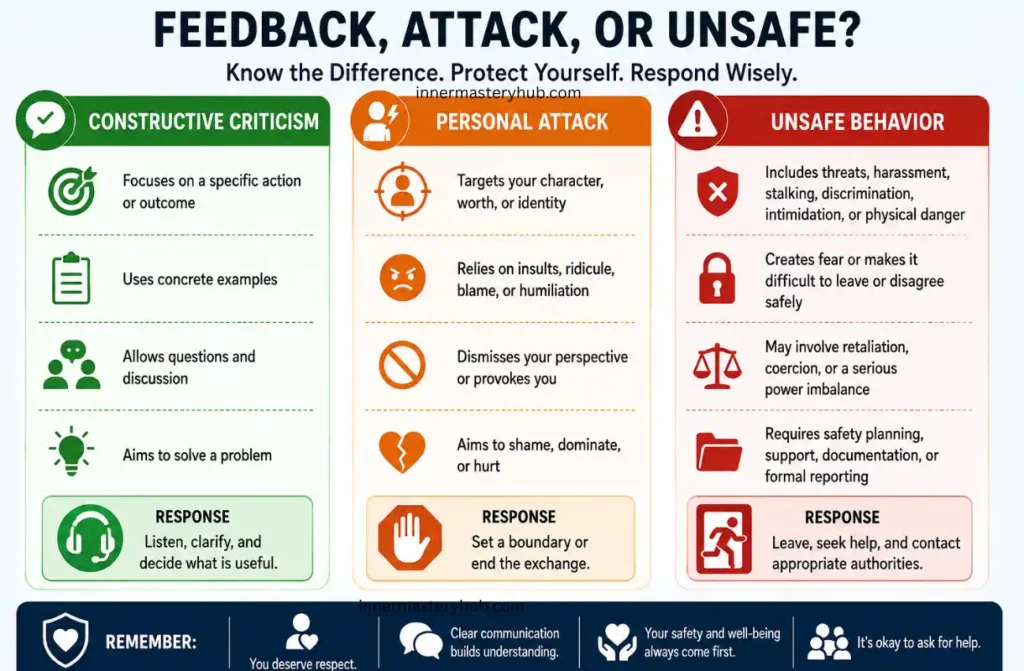
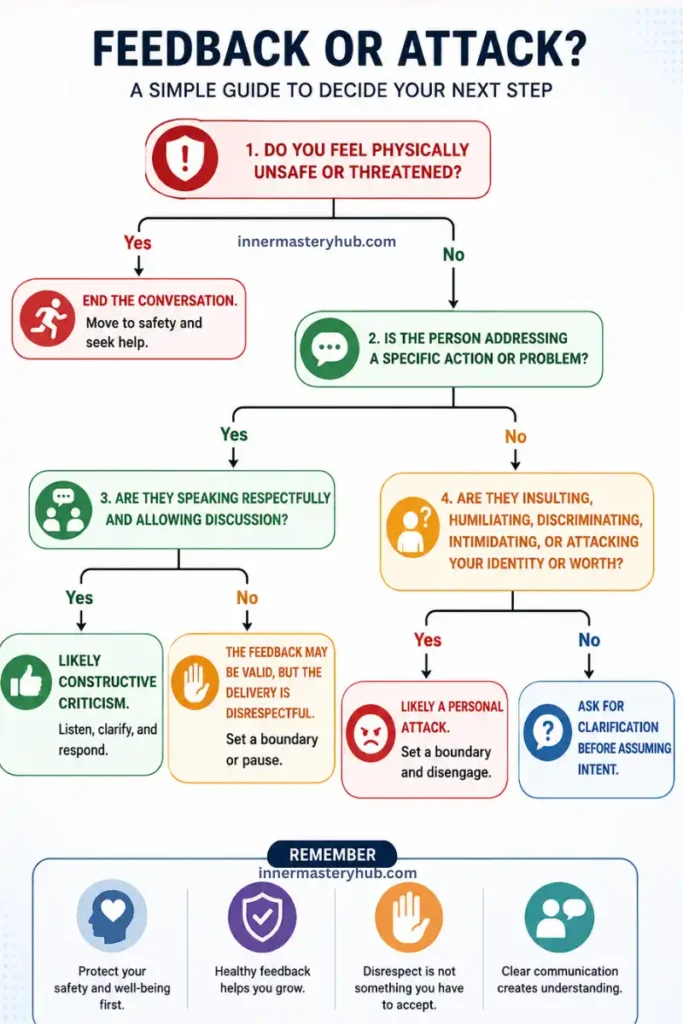
The first step in identifying a personal attack is to see if the attacker is focusing on your character rather than the problem. Rather than giving helpful criticism, insults, humiliation, false allegations, name-calling, hostile body language, cyberbullying, or threats could be signs of verbal abuse. But not every awkward statement constitutes an attack. Before responding, take into account the language, tone, context, and intended meaning.
Find out if the criticism is constructive, courteous, and improvement-oriented. Pause and ask for clarification if the statement seems ambiguous. When your safety or emotional well-being is at risk, maintain composure, set clear boundaries, record repeated behaviour, and seek help or disconnect.
How does feeling personally attacked show up?
1. You jump to defense instantly.
When a friend or coworker makes a tiny recommendation, you may react negatively or shut down since it feels like a full-fledged criticism. According to research, when someone sees everything as an attack, they frequently become trapped in a cycle of anxiety, miscommunication, and unfavourable expectations1.
2. You feel shame or humiliation.
You might replay a comment repeatedly and feel vulnerable, reduced, or “less than,” even if it wasn’t meant to hurt you. When you internalise others’ criticism as proof of your own shortcomings, even if it is unjustified, it may lead to shame2.
3. You assume hidden motives.
Instead of hearing someone’s words at face value, you ask: “What do they mean by that? Are they attacking me?” This can make you hyper-vigilant and exhausted.
4. Your self‐worth takes a hit.
When you’re always feeling attacked, you may believe: “I’m flawed,” “I’m inadequate,” or “People don’t value me.” People who feel personally attacked often have deep-seated insecurity or past negative experiences. Perceived rejection may momentarily weaken a person’s sense of a distinct and stable identity, according to research on rejection sensitivity. Previous negative experiences, such as family strife, strict parenting, emotional abuse, or neglect, may also be linked to heightened sensitivity to rejection3.
5. Relationships suffer.
Because you interpret remarks as threats, you withdraw, become defensive, or lash out. Others may feel walking on eggshells around you. Over time, friendliness fades and connection weakens.
6. You mistake feedback for betrayal.
Even genuine feedback and comments might feel like an attack on your character. You might respond: “Oh, so you think I’m incompetent?” instead of “Okay, you want me to improve.”
7. You get stuck in a victim mindset.
You may believe: “They always pick on me,” “It’s never fair,” or “I’m the one who suffers.” And that mindset keeps you from taking control.
8. You avoid speaking up.
Because you’re scared of being attacked again, you might stay silent or shrink in groups, expressing less of yourself to stay safe.
9. You overreact later.
Something small might set you off hours later; you think: “Why did they say that?” You reply, and it builds into anger or sadness.
10. Your physical stress goes up.
Feeling under attack keeps your body in a state of alertness. Some writing about feeling “under siege” says that when you believe you’re constantly threatened, your stress response stays on, and you get tired, anxious, and irritable.
11. You misread intentions.
You assume harmful intent even when someone’s being neutral or unclear, and that gap between what is said and what you hear drives conflict.
Understanding The Attacker’s Perspective
How to defend yourself if someone attacks you? There can be various
Imagine yourself in the following situation: Your reputation, self-worth, or general well-being are in danger. Seeking retribution may seem like the only way to defend oneself or restore control in such circumstances, which may trigger emotions.
Put yourself in a situation that makes you feel scared, ashamed, furious, or frustrated. These strong emotions may cloud your judgement and cause you to behave hastily without properly weighing the implications. You almost feel like you’re in the middle of an emotional storm, so you take revenge as a form of self-defence.
A sense of unfairness is often the driving force behind retaliation. You may sincerely think that everyone should be aware of the injustice you have endured. It feels like you’re saying, “I won’t stand for this,” and attempting to put things back in order. This yearning for justice is what drives your retaliatory behaviour.
Being personally attacked can occasionally resurface old wounds. Being wounded or traumatized in the past might create emotional scars that increase your propensity to defend yourself when you sense a threat. It feels like old hurts are resurfacing, which makes you feel a greater need to protect yourself.
Misunderstandings can help. If you mistake someone’s motives or speech, you may react defensively. A tangle of misunderstandings and revenge.
Consider your lifelong coping mechanisms. Retaliation can become a default reaction or emotional defence mechanism without effective techniques to manage negative emotions. You seem to be using it to avoid more hurt.
Final point: moral justification. It may seem ethical to retaliate in this case. This belief may justify your behaviour.

Best approach to deal with when feeling personally attacked
Let’s explore the psychological dynamics that can motivate someone’s “retaliatory” behavior.
No matter what triggers your reaction- hurt, guilt, devaluation, mistrust, disdain, rejection, outrage, insult, or whatever. This self-defense approach will emotionally protect you almost immediately.
Ask yourself, “Before the other person pushed your button, which one of their buttons might you have pushed?” when you lose your cool. Your initial unease, anger, or negative sentiments about yourself will start to reduce if you understand the other’s criticism as mainly expressing something about them.
You’re “taking in” what they said rather than “taking it out.” And this only makes things more complicated between the two of you. You can immediately do this to distance yourself from your internal suffering and turn your attention back externally.
You might start to develop new insights into the psychological dynamic that inspired that person’s “retaliatory” behavior by trying to understand where they might be coming from. And there are several questions you can put to them that, if phrased just correctly, can show the reason they were upset before turning against you.
By reframing yourself as an objective observer instead of a reactive victim, you’re essentially teaching your brain to stick with the more mature, logical side of you and not let the current slight undermine your superior decision-making.
Keep in mind that the attacker’s words or deeds reveal their problems. It isn’t an accurate representation of your value. You can emotionally distance yourself from the attack by adopting this mindset change.
Recall that emotional intelligence and inner strength are demonstrated when you remain composed in the face of personal abuse. With time, effort, and self-awareness, this skill can be refined.
Believing that we are good, deserving people is a sign of emotional growth, not arrogance.
Indications That You’re Getting Defensive
- You develop negative self-perceptions.
Thoughts like “I’m imperfect,” “I’m inadequate,” or “People don’t value me” are strengthened by the interaction.
2. You take criticism personally.
Any recommendation, no matter how minor, feels like a critique of your personality or skills.
3. You look for concealed hatred.
You question what someone “truly meant” rather than accepting their statements at face value.
4. You repeatedly play back the exchange.
You feel ashamed, vulnerable, or diminished when you keep going back to the comment.
5. In response, you argue, retreat, or shut down.
Your initial reaction is to defend yourself, launch a counterattack, sidestep the discussion, or shut up.
6. When you’re with other people, you become extremely alert.
You keep a keen eye out for indications of rejection or disapproval in people’s words, tone, and facial expressions.
Importance of Retaining Composure
When responding to a personal attack, it’s essential to retain your composure because:
- Your response reveals a lot about your values.
- You won’t get any help from confronting your attacker.
- By doing this, the situation will not worsen.
- You’ll be able to manage your emotions more effectively.
- Your response will provide the attacker with insight into how to approach you.
What to Avoid When Being Personally Attacked
Impulsive or defensive responses can exacerbate the problem and reduce the likelihood of a constructive resolution. You may have a more rational and insightful discussion if you maintain composure.
Deep breathing exercises can help you feel less stressed right away. Please take a few deep breaths through your nose, hold them for a moment, and gently release them through your mouth. Repeat several times to maintain your composure.
We frequently have the instinct to attack back to defend ourselves when we feel personally attacked. However, in general, fighting back only reinforces how the attackers perceive us as individuals. If you act in a manner that is inconsistent with your values, it may also lead to feelings of guilt.
If possible, take a quick pause to refocus. A brief break from the situation can give you a fresh perspective.
How to Avoid Engaging in Destructive Behavior
Everyone is free to express their opinions. Whether you agree with them or not is entirely up to you.
Step 1: Pause & breathe
When you feel triggered, stop. Take a deep breath. Give yourself one moment before responding. That time helps you see if it is an attack or just a misunderstanding.
Step 2: Reality check
Ask yourself: “Did they really mean to hurt me, or am I reading this based on past hurt?” The article about feeling under siege suggests: separate what actually happened from what you think happened.
Step 3: Use “I” statements
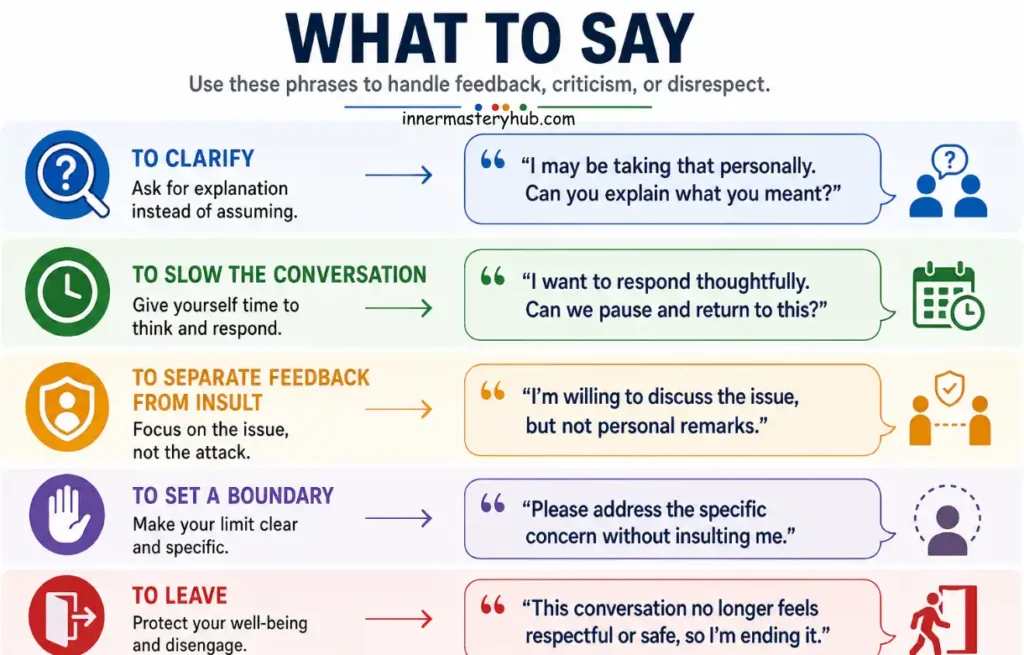
Instead of “You always attack me!”, try: “When you said X, I felt like you were criticizing me.” It opens dialogue instead of blame.
Step 4: Build your self-worth
Work on your belief in yourself. The more confident you are in your value, the less likely you’ll feel small when others speak. The “don’t take it personally” guide suggests that low self-confidence and a fear of rejection often underlie these feelings.
Step 5: Ask for clarity
Ask for clarification by saying, “What did you mean by that?” This gives the other person an opportunity to explain. Respond with an “I” statement, such as, “I felt disrespected when you said that,” instead of making accusations.
Step 6: Set boundaries
If someone consistently makes you feel attacked, it’s okay to step away or say, “That remark hurt; please don’t speak to me like that.”
Step 7: Reflect on triggers
What past experiences make you extra sensitive? Acknowledging them gives you the power to change your reaction.
Step 8: Learn to respond, not react
One article on how to calmly respond to personal attacks advises: Recognize the shock or shame, detach a little from the immediate insult, and respond from your values, not your hurt.
Step 9: Practice empathy
Try to see the other person’s side. Perhaps they’re off, stressed, or not expressing themselves well. Putting yourself in their shoes can calm your reaction.
When not to continue the conversation
If the other person threatens, harasses, discriminates against, stalks, intimidates, or puts you in danger, stop the conversation. When a significant power disparity makes it unsafe to disagree or depart freely, move away. Put safety first, record what happened, ask for help from reputable people or the appropriate authorities, and contact emergency services if there is a chance of immediate harm.
Conclusion
It’s not “in your head” to feel personally attacked. It’s genuine, and it shows in your behaviour, emotions, and reactions. However, you have the power to alter it. You may stop feeling like the target and begin to feel stronger, calmer, and more connected by taking a moment to reflect, gain clarity, and develop your inner strength.
People Also Ask
Why do people make personal attacks?
People may make personal attacks for various reasons, such as insecurity, frustration, or a desire to divert attention from their shortcomings. Personal attacks can also be used as a manipulation tactic to gain power or control in a disagreement. It’s essential to address such behavior constructively and maintain respectful communication.
How do you act when someone attacks you personally?
When someone attacks you, remain composed and refrain from retaliating with aggression. Listen actively to understand their perspective, and express your own calmly. Set boundaries and assertively communicate that personal attacks are unacceptable. If necessary, disengage from the situation or seek assistance from a mediator or authority figure to resolve the issue.
Are we expected to abide by thinly veiled insults?
No, you are not expected to tolerate thinly veiled insults. It’s essential to assertively address such behavior by communicating discomfort and setting clear boundaries. Encourage respectful, open communication to maintain healthy relationships, while not accepting or condoning insulting or disrespectful remarks.
Why do I always feel personally attacked even when someone says something small?
It could be that you’re sensitive to judgment, have past hurt or insecurity, and your mind reads neutral comments as threats. This makes you interpret even mild remarks as attacks.
Can religious or cultural backgrounds affect feelings of being personally attacked?
Yes. If you come from an environment where criticism was harsh or where honor and face are significant, you may be more sensitive to remarks and interpret them as attacks more quickly.
How can I stop taking everything personally?
Instead than viewing the particular remark as a critique of your entire personality, concentrate on it. Remind yourself that another person’s view does not define your value, ask for clarification, and evaluate whether the feedback provides helpful information.
What should I say when someone attacks me personally?
Respond calmly and describe the behaviour directly. You might say, “I am willing to discuss the issue, but I will not continue the conversation if I am being insulted.” Clear language helps you set a boundary without escalating the conflict.
Why do I become defensive when someone criticises me?
Defensiveness may occur when feedback feels like a threat to your competence, identity, or self-worth. Instead of reacting immediately, ask what specific behaviour needs improvement. This helps you determine whether the comment is useful criticism, poor communication, or a genuine personal attack.
- Cain, N. M., De Panfilis, C., Meehan, K. B., & Clarkin, J. F. (2017). A multisurface interpersonal circumplex assessment of rejection sensitivity. Journal of Personality Assessment, 99(1), 35–45. doi: 10.1080/00223891.2016.1186032 ↩︎
- Miceli, M., & Castelfranchi, C. (2018). Reconsidering the differences between shame and guilt. Europe’s Journal of Psychology, 14(3), 710–733. https://doi.org/10.5964/ejop.v14i3.1564 ↩︎
- Ayduk, Ö., Gyurak, A., & Luerssen, A. (2009). Rejection sensitivity moderates the impact of rejection on self-concept clarity. Personality and Social Psychology Bulletin, 35(11), 1467–1478. https://doi.org/10.1177/0146167209343969 ↩︎
Written By Mehwish Qurayshi
Mehwish Qurayshi is a Trauma-Informed Emotional Wellness Counsellor trained through NICABM’s Treating Trauma Master Series, which includes NBCC-approved education in Trauma Treatment and Emotional Wellness & Emotional Intelligence – Sourcecode Academia. She has over five years of experience providing emotional wellness counselling, helping individuals heal from trauma, regulate emotions, and build healthy relationships.