
Stability of an Unhappy Marriage: 12 Powerful Truths That Quietly Disturb Your Life

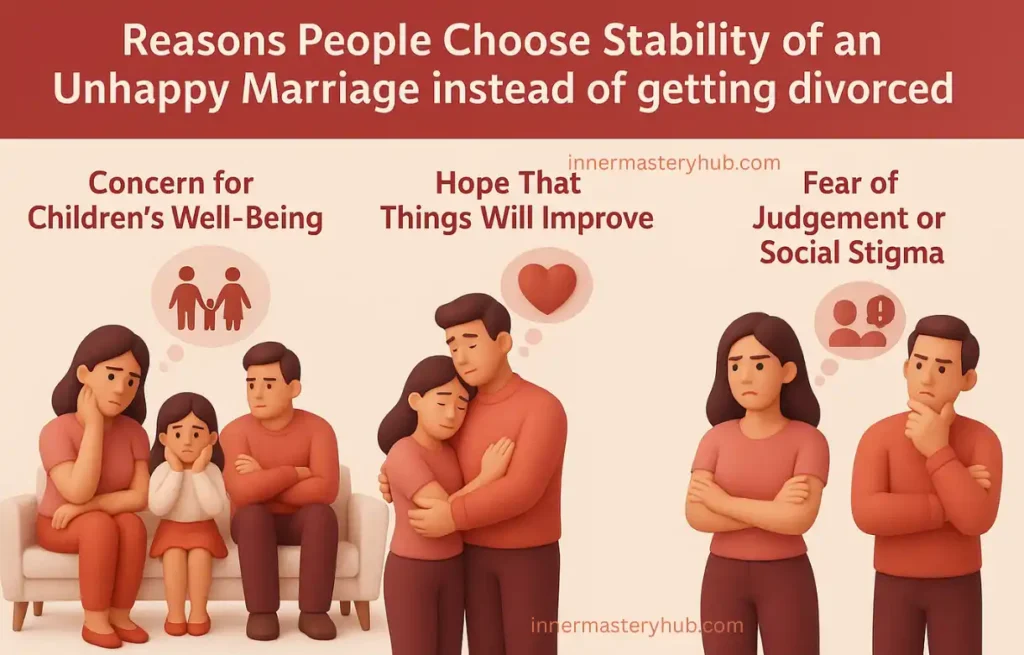
What is the stability of an unhappy marriage?
The stability of an unhappy marriage refers to a relationship that continues over time despite emotional dissatisfaction. It remains intact due to factors such as fear, habit, children, finances, or social pressure, even as emotional connection, intimacy, and fulfilment slowly decline.
When you think about the stability of an unhappy marriage, you may imagine a heavy mix of security, fear, habit, and hope all tangled together. Many people stay in marriages that no longer feel loving and fulfilling, not because they want to suffer, but because the idea of breaking apart feels even more overwhelming.
To help you see your own emotions clearly and make decisions with more self-awareness, rather than guilt and confusion, you need to identify the causes behind feeling a certain way in your relationship.
One of the findings researchers have made is that people tolerate unhappiness longer than expected when they believe the alternative may bring greater instability.
What most people misunderstand is this:
They think the problem is the relationship itself. But what is happening inside you matters just as much. Your interpretations, fears, and emotional patterns shape how you experience the marriage.
As psychologist John Gottman explains, emotional disconnection, not conflict, is the real predictor of relationship breakdown1.
What Does Stability of an Unhappy Marriage Really Mean?
The stability of an unhappy marriage means a relationship continues without breaking up, even when emotional satisfaction is low. It is structurally stable but emotionally unstable.
A marriage can look steady because there are no major conflicts. But stability does not mean happiness. It means:
- Avoidance of conflict
- Emotional distance
- Routine replacing connection
- Fear keeps things in place
You may stay because leaving feels harder than staying, but internally, something keeps asking for more.
Why Do People Stay in an Unhappy but Stable Marriage?
People stay because stability feels safer than uncertainty. Fear, responsibility, and emotional conditioning make staying seem like the easier choice.
The process looks like this:
- A trigger happens (lack of attention)
- You interpret it (“Maybe this is normal”)
- You feel numb or resigned
- You stay, reinforcing the pattern
Common reasons include:
- Financial dependency
- Children and family expectations
- Fear of loneliness
- Cultural or religious beliefs
- Emotional burnout
According to a study published in the Journal of Marriage and Family2, many couples remain in low-quality marriages due to perceived barriers to leaving rather than dissatisfaction.
Is the Stability of an Unhappy Marriage Actually Healthy?
No, long-term emotional dissatisfaction can harm mental and physical health, even if the relationship appears stable.
While stability reduces chaos, it can increase:
- Chronic stress
- Anxiety
- Emotional suppression
- Low self-worth
Research from the American Psychological Association shows that unhappy relationships are linked to higher stress levels and poorer immune function3.
So while the marriage “works,” your inner system slowly pays the cost.
What Happens Emotionally Inside You Over Time?
You gradually disconnect from your feelings, needs, and identity while maintaining the relationship externally.
It often unfolds quietly:
- You stop expressing needs
- You adjust expectations downward
- You normalise emotional distance
- You feel less like yourself
Esther Perel notes that many people do not leave relationships because they are unhappy; they leave because they feel dead inside4.
What Is the Biggest Misunderstanding About Unhappy Marriages?
The biggest misunderstanding is believing that “no conflict” means “no problem.”
In reality:
- Silence can replace communication
- Avoidance can replace resolution
- Comfort can replace connection
You might think, “At least we are not fighting.”
But the deeper issue is emotional absence, not emotional intensity.
What Common Mistakes Keep the Stability of an Unhappy Marriage Going?
People unintentionally perpetuate the situation by avoiding discomfort rather than addressing the emotional truth.
Common patterns include:
- Ignoring your feelings
- Over-justifying your partner’s behaviour
- Comparing to worse relationships
- Staying busy to avoid reflection
- Believing happiness is unrealistic
Because facing truth feels risky, staying feels easier.
How Does Emotional Regulation Affect This Situation?
Emotional regulation helps you cope, but it can also keep you stuck if it turns into emotional suppression.
Healthy regulation means:
- Understanding your feelings
- Expressing them calmly
- Responding intentionally
But unhealthy regulation looks like:
- Silencing your needs
- Minimizing your pain
- Accepting less than you need
This creates stability, but not fulfillment.
12 Reasons People Choose the Stability of an Unhappy Marriage Instead of Getting Divorced
1. Fear of Financial Instability
Even when a marriage feels emotionally empty, money remains a significant reason people stay in an unhappy marriage. Even while you may know deep down that you’re unhappy, the idea of having two different homes, paying legal bills, or losing joint assets can cause severe anxiety.
One of the top three reasons couples put off getting divorced is financial concerns. You may convince yourself that staying is safer when you consider your income, bills, housing, and expenses. Even when you feel emotionally trapped, that fear becomes a strong anchor, keeping you stuck.
2. Concern for Children’s Well-Being
Divorce may upset your children’s emotional stability, even if you are miserable. Many parents envision their children experiencing identity issues, guilt, or uncertainty. However, long-term research by psychologist E. Mavis Hetherington reveals that ongoing conflict, instead of getting divorced, harms kids the most.
However, in the midst of a challenging marriage, you could persuade yourself that staying together, even if it means being unhappy, is the better option. Because you think your children’s routine and structure are more important than your own happiness, you bear the emotional burden.
3. Emotional Comfort in Familiarity
It’s common to feel safer in the known than in the unknown. You’ve learnt to manage routines, expectations, and a rhythm even in an unhappy marriage. Even if it hurts, you may convince yourself that you can manage what you already know, but you’re not sure you can handle what might come next.
According to behavioural psychology studies, humans are inherently more comfortable with predictable discomfort than with unforeseen change. Even if it’s unstable, the familiar can seem like the only thing you have left when you’re worn out or emotionally spent.
4. Cultural or Religious Pressure
You may have learnt from your background that marriage must endure at any cost. Perhaps you grew up in a society where separation is viewed as a failure or where divorce is harshly condemned. Even if the relationship is exhausting, you may feel ethically bound to continue because of your religious convictions.
People living in very religious societies prefer to stay in toxic marriages instead of getting divorced because they feel a duty to preserve tradition. You can end up remaining out of fear of failing people more than because you want the marriage.
5. Hope That Things Will Improve
You might think that things could get back to how they were with time, patience, or compromise, or you might remember how the relationship used to be. That hope turns into a silent friend who murmurs, “Maybe it’s not time to give up yet.” This idea is called “optimism bias,” a human tendency to think that things will get better in the future despite evidence to the contrary. Because letting go feels like giving up on years of work and investment, you may stick to this hope.
6. Fear of Loneliness
Having someone physically present can make the notion of being totally alone frightening, even in situations where marriage doesn’t feel emotionally intense. You could question whether you’ll ever meet someone else or start a fresh relationship from scratch.
People fear social isolation more than relationship frustration. You may prefer the security of an unhappy marriage as an armour against the silence when you picture lonely nights, peaceful holidays, or sleeping by yourself.
7. Guilt About Hurting a Partner
You might feel accountable for your partner’s emotional well-being. You worry that leaving them would hurt them, even if you’re not happy. Guilt becomes a strong force that prevents you from acting when you remind yourself of their positive traits or the times they helped you.
People choose self-sacrifice when they think their decisions could hurt someone they care about, through guilt-based decision-making. You might stay out of compassion, along with regret-related fear, rather than out of love.
8. Shared Life Investments
Together, you build more than just memories over the years. Homes, money, pets, rituals, customs, and social circles are all shared. You have encouraged each other’s ambitions and built careers together.
Divorce seems like burning down a life you fought so hard to create because of the weight of all those shared investments when you think about starting over. The notion that the more you’ve invested, the more difficult it is to withdraw is known to economists as “sunk cost thinking.” You might decide to stay because you worry that leaving would make those years seem pointless.
9. Lack of Emotional or Practical Support Outside the Marriage
Leaving a marriage becomes much more difficult when you don’t have strong support from friends, family, or the community. You may be concerned about who will listen to you, help you move, or offer emotional support.
People who have few support systems are more likely to remain in bad partnerships because they find it challenging to handle a divorce on their own. Without a solid safety net, staying could seem like your only choice.

10. Fear of Judgment or Social Stigma
Divorce is still stigmatised in some families and societies today. You can be afraid of being blamed, pitied, or judged. You may also be concerned about how your breakup will impact your children’s social surroundings and your reputation.
Social expectations significantly influence marital decisions, and many people internalise the belief that “good people don’t get divorced.” You stay longer than your emotional health can sustain because of that internal voice.
11. Emotional Exhaustion
Sometimes you stay in an unhappy marriage just because you’re too emotionally spent to deal with the turmoil of divorce. Even minor choices feel difficult when you’re exhausted. “I’ll deal with it later,” you may think, but later may turn into months or years.
Emotional exhaustion impairs problem-solving and leads people to take the easiest route: staying in an unhappy marriage. It is easier to stay than to deal with lawyers, relocate, make financial decisions, and have unpleasant conversations.
12. A Sense of Duty or Commitment
Even if the marriage no longer feels emotionally satisfying, you might still strongly believe in honouring your commitments. You may remind yourself that you committed to stay “for better or worse,” and you may perceive the “worse” as something you must put up with.
The sense of obligation that originates from societal norms, personal values, or family role models. People who prioritise commitment as a moral ideal stay in marriages even after love or satisfaction wanes, according to numerous studies.
Can an Unhappy Marriage Become Truly Stable and Happy?
Yes, but only when emotional awareness replaces avoidance and both partners engage honestly.
Change does not come from:
- Waiting
- Hoping
- Enduring
It comes from awareness, because once you see clearly, you cannot unsee.
As Carl Jung said:
“Until you make the unconscious conscious, it will direct your life, and you will call it fate.”
The Quiet Stability Trap
A couple stays together for 12 years. No major fights, no major issues. But no emotional intimacy either.
The husband believes stability equals success. The wife feels unseen but cannot explain why.
Over time:
- Conversations become transactional
- Emotional needs go unmet
- Both feel alone, together
They did not fail suddenly. They slowly disconnected while maintaining structure.
This is the hidden cost of stability without emotional presence.
Choosing What Stability Means for You
A detailed examination of the durability of an unhappy marriage reveals that people seldom stay for no other reason than to be sad. They remain because they are attempting to shield themselves from uncertainty, critique, loneliness, and financial fear. It doesn’t mean you’re weak if you can identify your own ideas when reading this. It indicates that you are a normal person.
Just be honest about your motivations and allow yourself to envision a life that feels emotionally secure rather than merely predictable. You have the chance to select a type of stability that supports rather than depletes you.
Whether that means healing your marriage or eventually stepping away from it, clarity is the first step toward a life that feels more aligned with who you are and what you need.
Conclusion
The stability of an unhappy marriage is not about strength; it’s about endurance. And endurance, while admirable, can quietly distance you from yourself.
You are not just staying in a relationship. You are shaping how you experience your own life.
The real shift happens when you stop asking,
“How do I keep this stable?”
and start asking,
“What am I feeling, and why?”
Because clarity does not force change, but it makes staying unconscious impossible.
FAQs
Can the stability of an unhappy marriage still be valid?
Yes. A marriage can feel emotionally unhappy but remain stable because both partners maintain routines, responsibilities, and shared commitments. Stability comes from financial security, parenting, habit, or fear of change, not from emotional closeness or satisfaction.
Why do people stay in unhappy marriages?
People stay because of financial concerns, children, loneliness, cultural pressure, or fear of the unknown. Many people choose predictable discomfort over uncertain change, believing that stability carries fewer risks than getting divorced. Emotional exhaustion also makes leaving harder.
Can the stability of an unhappy marriage affect children?
Children sense emotional tension even in the absence of open conflict. While some believe staying “for the kids” is best, research shows that long-term strife, stress, or emotional distance between parents can influence children’s self-esteem and relationships later in life.
Is it healthy to stay in an unhappy marriage?
It depends on the level of conflict. Low-conflict, unhappy marriages may feel empty but manageable, while high-conflict marriages can affect physical and emotional health. Studies show that constant tension or hostility harms well-being more than separation.
Can staying in an unhappy marriage become happy again?
Yes, if both partners are willing to communicate honestly and make the necessary changes. Marriage counselling, emotional reconnection, and practical adjustments can help rebuild trust and closeness.
How do you know if it’s time to stop dragging yourself to stay in an unhappy marriage?
You may consider leaving when emotional or physical safety is at risk, when repeated efforts fail, or when the relationship drains your well-being. If staying feels like losing yourself, it may be time to reevaluate your future.
Why does the fear of divorce keep people stuck?
Divorce brings financial worries, lifestyle changes, legal processes, and emotional uncertainty—many fear loneliness, judgment, or starting over. The stability of an unhappy marriage feels easier than dealing with unpredictable consequences.
What happens emotionally when you stay in an unhappy marriage?
You may feel resentment, loneliness, or emotional numbness. Over time, staying without addressing issues can shape your self-esteem and stress levels. Some people adapt to the routine, while others feel stuck or disconnected from their identity.
Are people happier after leaving an unhappy marriage?
Many experience relief, renewed confidence, and emotional clarity, especially if the marriage involved conflict. Others may struggle with loneliness or financial stress at first. Long-term happiness often depends on personal growth and healthy support systems.
How can you bring stability without staying in an unhappy marriage?
You can work on communication, therapy, personal boundaries, emotional connection, and shared goals. Stability doesn’t have to mean settling. When both partners commit to changes, the marriage can become healthier without staying in emotional discomfort.
What are the signs of an emotionally disconnected marriage?
Signs include lack of deep conversations, reduced intimacy, emotional numbness, avoidance of conflict, and feeling like roommates instead of partners. These patterns often develop gradually.
What are the signs of an emotionally disconnected marriage?
Signs include lack of deep conversations, reduced intimacy, emotional numbness, avoidance of conflict, and feeling like roommates instead of partners. These patterns often develop gradually.
What is the difference between a stable and a healthy marriage?
A stable marriage continues over time, while a healthy marriage includes emotional connection, communication, and mutual fulfilment.
- Gottman, J. (1999). The Seven Principles for Making Marriage Work ↩︎
- Hawkins, A. J., & Booth, A. (2005). Unhappily ever after: Effects of long-term, low-quality marriages on well-being. Journal of Marriage and Family, 67(3), 727–743. https://doi.org/10.1111/j.1741-3737.2005.00170.x ↩︎
- American Psychological Association. (2013). Stress in Relationships. ↩︎
- Perel, E. (2017). The State of Affairs ↩︎
Written By Mehwish Qurayshi
Mehwish Qurayshi is a Trauma-Informed Emotional Wellness Counsellor trained through NICABM’s Treating Trauma Master Series, which includes NBCC-approved education in Trauma Treatment and Emotional Wellness & Emotional Intelligence – Sourcecode Academia. She has over five years of experience providing emotional wellness counselling, helping individuals heal from trauma, regulate emotions, and build healthy relationships.