
What Is Locus of Control? Internal vs. External With Examples

.
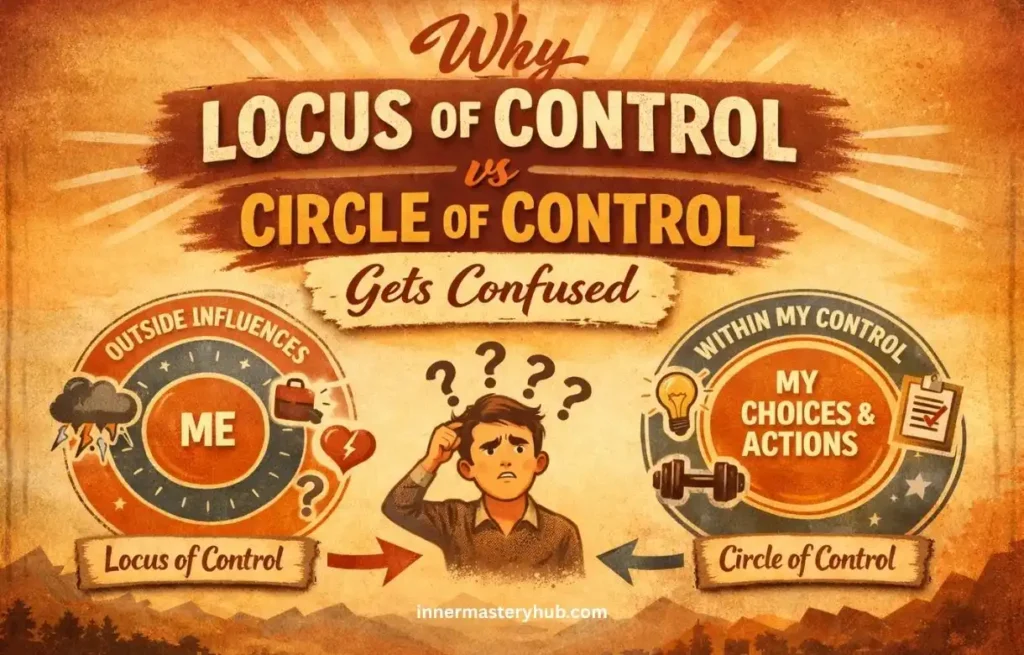
The locus of control vs circle of control distinction explains the difference between believing you control your life and focusing on what you actually can control. Emotional stress increases when attention moves outside control. Emotional regulation improves when belief and focus align internally.
| Locus of Control | Circle of Control |
|---|---|
| Psychological belief | Practical framework |
| Internal vs external | Control vs influence |
| Shapes interpretation | Shapes attention |
| Created by Rotter | Popularized by Covey |
| Explains mindset | Guides action |
The difference between where you focus your attention and where you think control starts is known as the locus of control or the circle of control. The locus of control is psychological, whereas the circle of control is practical. Emotions increase when your focus shifts beyond your control.
When you’re already nervous when you wake up, suddenly, an overlooked message changes your plan, or someone acts unjustly. Your mind responds quickly, but it’s not dramatic. You begin to wonder, “Why is this happening?” Why am I unable to get my way?
The concepts of the circle of control and the circle of influence are closely related to locus of control because both focus on how people respond to circumstances they can and cannot change.
This is the point at which emotional control gets messed up. It is due to the perception of control rather than actual events. The true internal question is straightforward: Do I control my life, or does life control me?
This is the space where the concept of locus of control vs the circle of control becomes important. One shapes your belief. The other shapes your focus. And together, they decide your emotional response.
Most people misunderstand the problem. They think stress comes from outside factors. But the tension actually forms in a hidden sequence, based on your internal beliefs. A trigger appears. Your mind interprets it as a loss of control. Emotions such as anxiety, anger, and helplessness rise, and behavior is followed by overthinking, blaming, and withdrawing.
This happens automatically. But it is shaped by whether your mind leans toward an internal or external locus of control, and by whether your attention sits inside or outside your circle of control.
Psychologist Julian B. Rotter introduced the concept of locus of control in 1966. He explained that people with an internal locus believe outcomes depend on their actions, while those with an external locus believe outcomes depend on luck, fate, or others. Research shows people with an internal locus experience lower stress and higher resilience1.
What is Locus of Control
Locus of control is your belief about who controls outcomes. The circle of control is the range of things you can actually influence. When your beliefs and attention align, emotions stabilize. When belief and focus separate, stress increases.
There is an internal locus of control, but the interpretation of it is what matters. The control circle is external. It thrives on attention.
You can think that the negative situations in your life are your fault. However, your attention becomes uncontrollable if you are preoccupied with other people’s actions.
Tension results from this mismatch, where you feel accountable but helpless.
This explains why even people who are struggling with emotional management are.
How does locus of Control Belongs To Emotional Regulation?
Emotional regulation improves when your locus of control is internal and your attention stays inside your circle of control. When your mind focuses on uncontrollable events, the brain signals threat and uncertainty, increasing anxiety.
Your brain constantly scans for control. When control feels lost, the nervous system activates. Cortisol rises. Thoughts multiply.
According to research published in the journal Personality and Individual Differences, individuals with an external locus of control report higher anxiety and lower emotional stability2.
But there is another layer.
Even people with an internal locus can feel anxious because their circle of control is misdirected. They believe they should control outcomes. But outcomes are not inside their circle. This creates pressure.
You start trying to control:
- how others behave
- How quickly success comes
- What people think
- uncertain results
- future outcomes
Naturally, anxiety increases.
What Mistakes Do People Make?
People confuse responsibility with control when they try to manage outcomes instead of responses. This shifts attention outside their circle and increases stress.
Common mistakes:
- trying to control others
- worrying about results
- overthinking future events
- seeking certainty
- blaming circumstances
- forcing positivity
These behaviors feel productive. But they move attention outward. So naturally, emotional stability decreases.
Why Your Locus of Control Gets Confused
The locus of control or circle of control gets confused because both refer to control. But locus of control is belief, while circle of control is focus. One’s interpretation. The other shapes attention.
People assume an internal locus of control means controlling everything. This is where confusion begins.
- You believe you should control outcomes.
- You try to manage uncertainty.
- You try to influence people.
But these sit outside your circle.
So you feel responsible, yet powerless.
This creates inner friction.
You think: “I should handle this.”
But also: “I cannot control this.”
This mismatch produces anxiety.
The confusion grows because both concepts sound similar. Both use the word control. But they operate differently.
8 Examples That Change Your Reactions
1. You don’t react to events; you react to perceived control
Your emotional reaction is shaped by whether you believe control is lost. When attention moves outside your circle of control, the brain senses uncertainty. This triggers anxiety, frustration, or helplessness even when the situation itself is small.
A delayed reply doesn’t hurt. But feeling powerless does.
A setback doesn’t overwhelm you. Loss of control does.
When your locus of control shifts outward, emotions intensify. When attention returns inward, reactions soften.
2. Overthinking is a sign that your focus has left your circle
Overthinking begins when attention shifts outside your circle of control. Your mind keeps analyzing things you cannot influence, searching for certainty.
- You replay conversations.
- You imagine outcomes.
- You predict reactions.
This mental loop happens because control feels distant. Returning focus inward naturally reduces overthinking.
3. Internal locus of control without boundaries creates pressure
Believing you control everything creates an emotional burden. An internal locus of control works only when paired with the circle of control. Otherwise, you take responsibility for outcomes that depend on others.
You start thinking:
- I should fix this
- I must handle everything
- I need to control outcomes
But outcomes sit outside your circle. This creates silent stress.
True emotional stability comes when you control your response, not results.

4. Anxiety increases when attention moves outside your circle
Your brain searches for predictability. When your focus shifts to things you cannot influence, uncertainty increases. This raises anxiety and overthinking.
You begin focusing on:
- What others think
- future outcomes
- external decisions
- uncertainty
These sit outside your circle of control. Emotional regulation weakens.
Returning attention inward restores calm.
5. External locus of control creates emotional helplessness
When you believe outside forces control life, your mind feels powerless. This reduces motivation and increases emotional reactivity.
You may think:
- nothing depends on me
- People decide everything
- Outcomes are luck
This belief pushes attention outward. You stop acting. You start worrying.
The reaction becomes heavier, not because life changed, but because control feels distant.
6. Emotional calm begins when belief and focus align
When your locus of control is internal and your attention stays inside your circle, emotions stabilize. You stop chasing certainty and start responding consciously.
You focus on:
- effort
- mindset
- response
- interpretation
These sit within your control. Your nervous system relaxes. Thoughts slow. Reactions change.
This is where locus of control vs circle of control becomes emotionally powerful.
7. The mind seeks control before it seeks clarity
Your brain first tries to find control, not truth. When control seems lost, it creates fear-based interpretations. This intensifies reactions even before facts are clear.
- You assume rejection.
- You assume failure.
- You assume risk.
These interpretations come from perceived loss of control. Restoring focus inward reduces emotional escalation.
8. Trying to control outcomes quietly increases frustration
Frustration grows when you try to control results instead of responses. Outcomes depend on many factors outside your circle of control. When your locus of control pushes you toward results, emotional tension builds.
You try to control timing. You try to control others. You try to control certainty.
But outcomes resist control. The mind interprets this as failure.
When to Use Locus of Control
Use the locus of control when examining your beliefs about responsibility. Use the circle of control when deciding where to place attention. Together, they guide emotional clarity and response.
Use locus of control when you notice thoughts like:
- Why is this happening to me
- Nothing is in my control
- People decide my life
- I cannot change anything
These thoughts signal an external locus.
Use the circle of control when you feel overwhelmed. It redirects attention toward:
- your response
- your effort
- your mindset
- your behavior
This creates grounding.
How Do Locus of Control and Circle of Control Work Together?
Locus of control shapes belief. The circle of control directs attention in your daily life. When belief and attention align internally, emotional clarity improves.
Think of it like this:
Locus of control = where power comes from
Circle of control = where energy goes
When both are internal:
- You act calmly
- You think clearly
- You respond instead of reacting
A circle of control worksheet can help you identify where your attention and energy are currently focused.
Why This Shift Changes Inner Experience
When attention returns to your circle of control, the brain senses predictability. Emotional intensity lowers. Thoughts slow. You respond instead of react.
You stop asking:
Why is this happening?
And start noticing:
What is in my control right now?
This small shift changes the emotional tone.
Not because life changes. But because the interpretation changes.
Conclusion
The tension you feel is not always about circumstances. It forms when your mind searches for control in the wrong place. The locus of control vs the circle of control reveals that belief and attention must align. When they do, emotions settle naturally. You stop fighting uncertainty and start responding with clarity.
Related Articles
People also ask
What is the locus of control activity?
The locus of control activity is an exercise used to identify an individual’s perceived control over their life events. It typically involves a questionnaire or scenarios in which one has to attribute outcomes to internal or external factors, thereby revealing their perceived locus of control: internal or external influences, or that all control relates to internal factors.
What is an example of locus of control with students?
In an educational context, a student with a solid internal and external locus of control might believe that their grades directly result from the time and effort they put into studying. Conversely, a student with an internal or external locus of control might attribute their degree to the subject’s difficulty, the teacher’s instructional methods, or luck.
What is an example of an external locus of control?
An example of an external locus of control is a person believing they didn’t get a job because of bad luck, despite having prepared extensively for the interview. They attribute the positive outcome only to outer factors and believe their efforts had minimal influence.
What is the difference between the locus of control and the circle of control?
Locus of control refers to your belief about who controls outcomes, while circle of control refers to the things you can directly influence. Together, they determine emotional reactions. When belief is internal and attention remains within your control, stress decreases and clarity improves.
Which is more important, locus of control or circle of control?
Both are connected. Locus of control shapes mindset, while circle of control shapes focus. Without circle awareness, the internal locus becomes pressure. Without an internal locus, circle awareness feels passive. Alignment between both improves emotional stability.
Is the circle of control part of the locus of control?
The circle of control is not part of the locus of control, but it supports it. Locus of control is psychological. The circle of control is practical. The circle trains attention to match an internal locus.
How does locus of control affect stress?
An external locus of control increases stress because outcomes feel unpredictable. An internal locus reduces stress by shifting attention to response and effort. Research shows that an internal locus correlates with greater emotional resilience.
Can you change your locus of control?
Yes, locus of control is flexible. Awareness, reflection, and shifts in attention gradually move it inward. The circle of control is often used as a mental model to develop an internal locus of control.
Why do people focus outside their circle of control?
The brain seeks certainty. When outcomes are unclear, attention moves outward. This creates anxiety. Returning focus inward restores predictability.
What is an example of locus of control vs circle of control?
Waiting for exam results. External locus focuses on grading. Internal locus focuses on preparation. The circle of control keeps attention on effort rather than on outcome.
Is the internal locus of control always good?
An internal locus helps resilience, but an extreme internal locus may create pressure. Balance comes from focusing only on controllable actions.
How does this help emotional regulation?
When attention stays in control, the nervous system relaxes. Emotions stabilize. Thoughts slow down.
- Benassi, V. A., Sweeney, P. D., & Dufour, C. L. (1988). Is there a relation between locus of control orientation and depression? Journal of Abnormal Psychology, 97(3), 357–367. https://doi.org/10.1037/0021-843X.97.3.357 ↩︎
- Cheng, C., Cheung, S. F., Chio, J. H., & Chan, M. P. (2013). Cultural meaning of perceived control: A meta-analysis of locus of control and psychological symptoms across 18 cultural regions. Personality and Individual Differences, 54(7), 859–863. ↩︎
Written By Mehwish Qurayshi
Mehwish Qurayshi is a Trauma-Informed Emotional Wellness Counsellor trained through NICABM’s Treating Trauma Master Series, which includes NBCC-approved education in Trauma Treatment and Emotional Wellness & Emotional Intelligence – Sourcecode Academia. She has over five years of experience providing emotional wellness counselling, helping individuals heal from trauma, regulate emotions, and build healthy relationships.