
25 Personal Why Statement Examples + How to Write Your Own

A personal why statement is a short sentence that explains why a goal, choice, or direction matters to you. It usually connects what you want to do with a value, relationship, or outcome that is personally important. For example: “My why is to build a secure career so I can support my family and create more opportunities for our future.”
Personal Why Statement Formula
You do not need to make your why sound impressive.
Start with two questions:
What do I want to do?
Why does that matter to me?
Then combine the answers:
My why is to [what I want to do] so that [why it matters].
For example:
“My why is to help people feel more confident so they can make decisions for themselves.”
What Makes a Personal Why Different From a Goal?
A goal tells you what you want to achieve.
Your why explains why that goal matters to you.
For example:
Goal: “I want a successful career.”
Why: “I want a secure career so I can support my family and create more choices for our future.”
The goal gives you a direction. Your why gives that direction personal meaning.
The examples below can help you see what that might look like in different parts of life. Use them as starting points rather than sentences to copy exactly.
Why Statement Examples for Personal Growth
- I want to keep learning about myself so I can make choices that feel true to who I am.
- I try to learn something from difficult experiences because I want to handle future challenges with more confidence.
- Taking care of my health is important to me because I want enough energy to enjoy my life and be present for the people I care about.
- Part of my growth is questioning beliefs that hold me back so I can make choices based on what I actually want.
- Living by my values matters more to me than meeting everyone else’s expectations, because I want to make decisions I can stand behind
Why Statement Examples for Career and Work
- I want to do work that uses my strengths to solve problems that genuinely matter to people.
- Doing work I can be proud of matters to me because I want my team and clients to know they can rely on me.
- I keep developing my professional skills so I can take on challenging, worthwhile work.
- Building a stable career is important to me because I want to give myself and my family more security and choices for the future.
- As a leader, I want people to feel respected and heard, because good work should not come at the cost of how people are treated.
Why Statement Examples for students
- Education gives me more choices for the future, which is why I want to keep learning and developing myself.
- What I learn becomes more meaningful when I can use it, so I want to build practical skills that help me solve real problems.
- Curiosity keeps me from assuming I already know enough, and I want to keep asking questions that broaden my understanding.
- Finishing my degree matters to me because it can open opportunities that are not available to me yet.
- When learning becomes difficult, I want to keep going so one setback does not decide what I do next.
Why Statement Examples for Relationships
- Home should feel like a place where people know they are loved, so I want to create a family environment built on support, respect, and listening.
- Open communication matters in my relationships because I would rather build trust than leave people guessing what I think or feel.
- Being there for the people I love is important to me, especially when they are going through something I cannot fix for them.
- Some family patterns are worth changing, and I want to make different choices rather than automatically repeating what came before me.
- During disagreements, I want to remember the relationship as well as the issue, so I can disagree without trying to hurt or defeat the other person.
Why Statement Examples for Service and Contribution
- Helping people recognise their own strengths matters to me because people often overlook what they are already capable of.
- What I have learned can be useful to someone else, so I want to share lessons that may make their path a little easier.
- When someone is having a difficult time, I want to be present rather than have all the answers, because feeling heard can matter too.
- My skills and time can contribute to something beyond my own goals, which is why I want to use them on issues in my community that I genuinely care about.
- Even small actions can reflect the kind of person I want to be, so I try to be helpful, honest, and considerate where I can.
How Do You Write a Personal Why statement?
1. Identify What Matters Most to You
Ask which values, people, experiences, or causes matter most.
2. Identify What You Want to Contribute
What do you want to create, improve, protect, teach, change, or provide?
3. Ask Why That Matters
Ask yourself why the answer matters. If the next answer still feels broad, ask again.
4. Connect Your Action to Its Impact
Use:
I want to _____ so that _____.
5. Make It Specific and Personal
Avoid generic phrases that could describe anyone.
6. Keep It Short
Aim for one or two sentences, not a life story.
7. Revise It as Your Priorities Change
A why statement does not have to stay the same forever. As your priorities change, you can revisit the statement and decide whether it still reflects what matters to you.
Personal Why Statement Templates
- I want to help _____ by _____ so that _____.
- My why is to _____ so that _____.
- I want to _____ because _____.
- I use my _____ to _____ because _____.
- What matters most to me is _____, so I choose to _____.
Good vs. Weak Why Statements
| Weak | Stronger |
|---|---|
| I want to be successful. | My why is to build financial stability so my family has greater security and opportunity. |
| I want to help people. | My why is to help people build confidence so they can make better decisions for themselves. |
| I want a good career. | My why is to use my skills on meaningful work while creating stability for the people I care about. |
| I want to learn. | My why is to keep learning so I can solve problems more effectively and contribute more to others. |

Personal Why vs Mission Statement
| Personal Why Statement | Personal Mission Statement |
|---|---|
| Explains why something matters | Explains what you intend to do |
| Focuses on values and motivation | Focuses on direction and action |
| Usually personal and emotional | Often more practical |
| Often one sentence | May be several sentences |
A compelling why statement explains not only what you desire but also why it is important to you to achieve or contribute to it.
Questions to Help You Find Your Why
These questions are not about finding one perfect answer. They can help you understand yourself better and notice which priorities keep showing up.
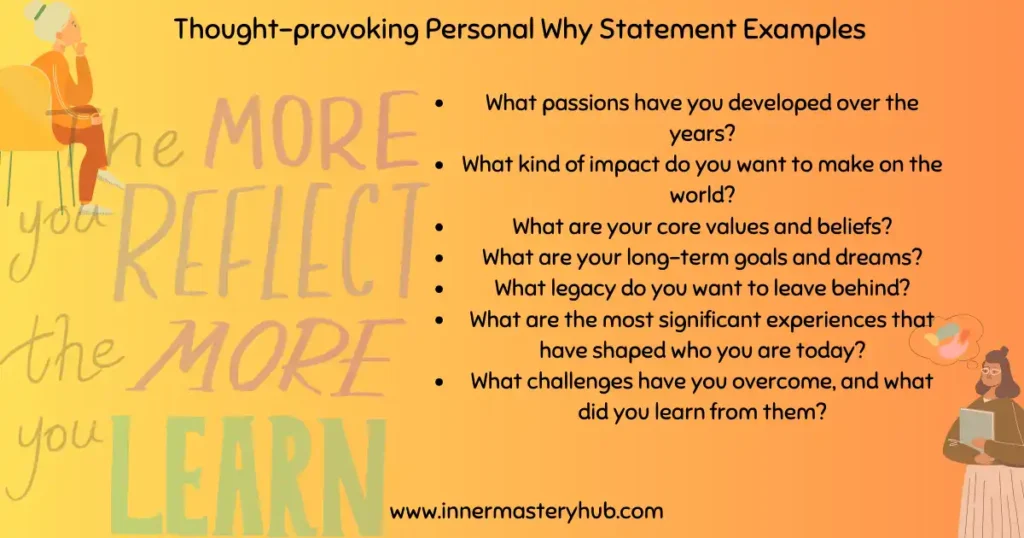
- What are the most significant experiences that have shaped who you are today?
- What challenges have you overcome, and what did you learn from them?
- What passions have you developed over the years?
- What kind of impact do you want to make on the world?
- What are your core values and beliefs?
- What are your long-term goals and dreams?
- What legacy do you want to leave behind?
What Psychology Says About Having a Personal “Why”
Research on motivation and meaning supports some of the ideas behind a personal why.
A large 2021 meta-analysis of 344 student samples, covering more than 223,000 participants, found that intrinsic motivation was associated with student success and well-being, while personally valuing an activity was particularly strongly related to persistence.[1]
Research on meaning in life also identifies purpose as an important part of how people experience meaning.[2]
These findings do not show that writing a personal why statement will automatically improve motivation or well-being. They support the broader idea that personally meaningful goals, values, and a sense of purpose can matter.
What a Personal Why Statement Can’t Do
A personal why statement can help you think more clearly about your values, goals, and direction, but it is not a treatment for anxiety, burnout, depression, or other mental health concerns. If distress is ongoing or starts affecting your sleep, work, relationships, or daily life, consider speaking with a qualified mental health professional.
Key Takeaways
- A personal why explains why a goal, choice, or direction matters to you.
- It should reflect your own values, relationships, priorities, or desired impact.
- A strong why is specific enough to feel personal, but simple enough to remember.
- Your personal why can change as your life, responsibilities, and priorities change.
- A why statement is different from a mission statement: your why explains the reason, while a mission usually describes what you plan to do.
- Use examples and templates as starting points, then rewrite them in words that sound like you.
People Also Ask
What is an example of a person’s why?
One example is:
“My why is to build a secure career so I can support my family and create more choices for our future.”
A good personal why explains both what matters to you and why it matters.
What is a personal Why statement?
A personal why statement is a short explanation of why a goal, choice, or direction matters to you. It connects what you want to do with the values, people, or outcomes that make it personally meaningful.
How do I write my personal Why Statement?
Start with two questions:
What do I want to do?
Why does that matter to me?
Then combine the answers into one clear sentence.
For example:
“I want to keep learning so I can create more opportunities for myself and my family.”
Can my personal why Statement change over time?
Yes. Your priorities, responsibilities, relationships, and goals can change.
You can revisit your why when it no longer reflects what matters to you now.
What’s the difference between a why statement and a mission statement?
A personal why statement explains why something matters to you.
A mission statement usually describes what you intend to do or work towards.
For example:
Why: “I want to support young people because I know how much good guidance can matter.”
Mission: “I aim to provide practical mentoring and career support for young people.”
How long should a personal why statement be?
Usually, one or two sentences are enough.
It should be long enough to explain why something matters to you, but short enough that you can easily understand and remember it.
- Howard, J. L., Bureau, J., Guay, F., Chong, J. X. Y., & Ryan, R. M. (2021). Student Motivation and Associated Outcomes: A Meta-Analysis From Self-Determination Theory. Perspectives on Psychological Science, 16(6), 1300–1323. DOI: 10.1177/1745691620966789. ↩︎
- King, L. A., & Hicks, J. A. (2021). The Science of Meaning in Life. Annual Review of Psychology, 72, 561–584. DOI: 10.1146/annurev-psych-072420-122921. ↩︎
Written By Mehwish Qurayshi
Mehwish Qurayshi is a Trauma-Informed Emotional Wellness Counsellor trained through NICABM’s Treating Trauma Master Series, which includes NBCC-approved education in Trauma Treatment and Emotional Wellness & Emotional Intelligence – Sourcecode Academia. She has over five years of experience providing emotional wellness counselling, helping individuals heal from trauma, regulate emotions, and build healthy relationships.