
The Twin Flame Journey: Spiritual Meaning, Psychology and 6 Stages
Written by Mehwish Qurayshi

The healthiest interpretation of the Twin Flame Journey respects the depth of the connection without confusing suffering, obsession, or dysregulation with evidence of destiny. It is best understood as an intense spiritual-romantic experience that combines soul-level meaning with attachment activation, projection, uncertainty, and difficulties in emotional regulation.
People call it a “Twin Flame Journey,” but the hardest part isn’t the label itself. It’s the feeling that someone has reached a place inside you that you don’t fully understand, something you can’t easily calm down, explain, or make sense of.
One day, everything feels clear and certain. Next, you feel distant, overwhelmed, or emotionally shaken. That constant swing is what makes emotional regulation so important. Even if the connection feels spiritual or fated, your nervous system is still reacting in very human ways to closeness, distance, silence, hope, and reunion.
It’s easy to think the real issue is the other person’s inconsistency. But what hurts most is what the connection brings up within you: deep longing, fear of loss, projection, idealization, and a powerful desire to feel complete.
This is why it matters to look at the experience from both angles. You can hold space for the spiritual meaning it may have for you, while also understanding the psychological patterns at play. That balance helps you make sense of the connection, without losing yourself in it.
What is a Twin Flame Journey?
A Twin Flame Journey is an intense emotional and spiritual bond often characterized by attachment activation and psychological projection. In spiritual communities, it is seen as a path of awakening. In psychological terms, it can also involve attachment activation, projection, emotional regulation struggles, and identity change.
Highs and lows abound throughout this journey. Though not everyone has a twin flame, everyone has soulmates. Taking a trip with twin flames is not for the weak of heart, and they are uncommon.
It challenges your patience and strength to the limit and forces you to develop in ways you never thought were possible. Being a twin flame is an exceptional talent that allows for this kind of development.
So, why is the twin flame journey so difficult to endure?
Since a twin flame and a soulmate are essentially one soul in two bodies, they interact on a much deeper level. Your twin flame reflects your identity, life experiences, and teachings. You can’t compare the unwavering love you have for them because they are your real counterpart, your other half.
Before coming into this life, twin lovers sign a soul contract. To concentrate on healing, this contract calls for a meeting, an awakening, and a brief separation.
Even while it might be excruciating, the process results in an unbelievable transformation.
Many readers search for one answer: “Is this connection real, or is it just pain?”
The honest answer is that the experience can feel deeply real even as your inner world shapes it.
Research helps explain why intense romantic bonds feel so consuming. Romantic attachment is not random. It follows patterns tied to bonding, safety, and emotional needs. Hazan and Shaver’s classic work framed romantic love as an attachment process, which remains foundational to understanding why certain connections feel unusually powerful1.
9 Signs Of Being In a Twin Flame Journey People Commonly Report
The twin flame journey is a spiritual belief that a soul seeks the other for wholeness. Here are some signs that you might have encountered your twin flame:
1. The Instant Connection
You instantly feel a sense of familiarity that is beyond time and space when you meet your twin flame. Even though you’ve just met this individual, it feels like you’ve known them for ages.
This bond is so strong that it feels almost instinctive, going beyond the surface level. It is the recognition of a soul that seems so familiar, as though you have known each other for a significant number of lifetimes.
This familiarity can bring a deep sense of understanding and calm, as though you’ve finally discovered the missing piece of your soul.
2. Synchronicity
One of the most obvious indicators that you’ve found your twin flame is that when your twin flame enters your life, you can observe odd coincidences or repetitive patterns.
For instance, the exact locations, music, or symbols may appear repeatedly, or you may see the exact numbers, such as 11:11. There seems to be more significance behind these encounters than just chance.
The cosmos seems to be telling you that you’re headed in the right direction and pointing you in the direction of your twin flame journey.
3. They trigger your deepest insecurities.
You can see both the good and bad sides of yourself reflected in your twin flame. They might highlight your positive qualities, reaffirming your potential and abilities.
They may also highlight your vulnerabilities and fears, though, which will compel you to face and resolve them. Your twin flame’s reflection of these aspects of you forces you to work on personal development and gain a better awareness of who you are, which ultimately results in self-transformation.
4. Shared Life Experiences
The similarities between twin flames’ life experiences are unexpected. You might find that you have experienced similar difficulties in your personal life, at work, or in your family.
Through these shared experiences, an intense bond and an inexpressible sense of understanding can be formed. It seems as though you have traveled the same route, even though your paths have diverged. This common past can deepen your connection and serve as a basis for understanding and support.
5. Emotional Intensity
In a twin flame relationship, the feelings are strong. Deep affection is experienced, yet there may also be fierce disagreements. Your emotional boundaries will be tested in this relationship, frequently evoking intense emotions you didn’t know you had.
They might be a more severe emotional rollercoaster than other types of relationships.
6. Telepathy
There is a degree of communication in a twin-flame connection that goes beyond words. They don’t need to speak for it to know their feelings and ideas. Because it forges an inexplicable link, it can be both reassuring and unexpected.
Beyond outward looks, there is a level of intimacy and trust that may make the conversation seem effortless, as though you can read each other’s minds. They know what you’re thinking or feeling, even when they don’t say it out loud.
7. They keep coming back.
It seems as though, despite their best efforts to keep them apart, a secret force keeps pulling them back together.
Has it ever happened to you in a relationship? It might be annoying at times, but it can also indicate a really special bond. You constantly find your way back to that person, no matter how far you go, as if there were an invisible thread connecting you to them.
The “on and off” nature of this connection is the cause. The intensity of the relationship and the difficulties that accompany it make it a familiar pattern. It might be a means for the two souls to learn from one another and balance their energy.

8. They are a catalyst to your spiritual awakening.
It seems that a profound spiritual metamorphosis may be triggered by meeting your soulmate.
A transformative event that abruptly changes your perspective on the world. This process can be accelerated, forcing you to change quickly.
Opportunities for spiritual development arise from the difficulties and disappointments. It seems as though the universe is encouraging you to realize your most significant potential by testing your limits.
It is ultimately about vibrating at a high enough frequency to unite and change the world for the better. That vision is stunning and motivating.
9. They push you to become a higher version of yourself.
Twin flames resemble twin mirrors. They show your strengths and weaknesses. This partnership pushes you to develop. It makes you a better person.
Frequently, twin flames have identical goals. This has risen to unprecedented levels. The bond is strong and sometimes intense. It resurrects past problems that you must confront. In many respects, this helps in your evolution. It is gratifying, but it may also be challenging.
Stages of a Twin Flame Journey
This journey involves different stages:
Stage 1: Meeting / Recognition
A sudden sense of familiarity or emotional intensity appears at the first encounter.
This stage is marked by strong meaning-making, where the connection feels unusually significant or “destined.”
Stage 2: Emotional Intensification
Emotions deepen quickly, often outpacing the relationship’s ability to stabilize.
Idealization may develop, alongside early attachment activation and heightened emotional focus on the other person.
Stage 3: Runner–Chaser Dynamic
One person begins to withdraw (runner), while the other seeks closeness or reassurance (chaser).
Psychologically, this reflects anxious–avoidant attachment patterns rather than a unique relational mechanism.
Stage 4: Separation
Contact is reduced or stops, leading to emotional withdrawal and uncertainty.
This phase also includes rumination, longing, and attempts to find meaning in the absence.
Stage 5: Inner Work Phase
Attention shifts inward. Emotional patterns, attachment wounds, and personal triggers become more visible.
This stage often involves self-reflection and challenges in emotional regulation.
Stage 6: Integration, Reunion, or Detachment
The relationship may move toward reconnection, transformation into a different form, or permanent separation.
Outcomes vary depending on emotional maturity, mutual compatibility, and real-life circumstances.
Why does the connection feel so intense?
The Twin Flame Journey feels intense because it combines desire, uncertainty, hope, fear, idealization, and emotional triggers all at once. Spiritually, people call this soul recognition. Psychologically, intensity increases when attachment needs and emotional regulation systems are strongly activated2.
What usually happens is not mysterious in structure, even if it feels mysterious in meaning.
- You notice something in the person that feels rare.
- You interpret that feeling as destiny, recognition, or “home.”
- That interpretation creates a strong emotional charge.
- Then every text, pause, reunion, or silence starts carrying more meaning than it normally would.
- As that meaning grows, your nervous system reacts faster and harder.
- Then the consequence appears: obsession, panic, withdrawal, idealization, over-contact, or emotional collapse.
That is the inner cycle that many people confuse with proof.
The misunderstanding is simple: People think intensity equals truth.
But intensity can also come from:
- attachment insecurity
- unresolved grief
- projection
- intermittent reinforcement
- emotional flooding
- fear of loss
- identity hunger
Research on emotion regulation shows that emotions become harder to manage when they are interpreted as highly significant and when regulation happens late, after the body is already activated. Gross’s work is central here: once emotion is fully escalated, it is harder to shift than when it is noticed earlier3.
This does not mean the connection is fake. It means your experience of it is shaped by both meaning and biology.
Arthur and Elaine Aron’s self-expansion research also helps explain why some connections feel life-changing. Close relationships can expand your sense of self, making the other person feel woven into your identity. That is one reason separation can feel like losing part of yourself, not just losing contact with someone4.
The pain of a twin flame bond is not just separation pain. It is broken identity pain.
How do attachment wounds appear in a Twin Flame Journey?
Attachment wounds appear in a Twin Flame Journey when closeness and distance quickly activate fear of abandonment, fear of engulfment, or fear of not being chosen. The other person may seem to be the cause, but the deeper pain often stems from older emotional patterns being reopened.
In simple terms:
- Anxious attachment may sound like:
“Why are they pulling away? What did I do? I need reassurance now.” - Avoidant attachment may sound like:
“This is too much. I need distance. I feel trapped when it gets real.” - Disorganized patterns may sound like:
“I want closeness badly, but I also fear it and do not trust it.”
This matters because many so-called twin flame dynamics look very similar to attachment activation. That does not cancel the spiritual frame. It just explains the emotional mechanics.
Research reviews continue to support the link between attachment insecurity and difficulties in emotion regulation. Secure attachment tends to support more balanced regulation, while insecure attachment is associated with less stable responses to relational stress.
A simple framework helps here:
- Trigger: distance, mixed signals, reunion, or conflict
- Interpretation: “I am losing them,” “This is fate,” “I am too much,” “They are afraid because the bond is real.”
- Emotion: panic, grief, longing, rage, hope
- Consequence: chasing, withdrawing, idealizing, self-abandoning, waiting, overthinking
When you can see the pattern, the bond becomes less foggy.
Why do separation and silence feel unbearable on the Twin Flame Journey?
Separation and silence feel unbearable because they create uncertainty, and uncertainty intensifies emotional stress. When you already feel bonded, the absence of contact can be interpreted as loss, rejection, or an unfinished meaning, which keeps the mind searching for answers5.
Relational uncertainty is not a small issue. It is emotionally expensive.
When you know where you stand, the mind can settle. When you do not know where you stand, the mind keeps working.
That creates a loop:
- silence becomes significant
- significance becomes rumination
- Rumination becomes emotional arousal,
- arousal becomes more silent, more pursuit, or more collapse
Research supports this pattern. Studies on relational uncertainty show that uncertainty in close relationships is associated with stress responses, including heightened cortisol responses during difficult interactions6.
This explains why “no contact” or inconsistent contact can feel much bigger than logic would suggest.
Your mind is missing more than just a person.
It is trying to stabilize meaning.
Rainer Maria Rilke’s ideas about love are helpful here. He saw love not as fusion, but as two people protecting each other’s solitude while growing toward truth. That view challenges the common twin flame fantasy that total emotional merging is proof of spiritual importance.
Sometimes what feels unbearable is not the bond itself. It is the collapse of certainty.
In many twin flame experiences, silence hurts less because of absence and more because of unresolved meaning.
What do people misunderstand about the Twin Flame Journey?
The most common misunderstanding is believing that emotional pain proves spiritual depth. Pain can mean growth, but it can also mean insecurity, projection, dysregulation, or unhealthy dynamics. A meaningful connection and a difficult pattern are not the same thing.
Common misunderstandings include:
- Intensity means destiny
Sometimes intensity means activation, not alignment. - If it is a twin flame, confusion is normal forever
Confusion may happen, but long-term chaos should not be romanticized. - The runner-chaser dynamic proves the bond
It may also reflect avoidant-anxious attachment patterns. - Suffering means transformation is working
Suffering can also mean your boundaries, regulation, or reality-testing are breaking down. - If I heal enough, they will return
Healing changes you. It does not control another person.
This is where the inner struggle becomes clearer. You are not only asking, “Are they my twin flame?” You are often asking, “Why does this touch something so deep in me?”
Is the Twin Flame Journey the same as limerence?
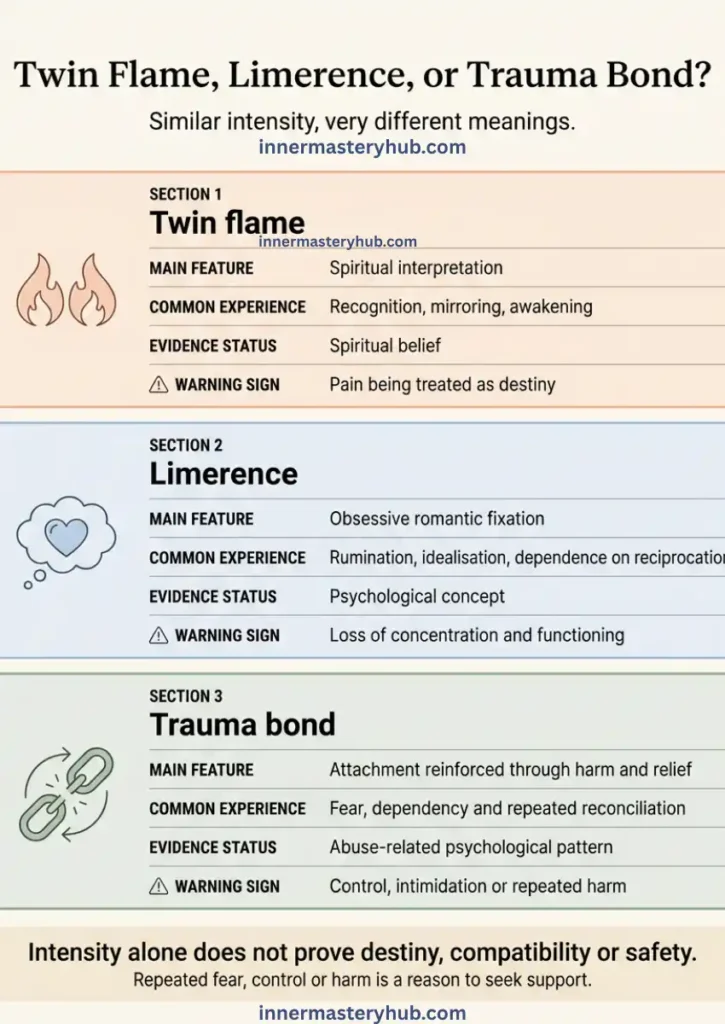
No, the Twin Flame Journey is not the same as limerence, but the two can overlap. The belief in twin flames is a spiritual framework. Limerence is an intense state of obsessive romantic preoccupation, often marked by intrusive thinking, longing, and emotional dependency on reciprocation.
Twin Flame vs Limerence vs Trauma Bonding
How to Navigate The Journey
The twin flame journey is undoubtedly tricky, but there are ways to learn more about it. Avoiding becoming engrossed in the dynamics of the relationship and instead concentrating on personal development is the key to surviving this journey. How to achieve that is as follows:
1. Self-Love Is the Foundation
The Twin Flame journey teaches that true union starts with loving yourself completely. When you heal self-doubt and embrace your worth, your energy balances, attracting harmony within and with your twin. Love yourself first; the connection mirrors your inner growth.
2. Detach from the outcome.
Getting too attached to the idea of marrying their twin flame is one of the worst mistakes people make. Emotional distress may result from this attachment, particularly during times of separation.
Instead, concentrate on your development and have faith that everything will work itself out if you are meant for each other. Detachment gives both partners the space they need to grow and recover.
3. Healing Comes Before Union
Many think reunion is the goal, but the Twin Flame journey is about healing emotional wounds. You must face inner pain, past traumas, and fears. Each challenge clears blockages, aligning you with higher love and spiritual maturity before genuine connection can manifest.
4. Separation Is Spiritual Training
In the Twin Flame journey, separation isn’t punishment; it’s preparation. The distance forces both to grow individually, discover purpose, and strengthen their souls. Through solitude, each learns independence and unconditional love, which are essential for lasting spiritual union.
5. Triggers Are Teachers
Every emotional trigger in the Twin Flame journey reveals what still needs healing. Anger, jealousy, or fear aren’t setbacks; they’re signals. Accepting and understanding these emotions transforms pain into wisdom, helping both souls evolve into higher versions of themselves.
6. The Runner-Chaser Dynamic Mirrors Inner Imbalance
When one runs and the other chases, the Twin Flame journey highlights imbalance within. The chaser learns surrender; the runner learns courage. Both must heal fear and attachment. When balance is restored, the cycle ends and peace begins.
7. Surrender Unlocks Progress
You can’t control the Twin Flame journey. Actual progress comes from surrender, trusting divine timing, and letting go of expectations. When you stop forcing outcomes, energy flows naturally, guiding both souls toward healing and eventual alignment.
8. Inner Work Changes Outer Reality
The Twin Flame journey reminds you that transformation starts within. As you clear limiting beliefs, practice gratitude, and raise your vibration, your outer world, including your connection, reflects this new energy. Healing yourself heals the bond.
9. Ego Must Be Transcended
Ego-driven reactions create conflict in the Twin Flame journey. Letting go of pride, control, and blame opens the heart to compassion. A genuine connection exists beyond ego, in pure, unconditional love, where both can see each other’s souls clearly.
10. Divine Timing Is Real
In the Twin Flame journey, everything unfolds when both souls are ready, forcing union before spiritual readiness leads to chaos. Trust the divine plan; each delay serves a purpose, helping both mature emotionally and spiritually for lasting union.
11. Forgiveness Heals Everything
Holding resentment blocks progress in the Twin Flame journey. Forgive your twin and yourself. Forgiveness doesn’t mean forgetting; it means freeing your heart from pain, allowing new energy to enter. Love grows where forgiveness flows.
12. The Purpose Is Awakening
The Twin Flame journey isn’t just about romance; it’s about spiritual awakening. It pushes you to expand consciousness, discover divine purpose, and live from love rather than fear. The connection serves humanity through your transformation.
13. Union Is an Inner State
The final truth of the Twin Flame journey is that union begins within. When you balance masculine and feminine energies, love yourself unconditionally, and live authentically, you achieve spiritual union, whether or not physical reunion happens.
Healthy Integration Framework
Awakening → Activation → Interpretation → Integration
This framework explains how intense emotional experiences can move from confusion to clarity when processed healthily.
1. Awakening = Emotional Impact
This is the moment something strongly affects you. You feel a sudden emotional pull, attraction, or deep interest.
It feels powerful and hard to ignore.
2. Activation = Attachment + Triggers
At this stage, deeper emotional patterns get activated. Old fears, attachment needs, or insecurities may come up.
You may feel anxious, attached, or emotionally overwhelmed.
3. Interpretation = Meaning-Making
Here, the mind tries to explain what is happening. You start creating meaning around the experience. This is where stories form, like “this is destiny” or “this is a sign.”
4. Integration = Emotional Maturity + Clarity
This is the healing stage. You begin to understand your emotions without being controlled by them. You see the difference between feelings, thoughts, and reality. There is more calm, balance, and clarity in your responses.
Conclusion
The Twin Flame Journey is powerful because it touches both longing and identity. It can feel spiritual, life-changing, and emotionally overwhelming all at once. But the deepest misunderstanding is thinking that the pain is only about the other person.
Often, the real struggle is the meeting between your hope, your wounds, your projections, your attachment patterns, and your ability to regulate emotion under relational stress. When you understand that, the journey changes. You stop asking only whether the bond is destined. You begin asking whether your relationship to the bond is honest, grounded, and whole.
Reflect on one question today: What part of my pain comes from the connection itself, and what part comes from what the connection activates inside me?
People Also Ask
How to Find Your Twin Flame?
You can’t force your twin flame to find you. Embrace personal growth, be true to yourself, and stay open to the universe’s plan.
Can you have only one twin flame?
According to the common belief that twin flames are two halves of the same soul, yes, you can have only one twin flame. However, this is debatable and largely depends on how you define a twin flame.
Does everyone have a twin flame?
It is a unique bond that not everyone experiences. In the end, not everyone feels that strong attraction to their other half because they haven’t undergone this separation.”
Can twin flames become toxic?
Yes, twin-flame relationships can become toxic. They may mirror our issues and unhealthy habits. Being apart can make functioning difficult, leading to codependency and defining self-worth through the relationship.
What are the common stages in the Twin Flame journey?
Typical stages include: awakening, crisis/separation, inner healing, runner-chaser dynamics, surrender, reunion, and spiritual union (or alignment). Each phase pushes deep healing and self-awareness.
How do I know if I’m on the Twin Flame journey?
You may feel firm internal shifts, recurring synchronicities, mirror-like behaviors in others, deep emotional triggers, and an urgency to heal. Your life feels pulled toward growth and awakening.
Do Twin Flames always end up together?
Not always. Union (physical or spiritual) is one possible outcome, but many pairs remain separated while still growing. Sometimes the relationship evolves into a higher form of connection rather than a traditional partnership.
How can I heal myself during the journey?
Focus on inner work: self-love, shadow integration, emotional release, healthy boundaries, meditation, and solitude. Invite spiritual support and allow yourself to evolve independently before pushing for union.
Can twin flames be in no contact for years?
Yes, many people report long periods of no contact. In those phases, the difficulty is often not only missing the person but also carrying unresolved meaning. Silence tends to intensify rumination because the mind keeps trying to explain the bond, the absence, and the possibility of return.
How do I know if this is a Twin Flame Journey or trauma bonding?
A Twin Flame Journey is usually described in spiritual language, while trauma bonding involves attachment formed through cycles of harm, relief, and dependency. If the connection relies on repeated pain, emotional control, fear, and instability, trauma dynamics may be more relevant than spiritual destiny.
Does healing guarantee union with your twin flame?
No. Healing can change your clarity, boundaries, choices, and emotional responses, but it does not control another person’s behavior. One of the hardest truths in this space is that your growth may be real even if reunion does not happen.
- Hazan, C., & Shaver, P. R. (1987). Romantic love is conceptualized as an attachment process. Journal of Personality and Social Psychology, 52(3), 511–524. ↩︎
- Brandão, T., Schulz, M. S., Gross, J. J., & Matos, P. M. (2020). Attachment, emotion regulation, and well-being in couples: Intrapersonal and interpersonal associations. Journal of Personality, 88(4), 748–763. ↩︎
- Gross, J. J. (1998). The emerging field of emotion regulation: An integrative review. Review of General Psychology, 2(3), 271–299. ↩︎
- Aron, A., Lewandowski, G. W., Jr., Mashek, D., & Aron, E. N. (2013). The self-expansion model of motivation and cognition in close relationships. In J. A. Simpson & L. Campbell (Eds.), The Oxford handbook of close relationships (pp. 90–115). Oxford University Press. https://doi.org/10.1093/oxfordhb/9780195398694.013.0005 ↩︎
- Priem, J. S., Solomon, D. H., & Steuber, K. R. (2011). Relational uncertainty and cortisol responses to hurtful and supportive messages from a dating partner. Communication Monographs, 78(4), 451–476. ↩︎
- Priem, J. S., Solomon, D. H., & Steuber, K. R. (2011). Relational uncertainty and cortisol responses to hurtful and supportive messages from a dating partner. Communication Monographs, 78(4), 451–476. ↩︎
Written By Mehwish Qurayshi
Mehwish Qurayshi is a Trauma-Informed Emotional Wellness Counsellor trained through NICABM’s Treating Trauma Master Series, which includes NBCC-approved education in Trauma Treatment and Emotional Wellness & Emotional Intelligence – Sourcecode Academia. She has over five years of experience providing emotional wellness counselling, helping individuals heal from trauma, regulate emotions, and build healthy relationships.