
Examples of Stonewalling in a Relationship and How It Destroys Communication
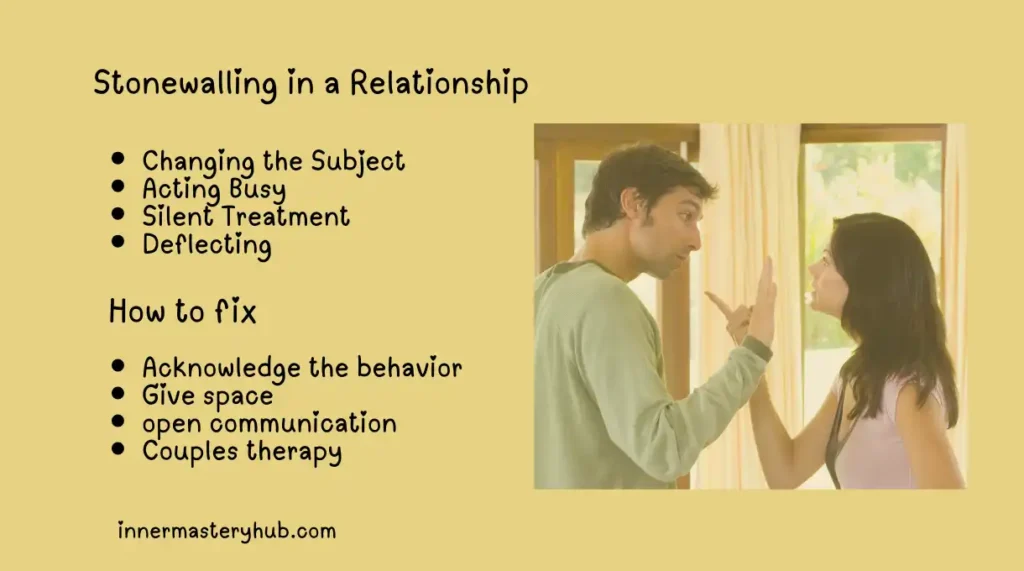
Examples of stonewalling in a relationship include ignoring questions, giving the silent treatment, walking away during conflict, refusing eye contact, saying “I’m fine” while shutting down, changing the subject, using work or phones to avoid talking, and emotionally withdrawing after disagreement. Stonewalling often appears cold, but beneath the surface, it may involve emotional flooding, fear, shame, avoidance, or poor emotional regulation.
Stonewalling has become common in relationship discussions, although it’s challenging to define. Stonewalling occurs when one spouse refuses to communicate, often in response to unsettling or stressful circumstances. When you feel ignored, shut down, or emotionally neglected in a relationship, you may be facing stonewalling. This article explains stonewalling, its types, its impact on relationships, and what to do if you encounter it.
Examples of Stonewalling in a Relationship
Stonewalling can silently harm relationships. It occurs when one person emotionally withdraws from a conversation or situation, thereby limiting interaction. They may avoid the matter, ignore the other person, or change the subject. The other partner feels ignored and frustrated.
Partnerships require both emotional connection and interaction. Someone is stonewalling you when they avoid communicating openly and fail to resolve disputes. Stonewalled people feel isolated and split up as the withdrawal continues.
How Does Stonewalling Affect a Relationship?
Examples of Stonewalling are continuous mental distress and frustration. Imagine having a fight with your partner who shuts down totally. No matter how much you interact, they change the subject or act busy to avoid communication. This delays the conflict and hampers an agreement.
Stonewalling can make the partner feel unimportant and irrelevant over time. The Gottman Institute found that stonewalling is one of the worst relationship practices1. It can cause emotional neglect, trust issues, and anxiety. As stonewalling continues, partners grow aloof, and it becomes harder to reconnect emotionally.
Examples of Stonewalling in a Relationship
Examples of Stonewalling in a Relationship can manifest in several ways, and recognizing it is the first step to addressing it. Here are some examples;
Changing the Subject. The stonewalling spouse avoids or deflects key topics, which hampers resolution.
Acting occupied. The stonewaller may pretend to be working, doing chores, or otherwise occupied to avoid discussing the matter. They may ignore emotional themes by watching TV or using their phone.
Deflecting. Stonewallers may blame others or point to prior mistakes when addressed. This lets them avoid discussing the matter.
Silent Treatment. One partner may refuse to discuss a problem and remain silent, which is one of the most common examples of stonewalling in a relationship.
Two Types of Stonewalling in a Relationship
Stonewalling isn’t a one-size-fits-all behavior. Two main types of stonewalling in a relationship:
- Active Stonewalling. This is when someone intentionally avoids communication. They may ignore their partner’s attempts to engage or end the conversation by leaving.
- Passive Stonewalling. A passive stonewalling spouse may appear physically present but emotionally disengages. They may nod or respond briefly but avoid a profound connection. This type is more difficult to identify because it generates emotional isolation without physical disengagement.

Reasons a Person May Stonewall
Stonewalling generally results from anxiety, fear, or insecurity. Several reasons are examples of Stonewalling in a Relationship:
- Emotional Overload. When overwhelmed by emotions, people may withdraw since they can’t express themselves.
- Avoidance of Conflict. Some people avoid uncomfortable topics by stonewalling. They may think avoiding the topic will settle things temporarily.
- Fear of Judgment or Criticism. Someone may stonewall because they fear criticism, judgment, or rejection.
- Power and Control. Stonewalling can be used to manipulate relationships and avoid conflict.
Effective problem-solving requires understanding why someone might stonewall. Stonewalling hurts the connection regardless of the reason.
What to Do When Someone is Stonewalling You
If you’re on the receiving end of stonewalling, it can be so frustrating and hurtful. Here are some tips on how to handle the situation;
Keep it peaceful. Don’t let your emotions get the best of you; instead, use them to your advantage. Use a long breathing exercise, and if your partner needs it, give them some space.
Accept the Behaviour. The point out the behavior in a quiet manner. By way of example, “I saw that you aren’t responding to me right now, and I feel like I’m not being heard.”
Provide Them Space. People stonewall when they feel overwhelmed. Allow them some time to calm down, but make plans to talk again after
Get Advice. If stonewalling occurs frequently in your relationship, it may be beneficial to consult a therapist. Therapy can help both individuals in a relationship understand what triggers their reactions and communicate more effectively with each other.
Why Do People Stonewall During Arguments?
People stonewall because they feel overwhelmed or emotionally flooded. Their body moves into self-protection, while their partner experiences it as rejection. Stonewalling is a poor emotional regulation strategy, not a real solution.
Here is the inner process.
A conflict starts. Maybe you say, “You never listen to me.” Your partner hears more than the words. They hear, “I am failing.” Their body tightens. Their minds move fast. They may feel shame, fear, anger, or helplessness. But instead of saying, “I feel attacked, and I need a pause,” they shut down.
Then the consequence arrives. You feel abandoned, so you push harder. They feel more trapped, so they withdraw more. The more you reach, the more they disappear. Naturally, both people end up confirming their deepest fear.
You fear you do not matter. They fear they cannot get it right.
This is why stonewalling is not just a communication issue. It is a nervous system issue, an attachment issue, and an emotional regulation issue.
Is the Silent Treatment an Example of Stonewalling?
Yes, the silent treatment is one of the clearest examples of stonewalling in a relationship. It happens when silence is used to avoid, punish, control, or escape emotional contact. Silence becomes harmful when it leaves one partner anxious, confused, or desperate for repair.
The silent treatment feels like emotional punishment because it deprives you of access. You cannot solve the problem, but you also cannot stop thinking about it. Your nervous system keeps searching for safety.
A partner may think, “I am just staying quiet, so I do not make it worse.” But the other partner may feel, “You are making me invisible.”
That gap matters. One person experiences protection, while the other experiences rejection.
Research on demand-withdrawal communication shows that this pattern is linked with relationship distress, and it can happen in everyday home conflict, not only in therapy labs2.
What Does Stonewalling Feel Like to the Person Who Shuts Down?
The person stonewalling feels overwhelmed, cornered, ashamed, numb, or afraid of saying the wrong thing. They may not have words for their inner state. But even when a shutdown is understandable, it still harms the relationship when there is no return, repair, or accountability.
Some people stonewall because conflict feels like danger. They learned early that emotions led to yelling, rejection, punishment, or failure. So now, even a normal concern from a partner can feel like a threat.
They may think:
- “I can’t handle this.”
- “Nothing I say will be right.”
- “I need to get away.”
- “If I stay quiet, this will pass.”
- “I don’t know what I feel.”
Attachment research connects insecure attachment with emotion regulation difficulties. Avoidant attachment is linked with emotional distance, suppression, and discomfort with dependence or closeness3.
Again, this explains the pattern. It does not make it harmless.
What Is the Difference Between Stonewalling and Needing Space?
Needing space is healthy when it includes respect, timing, and a return to the conversation. Stonewalling is harmful when it blocks communication without care or repair. The difference is not the pause itself, but whether the pause protects the connection or avoids it.
A healthy pause sounds like:
“I am getting overwhelmed. I need 30 minutes, but I want to talk after dinner.”
Stonewalling sounds like:
“I’m done,” followed by hours of silence.
A healthy space has three parts:
- A clear reason
- A clear return time
- A real willingness to re-engage
Stonewalling has none of those. It leaves the other person emotionally suspended.
What Are Examples of Stonewalling Through Technology?
Technology-based stonewalling happens when a partner uses social media or delayed replies to avoid emotional contact. Examples include reading messages without replying, changing the topic by text, blocking, muting, or pretending to be unavailable during serious conflict.
Modern stonewalling does not always happen face-to-face. It can happen through screens.
Examples include:
- Leaving serious messages on read
- Replying with “k” after a vulnerable text
- Ignoring calls after conflict
- Posting online while refusing to answer you
- Muting you during disagreement
- Using work emails or group chats as an escape
- Blocking and unblocking to control access
This kind of stonewalling can feel especially confusing because the person is present online but absent from the relationship.
Can Stonewalling Be Emotional Abuse?
Stonewalling can become emotionally abusive when silence is used to punish, control, intimidate, or make a partner feel powerless. Not every shutdown is abuse, but repeated cold withdrawal that causes fear, self-blame, or emotional dependence is a serious warning sign.
The key question is not only, “Are they silent?” The deeper question is, “What does the silence do?”
If silence is used to make you chase, apologize, surrender, or feel unstable, it becomes a pattern of control. If your partner refuses all repairs but expects you to act normally later, the relationship starts to revolve around their comfort.
A useful definition: Stonewalling becomes harmful when one person’s emotional protection repeatedly becomes the other person’s emotional isolation.
What Mistakes Do People Make When Dealing With Stonewalling?
Common mistakes include chasing harder, blaming yourself completely, pretending it does not hurt, using louder criticism, or accepting silence as normal. These reactions make sense emotionally, but they often deepen the demand-withdraw pattern and leave both partners more defended.
When you are stonewalled, you may try to break the wall by pushing. You ask more questions. You repeat yourself. You raise your voice. You demand an answer. This is human, especially when silence feels unbearable.
But the withdrawing partner may interpret your urgency as more pressure. Then they shut down harder.
Another common mistake is going silent too, but not from calm. You do it from hurt. Then both people are alone, and the relationship becomes a room full of unspoken pain.
A third mistake is making yourself smaller. You stop asking for care because you fear the shutdown. But this creates emotional neglect inside the bond.
How Does Stonewalling Affect Trust and Intimacy?
Stonewalling damages trust because it teaches one partner that emotional needs may be ignored. It also weakens intimacy because closeness requires response, not just presence. Over time, unresolved silence can turn small conflicts into deeper fears about love, safety, and commitment.
Trust is built through response. When you reach, and your partner responds with care, your body relaxes. When you reach a wall and meet it, your body remembers.
This can affect affection, sex, friendship, and everyday warmth. You may still live together, share chores, and laugh sometimes, but emotionally, you become careful.
The relationship may look stable from the outside while feeling fragile inside.
What Should You Notice Before Calling It Stonewalling?
Before calling it stonewalling, notice whether the shutdown is repeated, unresolved, and emotionally costly. A one-time pause during stress is not the same as a long-term pattern. Stonewalling is usually marked by avoidance, refusal, emotional distance, and a lack of return to repair.
Ask yourself:
- Does this happen during most hard conversations?
- Does my partner come back to repair?
- Do I feel punished by the silence?
- Do I avoid normal needs to prevent shutdown?
- Does the silence make me feel anxious or small?
- Is there accountability after the conflict?
The pattern matters more than one moment.
What Is the Healthier Understanding of Stonewalling?
The healthier understanding is that stonewalling is usually a failed attempt to manage emotional overwhelm, but it becomes damaging when it replaces communication. The goal is not to shame the person who shuts down. The goal is to stop letting silence carry the relationship.
Stonewalling begins as self-protection, but it lands as disconnection. That is the painful truth. One partner may be trying not to explode, while the other feels emotionally abandoned.
A shift happens when you stop asking, “Why won’t they just talk?” and start seeing the deeper question: “What happens inside us when closeness feels unsafe?”
That does not mean you accept the behavior. It means you understand the pattern clearly enough to name it.
Examples of Stonewalling in a Relationship Reveal a Deeper Pattern
Examples of stonewalling in a relationship show how silence, avoidance, and emotional shutdown can slowly weaken love. The real issue is not only that one partner stops talking. It is when emotional safety disappears that repair never comes.
Stonewalling can look like ignoring, walking away, blank staring, changing the subject, staying on the phone, refusing affection, or using silence as punishment. But beneath the behavior lies often a hidden emotional process. Someone feels triggered, interprets the moment as danger or failure, feels flooded, and chooses distance. Then the other person feels abandoned and pushes harder.
The misunderstanding is thinking stonewalling means “they do not care.” Sometimes it means they do not know how to stay present. But care without emotional presence still leaves pain.
The shift is this: stonewalling is not just a bad habit. It is a relationship pattern that asks both people to take emotional safety seriously. Silence may protect one’s nervous system for a moment, but connection needs return, repair, and truth.
If this pattern feels familiar, name the behavior clearly, track how repair actually happens, and consider speaking with a licensed couples therapist if silence has become the main language of conflict.
FAQs
What is an example of stonewalling in a relationship?
Stonewalling, which can result in unresolved problems and dissatisfaction, occurs when one spouse emotionally distances themselves from the other and refuses to engage in conversation.
Why do people stonewall?
Emotional exhaustion, a fear of disagreement, a desire for control in the relationship, or other factors can cause someone to stonewall.
How can I tell if my partner is stonewalling?
Silence, avoiding eye contact, shifting the topic, or leaving a conversation are all examples of stonewalling in a relationship.
Can stonewalling be harmful?
In a relationship, stonewalling can impede communication, create emotional distance, and lead to feelings of neglect, loneliness, and frustration.
What should you do when someone is stonewalling you?
Remain composed, give them room, and address the conduct later. Refrain from making things worse, and if necessary, seek expert assistance.
Is stonewalling the same as the silent treatment?
Although both require quiet, stonewalling is a strategy for avoiding emotional interaction, whereas the silent treatment is often used as a form of punishment.
What is the antidote to stonewalling?
Honest, open communication is the remedy. Addressing the root causes and avoiding emotional disengagement are made easier by actively and sympathetically participating.
What is the impact when someone is stonewalling you in a relationship?
Frustration, misunderstandings, and emotional neglect result from stonewalling. It has the potential to weaken intimacy and trust between spouses over time.
What should I say when someone is stonewalling?
You can say, “I can see this conversation feels overwhelming. I am willing to pause, but I need us to come back to it.” This protects both people. It gives space without accepting endless avoidance. The key is calm clarity, not chasing or attacking.
Can someone stonewall without realizing it?
Yes. Some people learned to shut down as a Survival response. They may not realize their silence feels like rejection. Still, once the pattern is named, they are responsible for learning healthier emotional regulation, clearer pauses, and real repair after conflict.
- Gottman Institute. (2013/2026). The Four Horsemen: Criticism, Contempt, Defensiveness, and Stonewalling. The Gottman Relationship Blog. ↩︎
- Papp, L. M., Kouros, C. D., & Cummings, E. M. (2009). Demand-withdraw patterns in marital conflict in the home. Personal Relationships. ↩︎
- Messina, I., et al. (2024). Attachment orientations and emotion regulation. NIH / PMC. ↩︎
Written By Mehwish Qurayshi
Mehwish Qurayshi is a Trauma-Informed Emotional Wellness Counsellor trained through NICABM’s Treating Trauma Master Series, which includes NBCC-approved education in Trauma Treatment and Emotional Wellness & Emotional Intelligence – Sourcecode Academia. She has over five years of experience providing emotional wellness counselling, helping individuals heal from trauma, regulate emotions, and build healthy relationships.