
11 Examples of Mild Narcissism in Everyday Relationships

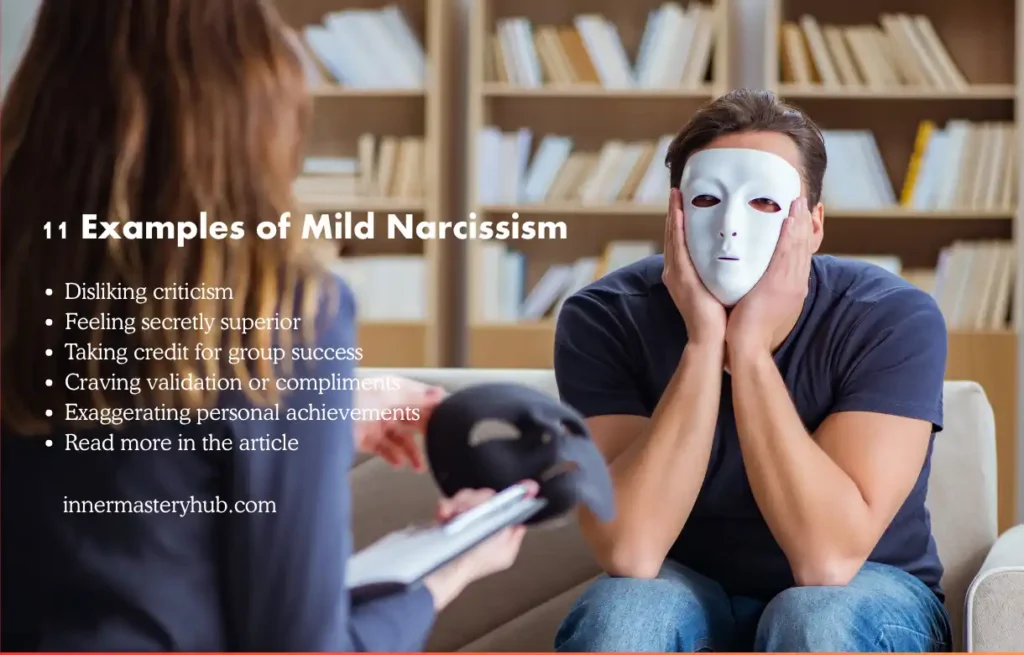
You tell a friend something you’ve been excited about all week. Before you can finish, they’re talking about their own achievements.
At first, you brush it off. Everyone gets carried away sometimes. But when the same thing happens at dinner, during phone calls, and even when you’re sharing difficult news, you begin to notice how rarely the conversation comes back to you.
These are some of the everyday behaviours people describe as mild narcissism. The term isn’t a clinical diagnosis, and one awkward conversation doesn’t tell you much about someone’s personality.
Key takeaways
- “Mild narcissism” is informal, not a diagnosis.
- One isolated behaviour is not enough.
- Look for repetition, accountability, and relationship impact.
- Protecting your wellbeing matters more than choosing a label.
What Is Mild Narcissism?
Mild narcissism is an informal term for self-focused or approval-seeking traits that may appear in everyday behaviour. It isn’t a separate mental health diagnosis.
Say your friend regularly wants to be recognised for helping others. At dinner, they mention the favour they did for a neighbour three times. When someone changes the subject, they bring it back to what they did.
You might find the conversation tiring, particularly if your own stories rarely get the same attention.
But enjoying praise or talking about an achievement doesn’t tell you whether someone has narcissistic traits. You would need a much fuller picture of their behaviour to conclude their personality.
Researchers have studied different expressions of narcissism, including traits involving status and admiration as well as sensitivity to how others view you.1 These can vary between people. The phrase mild narcissism doesn’t identify a specific level or combination of traits.
For your relationship, the more immediate question may be whether there’s enough room for both people to be heard.
Mild Narcissism vs Healthy Self-Esteem
The difference isn’t simply whether someone is confident or enjoys attention. Pay attention to how they treat you when you disagree, need support, or say no.
For example, your partner may feel proud of a promotion and want you to celebrate with them. That’s understandable. But if they repeatedly dismiss your achievements or become angry when the conversation isn’t about them, you may begin to notice an imbalance.
The table below compares possible patterns. It isn’t a test for narcissism, and one difficult conversation doesn’t tell you everything about someone’s personality.
| Situation | Behaviours sometimes associated with narcissistic traits | Healthier ways of responding |
|---|---|---|
| Receiving praise | Frequently seeks reassurance or becomes resentful when someone else gets attention | Enjoys recognition without expecting to be the centre of every conversation |
| Hearing criticism | Repeatedly dismisses feedback or shifts responsibility to someone else | May feel upset initially but can return to the issue and discuss it |
| Having a disagreement | Focuses on winning or proving the other person wrong | Can explain their position while allowing the other person to disagree |
| Talking about achievements | Regularly turns someone else’s good news into a comparison | Can share their own success while showing interest in yours |
| Respecting boundaries | Continues requesting something after you’ve clearly declined | Takes your answer seriously, even when disappointed |
| Responding to hurt feelings | Repeatedly dismisses your concern or makes the conversation about their intentions | Tries to understand what happened and discuss what could change |
| Taking responsibility | Denies their part in a problem or expects you to repair every disagreement | Can acknowledge a mistake and make a reasonable effort to address it |
You don’t need to decide whether someone has narcissistic traits before taking your own concerns seriously.
If the same behaviour keeps coming up, you can address that behaviour directly: “When I tell you something important, I need you to hear me out before changing the subject.”
Their response may tell you more about whether the relationship can improve than the label you choose.
What Might Contribute to Narcissistic Traits?
Researchers have looked at whether childhood experiences, parenting, and temperament are related to narcissistic traits. So far, no single explanation accounts for everyone.
In a 2015 study involving 565 children and their parents, Brummelman and colleagues found that children whose parents consistently treated them as more special and deserving than others tended to develop higher levels of narcissistic traits during the study.2
Imagine growing up in a family where your achievements are praised, but your siblings’ efforts receive little attention.
At dinner, you get the largest share of praise for passing an exam. When your sister mentions her results, someone interrupts to remind everyone how well you’ve done.
Years later, you may remember those family conversations. But they cannot tell you why you or your siblings behave a particular way as adults.
Perhaps your partner gets irritated when you disagree about a household decision.
You say, “I know you prefer your idea, but I need you to hear mine before we decide.”
They might listen, dismiss you, or ask to discuss it later. You can pay attention to what happens without assuming you know what shaped their reaction.
If difficult conversations regularly leave you second-guessing what you said, our article on replaying past conversations in your head explores that experience in more detail.
A person’s past may be relevant to understanding them, but it doesn’t tell you how they’ll respond when you raise a concern today.
How Repeated Self-Focused Behaviour Can Affect Your Relationship
You tell your partner you’ve been offered a new job.
Before you can explain why you’re excited, they ask, “What about my schedule? Will you still be home at the same time?”
You understand that the change affects both of you, but you wish they’d asked about the job first.
A few days later, you ask if they can handle dinner because you have to work late.
“I’ve already done enough this week,” they reply.
You prepare dinner when you get home.
The next time something important happens at work, you think about telling them, then decide to wait.
It’s not one disagreement that’s bothering you. You’ve noticed that when you need support, the conversation often ends with you explaining yourself or putting your plans aside.
You might start checking whether they’re in a good mood before bringing something up. Sometimes you decide not to mention it at all.
If you’ve been finding it difficult to name what bothers you after these conversations, our article on emotional awareness may help you put those experiences into words.
Repeatedly feeling unable to raise ordinary concerns is worth paying attention to, whether or not the other person has narcissistic traits.

11 Examples of Mild Narcissism in Daily Life
You might notice that someone regularly brings conversations back to themselves, expects praise for ordinary favours, or becomes irritated when you disagree.
Those behaviours can be frustrating, especially when you’ve already explained how they affect you.
1. Humble Bragging and Indirectly Seeking Praise
You’re having lunch with colleagues when one says, “I’m exhausted. My manager keeps giving me the biggest projects because apparently nobody else can handle them.”
You ask whether they’ve had a chance to take some time off.
“Not really. Even when I’m home, the team keeps calling me for advice.”
Later, another colleague shares news about finishing a difficult project.
“That’s nothing,” the first person replies. “You should see what I’ve been dealing with.”
The conversation moves back to their workload, and your colleague never gets to finish talking about their achievement.
Humble bragging is when someone draws attention to an achievement through a complaint or a modest-sounding remark. Sezer and colleagues (2018) studied this way of presenting oneself and how others respond to it.3
Your colleague may genuinely be overworked. The remark alone doesn’t tell you their intentions. But you’ve noticed that other people’s achievements keep getting pushed out of the conversation.
If you often leave similar conversations wondering why you didn’t get a chance to speak, our article on building resilience through conversation offers related ideas for handling difficult discussions.
2. Constant Name-Dropping or Status Reminders
The committee is trying to raise money for a community fundraiser, but one member keeps bringing up the director of a large organisation.
“I know him personally. We’ve met several times,” he says.
Someone asks whether the director might be interested in sponsoring the event.
“Oh, he’d definitely take my call. We’re on very good terms.”
“Great. Could you ask him about a donation?”
He starts describing the events they’ve attended together but makes no offer to contact him.
By the end of the meeting, the committee still doesn’t know whether the organisation will contribute anything.
At the next meeting, he brings up the director again. This time, another member asks, “Have you spoken to him about the fundraiser yet?”
“No, I’ve been busy,” he replies, before telling everyone about another well-known person he recently met.
His connections have taken up plenty of meeting time. The committee is still waiting for a phone call.
3. Needing Continual Praise or Compliments
You never used to think twice about complimenting your partner.
Now, even a simple “thank you” can lead to questions you weren’t expecting.
Last night, you thanked them for making dinner.
“Was it better than the meal we had on Saturday?”
You said both meals were lovely.
“So mine wasn’t special?”
You explained that you’d enjoyed the food and appreciated the time they’d spent preparing it.
Later, while getting ready for bed, they asked why you hadn’t sounded more excited.
You began wondering whether your compliment had somehow come across the wrong way. You’d meant every word, yet you’d spent much of the evening trying to convince them.
The next morning, you caught yourself going over the conversation again, thinking about what else you could have said.
If you recognise that habit, our article on reframing your thoughts explores how to examine those doubts without automatically assuming you’ve said something wrong.
4. One-Upmanship
The medal is still hanging around your daughter’s neck when your brother starts talking about the swimming competitions he won as a teenager.
She’d finished third in her first school race and couldn’t wait to tell the family.
“Third is good,” he says. “I used to come first almost every time.”
Your daughter begins describing how she caught up with another swimmer in the final lap.
He interrupts to explain how much faster he used to swim.
She listens for a moment, then takes off her medal and puts it in her bag.
Later, when her grandmother arrives, she pulls it out again and excitedly explains the race from beginning to end.
Her uncle never did ask how she’d felt when she reached the finish line.
5. Interrupting or Redirecting the Conversation to Oneself
Halfway through lunch, a woman begins telling her friend about a disagreement at work.
Before she reaches the part that upset her, her friend interrupts with a story about his own manager.
She listens, then tries again.
This time, she mentions that her working hours have changed.
“That reminds me,” he says, before describing his own schedule.
After a few attempts, she stops talking about work and asks him about his weekend.
Later, he tells another friend that she’s become unusually quiet.
He may remember having a long conversation with her. She remembers trying several times to finish one story.
6. Expecting Favours Without Respecting Boundaries
You almost cancel your dentist appointment.
Your sister needs someone to watch her children on Friday afternoon, and she’s already told them they’re coming to your house.
When you explain that you have an appointment, she sounds annoyed.
“It’s just a checkup. Can’t you move it?”
You begin looking at your calendar, wondering whether you could rearrange the rest of your week.
Then you remember how difficult it was to get the appointment in the first place.
You call your sister back and tell her you won’t be available.
She isn’t pleased.
You spend the evening thinking about the conversation, although your plans haven’t changed.
If you’ve found yourself rearranging appointments because someone is unhappy with your answer, our article on the circle of control and circle of influence explores the difference between decisions you can make and reactions you cannot choose for someone else.
7. Showing Inconsistent Empathy
You remember how patiently your friend listened when you were struggling after your father’s death.
She called regularly, brought food, and stayed with you when you didn’t feel like being alone.
That’s why her reaction last Thursday surprised you.
You’d asked if she could accompany you to an appointment because you were nervous about going alone.
“Can’t you manage one appointment by yourself?” she asked.
You told her you understood if she was unavailable.
Instead of explaining whether she could come, she continued questioning why you needed anyone with you.
You went alone.
You still appreciate everything she did when your father died. But you wish she’d simply told you she couldn’t make it, rather than making you feel embarrassed for asking.
If the conversation keeps coming back to you afterward, our article on building emotional agility explores ways to recognise difficult feelings before deciding what to say about them.
8. Selective Memory of Promises or Commitments
A couple agree that one partner will pay the electricity bill while the other covers the groceries.
When a late-payment notice arrives, the partner responsible for the bill says they thought the arrangement was different.
They check their messages and find the original agreement.
The bill gets paid, but the same disagreement happens the following month.
This time, the problem isn’t just the forgotten payment. One person is spending time checking deadlines, following up, and fixing late payments that the other agreed to handle.
They decide to set up a reminder for the bill and check the payment together at the end of the month.
If payments are still missed, they’ll need to reconsider who manages the account.
Forgetting an agreement can happen. Repeatedly leaving the consequences for someone else to manage creates another problem.
9. Denying or Minimising Previous Statements
Two people can leave the same argument remembering different words. How they talk about it afterward can make another difference.
Imagine your partner missed an important family dinner. During the argument, you remember hearing, “Your family isn’t important to me.”
When you bring it up the next day, they say, “I didn’t say that. I told you I was too tired to go.”
You explain that the remark hurt you.
“Now you’re making things up,” they reply. “You always turn a small disagreement into something bigger.”
You try to return to what happened at dinner, but they keep questioning your memory. Eventually, you stop trying to explain.
Compare that with someone saying, “I don’t remember those exact words, but I understand why you were upset. I should’ve told you earlier that I couldn’t come.”
Neither response proves what was said during the argument. But the second leaves room to discuss the missed dinner, while the first gives you another argument about your memory.
10. Jealousy Masked as Concern or “Joking”
The comments started after you bought your first house.
At the housewarming party, a friend looked around the living room and said, “Must be nice having that kind of money.”
You laughed awkwardly and explained that you’d spent years saving for the deposit.
“Relax, I’m joking,” they replied.
A month later, you mentioned that you were planning to replace the old kitchen cabinets.
“Of course you are. Some of us have actual bills to pay.”
This time, you asked why they kept making comments about your money.
“Can’t you take a joke anymore?”
You stopped talking about the renovations. Later, when you had friends over, you found yourself avoiding questions about the house whenever that person was nearby.
You’d been excited to make the place your own. Now even mentioning a new kitchen cabinet felt like inviting another remark.
If you’ve caught yourself staying quiet to avoid someone’s reaction, our article on seeming calm but feeling anxious underneath explores what it can feel like to appear comfortable in a conversation while worrying about what someone might say next.
11. Using Others for Self-Image
At his daughter’s school awards ceremony, a father tells the other parents how much time he spends helping her study.
He poses proudly beside her certificate and shares the photographs on social media, writing about all the hard work they’ve put in together.
A few days later, his daughter asks him to help her practise for a class presentation.
“Ask your mother. I’m busy,” he says without looking up from his phone.
The following weekend, he tells relatives how he’s been helping her prepare for school.
His daughter looks confused.
“But Mum’s the one practising with me,” she says.
He laughs, changes the subject, and starts showing everyone photographs from the awards ceremony.
The next time she needs help with homework, she goes straight to her mother.
Her father continues posting about her school achievements, but she no longer expects him to sit beside her and help her prepare.
Over time, experiences like this can leave someone feeling overlooked, even when the relationship looks supportive to everyone else. Our article on building emotional awareness explores how to recognise those feelings and put them into words.
How to Respond to Mild Narcissistic Behaviour
The next time your friend asks you to cancel your plans to help them, you don’t have to give a different excuse.
“I can’t come on Saturday,” you say.
They remind you of everything they’ve done for you.
You thank them for that help, but keep your Saturday plans.
If your partner repeatedly forgets arrangements, put the next agreement in a shared calendar before either of you relies on it.
And when someone makes another joke about your salary after you’ve asked them to stop, you can leave the conversation rather than explain for the fourth time why you dislike it.
Your response will depend on what happened. Sometimes you’ll want to discuss it. Other times, changing an arrangement or ending a conversation may be enough.
If the same disagreement returns despite several attempts to address it, consider what you’re willing to keep accepting.
What Mistakes Do People Make When Identifying Mild Narcissism?
The most common error is to assume that narcissism must appear excessive. Subtle and emotionally erratic, mild narcissism is frequently concealed by charm, success, brilliance, or emotional weakness.
Mistake 1: “They are confident, so they must be narcissistic.”
Accountability and empathy are components of healthy confidence. Self-centredness without emotional equilibrium is a sign of mild narcissism.
Mistake 2: “They had trauma, so the behavior is okay.”
Trauma may help explain some behaviour, but it does not excuse harm or prove why a person acts a certain way.
Mistake 3: “If they love me, they cannot be emotionally self-centered.”
People can love others while still lacking emotional maturity. This is emotionally difficult to accept because love alone does not automatically create emotional safety.
Conclusion
One difficult conversation isn’t enough to tell you whether someone has narcissistic traits.
A person might forget a promise, become defensive when criticised, or interrupt you during a stressful week. Those incidents deserve context.
Repeated behaviour deserves attention too.
If you’ve asked someone to stop making jokes about your appearance and they continue, you have a specific concern to raise. If they apologise and stop, that’s different from laughing at your request and making the same comment at the next gathering.
The term mild narcissism can describe certain self-focused behaviours informally, but it isn’t a clinical diagnosis.
Rather than trying to work out what someone is like underneath, consider what happens when you explain that something has hurt you and whether their behaviour changes afterward.
If the same arguments leave you upset long after they’ve ended, our article on building emotional resilience through conversation offers further reading on handling difficult discussions.
People Also Ask About Mild Narcissism
What is mild narcissism?
Mild narcissism is an informal term for narcissistic traits that may appear in everyday behaviour, such as seeking admiration, expecting special treatment, or reacting defensively to criticism. It isn’t a separate clinical diagnosis, and these behaviours alone don’t establish narcissistic personality disorder (NPD).
What does mild narcissism look like in a relationship?
Your partner might interrupt when you’re explaining a problem, expect frequent compliments, or become annoyed when you decline a favour. One difficult interaction tells you little on its own. Pay attention to whether the same incidents happen again, especially after you’ve explained what bothered you.
Can mild narcissistic traits hurt a relationship?
Yes, some behaviours associated with narcissistic traits can cause relationship difficulties. For example, if your partner repeatedly dismisses your concerns, you might stop bringing up problems because previous conversations ended in arguments. You don’t need to establish whether they have narcissistic traits to address that experience.
Can mild narcissism develop into narcissistic personality disorder?
Mild narcissism isn’t a recognised diagnostic stage that automatically progresses to NPD. Narcissistic traits and a personality disorder aren’t interchangeable. A qualified mental health professional would need to assess a person’s broader history and functioning before considering an NPD diagnosis.
Can someone with mild narcissistic traits change?
People can change how they behave, but promises alone won’t tell you whether anything has improved. Suppose your friend repeatedly makes jokes about your finances. After you explain that the comments embarrass you, they apologise and stop bringing up your spending around others. That gives you something concrete to judge over time.
How is mild narcissism different from healthy self-esteem?
Someone with healthy self-esteem can feel proud of an achievement without needing to make yours seem smaller. Imagine sharing news about a promotion. A friend might congratulate you and ask about your new role. Another might immediately compare salaries and qualifications. One exchange isn’t enough to assess personality traits, but the responses show different ways of handling another person’s success.
Should you confront someone who shows mild narcissistic behaviour?
You can raise a specific concern without calling the person narcissistic. For example, “I asked you not to discuss my salary at family dinners, but you brought it up again on Sunday.” If the conversation becomes heated, you can leave it for another time. If you fear intimidation or retaliation, prioritise your safety rather than confronting the person alone.
When should you consider distancing yourself from someone with narcissistic traits?
Consider how the relationship affects your daily life. Are you cancelling appointments to meet their demands, avoiding ordinary conversations, or repeatedly dealing with broken agreements? You may choose to limit contact, change what you’re willing to take on, or seek support before making a bigger decision. If there’s abuse, threats, or controlling behaviour, getting help with a safe plan is more important than settling on a personality label.
- Cain, N. M., Pincus, A. L., & Ansell, E. B. (2008). Narcissism at the crossroads: Phenotypic description of pathological narcissism across clinical theory, social/personality psychology, and psychiatric diagnosis. Clinical Psychology Review, 28(4), 638–656. ↩︎
- Brummelman, E., Thomaes, S., Nelemans, S. A., Orobio de Castro, B., Overbeek, G., & Bushman, B. J. (2015). Origins of narcissism in children. Proceedings of the National Academy of Sciences, 112(12), 3659–3662. ↩︎
- Sezer, O., Gino, F., & Norton, M. I. (2018). Humblebragging: A distinct and ineffective self-presentation strategy. Journal of Personality and Social Psychology, 114(1), 52–74. ↩︎
Written By Mehwish Qurayshi
Mehwish Qurayshi is a Trauma-Informed Emotional Wellness Counsellor trained through NICABM’s Treating Trauma Master Series, which includes NBCC-approved education in Trauma Treatment and Emotional Wellness & Emotional Intelligence – Sourcecode Academia. She has over five years of experience providing emotional wellness counselling, helping individuals heal from trauma, regulate emotions, and build healthy relationships.