
30+ Conversation Starter Games for Emotional Awareness and Deeper Conversations

Written by Mehwish Qurayshi, Emotional Wellness Counselor
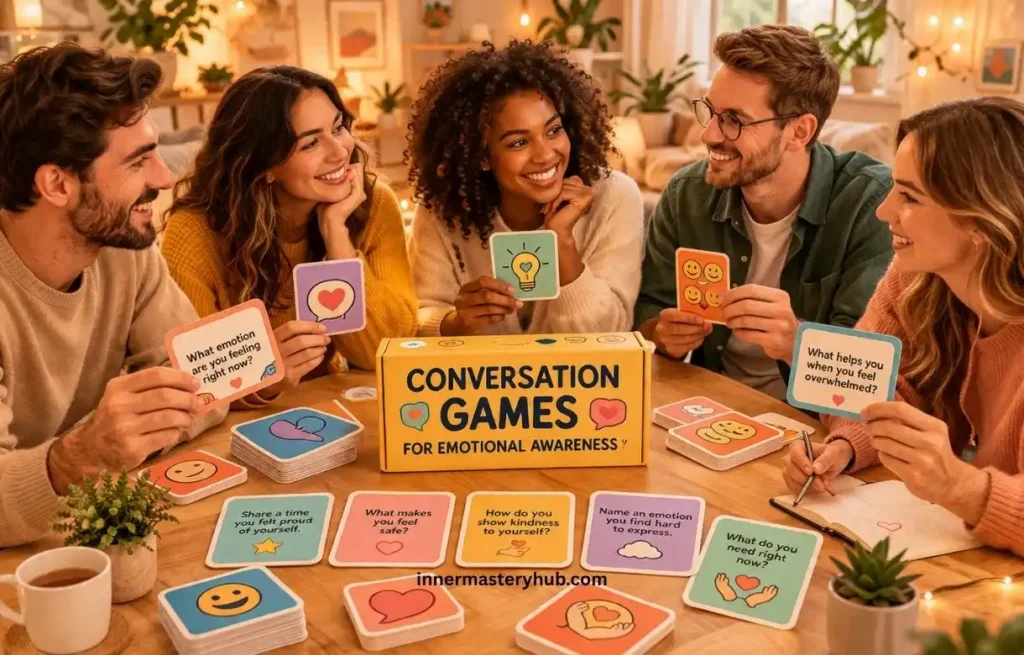
Conversation starter games can give people a structured way to notice, name, and talk about what they’re feeling. They give you a place to start without expecting every conversation to become deep or personal.
Quick Guide: Which Game Should You Choose?
Sometimes you want to talk to someone but don’t know how to get past “How was your day?”
A simple prompt can make it easier to notice what you’re feeling and put it into words.
Some of these games are simply for talking; others give you a chance to slow down and reflect. You can use them alone, with a partner, or whenever you want to better understand what you’re feeling.
A good conversation game doesn’t force people to go deeper. It gives them an easier way to start talking, while letting them decide how much they want to share.
| What you want | Try |
|---|---|
| Break the ice | This or That |
| Get to know someone | Memory Lane |
| Talk about feelings | Emotion Check-In |
| Have a deeper conversation | Finish the Sentence |
| Connect as a couple | Gratitude Jar |
| Reflect alone | Past–Present–Future |
Not Every Conversation Needs to Be Deep
A common misconception with conversation games is assuming that a meaningful conversation has to become personal straight away. It doesn’t.
If you’re talking to someone you don’t know well, asking about their deepest fears can feel odd. Not everyone enjoys being asked a deeply personal question out of nowhere. If you’re playing with someone you don’t know well, start with preferences or stories before moving toward fears, relationships, or regrets.
I find it more useful to think about conversation in three layers:
Layer 1: Easy preferences
These are low-pressure questions about things such as:
- favourite foods
- music
- travel
- hobbies
- books or films
- everyday preferences
They’re useful when people are meeting for the first time or when the group needs an easy way to start talking.
Layer 2: Memories and stories
Once the conversation feels more comfortable, you can move toward experiences:
- a memorable childhood experience
- a funny travel story
- something you learned from a difficult experience
- a person who influenced you
- a time you surprised yourself
These questions usually give people more to talk about than a simple preference question because they invite a story rather than a one-word answer.
Layer 3: Values, fears, identity and meaning
These are the more personal questions:
- What matters most to you at this stage of your life?
- What are you afraid of losing?
- What has changed the way you see yourself?
- What do you wish people understood about you?
- What does a fulfilling life mean to you?
People can also react very differently to the same personal question: one person may enjoy talking about feelings, while another may become quiet or uncomfortable. Someone else may be comfortable with the same question because there’s already trust between you.
A good conversation game should open a door, not push someone through it.
Research on closeness also supports taking things gradually rather than jumping straight into very personal questions1.
Why the Same Question Can Feel Safe or Intrusive
A question can work well with one person and fall flat with another. The difference isn’t always the question itself. It can depend on how well people know each other, whether they trust each other, how personal the topic feels, and whether the person actually wants to answer.
Research on intimacy suggests that sharing something personal is only part of what helps people feel closer. Feeling understood, accepted, and cared for also matters2.
That is why I wouldn’t treat these games as a way to get someone to open up. A better approach is to offer a question and let the other person decide how much they want to share.
A good conversation starter opens the door. It doesn’t push someone through it.
Why Conversation Starter Games Help
Sometimes you know something is bothering you, but you can’t quite put it into words. Sometimes you make snap decisions that you regret later.
- Put what you’re feeling into words
- Pause before responding.
- Help you identify your feelings.
- Make difficult conversations easier to start
- Give you a moment to slow down and reflect.
You can start with a simple question and decide for yourself whether you want to go deeper.
E.A.S.E. Framework for Conversations
E – Explore the feeling
A – Acknowledge the trigger
S – Slow the reaction
E – Express the need
Conversation Starter Games
These simple games can help you notice and explore what you’re feeling.
1. The “Name It to Calm It” Game
Best for: Emotional check-ins
Time: 2–5 minutes
How to play:
Pause and name what you are feeling.
Try these prompts:
- What am I feeling?
- Where do I notice it in my body?
- What happened before I felt this way?
- What do I need right now?
Make it easier:
Choose one word for the feeling.
2. The Pause Game and Reflect Game
Best for: Slowing down before reacting
Time: 2–5 minutes
How to play:
Think about a recent moment that upset you.
Complete:
- Right now I feel…
- This started when…
- What I need is…
Make it easier:
Write your answers instead of saying them aloud.
3. The Emotion Scale Game
Best for: Checking emotional intensity
Time: 2 minutes
How to play:
Rate your feeling from 1 to 10.
Ask:
- How strong is it?
- What might bring it down by one point?
Make it easier:
Don’t try to get from 10 to 0. Look for one small step.

4. The Emotion Check-In Game
Best for: Couples, friends, or family
Time: 5 minutes
How to play:
Take turns answering four questions:
- What am I feeling?
- What caused it?
- How strong is it, from 1–10?
- What do I need?
Make it easier:
Anyone can pass.
5. “Name the Feeling” Game
Best for: Building emotional vocabulary
Time: 5–10 minutes
How to play:
One person describes a situation. The others guess the possible feelings.
Example:
“I worked hard, but nobody noticed.”
Possible feelings:
- disappointed
- frustrated
- sad
Make it deeper:
Ask, “What makes you think that?”
6. Body Awareness Game
Best for: Noticing physical signs of emotion
Time: 3–5 minutes
How to play:
Think of a current feeling and notice your body.
Ask:
- Where do I feel it?
- Is the area tight, heavy, warm, or restless?
- What was happening when I noticed it?
Make it easier:
Notice one body area at a time.
7. High–Low–Emotion Game
Best for: Daily check-ins
Time: 5 minutes
At the end of the day, each person gives three answers: the high point, the low point, and the emotion that stayed with them most.
How to play:
Each person shares:
- High: The best part of my day
- Low: The hardest part
- Emotion: The feeling I noticed most
Example:
High: Finished my work
Low: Had an argument
Emotion: Anxious
Make it easier:
Keep each answer to one sentence.
8. Trigger Tracker Game
Best for: Understanding upsetting moments
Time: 5 minutes
How to play:
Think about something that upset you today.
Ask:
- What happened?
- What did I feel?
- What seemed to set it off?
Make it easier:
Focus on one event, not the whole day.
9. Finish the Feeling Game
Best for: Getting to know your emotional patterns
Time: 5 minutes
Complete:
- I feel calm when…
- I feel stressed when…
- I feel safe when…
- I feel overwhelmed when…
Make it deeper:
Compare your answers with someone you trust.
10. Emotion vs Reaction Game
Best for: Looking back on difficult moments
Time: 5 minutes
How to play:
Choose one recent situation.
Answer:
- What happened?
- What did I feel?
- How did I react?
- What would I like to do differently next time?
Make it easier:
Focus on understanding the reaction, not judging it.
11. One Word Emotion Game
Best for: Quick check-ins
Time: 2–5 minutes
How to play:
Describe how you feel in one word.
Examples:
- tired
- hopeful
- anxious
- peaceful
Then explain why you chose that word.
Make it easier:
You can say “I don’t know” if no word fits.
12. The Emotional Weather Game
Best for: People who find feelings hard to explain
Time: 5 minutes
How to play:
Describe your mood as weather.
Examples:
- Sunny = calm
- Cloudy = unsure
- Stormy = upset
- Foggy = confused
Try this:
“I feel cloudy because…”
13. The Need Behind the Feeling Game
Best for: Understanding what you may need
Time: 5 minutes
How to play:
Name a feeling, then ask what you might need.
Example:
Feeling: frustrated
Possible need: support
Try:
- What am I feeling?
- What might I need?
- Can I ask for it?
Make it easier:
Use “I might need…” rather than looking for one correct answer.
14. The Gentle Honesty Game
Best for: Quiet reflection or trusted relationships
Time: 5–10 minutes
Complete one sentence:
- Something I’m still working through is…
- I feel safe when…
- I struggle to express…
- I wish someone understood…
Make it easier:
Choose only the sentence that feels comfortable.
15. Past–Present–Future Game
Best for: Reflecting on change
Time: 5–10 minutes
How to play:
Choose something that has affected you.
Complete:
- In the past…
- Today I…
- Moving forward, I want…
Make it easier:
You don’t have to share the answer with anyone.
16. The Younger Me Game
Best for: Self-compassion and reflection
Time: 5–10 minutes
How to play:
Think about yourself at a younger age.
Ask:
- What did I need then?
- Do I still need some of that now?
- What could I give myself today?
Make it easier:
Use a childhood memory that feels safe to revisit.
17. The Energy Check-In Game
Best for: Noticing daily patterns
Time: 5 minutes
Ask:
- What drained me today?
- What gave me energy?
- What brought me peace?
- What feeling stayed with me?
Make it easier:
Pick just one question.
Conversation Starter Games for Different Emotional Needs
You don’t need the same type of conversation every day. Choose a game based on what you want to explore.
A 2026 study found that people reported feeling closer during conversations involving emotional self-disclosure than during those without it3.
1. When You Feel Anxious
Try:
- The “Name It“ Game — Put your feeling into words.
- The Emotion Scale Game — Rate how strong the feeling is and look for one small step that may help.
Why put feelings into words?
Putting a feeling into words can make it easier to understand what you’re experiencing. Research on affect labeling, or putting feelings into words, suggests that this process can sometimes change emotional responses, though the effects vary across situations4.
That is why a simple question such as “What am I feeling right now?” can be a useful starting point. You don’t need to find the perfect word. “Something feels off,” “I’m tense,” or “I’m not sure” can be enough to begin.
The goal isn’t to make the feeling disappear. Naming it may simply help you understand what you’re dealing with before deciding what to do next.
2. When You Feel Overwhelmed
Try:
- The Pause and Reflect Game — Slow down and separate what happened from what you need.
- The Emotional Weather Game — Describe your mood without having to find the perfect emotion word.
3. When You Feel Lonely
Try:
- The High–Low–Emotion Game — Share one good moment, one hard moment, and the feeling that stayed with you.
- The Gentle Honesty Game — Share something you wish someone understood.
4. When You Feel Angry
Try:
- The Trigger Tracker Game — Look at what happened before the anger.
- The Emotion vs. Reaction Game — Separate the feeling from what you did next.
5. When You Feel Disconnected
Try:
- The Finish-the-Feeling Game — Talk about when you feel safe, calm, stressed, or overwhelmed.
- The One-Word Emotion Game — Start with one feeling and explain why you chose it.
6. When You Want to Understand Yourself Better
Try:
- The Past–Present–Future Game — Look at how an experience has shaped you.
- The Younger Me Game — Reflect on what you needed when you were younger and what you need now.
Conversation Starter Games for Couples
These games give couples an easy way to talk, laugh, remember good moments, and learn more about each other. You don’t need to make every conversation serious.
1. The Compliment Chain
Best for: Appreciation
Time: 5–10 minutes
How to play:
Take turns complimenting each other. Once a compliment is used, you can’t repeat it.
Try this:
Be specific. Instead of “You’re great,” say what you appreciate and why.
2. Memory Lane
Best for: Sharing memories
Time: 10 minutes
Pick an ordinary memory from childhood that still makes you smile. It doesn’t have to be an important event. Sometimes the small stories tell you more about a person than the big ones.
How to play:
Pick an object from a bag or around your home.
Use it to tell a memory connected to it.
Try this:
Ask, “What do you remember most about that day?”
3. The Honeymoon Game
Best for: Talking about dreams
Time: 10–15 minutes
How to play:
Plan your ideal honeymoon together, even if you’re already married or have no wedding plans.
Talk about:
- Where would you go?
- What would you do?
- What would you skip?
- What would make the trip special?
4. The Finish-the-Sentence Game
Best for: Learning more about each other
Time: 5–10 minutes
Take turns finishing sentences such as:
- I feel most loved when…
- I’d love for us to…
- One thing I want to try together is…
- A perfect weekend would be…
Make it easier:
Keep the questions light at first.
5. The Love Language Quiz
Best for: Talking about preferences
Time: 10 minutes
Use the popular five love languages idea as a starting point.
After taking a quiz, ask:
- Did the result surprise you?
- What makes you feel appreciated?
- How do you usually show care?
Keep in mind:
Treat the quiz as a conversation starter, not a fixed label for either person.
6. The “This or That” Game
Best for: A quick, playful conversation
Time: 5 minutes
Start here if nobody feels like having a “deep conversation.” Pick between two options, coffee or tea, city or countryside, planned trip or spontaneous trip, and explain your choice.
Take turns choosing between two options.
Examples:
- Beach or mountains?
- Stay in or go out?
- Movie night or dinner date?
- Plan everything or be spontaneous?
Then ask “Why?” when an answer interests you.
7. The Gratitude Jar
Best for: Showing appreciation
Time: A few minutes
Write down things you appreciate about each other.
Put the notes in a jar.
Take one out during the week and talk about why you wrote it.
Try this:
Mention a specific action or moment rather than a general compliment.
8. The “What If We Met Somewhere Else?” Game
Best for: Playful relationship talk
Time: 10 minutes
Imagine you met somewhere completely different.
Ask:
- Where would we meet?
- What would you notice about me?
- What might make us talk?
- What would our first date look like?
Keep it playful rather than trying to predict how your relationship “would have” happened.
9. The Dinnertime Debate
Best for: Playful disagreement
Time: 10–15 minutes
Choose a harmless topic and take opposite sides.
Try:
- Pineapple on pizza?
- Best movie genre?
- Early mornings or late nights?
- City life or country life?
Rule:
The goal is to have fun, not to win.
10. The Dream Team Game
Best for: Talking about the future
Time: 10–15 minutes
Choose a goal or challenge you might face together.
Ask:
- What would we need?
- What could each of us contribute?
- What might get in the way?
- How could we support each other?

Conversation Starter Games for Groups and Parties
For groups, I prefer games that let people join in without asking them to share something deeply personal. Start with easy questions and let deeper conversation happen on its own.
1. Two Truths and a Story
Best for: New groups
Time: 10 minutes
Each person shares two true things about themselves and one short story.
The group guesses which story they didn’t expect to hear.
Try this:
Ask one follow-up question about the story people find most interesting.
2. Would You Rather?
Best for: Breaking the ice
Time: 5–10 minutes
Take turns asking “Would you rather?” questions.
Try:
- Travel alone or with friends?
- Give up your phone or television for a month?
- Have a quiet weekend or a busy one?
Make it better:
Ask, “Why?” after each answer.
3. Guess Who?
Best for: Friends and family
Time: 10 minutes
Write a few facts about everyone without adding names.
Read them aloud and let the group guess who each fact belongs to.
Try this:
Use funny or unexpected facts.
4. One Question, Everyone Answers
Best for: Dinner or small groups
Time: 5–10 minutes
Choose one question and let everyone answer.
Try:
- What’s something you enjoyed this week?
- What’s one place you’d like to visit?
- What’s something you’ve changed your mind about?
Rule:
No one has to answer.
5. Story Building Game
Best for: Fun groups
Time: 10 minutes
One person starts a story with one sentence.
Each person adds another sentence.
Keep going until everyone has contributed.
Make it harder:
Add a random word that the next person has to include.
6. The “Most Likely To” Game
Best for: Friends who know each other well
Time: 10 minutes
Ask questions such as:
- Who is most likely to move abroad?
- Who is most likely to start a business?
- Who is most likely to forget their keys?
Everyone chooses an answer and explains why.
Keep it light:
Avoid questions that could embarrass someone.
If someone answers with “I don’t know,” don’t immediately offer three alternative questions. Give them a second. Sometimes “I don’t know” simply means they need time to think.
Conversation Starter Games You Can Use Alone
1. One-Word Check-In
Best for: A quick daily check-in
Time: 2 minutes
Choose one word that describes how you feel.
Then ask:
Why this word?
Write down whatever comes to mind.
2. Past–Present–Future
Best for: Reflecting on change
Time: 5–10 minutes
Write three short answers:
- Something from my past that shaped me…
- How I see it now…
- What I want to do differently in the future…
You don’t need to find a lesson in every experience.
3. Energy Check-In
Best for: Noticing daily patterns
Time: 5 minutes
Ask yourself:
- What drained me today?
- What gave me energy?
- What helped me feel at ease?
Look for patterns over time rather than judging one difficult day.
4. The Younger Me Game
Best for: Self-compassion
Time: 5–10 minutes
Think about a younger version of yourself.
Ask:
- What did I need then?
- What do I need now?
- How can I treat myself with more care?
If a memory feels too difficult to revisit, choose another prompt.
5. Finish the Sentence
Best for: Quiet reflection
Time: 5 minutes
Complete one or two:
- I’ve been thinking about…
- I wish I could say…
- I feel most like myself when…
- Something I want to understand better is…
Don’t worry about writing a perfect answer.
6. The “What Do I Need?” Game
Best for: A quick emotional check-in
Time: 2–5 minutes
Ask:
- What am I feeling?
- What do I need right now?
- Is there one small thing I can do about it?
The answer might be something simple: rest, food, space, company, or finishing one small task.
How to Use Conversation Starter Games Daily
You don’t need to work through several questions at once. One is often enough.
You can use them:
- during journaling
- Before bed reflection
- during self-care time
- with a partner
- in therapy-style self-work
- during emotional overwhelm
Just pick one question and sit with it. That’s enough.
What is the biggest mistake people make with conversation starter games?
The biggest mistake is going too deep, too quickly.
When the questions get personal too quickly, the game can start to feel more like a test than an invitation.
People can ask personal questions with good intentions and still make someone uncomfortable. But a personal question asked too soon can feel intrusive. When that happens, people often become more guarded rather than more open.
Common mistakes include:
- Starting with questions about personal trauma
- Choosing games that prioritize speed over listening
- Using the same prompts in each set of games
- Making the game into a show or a contest
- Not noticing when someone is tired, quiet, uncomfortable, or simply doesn’t want to answer.
- Pressuring people to take part instead of letting them choose
When to Use Conversation Starter Games
These prompts are especially helpful when:
- You’re feeling overwhelmed
- You can’t name your emotions
- You’re healing from something
- You want deeper self-awareness
- You’re working on emotional regulation
- You want meaningful conversations
They can give you a gentle place to start.
Which conversation starter games work best in different situations?
The right game depends on the people, the setting, and the kind of conversation you want to have. A lively group may enjoy something playful, while a quieter or less familiar group may need an easier way in. A simple question that fits the people you’re with is usually better than a clever question that doesn’t.
People don’t all experience “deep conversation” in the same way. One person may find a question about childhood easy; another may find it intrusive. That’s why these games move through different levels of disclosure rather than assuming that deeper automatically means better.
Here is a simple framework you can use.
The C.A.L.M. framework for choosing conversation starter games
Before choosing a game, I’d consider four things: context, anxiety level, length, and meaning.
- Context: Is this a party, a classroom, a team meeting, a date, or a family dinner?
- Anxiety level: Are people relaxed, shy, guarded, or emotionally flat?
- Length: Do you have 5 minutes or 45?
- Meaning: Do you want laughter, bonding, reflection, or collaboration?
| Situation | Start with | Avoid initially |
|---|---|---|
| New group | playful preferences | trauma questions |
| First date | preferences + stories | forced vulnerability |
| Close friends | memories + values | putting someone on the spot |
| Family | shared memories | confrontational questions |
| Couples | appreciation + plans | “relationship test” questions |
| Emotionally tense conversation | gentle check-in | rapid-fire questioning |
The point is simple: a question that works with close friends may not work with strangers, a first date, or a tense family conversation.
Takeaway
A good conversation doesn’t have to begin with something profound. Sometimes it starts with one simple question.
Talking about feelings can feel easier when you have a simple question to start with. A good prompt can help you slow down, notice what you’re feeling, and put some of it into words.
Sometimes having a question in front of you makes it easier to begin talking or reflecting. For some people, that structure can make a difficult conversation feel more manageable. They aren’t a substitute for therapy or a guarantee of emotional healing.
I wouldn’t use depth as a measure of whether a conversation went well. Sometimes two people can spend an hour talking about ordinary things and feel closer afterward. Other times, a very personal question can make someone shut down. The useful question is not “How deep did we get?” but “Did both people feel comfortable enough to take part?”
You don’t need the perfect question. A gentle place to start is enough.
People Also Ask
How do you keep conversation games from feeling awkward?
Start with an easy question and let the conversation build naturally. Answer the question yourself, listen to the response, and ask a follow-up when there is something worth exploring. You don’t need to move to deeper questions just because they’re on the list.
How many people can play a conversation game?
It depends on the game. Two people work well for couples or one-to-one conversations, while simple round-robin questions can work with larger groups. For bigger groups, choose questions that everyone can answer quickly.
What should you do if a conversation suddenly becomes serious?
Slow down and listen. You don’t have to solve the problem or turn the moment into a therapy session. If the person wants to talk, give them space. If they would rather change the subject, respect that too.
What makes a conversation question better than small talk?
A good question usually gives the other person something specific to respond to. Instead of asking only “How was your day?”, you might ask, “What was the best part of your day?” or “What surprised you today?” The goal isn’t to make every question deep; it’s to give the conversation somewhere to go.
What if the conversation doesn’t go deeper?
That’s not necessarily a problem. A short, funny, or ordinary conversation can still be enjoyable. People have different comfort levels, moods, and reasons for wanting to talk.
Can conversation games replace therapy?
No. They can provide prompts for talking and self-reflection, but they aren’t a substitute for therapy or other professional support. If a conversation brings up something difficult that you are struggling to manage, it may be better to discuss it with a qualified professional.
- Aron, A., Melinat, E., Aron, E. N., Vallone, R. D., & Bator, R. J. (1997). The experimental generation of interpersonal closeness: A procedure and some preliminary findings. Personality and Social Psychology Bulletin, 23(4), 363–377. https://journals.sagepub.com/doi/10.1177/0146167297234003 ↩︎
- Laurenceau, J. P., Barrett, L. F., & Pietromonaco, P. R. (1998). Intimacy as an interpersonal process: The importance of self-disclosure, partner disclosure, and perceived partner responsiveness in interpersonal exchanges. Journal of Personality and Social Psychology, 74(5), 1238–1251. https://doi.org/10.1037/0022-3514.74.5.1238 ↩︎
- Yu, Y., Zhao, H., Liu, M., Gao, C., & Li, W. (2026). How emotional disclosure enhances interpersonal closeness from a speaker-listener perspective: An fNIRS hyperscanning study. Neuropsychologia, 225, 109402. https://doi.org/10.1016/j.neuropsychologia.2026.109402 ↩︎
- Lieberman, M. D., Eisenberger, N. I., Crockett, M. J., Tom, S. M., Pfeifer, J. H., & Way, B. M. (2007). Putting feelings into words: Affect labeling disrupts amygdala activity in response to affective stimuli. Psychological Science, 18(5), 421–428. https://doi.org/10.1111/j.1467-9280.2007.01916.x ↩︎
Written By Mehwish Qurayshi
Mehwish Qurayshi is a Trauma-Informed Emotional Wellness Counsellor trained through NICABM’s Treating Trauma Master Series, which includes NBCC-approved education in Trauma Treatment and Emotional Wellness & Emotional Intelligence – Sourcecode Academia. She has over five years of experience providing emotional wellness counselling, helping individuals heal from trauma, regulate emotions, and build healthy relationships.