
11 Examples of Mild Narcissism in Everyday Relationships
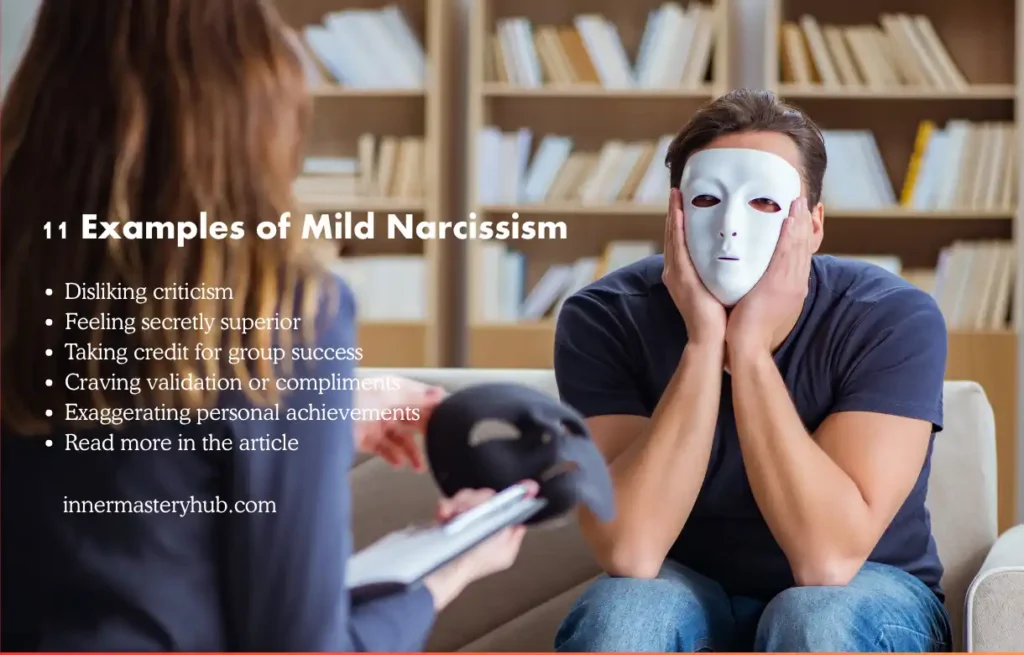
Examples of mild narcissism show up in some ways, such as the need for continual affirmation, turning talks back to oneself, finding it difficult to take criticism, being emotionally distant, and only showing empathy when it is convenient. In contrast to narcissistic personality disorder, mild narcissism is subtle and socially acceptable, making it more difficult to identify in friendships, family dynamics, and partnerships.
Mild Narcissism vs Healthy Self-Esteem
| Aspect | Mild Narcissism | Healthy Self-Esteem |
|---|---|---|
| Source of confidence | Needs external validation (praise, attention, approval) | Comes from internal self-worth and stability |
| Reaction to criticism | Defensive, sensitive, may deflect or blame | Open to feedback, can reflect without collapse |
| Focus on conversations | Often shifts attention back to self | Balanced; listens and shows interest in others |
| Empathy | Inconsistent; present when convenient | Consistent and emotionally attuned |
| Need for recognition | Frequent and emotionally dependent | Appreciates recognition but does not rely on it |
| Self-image | Can fluctuate between superiority and insecurity | Stable and realistic self-view |
| Relationships | May create imbalance or emotional exhaustion | Reciprocal and emotionally safe |
| Handling others’ success | May feel threatened or competitive | Can celebrate others without comparison |
| Accountability | Struggles with admitting fault | Takes responsibility when wrong |
| Emotional regulation | Reacts strongly to ego threats | More regulated and grounded |
You may notice that conversations frequently return to them. In public, they may appear endearing, self-assured, and emotionally expressive, but in private, you feel invisible, emotionally exhausted, and guilty for having needs of your own. It is challenging to recognise mild narcissism because of this misconception.
Many people connect narcissism with selfishness, manipulation, or arrogance. However, mild narcissism is often seen as normal. In fact, because self-focus, ambition, and confidence can initially seem appealing, some behaviours are even socially rewarded.
Key takeaways
- “Mild narcissism” is informal, not a diagnosis.
- One isolated behaviour is not enough.
- Look for repetition, accountability and relationship impact.
- Protecting your wellbeing matters more than choosing a label.
What Is Mild Narcissism?
The term “mild narcissism” describes slight narcissistic characteristics that do not fit the criteria for NPD. Self-centredness, sensitivity to criticism, emotional instability, attention-seeking, and difficulty consistently showing profound empathy are among these traits.
Many persons with mild narcissistic characteristics are successful in both their social and professional lives. As a result, these qualities are frequently overlooked. Not all cases of mild narcissism include abuse or deliberate harm. Rather, it frequently reveals emotional insecurities concealed beneath self-assurance or self-interest.
The person may:
- Regularly require admiration
- Have difficulty with emotional accountability.
- Quickly become defensive
- Prioritise image and appearance over emotional depth.
- Desire to connect yet avoid vulnerability
Psychologists describe narcissistic traits as existing on a continuum rather than as an “all-or-nothing” disorder1.
Causes of Mild Narcissistic Traits
Mild narcissistic patterns develop because of:
- Childhood emotional neglect
- Insecure attachment styles
- Shame-based coping mechanisms
- Fear of vulnerability or rejection
Researchers have investigated possible relationships between temperament, emotional neglect, shame, attachment experiences, and self-esteem control and narcissistic tendencies. These criteria do not account for every person, and behaviour alone cannot determine the cause2.
Although many people believe that “thinking too highly” of oneself is the root cause of narcissism, research shows that many narcissistic features actually shield vulnerable self-esteem beneath the surface.
A study published in Personality and Individual Differences found that narcissistic traits fluctuate between superiority and insecurity3.
Effect Of Mild Narcissism on Relationships
Even mild narcissism can create:
- Emotional imbalance
- Feeling emotionally unseen
- Walking on eggshells
- One-sided emotional labor
- Confusion about your own needs
The emotional exhaustion usually happens slowly, not suddenly.
Relationship Psychology Behind Mild Narcissism
Many clients I worked with described the same emotional experience:
“I feel loved sometimes, but emotionally alone at the same time.”
That contradiction creates confusion.
The partner may:
- When things are going well, show affection.
- During emotional accountability, retreat
- More admiration is required than reciprocal vulnerability.
- Emotional reciprocity is a challenge.
Some people may become uptight, cautious, or uncertain about the other person’s reaction if they experience emotional unpredictability regularly.
You begin monitoring:
- Their mood
- Their reactions
- Their emotional availability
Instead of feeling emotionally grounded, you feel emotionally alert.
This is especially common in people with anxious attachment styles or a fear of abandonment.

Examples of Mild Narcissism in Daily Life
Here are 11 examples of mild narcissism, behaviors that may not scream “narcissist,” but still reflect traits. Recognizing them is the first line of protection.
1. Humble bragging
The boaster pretends to be complaining when he adds, “I wish I had more free time; I’m fatigued from finishing three tasks.” But the real objective is to highlight achievement. This subject has been the subject of scientific investigation.
2. Constant name-dropping or status reminders
To improve their reputation, the person employs a variety of references, including people they know, locations they’ve visited, or their prior standing. Name-dropping is okay on occasion, but when it repeatedly interrupts other people’s talks, it turns into a sign of self-promotion.
3. Needing continual praise or compliments
The person is constantly seeking recognition. They respond adversely or defensively if they don’t receive praise. This happens in small quantities in smaller situations, such as when someone says, “Did you notice I lost weight?” or “Do you think I handled that well?”
4. One-upmanship
The other person always tries to outshine you in chats. They react with a more exaggerated version of themselves if you convey good news. This redirects focus and gently minimizes your accomplishment.
5. Interrupting or redirecting the conversation to oneself
This person often cuts you off or changes the subject of your story to something about themselves. They turn to their own experiences once you mention a challenge.
6. Expecting Favours Without Respecting Boundaries
This person believes that you will cancel your plans or perform favors for them without asking for anything in return. They treat you as though you owe them time or effort.
7. Showing Inconsistent Empathy
When you are vulnerable, the other person either uses repetition, listens superficially, or changes the subject. They would remark, “That must be hard,” before quickly returning to their initial ideas.
8. Selective memory of promises or commitments
That person conveniently forgets agreements or commitments when it suits them. Despite their prior agreement, they may assert, “I never said I’d help you.”
9. Denying or Minimising Previous Statements
Repeatedly refusing to make clear claims or causing someone to question their recall can have detrimental psychological effects. It takes more than one argument or defensive reaction to prove gaslighting.
“You’re overreacting,” or “I didn’t mean it like that,” are instances of how someone minimises or contradicts what they said, making you doubt what you heard. Even in its delicate manifestation, it is one of the lesser types of narcissism; it is less obvious than outright abuse.
10. Jealousy masked as concern or “joking.”
Under the guise of concern, the person makes comments about your activities or the people you interact with, such as “Are you spending too much time with others?” or “I hope that coworker isn’t flirting with you.”
11. Using others for self-image
To improve their reputation, the person makes acquaintances or emphasises interactions in public (social media, events). For instance, sharing a picture of oneself with a famous buddy in order to get social credit instead of showing true intimacy.
On their own, each of these instances would appear harmless. However, when combined, they suggest a pattern. Therefore, modest narcissism is neither uncommon nor always harmful. However, it can damage relationships if left uncontrolled.
How Can You Respond to Mild Narcissism
Here are strategies to protect yourself from narcissism
1. Set clear boundaries
List the things you will and won’t accept. You can add, “I’d like to finish my thought before switching,” if they interrupt frequently. Saying, “I can’t help right now,” is an option if they keep asking for favors.
Setting boundaries keeps people from taking advantage of you.
2. Use “I” statements and stick to facts.
Avoid making judgments like “You always…” while confronting. Instead, state, “I felt ignored when the topic shifted to you while I was speaking.” Consider a particular instance.
Defensiveness is decreased, and the discussion remains grounded.
3. Limit emotional investment
When you don’t have trust, protect your emotional privacy. You don’t have to disclose sensitive information to someone who consistently ignores or exploits it against you. Cutting off is not necessary, but avoid disclosing too many of your flaws until you’ve built trust.
4. Engage in self-validation
Please don’t rely on their support or praise. Create your own sources of support, such as friends, hobbies, and core values. This lessens the likelihood that you will act in a way that seeks approval.
5. Make use of checks and balances.
Ask a therapist or a reliable friend for an outside view if you are unsure about your experience. A pattern is simple to see from the outside. To help you remember specific circumstances rather than vague feelings. Keep a private written record of recurring incidents if it helps you identify patterns clearly.
6. Engage only when meaningful.
Choose which battles to participate in. It’s not always worthwhile to engage with people who show milder forms of narcissism. You can focus on more important issues and overlook minor errors.
What Mistakes Do People Make When Identifying Mild Narcissism?
The most common error is to assume that narcissism must appear excessive. Subtle and emotionally erratic, mild narcissism is frequently concealed by charm, success, brilliance, or emotional weakness.
Mistake 1: “They are confident, so they must be narcissistic.”
Accountability and empathy are components of healthy confidence. Self-centredness without emotional equilibrium is a sign of mild narcissism.
Mistake 2: “They had trauma, so the behavior is okay.”
Trauma may help explain some behaviour, but it does not excuse harm or prove why a person acts a certain way.
Mistake 3: “If they love me, they cannot be emotionally self-centered.”
People can love others while still lacking emotional maturity. This is emotionally difficult to accept because love alone does not automatically create emotional safety.
Conclusion
It can be challenging to identify mild narcissistic traits since they might seem normal, charming, self-assured, or socially acceptable.
A person does not necessarily have a narcissistic pattern based on a single behaviour. Instead, consider the relationship’s impact on your wellbeing as well as repetition, accountability, empathy, and respect for limits.
Diagnosing someone else is not the aim. When a relationship repeatedly becomes one-sided or unclear, it’s important to identify problematic habits, communicate effectively, and safeguard your emotional well-being.
People Also Ask
What is mild narcissism?
Though not the whole clinical condition, mild narcissism refers to personality features such as sporadic self-absorption, praise-seeking, or slight entitlement. Instead of persistent grandiosity, it manifests in tiny patterns.
How can I tell if someone has milder forms of narcissism?
Keep an eye out for recurring behaviours such as one-upping, interrupting, soliciting compliments, disregarding your emotions, or using you to validate yourself. Look for consistency throughout time; sporadic behaviour is insufficient.
Is mild narcissism harmful?
It’s not necessarily bad to have mild narcissistic tendencies. When trust and wellbeing are impacted by persistent entitlement, invalidation, defensiveness, or emotional imbalance, they could become harmful.
Can a milder form of narcissism turn into narcissistic personality disorder (NPD)?
Narcissistic personality disorder and narcissistic traits are not merely phases of the same process. The only person who can determine whether someone fits the diagnostic criteria for NPD is a licensed mental health professional. Narcissistic traits lie on a spectrum. Most mild traits do not escalate into full NPD unless reinforced by environmental, genetic, or psychological factors.
How should I respond to someone with mild narcissism?
Use clear boundaries, factual “I” statements, limit emotional exposure, and self-validate. Respond selectively, not out of anger, and seek external support to analyze patterns.
Can a person with mild narcissism change?
Some can shift their behavior if they become self-aware and accept feedback. But change is slow and inconsistent, and it depends on willingness, humility, and the environment.
Is mild narcissism common in relationships?
Relationships can show narcissistic traits, albeit this is not always the case. Instead of making a diagnosis, concentrate on recurring behaviour and its effects.
How is mild narcissism different from high self-esteem?
Mild narcissism is the desire for outside approval, comparison, or special treatment; self-esteem is internal confidence. A narcissistic person could respond defensively, but a healthy person can take criticism.
Should I confront someone with mild narcissism?
You can, but do it carefully, with clear examples and low expectations. Speak calmly and truthfully. If they gaslight you or don’t want to engage, use limits instead of arguing.
When should I walk away from a mildly narcissistic person?
When the pattern persists, your welfare suffers, boundaries are consistently disregarded, or the other person refuses to admit damaging behaviour, you should think about establishing space. Distancing or dissolving the relationship may be required if there is a lack of respect, empathy, or basic justice.
- Cain, N. M., Pincus, A. L., & Ansell, E. B. (2008). Narcissism at the crossroads. Clinical Psychology Review. ↩︎
- Weinberg, I., & Ronningstam, E. (2022). Narcissistic personality disorder: Progress in understanding and treatment. Focus, 20(4), 368–377. ↩︎
- Bushman, B. J., & Baumeister, R. F. (1998). Threatened egotism, narcissism, self-esteem, and direct aggression. Journal of Personality and Social Psychology.
https://psycnet.apa.org/record/1998-00185-002 ↩︎
Written By Mehwish Qurayshi
Mehwish Qurayshi is a Trauma-Informed Emotional Wellness Counsellor trained through NICABM’s Treating Trauma Master Series, which includes NBCC-approved education in Trauma Treatment and Emotional Wellness & Emotional Intelligence – Sourcecode Academia. She has over five years of experience providing emotional wellness counselling, helping individuals heal from trauma, regulate emotions, and build healthy relationships.