
18 Signs You’re Confusing Comfort With Contentment

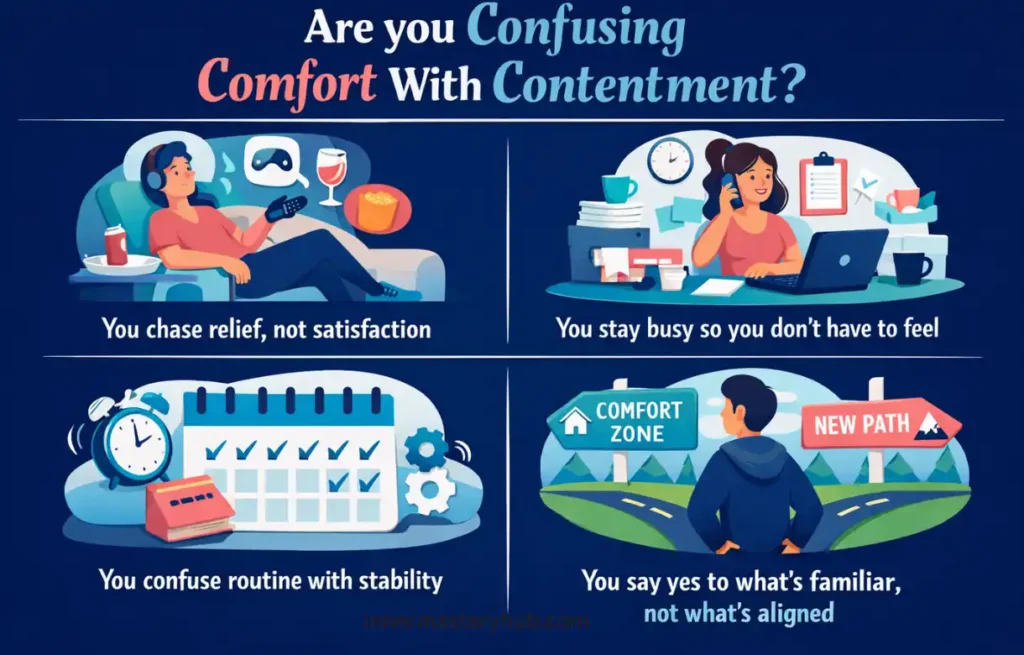
Confusing comfort with contentment happens when emotional safety is mistaken for true fulfillment. Internal restlessness coexists with a sense of stability and security. This happens as a result of your mind’s preference for consistency over development, which creates a vicious loop where avoiding discomfort, even if it results in stagnation, feels peaceful.
If you’ve struggled to distinguish between contentment and comfort, life may appear pleasant on the outside but feel strangely flat on the inside. You’re not quite happy, but you’re also not miserable. You keep yourself occupied enough to prevent overanalysing, manage your days, and steer clear of major crashes. But a voice inside of you asks, “Is this it?” as the sound fades. True contentment is dazzling rather than loud.
What Is the Difference Between Comfort and Contentment?
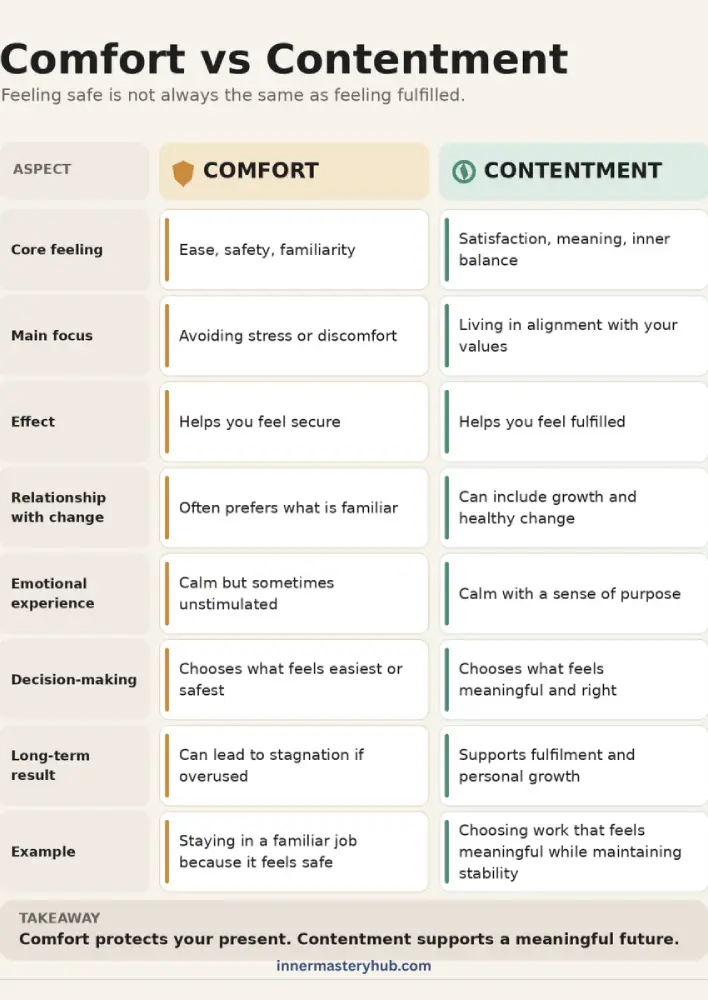
The Comfort-Contentment Cycle
Comfort loop
Discomfort → Avoidance → Familiar choice → Immediate relief → Pattern reinforced
Contentment path
Discomfort → Reflection → Values-based choice → Meaningful action → Growth or satisfaction
Example
You dislike your job. The comfort loop says, “Don’t think about it because changing careers feels risky.” The contentment mindset asks, “What specifically is missing, and what small action would move my work closer to my values?”
Why Do We Confuse Comfort With Contentment?
They both seem peaceful on the surface, which is why we confuse them. However, happiness results from meaningful participation with life, whereas comfort comes from avoiding problems.
The Psychological process
It starts with a trigger. You may be uncomfortable, bored, unhappy, or restless. Your mind perceives it as something to stay away from. Because being uncomfortable seems risky. Thus, you decide on familiarity. You remain in areas where things are predictable. This provides short-term respite. It turns into an emotional reward. Your brain eventually comes to classify that situation as “excellent.”
However, the outcome? You give up doubting your life. You stop developing and paying attention to that more profound voice.
There is a deeper cause for this misperception as well: contentment goes beyond “less stress.” Three basic needs are closely linked to well-being, according to a large body of research on self-determination theory: relatedness (you feel connected), competence (you feel capable and improving), and autonomy (you think you have a choice)1.
18 Behaviours that show you’re confusing comfort with contentment
1. You chase relief, not satisfaction
You plan your life based on what will allow you to relax fastest. You resort to fast fixes like browsing, snacking, shopping, or sleeping when you’re uncomfortable. Relief isn’t necessarily a bad thing, but if you use it every time you’re feeling anxious, you’ll start to experience its negative effects. When was the last time you felt proud after a day instead of just relaxed?
2. You call “no conflict” a healthy relationship.
You avoid awkward conversations because you want everything to go well. You reduce your drive to remain composed and mistake quiet for intimacy. Even tho you are surrounded by people, you could eventually feel lonely.
Strong relationships are genuine and healed despite their flaws. Good connections promote both happiness and health, according to long-standing research. You are equating comfort with contentment if your relationship is based on hiding the truth.
3. You delay decisions so you can’t fail.
You’re scared to commit, not because you’re agile. You tell yourself that you’re “thinking it over,” yet nothing changes for months. On the exterior, this seems responsible, but on the inside, it seems stuck. Contentment rises when you make a choice and stick with it in spite of its shortcomings.
4. You stay busy, so you don’t have to feel.
Your schedule is packed, your mind is racing, and your free time is filled with diversions. One could even refer to it as productivity. But you know deep down that you are dodging questions you don’t want to answer. Lastly, you become anxious when you sit in silence. This restlessness is an indication that your life is going nowhere.
5. You avoid being a beginner
You quickly become skilled by sticking to what you already know. You don’t take lessons, explore new hobbies, or push yourself. You could persuade yourself that you’re too old or too busy, but the true cause is usually a fear of seeming uncomfortable. One aspect of contentment is the calm confidence that you can grow and learn at your own pace.
6. You treat your dreams like “nice ideas.”
You express your desires, but you don’t act upon them. You store your dreams in a glass box that is protected from testing. While living the same week over and over, you might think, “One day.” Because “someday” never asks you to take a chance today, comfort loves “someday.”
7. You overvalue convenience in every choice.
You pick the most leisurely meal, the easiest exercise (or none at all), the easiest superficial conversation, and the easiest entertainment. Convenience is fine, but your life becomes less meaningful if it becomes your primary filter. Asking yourself if you’re creating a life that feels genuine or easy is a worthwhile exercise.
8. You keep your standards low to avoid disappointment
You tell yourself you don’t need much, but it’s protective rather than modest. To prevent the agony of desiring more, you have lower expectations. This
9. You confuse routine with stability
Although your habits keep you going, they also prevent you from evolving. You see the same people, act in the same ways, and think the same things. While routine can be calming, too much repetition can cause mental dullness. Your spirit feels undernourished, but your psychological system feels secure.
10. You say yes to what’s familiar, not what’s aligned
You choose the position, role, or duty that best suits the narrative that people anticipate from you. Even though you’re skilled at it, you don’t feel like yourself doing it. You eventually start to feel like you’re living your own life. When your decisions reflect your values rather than merely your skills, contentment usually manifests.
11. You numb stress instead of reducing it
Instead of addressing the root causes, you seek coping mechanisms that numb emotions. Substances, screens, and never-ending work can all be the cause. Chronic stress is more than just a mood; it can have long-term effects on the body through processes such as inflammation and deterioration of the healing systems. Your “comfort habits” won’t truly bring you serenity if they harm your health.
12. You avoid movement because rest feels earned only after exhaustion.ion
You tell yourself you’ll “get back to it” later, only to sit for extended periods. But then continues to move. According to studies from around the world, a significant portion of adults do not engage in the required amounts of physical activity, and this is linked with an increased risk of illness. Energy is typically necessary for contentment, and it isn’t easy to develop if your days don’t involve fundamental activity.
13. You keep your life “managed” but not enjoyed
Tasks are completed, bills are paid, and obligations are managed. However, happiness seems uncommon. Because you’ve been living in duty Mode, you might not even know what you enjoy anymore. This is a typical comfort trap: you don’t feel alive since nothing is being constructed, but you feel safe because nothing is collapsing.
14. You wait for motivation before taking action.n
You promise yourself that when you’re ready, you’ll begin. But rather than being a prerequisite for action, readiness frequently follows from it. Behavioural activation in mental health research is predicated on the notion that engaging in worthwhile activities can elevate mood and lessen symptoms even when you don’t feel like it. You can learn from it without being depressed: sentiments can follow action.
15. You keep friendships that are comfortable but shallow
You can chat to anyone, but you don’t have anybody you can really rely on. To avoid being seen, you have light discussions. You may eventually feel “social” but remain isolated. Real connection, which necessitates being known rather than merely liked, is necessary for contentment.
16. You treat anxiety as a stop sign instead of a signal
Any discomfort seems to be evidence that the action is wrong. You swiftly withdraw and call it “listening to your gut.” That may be insightful at times, but it’s usually fear disguised as wisdom.
According to several performance models, there is a middle ground where a little stress can help you concentrate, but too much stress can overwhelm you, and too little stress can cause boredom. You might choose the lowest-growth life if you consistently select the least stressful alternative.
17. You keep consuming information, but don’t apply it
You bookmark posts, watch movies, read books, and get advice. It keeps you in your thoughts, yet it feels useful. Knowledge can act as a safety net, providing you with a sense of advancement without the threat of change. You’re probably safeguarding comfort if you have ten tabs open with instructions on “how to start” and no action taken.
18. You feel safe, but you don’t feel proud.
Even if your life is steady, you hardly ever experience the subtle pride that comes with standing up for yourself. Pride doesn’t require outstanding accomplishments. It might result from fulfilling commitments to oneself, being truthful in interpersonal interactions, completing essential tasks, or taking small risks regularly. Comfort is probably in charge if you can’t recall the last time you were pleased with your way of life.
Is Comfort Bad?
Comfort is necessary for emotional safety, but it becomes harmful when it replaces growth and self-awareness.
Balanced Understanding
Comfort helps you:
- Regulate emotions
- Recover from stress
- Build stability
But too much comfort leads to:
- Stagnation
- Fear of change
- Loss of purpose
As Abraham Maslow explained in his hierarchy of needs, once safety is met, humans naturally seek growth and self-actualization2. Ignoring that need creates inner conflict.
What Is Actually Happening Inside You?
Internally, your mind is prioritising safety over meaning. This creates a gap between what feels easy and what feels fulfilling.
The Comfort Loop
- Discomfort appears
- You avoid it
- You choose familiarity
- Relief follows
- The brain reinforces the pattern
The Contentment Path
- Discomfort appears
- You stay with it
- You explore meaning
- Growth happens
- Fulfillment develops
The difference is subtle. One avoids discomfort. The other transforms it.
Emotional Regulation vs Emotional Suppression
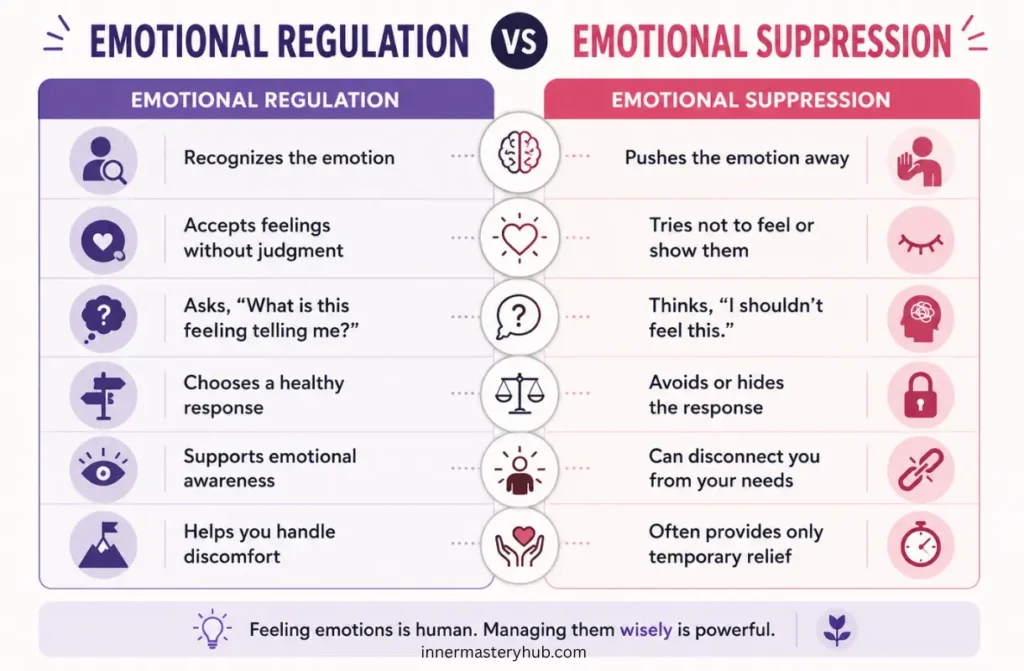
How to Move From Comfort to Contentment
Moving from comfort to contentment does not require changing your entire life. The goal is to notice where familiarity is helping you recover and where it is keeping you from meaningful action.
1. Identify What Feels Comfortable but Empty
Look at areas such as work, relationships, routines, and personal goals. Ask yourself where you feel safe but consistently unfulfilled. Naming the gap helps you separate genuine stability from avoidance.
2. Clarify What Matters to You
Think about the values you want your daily life to reflect. These may include connection, creativity, learning, independence, health, contribution, or honesty. Contentment is easier to build when your choices reflect what matters to you rather than what simply feels easiest.
3. Choose One Small Uncomfortable Action
Growth does not require dramatic change. Start with one manageable step, such as having an honest conversation, learning a skill, applying for an opportunity, setting a boundary, or returning to an activity you care about.
4. Notice Avoidance Without Judging Yourself
Pay attention to what happens when discomfort appears. Do you scroll, delay, overwork, withdraw, or tell yourself you will deal with it later? Recognising the pattern gives you more choice before automatic habits take over.
5. Build Rest and Growth Into the Same Life
Contentment does not mean constantly pushing yourself. Make space for genuine rest while also protecting time for meaningful effort. A balanced life includes both recovery and challenge.
6. Review Your Choices Regularly
Once a week, ask yourself: “What gave me temporary relief?” and “What gave me a deeper sense of satisfaction?” Over time, this helps you identify which habits support contentment and which mainly protect familiarity.
When Comfort May Actually Be What You Need
You don’t have to give up comfort. Stability, relaxation, and predictability may be precisely what promotes your well-being during certain stages of life.
1. Burnout
Pursuing continuous improvement can make healing more difficult if you are emotionally and physically worn out. Setting lofty new objectives might not be as beneficial as lowering demands, taking breaks, and streamlining routines.
2. Illness
Comfort can promote healing during illness. You may save energy while your body heals with the help of familiar habits, enough rest, helpful support, and less strain.
3. Grief
Grief frequently impairs one’s emotional and physical abilities. You might require more solitude, comfort, and assistance than normal. This is not a state of stagnation. It may be a component of coping with loss.
4. Major Life Stress
Stability might be especially important in situations like job loss, relationship changes, caregiving obligations, financial strain, or migration. While you adjust, sticking to basic routines might provide you with a feeling of order.
5. Recovery
Comfort can offer a secure base whether you are healing physically, emotionally, or from a protracted stressful time. Recovery does not always appear to be beneficial. Progress sometimes entails rebuilding capacity while doing less.
6. Sleep Deprivation
Sleep deprivation has an impact on mood, focus, judgement, and emotional control. Rest could be more crucial than forcing yourself to make tough choices or significant adjustments when you are extremely sleep deprived.
“Is this comfort helping me heal or helping me avoid something that matters?” is the crucial issue, not “Am I too comfortable?” You regain your capacity when you are comfortable. Avoidant comfort prevents you from making decisions that you know require consideration.
Choose contentment on purpose, not comfort by default.
Because comfort shields you from both discomfort and personal development, you may lead a seemingly peaceful but hollow existence if you confuse comfort with contentment. The change is not to forsake comfort completely.
The change is to cease making decisions based solely on comfort. You can be thankful without shrinking, you may rest without running away, and you can create a life that is both solid and purposeful. Start small, be truthful, and keep choosing what makes you feel genuine, competent, and connected. That’s where contentment resides, and it’s much more fulfilling than just being comfortable.
Conclusion
Confusing comfort with contentment is not a failure. It is a natural response to wanting safety. But staying there too long creates distance from who you are becoming. You are not meant to feel restless forever.
But that restlessness is not your enemy. It is your signal. It is telling you that stability alone is not enough, that calm is not always peace, and that fulfilment requires something comfort cannot give: Honest engagement with your life.
People Also Ask
What does confusing comfort with contentment mean?
You’re mixing “living feels easy and comfortable” with “life feels truly satisfying.” Even with routines, security, and fewer risks, you may feel empty or bored. Increasing comfort reduces discomfort, while contentment is lasting inner serenity and sufficiency.
Why do you feel empty even when life is comfortable?
Your mind senses a hole when your days lack meaningful connection and knowledge because comfort can reduce tension without significance. Because you forgo growth and belonging in favour of basic needs, “fine” may become flat over time.
Is contentment the same as complacency?
Contentment is accepting your situation without hating it. Complacency is resisting change because it’s safer. You can be cheerful and courageous. The key is whether you want growth or avoid it for comfort.
Can you be ambitious and still be content?
Sure. When you feel stable on the inside and are grateful for what you have, you are happy. When you keep developing and getting better, you are ambitious. In other words, you pursue your goals with a purpose rather than out of fear or self-proving. You don’t grow because you feel “not enough,” but instead because you choose to.
What are quick self-reflection questions to check if you’re settling?
Consider this: “What am I avoiding?” “Where am I sacrificing the truth for ease?” “If I trusted myself more, what would I do?” “What do I miss about the attempt-making version of myself?” Write your responses. If you are sincere, patterns become clear very quickly.
How do you stop using distractions as comfort?
First, identify your trigger: fear, loneliness, boredom, or tension. Next, take a two-minute break before browsing, eating, or shopping. Replace the habit with a “reset,” such as drinking water, taking a little stroll, writing in a diary, or contacting a trusted person.
Why is confusing comfort with contentment a problem?
Mistaking comfort for contentment limits growth. You may cease challenging yourself when routines are enjoyable. Mistaking comfort for contentment keeps people in stagnant jobs and relationships. Contentment provides long-term fulfilment, purpose, resilience, and intentional daily life choices, whereas comfort temporarily decreases stress.
How do I move beyond my comfort zone without disrupting my life?
Gradually step beyond your comfort zone. Pick one minor task at a time, like picking up a new skill, establishing boundaries, or attempting something different. To make progress feel manageable rather than overpowering or disruptive, maintain supporting habits.
How can I tell whether I need rest or growth?
You might need to relax if you feel worn out, agitated, distracted, or physically depleted. You might need to grow if you feel steady but bored, trapped, or unfulfilled. While growth pushes you to pursue important objectives and standards, relaxation replenishes your energy.
- Ryan, R. M., & Deci, E. L. (2000). Self-determination theory and the facilitation of intrinsic motivation, social development, and well-being. American Psychologist, 55(1), 68–78. https://doi.org/10.1037/0003-066X.55.1.68 ↩︎
- Maslow, A. H. (1943). A theory of human motivation. Psychological Review, 50(4), 370–396. https://doi.org/10.1037/h0054346 ↩︎
Written By Mehwish Qurayshi
Mehwish Qurayshi is a Trauma-Informed Emotional Wellness Counsellor trained through NICABM’s Treating Trauma Master Series, which includes NBCC-approved education in Trauma Treatment and Emotional Wellness & Emotional Intelligence – Sourcecode Academia. She has over five years of experience providing emotional wellness counselling, helping individuals heal from trauma, regulate emotions, and build healthy relationships.