Dealing With Self-Defeating Behaviours That Are Secretly Controlling Your Life
Self-defeating behaviours can keep you stuck in the same frustrating cycle. Start by noticing your triggers, thoughts, and habits without judgment. Replace “all-or-nothing” thinking with small, realistic steps. Set one clear goal, track progress weekly, and practice self-compassion. Consistency, support, and accountability create lasting change.
You tell yourself this is the last time.
The last time you overthink. The last time you avoid. The last time you sabotage something that matters.
But somehow, you end up in the same place again.
Self-defeating behaviours don’t feel logical, yet they feel familiar. And that familiarity is what keeps them alive.
At the center of this is emotional regulation. You are not just making bad choices. You are trying to manage something inside that feels overwhelming, unclear, or unsafe. That inner tension creates a loop. You react, not because you want to fail, but because something inside you is trying to protect you.
So the real question is not:
“Why do I keep messing up?”
It’s: “What is this behaviour trying to protect me from?”
Most people misunderstand self-defeating behaviours. They think it’s laziness, lack of discipline, or poor mindset. But underneath, there’s a deeper psychological process unfolding quietly.
Why Do Self-Defeating Behaviours Happen?
Self-defeating behaviours happen because your mind tries to protect you from emotional discomfort. What looks like sabotage is a coping mechanism shaped by your past experiences.
These patterns begin with a trigger. It could be rejection, pressure, or uncertainty. Your mind interprets it through old beliefs, like “I’m not enough” or “I’ll fail anyway.”
That interpretation creates troubled emotions. Anxiety, shame, or fear. And instead of facing that feeling, you act in a way that reduces discomfort in the moment.
The Inner Loop
- Trigger → You feel challenged or threatened
- Interpretation → You attach meaning based on past beliefs
- Emotion → You feel discomfort (fear, shame, anxiety)
- Behaviour → You escape or react
- Consequence → Short-term relief, long-term damage
This is why patterns repeat.
According to research published in Journal of Personality and Social Psychology, avoidance-based coping increases long-term stress and decreases life satisfaction1.
What Are Common Examples of Self-Defeating Behaviours?
Common self-defeating behaviours include procrastination, overthinking, self-sabotage, people-pleasing, perfectionism, and avoidance. These patterns feel protective in the moment but harm long-term growth.
Common Patterns You Might Recognize
- Procrastination → Avoiding tasks to escape pressure
- Overthinking → Trying to control outcomes through excessive thinking
- Self-sabotage → Ruining opportunities when things go well
- People-pleasing → Ignoring your needs to avoid rejection
- Perfectionism → Delaying action due to fear of failure
- Emotional withdrawal → Disconnecting when things feel overwhelming
Each of these is not random. They are emotional strategies.
Are Self-Defeating Behaviours a Form of Self-Sabotage?
Yes, self-defeating behaviours are a form of self-sabotage, but they are not intentional. They arise from unconscious emotional patterns aimed at avoiding pain or discomfort.
Psychologist Sigmund Freud suggested that much of human behavior is driven by unconscious processes. Modern psychology supports this idea2.
You are not trying to hurt yourself. You are trying to avoid something that feels worse.
But here’s the paradox:
What protects you in the short term limits you in the long term.
What Is the Psychological Root of Self-Defeating Behaviours?
The root lies in early experiences, core beliefs, and emotional conditioning. These shape how you interpret situations and regulate emotions.
Key Roots
- Core beliefs → “I’m not good enough,” “I will fail”
- Past experiences → Rejection, criticism, neglect
- Emotional conditioning → Learned ways of coping
According to Aaron T. Beck, our thoughts shape emotions and behaviours. When beliefs are distorted, behaviours follow3.
So when you avoid something, it’s not just about the task.
It’s about what that task means to you.
Why Do You Repeat Self-Defeating Patterns Even When You Know Better?
You repeat these patterns because awareness alone does not change emotional responses. Your nervous system still reacts based on old conditioning.
Knowing something logically is different from feeling it emotionally.
Why Awareness Isn’t Enough
- Your brain prioritizes safety over logic
- Familiar patterns feel safer than unknown outcomes
- Emotional memory overrides rational thinking
This is why you can say, “I know I shouldn’t do this,” and still do it.
Because your body remembers what your mind tries to forget.
What Are the Biggest Mistakes People Make About Self-Defeating Behaviours?
The biggest mistake is treating these behaviours as weaknesses instead of understanding them as emotional signals.
Common Mistakes
- Trying to “fix” behaviour without understanding emotions
- Blaming yourself instead of observing patterns
- Using willpower instead of awareness
- Ignoring emotional regulation
- Comparing yourself to others
When you fight the behaviour, it gets stronger.
But when you understand it, something shifts.
Why dealing with self-defeating behaviours matters
Self-defeating behaviour, sometimes referred to as self-sabotage, is conduct that damages your wellbeing. Self-defeating behaviour is defined by psychology as repeated behaviour that inhibits the achievement of goals and leads to failure or tragedy.
According to one study, these activities are used as a defence against more serious anxiety or threat and have a lower reward/cost ratio (you get less benefit but a significant expense).
In the wake of these patterns, people could feel helpless. “I’ll try, but I mess up anyway,” is a common belief they hold. The emotional toll, which includes disappointment, embarrassment, and missed opportunities, increases with time.
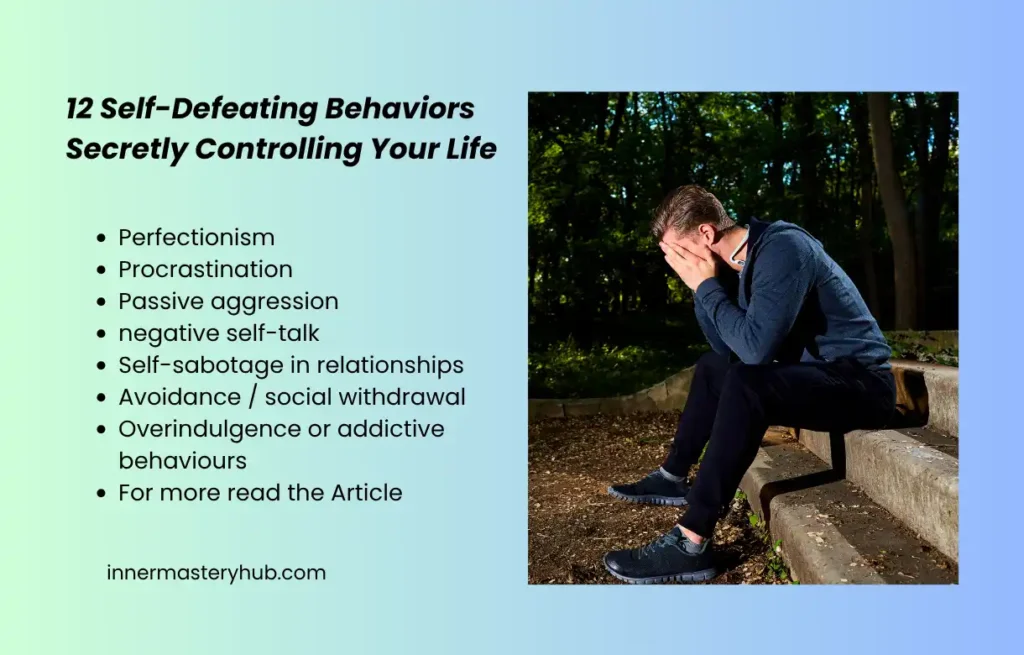
1. Procrastination
Even when people are aware that delaying a task will harm them, they still do it. It’s called procrastination. Fear is frequently concealed by procrastination, including fear of failure, fear of being judged, and worry about not completing tasks precisely.
Studies have linked procrastination to perfectionism and a fear of failing. Among the consequences are feelings of guilt, stress, missed deadlines, and low performance. It feels like you’re chasing your own tail.
When dealing with this behaviour, divide the work into small, manageable steps. Set brief due dates, such as “just 10 minutes”, set timers, nd make your commitment in public (inform someone). Record your progress every day by following the momentum and confidence you gain in your abilities to take action over time.
2. Self-criticism and negative self-talk
Some people are hard on themselves, labelling blunders as “stupid,” “useless,” or “never good enough.” That’s self-criticism. A critical inner voice can exacerbate low self-esteem and lead to stress. According to cognitive distortion research, negative self-talk plays a fundamental role in depression and anxiety. Constant self-criticism may sap confidence, causing people to avoid taking chances.
Notice your inner critic, present proof to back up your claims (“What would I tell a friend?”). Use neutral or soft language while self-talking and maintain a log of “criticism → reframe” to cultivate a softer inner voice.
3. Perfectionism
People demand flawless performance in work, relationships, or appearance. That is perfectionism. Perfectionism masks fear: making a mistake feels intolerable. Researchers link perfectionism with burnout, suicidal thinking, and higher stress. Perfectionism can delay action (you wait until conditions are “perfect”) or create paralysis.
To overcome perfectionism, set “good enough” standards by allowing yourself to make mistakes. Practice finishing things at 80% and reflect on what “perfect” truly means.

4. Comparing yourself to others
People look at others’ success, appearance, or social media and feel inferior by comparing themselves to others. Comparison fuels envy, shame, and discouragement. In social psychology, upward comparison (comparing oneself to “better” others) can lead to depression or lower self-worth. Comparing yourself to others can steal your joy and distract you from your path.
You can limit exposure to comparison triggers (such as social media and certain circles). Pay attention to your own baseline: where you started, what small wins you’ve had. Use others’ successes as inspiration, not as a measurement.
Is self-defeating behaviour the same as self-sabotage?
Yes, most people use the terms interchangeably for patterns that undermine success or happiness.
5. Avoidance / social withdrawal
People skip social opportunities, hide, or disengage when they are stressed or fearful. Avoidance may feel safe in the short term, but it ultimately cuts off growth, support, and connection. It reinforces shame or anxiety. Isolation worsens mood, makes coping harder, and leads to a cycle of withdrawal.
Begin with small social acts, such as sending a message to a loved one or attending a local event. Use accountability (a friend to call you), pair exposure with self-compassion. Reflect on what fear lies behind the desire to withdraw.
6. Self-sabotage in relationships
People push away others, behave destructively, or provoke conflict even with loved ones. That is relational sabotage. Sabotaging stems from fear of intimacy, fear of abandonment, or the belief that “I don’t deserve love.” Sabotage creates distance, distrust, breakups, and loneliness.
Track recurring relational drama: what triggers your sabotage? Pause before reacting. Use “I feel…” statements and practice vulnerability. Seek therapy or couples communication training.
7. Excessive control/rigidity
People try to control every outcome or micromanage their lives to avoid risk. Rigidity hides the fear of unpredictability, uncertainty, or chaos. Rigidity can cause stress, burnout, and frustration when things don’t go as planned. You miss spontaneous chances.
Letting go in one small area daily (e.g., allowing a delay or accepting imperfection). Use “Plan B” tolerance. Reflect: what if the outcome differs? Learn flexibility over time.
8. Overindulgence or addictive behaviours
People lean on alcohol, gambling, overeating, compulsive shopping, or digital addiction. That is overindulgence. Research on self-defeating behaviour finds that some maladaptive behaviours serve as self-medication or an escape mechanism. Overindulgence damages health, finances, and relationships. It provides temporary relief but comes at a long-term cost.
Identify emotional triggers (stress, boredom). Replace unhealthy coping mechanisms with healthy alternatives, such as exercise, talking with a friend, or engaging in a creative outlet. Use limits, accountability, and professional support if needed.
9. Learned helplessness / giving up
People believe they can’t change, so they stop trying. That is learned helplessness. Psychological research indicates that when individuals repeatedly face failure, they may develop a tendency to expect failure and subsequently cease taking action. Giving up on locks in the face of failure prevents growth or recovery.
Start with small tasks you can succeed at. Keep a “success log.” Use “I can try this step.” Focus on effort, not outcome. Get support to rebuild belief in the possibility.
10. People-pleasing / absence of boundaries
People often say “yes” when they really want to say “no,” overcommit, or overlook their own needs to gain approval. People-pleasing stems from fear of rejection and the belief that your worth depends on others. This behaviour leads to burnout, resentment, and relationship imbalance.
Practice saying “no” in low-stakes situations. Identify your limits. Use assertive language: “I can’t take that now.” Remember: refusing requests doesn’t make you a bad person.
11. Passive aggression
People often express anger indirectly, through sarcasm, silent treatment, or procrastination, when they are resentful. That is passive aggression. Passive aggression conceals conflict; it avoids open confrontation but sours relationships. It breeds resentment, misunderstanding, and emotional distance.
Name the underlying feeling (“I feel hurt when…”). Use direct but kind communication. Practice “I prefer to say this directly rather than sabotage.” Learn emotional awareness and conflict skills.
12. Self-neglect / physical and mental neglect
People often skip sleep, ignore their health, avoid therapy, neglect rest, and disregard self-care. That is self-neglect. Neglect usually stems from the belief that “I don’t deserve care.” Neglect drains energy, worsens one’s mood, impairs the ability to act, and negatively affects one’s health.
Build minimal routines (sleep, hydration, movement). Schedule “you time” as nonnegotiable. Use small steps (5 min meditation, short walks). Track the positive effect of small acts.
Why these behaviours cluster
Fear, humiliation, unfulfilled inner needs, and skewed beliefs are common themes among all these behaviours. Avoiding vulnerability, failure, and rejection are a few coping mechanisms. Fear-based coping mechanisms, however, often fall into traps.
Self-defeating habits over time increase emotional suffering. It’s possible to feel melancholy, nervous, disempowered, or stuck. It becomes increasingly tricky to disrupt patterns the more frequently they occur.
Research from the mental health domains indicates that recurring self-defeating behaviours (such as addiction, avoidance, and self-criticism) are strong indicators of anxiety, despair, and unfavourable life outcomes.
Dealing with self-defeating behaviours
Step 1: Awareness
Keep a journal. Note each time you catch one of the 12 behaviours. Write trigger, what you did, what you felt.
Step 2: Pause before reacting
When you sense a habit kicking in, insert a pause (even 5 seconds) to think: “Is this behaviour helping or hurting?”
Step 3: Replace with an alternative
Have healthier options ready. If you have an urge to overeat, go for a walk. If you feel the urge to self-criticise, speak gently.
Step 4: Small wins
Start with behaviours you feel you can shift (e.g., people-pleasing). Each success builds confidence.
Step 5: Cognitive work
Challenge core beliefs (“I must be perfect” → “I can be good enough”). Rewrite the inner rules to be more compassionate.
Step 6: Community & support
Talk to trusted friends, mentors, or therapists. An external perspective helps interrupt hidden cycles.
Step 7: Be patient and persistent
Patterns took time to form; they take time to change. Expect setbacks; use them as data, not as a source of guilt.
What are examples of self-defeating behaviours?
Procrastination, people-pleasing, staying in harmful relationships, quitting too early, overcommitting, or rejecting help.
How Does Emotional Regulation Connect to Self-Defeating Behaviours?
Self-defeating behaviours are attempts to regulate overwhelming emotions. When you cannot process emotions effectively, you act to escape them.
Emotional Regulation Link
- You feel overwhelmed
- You don’t know how to process it
- You choose relief over growth
For example:
- Anxiety → procrastination
- Fear → avoidance
- Shame → self-sabotage
Research from American Psychological Association shows poor emotional regulation is linked to maladaptive coping behaviors4.
So the behaviour is not the problem.
It is the solution your mind found, even if it’s not helpful.
Can Self-Defeating Behaviours Be Unlearned?
Yes, but not through force. They shift when you understand the emotional need behind them and change how you relate to that need.
You don’t remove the behaviour directly.
You change the meaning behind it.
When the emotional charge reduces, the behaviour loses power.
What Is the Shift in Understanding You Need?
The shift is realizing that self-defeating behaviours are not flaws, but signals. They show where you feel unsafe, unworthy, or overwhelmed.
Instead of asking:
“Why am I like this?”
Ask:
“What is this protecting me from?”
That question changes everything.
Putting this into everyday life
Let’s say your goal is to create a book. You fear that your writing is poor when you wake up. You put things off (Behaviour 1). After that, you perform more duties while critiquing yourself (Behaviour 2). Behaviours include demanding perfection (Behaviour 3) and comparing yourself to the best authors (Behaviour 4).
withdrawing from critique groups (Behaviour 5), sabotaging a meeting with the publisher (Behaviour 6), trying to control every detail (Behaviour 7), distracting yourself with binge-watching (Behaviour 8), occasionally feeling like “why bother?” (Behaviour 9), accepting other people’s tasks rather than writing your own (Behaviour 10), displaying passive hostility regarding deadlines (Behaviour 11), and neglecting your sleep or exercise (Behaviour 12).
Each behaviour fuels the next. The solution is not magical, but relatively steady work: you catch one behaviour, insert a better response, celebrate progress, and build new neural habits.
Take away
Conclusion
Self-defeating behaviours are not your enemy.
They are patterns shaped by experiences, beliefs, and emotional struggles.
You are not broken. But you are repeating something that once helped you cope.
And while it may not serve you now, it makes sense why it exists.
When you stop fighting the behaviour and start understanding it, something subtle changes. Not instantly, not dramatically, but deeply.
And that’s where real change begins.
If you’ve seen yourself in these patterns, pause and reflect. Don’t rush to fix. Start by noticing. Because the moment you understand the pattern, you begin to loosen its hold.
FAQs
What are self-defeating behaviours?
Self-defeating behaviours are acts or ways of thinking that harm one’s own aspirations and wellbeing. These behaviours include self-sabotage, avoidance, perfectionism, negative self-talk, and procrastination. These behaviours keep people from living fully, succeeding, and preserving healthy connections and are usually the result of fear, low self-esteem, or unresolved trauma.
Why do people develop self-defeating behaviours?
During times of stress or trauma, self-defeating behaviours frequently develop as coping strategies. People may unintentionally adopt these behaviours as a form of self-defence or comfort. They eventually grow into deeply ingrained behaviours that limit development.
How do self-defeating behaviours affect mental health?
Self-defeating actions increase sadness, anxiety, and stress. Persistent self-defeating undermines self-esteem and produces a vicious cycle of regret, guilt, and despair. Additionally, they may push unhealthy coping mechanisms, including substance misuse and social disengagement.
What are examples of self-defeating behaviours?
Procrastination, perfectionism, overanalysing, negative self-talk, people-pleasing, self-isolation, avoiding problems, and addictive habits are examples of common self-defeating behaviours. These behaviours build obstacles to development and achievement. The first step in replacing unhealthy coping mechanisms that increase self-assurance, efficiency, and mental wellness in day-to-day living is acknowledging these actions.
How to change self-defeating behaviors?
Awareness, introspection, and deliberate change are necessary to overcome self-defeating behaviours. Identifying triggers, engaging in self-compassion exercises, setting reasonable goals, and developing healthy coping strategies are key steps.
Positive affirmations, journaling, mindfulness, and therapy can all be beneficial.
Are self-defeating behaviours linked to childhood experiences?
Indeed, many self-defeating behaviours have their roots in early life. Fear of failure or rejection can be ingrained in children who grow up in circumstances that are critical, uncaring, or have irrational expectations. These tendencies continue as unhealthy coping strategies into adulthood.
What is the first step to stopping self-defeating behaviours?
The first step to stopping self-defeating behaviours is awareness. Recognise patterns that hinder your progress and identify the emotions behind them. Journaling, mindfulness, and honest self-reflection can help. Once acknowledged, gradually replace them with positive habits that align with goals, fostering self-compassion and long-term personal transformation.
How to overcome self-defeating personality disorder?
Self-defeating patterns improve with therapy and daily practice. Work with a psychologist (CBT, schema therapy, or DBT) to challenge “I deserve less” beliefs, stop rescuing others at your expense, and build self-respect. Track triggers, replace self-criticism with realistic self-talk, and set small boundaries weekly.
- Holahan, C. J., & Moos, R. H. (1990). Life stressors, resistance factors, and improved psychological functioning: An extension of the stress resistance paradigm. Journal of Personality and Social Psychology, 68(5), 909–917. ↩︎
- Freud, S. (1957). The unconscious. In J. Strachey (Ed. & Trans.), The standard edition of the complete psychological works of Sigmund Freud (Vol. 14, pp. 159–215). Hogarth Press. (Original work published 1915) ↩︎
- Beck, A. T. (1976). Cognitive therapy and the emotional disorders. International Universities Press. ↩︎
- Aldao, A., Nolen-Hoeksema, S., & Schweizer, S. (2010). Emotion-regulation strategies across psychopathology: A meta-analytic review. Clinical Psychology Review, 30(2), 217–237. https://doi.org/10.1016/j.cpr.2009.11.004 ↩︎