
Secure vs Insecure Attachment: Signs, Types & Examples

Secure vs Insecure Attachment
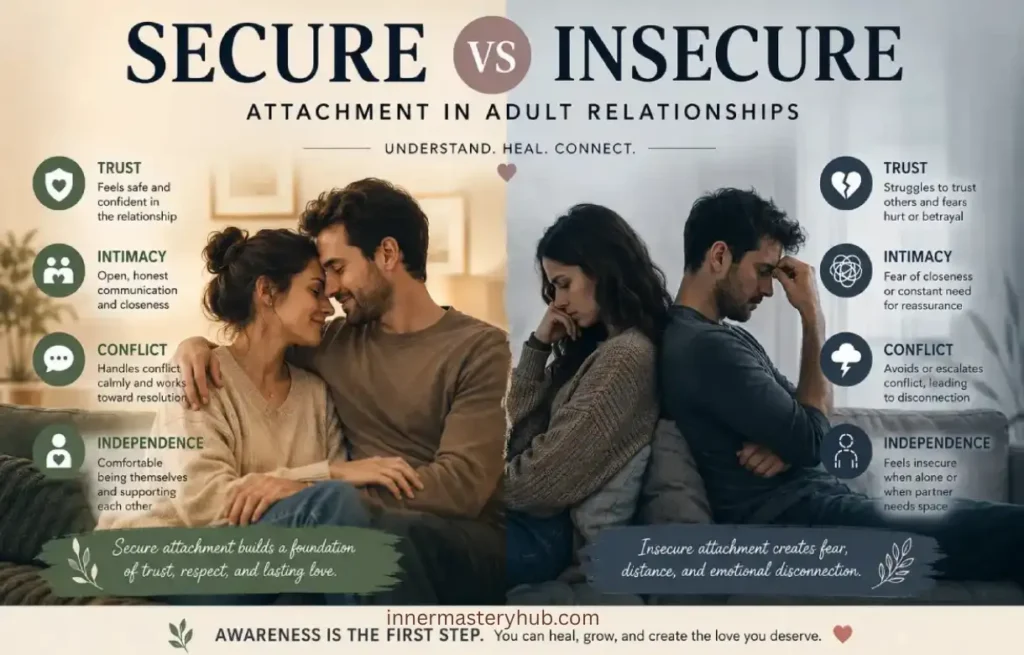
The main difference between secure and insecure attachment is how safe and manageable emotional closeness tends to feel. A securely attached adult can depend on others while maintaining independence. Someone with an insecure attachment wants closeness but fears losing it, avoids relying on others, or struggles to seek connection and then pulls away. In popular adult attachment frameworks, insecure patterns are often described as anxious, avoidant, and fearful-avoidant. Modern research also commonly studies attachment dimensionally through anxiety and avoidance.
Secure vs Insecure Attachment at a Glance
| Secure Attachment | Insecure Attachment |
|---|---|
| Comfortable with closeness | Closeness may create anxiety or discomfort |
| Can trust while keeping boundaries | Trust may feel difficult |
| Expresses needs more openly | May hide, minimize, or urgently express needs |
| Handles space without assuming rejection | Distance may trigger fear or withdrawal |
| Can give and receive support | May struggle to depend on others |
These are general patterns, not rules. A person may feel secure in one relationship and much less secure in another.
What Is Attachment Theory?
According to attachment theory, people look for security and connection in relationships. John Bowlby’s research on the relationship between children and carers served as its foundation, and Mary Ainsworth’s study expanded on it. Later, attachment-related expectations in romantic and other close relationships were studied in adult attachment research1.
Attachment is more than whether you enjoy being around people. It concerns questions that can work beneath a relationship:
Will you be there when I need you?
Can I depend on you without losing myself?
What happens if you pull away?
Is it safe for me to show you what I really need?
Your answers may shape how you respond to intimacy, disagreement, separation, and vulnerability.
Modern adult attachment research often focuses on two dimensions: attachment anxiety and attachment avoidance2.
Attachment anxiety involves concern about rejection, abandonment, or whether another person is available.
Attachment avoidance involves discomfort with emotional dependence, vulnerability, or closeness.
A person can experience different degrees of both.
What Is Secure Attachment?
In general, secure attachment refers to the ability to work independently while still feeling at ease with emotional intimacy. Adults who are securely connected are typically able to communicate their needs, get support, tolerate necessary separation, and resolve conflicts without automatically seeing them as signs that the relationship is ending.
Being securely attached does not mean never feeling jealous, anxious, hurt, or afraid.
It means those emotions are less likely to control how you relate to another person.
For example, imagine your partner seems unusually quiet after work.
A secure response might be:
“They seem distracted. I’ll ask whether something is wrong.”
You noticed the silence, but it does not immediately become evidence of rejection. That ability to leave room for several explanations is an important part of relationship security.
Signs of Secure Attachment
Typical indicators of a stable attachment could be:
- Being at ease both giving and receiving love
- Expressing emotional needs
- Observing the boundaries of others
- Keeping up your personal hobbies and friendships
- Seeking assurance without continuously requiring it
- Having faith without constantly needing evidence
- Resolving conflicts without instantly worrying about being abandoned
- Being able to express regret and make apologies after a dispute
Secure attachment is therefore better understood as flexibility than constant peace.
What Is Insecure Attachment?
Increased anxiety, avoidance, or trouble finding a comfortable balance between intimacy and independence are characteristics of insecure attachment. A person who is insecurely attached may conceal attachment needs, distrust emotional dependence, or have conflicting urges to be close and stay far away.
It does not mean that something is fundamentally wrong with you.
Insecure attachment does not mean that your childhood was traumatic or that your relationships will fail. Instead, attachment theory suggests that people develop expectations about relationships through repeated interpersonal experiences. Those expectations can shape what you notice and how you interpret uncertain situations.
For example:
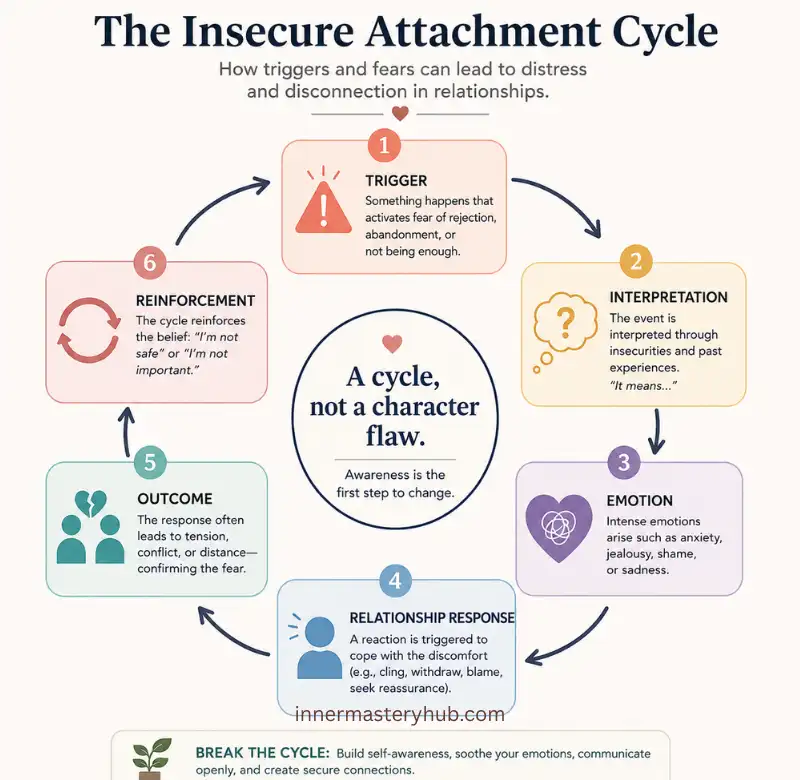
Trigger: Your partner takes longer than usual to respond.
Interpretation: “Maybe they’re losing interest.”
Emotion: Anxiety.
Behavior: Repeated texting or seeking reassurance.
Consequence: Temporary relief, followed by more uncertainty.
Someone else might experience the same trigger differently:
Trigger: A partner asks for more emotional closeness.
Interpretation: “I’m going to lose my independence.”
Emotion: Discomfort.
Behavior: Withdrawal.
Consequence: Emotional distance.
The trigger alone does not explain the behavior. The meaning you assign to a trigger can strongly influence the emotion and behavior that follow.
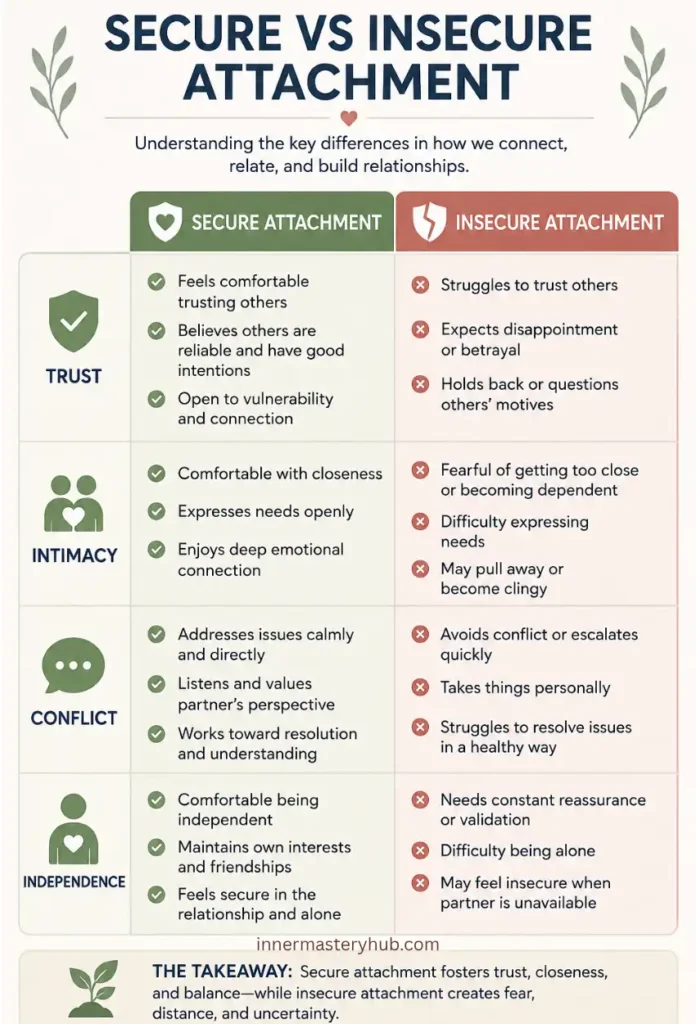
Secure vs Insecure Attachment: What Is the Difference?
Both securely and insecurely attached people need connection. The difference lies more in how people experience dependence, emotional availability, uncertainty, intimacy, and the possibility of rejection within close relationships.
Here is a deeper comparison.
| Area | Secure Attachment | Insecure Attachment |
|---|---|---|
| Closeness | Usually feels comfortable | May feel uncertain or threatening |
| Trust | Develops with experience | May require extra reassurance or distance |
| Independence | Compatible with intimacy | May be overprotected or difficult |
| Conflict | Problem to work through | May feel like rejection or loss of control |
| Vulnerability | Usually manageable | May feel risky |
| Reassurance | Helpful when needed | May be frequently sought or avoided |
| Emotional needs | More openly communicated | May be intensified, hidden, or dismissed |
| Partner needs space | Usually tolerated | May trigger anxiety or withdrawal |
| Support | Easier to seek and receive | Depending on others may feel unsafe |
Secure attachment does not prevent emotional pain. It can make difficult emotions easier to manage without automatically losing trust, connection, or your sense of self.
What Are the Types of Insecure Attachment?
Anxious, avoidant, and fearful-avoidant are the three primary insecure attachment styles frequently observed in adulthood. Since different attachment theories use different terms, these classifications should be seen as useful descriptors rather than rigid personality types.
Understanding the different insecure attachment patterns can help you recognize how attachment insecurity may appear in relationships.
1. Anxious Attachment
Anxious attachment is characterised by a strong craving for connection and a heightened fear of rejection or abandonment.
How it appears:
You can question whether the relationship is stable or if someone still loves you.
For instance:
When your partner doesn’t respond for a few hours, you start to think, “They’re losing interest.”
How to react:
Before you react, take note of the contrast between what you know and what fear is anticipating.
People with attachment anxiety may also notice:
- Seeking clarity on a regular basis
- Sensitivity to shifts in communication
- Fear of being replaced
- Inability to accept uncertainty
- Strong reactions to perceived distance
The root concern is not simply:
“Why haven’t they texted?”
It may be:
“Am I still important to you?”
2. Avoidant Attachment
In general, avoidant attachment is characterised by uneasiness with emotional vulnerability and reliance.
How it appears:
You might place such a high importance on independence that you find it awkward to need someone.
For instance:
As a relationship grows closer on an emotional level, you start to wonder why it might not work.
How to react:
Instead of waiting until intimacy becomes overpowering, practice communicating basic emotional needs.
Avoidant patterns may include:
- Difficulty asking for emotional support
- Pulling away during conflict
- Neglecting emotional needs
- Feeling uncomfortable when others depend on you
- Keeping emotional distance
- Strong emphasis on self-reliance
This does not necessarily mean the person doesn’t want love. Sometimes the internal strategy is closer to:
“Connection matters, but depending on someone feels risky.”
3. Fearful-Avoidant Attachment
Fearful-avoidant patterns involve both a desire for closeness and fear surrounding it.
What it looks like:
You may strongly want connection but become uncomfortable once someone gets emotionally close.
Example:
You feel distressed when your partner pulls away, yet after they reconnect, you feel an urge to create distance.
How to respond:
Pay attention to the fear underlying both the pursuit and the withdrawal, rather than judging the inconsistency.
This can create a painful cycle:
Want closeness → receive closeness → feel vulnerable → withdraw → feel disconnected → seek closeness again
However, not every push-pull relationship shows a particular attachment style. Conflict, incompatibility, stress, past experiences, and the other person’s behavior can produce similar patterns.
Signs of Insecure Attachment in Adults
Increased fear of rejection, difficulty trusting, excessive reassurance-seeking, discomfort with relying on others, emotional withdrawal, or erratic reactions to closeness are all indicators of insecure attachment in adults. Rather than appearing randomly in stressful situations, these behaviours are most significant when they become repeated patterns in relationships.
Here are some common patterns.
1. You Frequently Fear Being Abandoned
What it looks like:
Small changes in someone’s behavior can make you feel tension that the relationship is ending.
Example:
A shorter-than-usual message makes you wonder whether your partner has lost interest.
How to respond:
Separate observable facts from the story the fear is creating in your mind.
2. You Need Frequent Reassurance
What it looks like:
For a short while, reassurance is helpful, but uncertainty soon returns.
Example:
Even after your partner says everything is fine, you feel compelled to ask again.
How to respond:
Notice whether you genuinely need information or are mainly using reassurance to temporarily reduce anxiety.
3. Emotional Distance Feels Like Rejection
What it looks like:
The demand for distance may seem personal to someone else.
Example:
Your partner wants an evening alone, and you interpret it as evidence that you’re unwanted.
How to respond:
Remind yourself that independence and intimacy can exist together.
4. You Struggle to Trust People
What it looks like:
Even when there is little indication of disappointment, you nevertheless anticipate it.
For instance:
You are always on the lookout for indications that a reliable companion might turn on you.
How to react:
Let trust develop from repeated, consistent behavior rather than expecting complete certainty.
5. You Pull Away When Someone Gets Too Close
What it looks like:
Emotional intimacy can create discomfort rather than relief.
Example:
After a vulnerable conversation, you suddenly want more distance.
How to respond:
Try tolerating a small amount of vulnerability before automatically withdrawing.
6. Asking for Help Feels Uncomfortable
What it looks like:
Reliance on someone else can come out as weak, dangerous, or oppressive.
For instance:
Even when a reliable person has offered help, you still struggle on your own.
How to react:
Try making a small, targeted request.
7. Conflict Feels Bigger Than the Conflict
What it looks like:
You take an ordinary disagreement as if it’s a threat to the entire relationship.
Example:
Your partner disagrees with you and your mind jumps to, “Maybe we’re not right for each other.”
How to respond:
Ask whether the relationship is actually threatened or whether an old fear has been activated.
Remember: these signs of insecure attachment are not a diagnostic checklist. Anxiety, sadness, past betrayal, trauma, or other situations can also cause many to manifest.
Secure Attachment Examples
Examples of secure attachment sometimes involve everyday situations in which a person can maintain a connection without either giving up on themself or assuming that typical relationship stress amounts to rejection. Rather than when everything is going smoothly, security is frequently most apparent during times of uncertainty, conflict, separation, and vulnerability.
- A delayed reply does not immediately feel like rejection.
- You can ask for support without feeling ashamed.
- You can disagree without fearing the relationship will end.
- You respect your partner’s need for space.
- You can set boundaries while staying emotionally connected.
- You can apologize and repair after conflict.
Insecure Attachment Examples
Examples of insecure attachment frequently surface when there is uncertainty in a relationship. Depending on the individual’s attachment style and the circumstances of the relationship, the same situation may lead to pursuit, reassurance-seeking, withdrawal, emotional repression, or contradictory approach-and-avoidance behaviours.
- A delayed reply triggers fear that someone is losing interest.
- You repeatedly seek reassurance.
- You pull away when emotional closeness increases.
- You avoid asking for help because dependence feels uncomfortable.
- Conflict feels like rejection or abandonment.
- You want closeness but also feel afraid of it.
Why Does Insecure Attachment Develop?
Attachment patterns develop through multiple influences rather than a single cause. Early caregiving is one factor, but temperament, later relationships, loss, betrayal, stress, and corrective relational experiences can also shape adult attachment.
Early caregiving experiences, later relationships, temperament, traumatic events, bereavement, betrayal, and current relationship dynamics can all contribute to the development of insecure attachment. Adult attachment is not solely determined by childhood, while attachment theory emphasises repeated experiences of whether significant others feel available and responsive.
It is tempting to think:
Bad childhood → insecure adult attachment.
Human development is more complicated.
Expectations of intimacy and support can be influenced by early relationships. However, those expectations can also be influenced by later friendships, sexual relationships, therapy, stressful situations, encouraging experiences, and personal growth.
For example, someone may learn:
“When I’m upset, people disappear.”
Later, emotional distance can carry more meaning than it objectively deserves.
Another person may have learned:
“Depending on people leads to disappointment.”
They may become highly self-reliant. Neither strategy needs to be viewed as a conscious choice. It may simply be a familiar way of managing interpersonal uncertainty.
What Research Says About Secure and Insecure Attachment
Research consistently links adult attachment insecurity to emotional well-being, interpersonal functioning, and mental health3. Most data show connections, not that insecure attachment causes psychological issues. Thus, attachment is part of a bigger developmental and relational landscape.
A major 2022 meta-analysis included 224 studies and 79,722 people4.
Attachment anxiety and avoidance increased anxiety, loneliness, and other mental-health issues. These factors also lowered life satisfaction and self-esteem. Attachment anxiety was more linked to mental health than avoidance.
Another meta-analysis of 40 samples and 2,927 participants indicated that major depressive disorder, bipolar disorder, and schizophrenia-spectrum disorder patients had much higher attachment insecurity than healthy controls. The researchers noted that insecure attachment may be a general risk factor and stressed the need to understand the paths of attachment5.
Research also links attachment insecurity to the misinterpretation of information. A meta-analysis of 41 samples with 8,727 participants linked anxious and avoidant attachment to negative attribution bias, the tendency to misinterpret uncertainty6.
That discovery helps explain normal relationships.
Imagine receiving:
“Okay.”
The message itself contains little information.
But your attachment-related expectations may help shape what happens next:
Event → Interpretation → Emotion → Response
If your interpretation is:
“They’re angry and about to leave.”
you may experience anxiety.
If it becomes:
“They’re demanding something from me.”
you may feel irritated and withdraw.
The emotional reaction is therefore not necessarily produced by the message alone.
What the Research Does Not Mean
Research does not mean that:
- Insecure attachment is a mental illness.
- Everyone with insecure attachment has poor mental health.
- Secure people never experience anxiety.
- Childhood completely determines adult relationships.
- An attachment style explains every relationship problem.
- You can diagnose someone’s attachment style based on a few behaviors.
Attachment is a framework for understanding relationship patterns, not a complete explanation of a person.
How Secure vs Insecure Attachment Can Affect Relationships
How partners seek intimacy, resolve conflict, perceive distance, seek assistance, and react to uncertainty can all be influenced by secure versus insecure attachment. Problems often arise because partners’ methods of establishing emotional safety clash, rather than because one spouse doesn’t care.
Consider an anxious-avoidant interaction.
One partner feels distance and moves closer:
“Can we talk?”
The other feels pressure and moves away:
“I need space.”
The first partner experiences the withdrawal as rejection and pursues harder.
The second experiences the pursuit as pressure and withdraws further.
The cycle becomes:
Distance → anxiety → pursuit → pressure → withdrawal → greater anxiety
Eventually both people may believe:
“You are the problem.”
Sometimes neither partner is “the problem”; the repeating interaction cycle is what needs attention.
This is one reason attachment awareness can be useful. It changes the question from:
“What’s wrong with my partner?”
to:
“What happens between us when either of us feels unsafe?”
That question creates much more room for change.
What People Commonly Misunderstand About Attachment Styles
Treating attachment patterns as permanent personality labels is the most common misconception about them. In intimate relationships, attachment theory explains patterns of expectations and reactions. Individuals can demonstrate varying degrees of security across relationships and situations, and attachment-related behaviours may fluctuate rather than remain constant.
Myth: Secure people never feel jealous
Reality: People who are secure can feel fear, insecurity, and jealousy. The way they interpret and react to those feelings is frequently where they diverge.
Myth: Avoidant people don’t want relationships
Reality: Discomfort with intimacy or reliance is associated with attachment avoidance. It doesn’t always imply that someone doesn’t have emotions or a need to connect.
Myth: People who are anxious are just needy
Reality: Seeking reassurance may occasionally indicate heightened sensitivity to interpersonal uncertainty.
Myth: Your attachment pattern is a result of your parents
Reality: According to attachment theory, early caregiving is important, but a variety of experiences influence development. Childhood does not dictate relationships in adulthood.
Myth: A secure partner will automatically fix insecure attachment
Reality: Both partners still require communication, limits, emotional intelligence, and accountability, even though supportive relationships can encourage new relational experiences.
Can Insecure Attachment Become Secure?
It is possible for attachment-related patterns to change. It is not appropriate to view insecure attachment as a permanent identity. Though change is typically gradual rather than instantaneous, new relationship experiences, increased self-awareness, better emotion regulation, healthier boundaries, and psychotherapy can eventually lead to improved attachment security.
A meta-analysis of 36 studies involving 3,158 patients found that people with more secure attachment before treatment tended to have better psychotherapy outcomes. Importantly, increases in attachment security during therapy were also associated with better outcomes7.
This does not mean therapy guarantees a particular attachment style. It does suggest that attachment security is not necessarily static. Change often begins by recognizing your automatic pattern.
Instead of:
Trigger → automatic interpretation → automatic response
you create another step:
Trigger → notice → question interpretation → regulate → choose response
That small pause can become meaningful over time.
How to Build More Secure Attachment Patterns
Increasing attachment security typically entails developing relationships in which trust is reinforced by consistent behaviour, learning to handle relationship uncertainty, communicating needs clearly, regulating emotions before reacting, and maintaining appropriate boundaries. The objective is to respond to attachment requirements more adaptably rather than to completely eradicate them.
1. Identify Your Triggers
Ask what situations trigger you.
Is it delayed communication?
Criticism?
Someone needing space?
Emotional intimacy?
Uncertainty?
The trigger reveals where your attachment system becomes most sensitive.
2. Separate Facts From Interpretations
Try writing:
What happened:
“They haven’t replied for four hours.”
What my mind says:
“They’re losing interest.”
Those are not the same statement. Research linking attachment insecurity to negative attribution bias makes this distinction particularly important8.
3. Name the Emotion Beneath the Reaction
Anger may contain fear. Withdrawal may contain vulnerability. Reassurance seeking may contain uncertainty.
Ask:
“What am I actually afraid might happen?”
4. Communicate the Need Instead of Acting Out the Fear
Instead of:
“Obviously you don’t care.”
Try:
“I noticed I felt disconnected today. Can we check in?”
Instead of disappearing:
“I need some time to settle down, but I’d like to continue this conversation tonight.”
Security does not mean never needing anything.
It means learning to communicate needs without turning them into attacks, tests, or demands.
5. Practice Tolerating Small Amounts of Uncertainty
You cannot remove all uncertainty from relationships. Trying to do so can sometimes strengthen anxiety.
Allow your mind to tolerate small moments of uncertainty without immediately checking, pursuing, withdrawing, or assuming the worst.
6. Build Relationships Around Consistency
Attachment work is not only internal. Pay attention to whether relationships actually provide:
- Respect
- Reliability
- Emotional responsiveness
- Reasonable boundaries
- Mutual effort
- Accountability
- Safety
Not every uncomfortable feeling is an attachment wound. Sometimes someone’s behavior really is inconsistent or unhealthy.
7. Consider Therapy When Patterns Feel Difficult to Change
When attachment-related anxieties frequently interfere with relationships, self-esteem, emotional control, or day-to-day functioning, psychotherapy may be helpful.
When you rely on someone else, attachment-informed therapy can help you explore not only what you do but also what you anticipate will happen.
A Simple Exercise for Understanding Your Attachment Pattern
Analysing what happens between a relationship trigger and your reaction might help you understand your attachment style. Determine the interpretation, feeling, protective behaviour, and outcome that recur in significant connections rather than labelling yourself as “anxious” or “avoidant” right away.
Choose one recent emotional moment and write:
Trigger:
What actually happened?
Interpretation:
What did I assume it meant?
Emotion:
What did I feel?
Protective response:
What did I do to feel safer?
Consequence:
Did my response create connection or more distance?
For example:
Trigger: Partner asks for an evening alone.
Interpretation: “They’re getting tired of me.”
Emotion: Fear.
Response: Repeated reassurance seeking.
Consequence: Partner feels pressured.
The goal is to notice the pattern clearly enough that you have another option next time.
Reflection Questions
Consider these questions without trying to diagnose yourself:
- What happens inside you when someone becomes emotionally distant?
- What are you afraid might happen if you depend on another person?
- Is asking for reassurance easy or uncomfortable?
- What happens when someone needs space?
- During conflict, do you move toward connection or away from it?
- Which relationship experiences make you feel safest?
- What would responding more securely look like in one situation this week?
Your answers may tell you more than attaching a label to yourself.
Key Takeaways
- Secure vs insecure attachment describes different patterns around closeness, trust, and dependence.
- Secure attachment allows both intimacy and independence.
- Insecure attachment may involve anxiety, avoidance, or conflicting feelings about closeness.
- The main types of insecure attachment are commonly described as anxious, avoidant, and fearful-avoidant patterns.
- Attachment styles are not mental-health diagnoses.
- Attachment patterns can shape how you interpret relationship uncertainty.
- Research links attachment insecurity with differences in emotion regulation and mental health, but association does not prove causation.
- Attachment patterns can change over time.
FAQs About Secure vs Insecure Attachment
What is the main difference between secure and insecure attachment?
Increased comfort with intimacy, trust, support, and independence are typically associated with secure attachment. Conflicting feelings about intimacy, discomfort with emotional dependency, or increased concern over rejection are all signs of insecure attachment. These are not permanent personality types or diagnoses, but rather patterns of relationships.
What are the main signs of insecure attachment?
Common signs of insecure attachment include fear of abandonment, frequent reassurance seeking, difficulty trusting, discomfort with vulnerability, emotional withdrawal, and strong reactions to perceived distance. However, individual behaviors cannot confirm an attachment style because stress, relationship problems, anxiety, and previous experiences can produce similar responses.
Does insecure attachment mean you had a bad childhood?
No. Early caregiving experiences can influence attachment, but insecure attachment does not prove that someone had a bad childhood. Later relationships, loss, betrayal, stress, temperament, and other life experiences can also shape attachment patterns.
Is insecure attachment a mental-health disorder?
Insecure attachment is not a diagnosis of mental illness in and of itself. Although attachment insecurity has been linked to a number of indicators of worse mental health, this does not imply that everyone with an insecure pattern needs therapy or that insecure attachment inevitably produces a problem.
What does secure attachment look like in a relationship?
Secure attachment may appear quite commonplace. You are able to communicate your needs, keep boundaries, ask for help, trust without continually checking, tolerate appropriate space, and handle disputes without presuming the relationship is ending. Being secure does not imply constant calmness or self-assurance.
Can an insecure attachment become secure?
Attachment-related patterns can change. Supportive relationships, emotional awareness, communication skills, healthier boundaries, and psychotherapy may lead to an improved sense of security. Research also suggests that improvements in attachment security during psychotherapy can occur alongside better treatment outcomes, although individual experiences vary.
What are the types of insecure attachment?
The types of insecure attachment commonly discussed in adult relationships include anxious, avoidant, and fearful-avoidant patterns. Anxious attachment emphasizes fear of rejection, while avoidance involves discomfort with dependence. Fearful-avoidant patterns may involve both wanting intimacy and feeling threatened by it.
Can you have both secure and insecure attachment?
Yes. Attachment does not always fit neatly into one category. A person may show different levels of anxiety, avoidance, and security depending on the relationship and circumstances. Attachment is increasingly understood in dimensional terms, so thinking in terms of tendencies can be more useful than choosing a single permanent label.
- Bowlby, J. (1982). Attachment and loss: Vol. 1. Attachment (2nd ed.). Basic Books. (Original work published 1969). Ainsworth, M. D. S., Blehar, M. C., Waters, E., & Wall, S. (1978). Patterns of attachment: A psychological study of the Strange Situation. Lawrence Erlbaum Associates. ↩︎
- Brennan, K. A., Clark, C. L., & Shaver, P. R. (1998). Self-report measurement of adult attachment: An integrative overview. In J. A. Simpson & W. S. Rholes (Eds.), Attachment theory and close relationships (pp. 46–76). Guilford Press. ↩︎
- Eilert, D. W., & Buchheim, A. (2023). Attachment-related differences in emotion regulation in adults: A systematic review on attachment representations. Brain Sciences, 13(6), 884. ↩︎
- Zhang, X., Li, J., Xie, F., Chen, X., Xu, W., & Hudson, N. W. (2022). The relationship between adult attachment and mental health: A meta-analysis. Journal of Personality and Social Psychology, 123(5), 1089–1137. ↩︎
- Herstell, S., Betz, L. T., Penzel, N., et al. (2021). Insecure attachment as a transdiagnostic risk factor for major psychiatric conditions: A meta-analysis in bipolar disorder, depression and schizophrenia spectrum disorder. Journal of Psychiatric Research, 144, 190–201. ↩︎
- Li, D., Carnelley, K. B., & Rowe, A. C. (2023). Insecure attachment orientation in adults and children and negative attribution bias: A meta-analysis. Personality and Social Psychology Bulletin, 49(12), 1679–1694. https://doi.org/10.1177/01461672221122515 ↩︎
- Levy, K. N., Kivity, Y., Johnson, B. N., & Gooch, C. V. (2018). Adult attachment as a predictor and moderator of psychotherapy outcome: A meta-analysis. Journal of Clinical Psychology, 74(11), 1996–2013. https://doi.org/10.1002/jclp.22685 ↩︎
- Li, D., Carnelley, K. B., & Rowe, A. C. (2023). Insecure attachment orientation in adults and children and negative attribution bias: A meta-analysis. Personality and Social Psychology Bulletin, 49(12), 1679–1694. ↩︎
Written By Mehwish Qurayshi
Mehwish Qurayshi is a Trauma-Informed Emotional Wellness Counsellor trained through NICABM’s Treating Trauma Master Series, which includes NBCC-approved education in Trauma Treatment and Emotional Wellness & Emotional Intelligence – Sourcecode Academia. She has over five years of experience providing emotional wellness counselling, helping individuals heal from trauma, regulate emotions, and build healthy relationships.