
Coping Skills for Trauma: Grounding Techniques, Managing Triggers, and Recovery Strategies
Coping skills for trauma are Practical techniques that may help people deal with strong emotions, painful memories, and triggers related to trauma. While they may help with emotional regulation, present-moment awareness, and a stronger sense of security, they do not erase traumatic experiences and memories completely. However, these practices may help reduce distress and support emotional regulation.
What Are Coping Skills for Trauma
Trauma coping strategies are techniques that help you manage challenging feelings, memories, and bodily responses related to stressful or traumatic events. Grounding exercises, relaxation methods, emotional regulation skills, and strategies for developing a stronger sense of security are a few examples.
Using trauma coping strategies is not equivalent to “moving on” or disregarding the past. Rather, they teach you healthy coping mechanisms while helping you maintain your connection to the present.
Following traumatic events, some people suffer significant reactions, such as feeling overburdened, avoiding reminders, becoming emotionally numb, or feeling alert all the time. Coping mechanisms might reduce the impact of these reactions on day-to-day living, even if they can be reasonable reactions to stressful circumstances.
Examples of coping skills for trauma include:
- Exercises that help you re-establish a connection with the present moment
- Techniques for slow breathing that encourage focused attention
- Recognising and labelling feelings
- Developing supportive partnerships
- Establishing dependable habits
- Self-compassion exercises
- Establishing reasonable boundaries
However, coping skills for trauma and treatment are not the same. They are helpful resources that could aid with distress management. Working with licensed mental health specialists can be beneficial for certain people, especially when trauma symptoms significantly impact relationships, sleep, work, or day-to-day functioning.
How Coping Skills Differ From Avoidance
Healthy coping and avoidance can look similar at first, but they have different purposes.
| Healthy coping | Avoidance |
|---|---|
| Helps you manage emotions | Attempts to escape all emotional experiences |
| Creates awareness and choice | Often increases fear over time |
| Supports healing and adjustment | May prevent processing difficult experiences |
| Helps you stay connected to life | Can limit relationships and activities |
For instance, taking a quick stroll after feeling overwhelmed could be a helpful coping mechanism. Avoiding anything that makes you think of a traumatic event could help you temporarily, but it can also keep you afraid.
How Trauma Can Affect Emotional Responses
Trauma affects your emotional responses, thoughts, memories, and body sensations, but each person’s reaction is different. Some people experience strong emotional reactions, while others may feel numb, disconnected, or unaffected for a period of time.
Trauma psychology research shows that stressful situations may affect how people process emotions, remember events, and respond to danger. Trauma responses are complicated and depend on many aspects, including the incident, personal history, relationships, coping resources, and support1.
Understanding the Trauma Response
When people experience overwhelming stress, the body and mind may respond through protective patterns: fight, flight, freeze, or fawn.
Common responses include:
| Response | What it may look like | Possible emotional experience |
|---|---|---|
| Fight | Anger, frustration, defensiveness | Feeling threatened or powerless |
| Flight | Avoiding situations, staying busy | Feeling unsafe or anxious |
| Freeze | Feeling stuck, disconnected, unable to act | Feeling overwhelmed or numb |
| Fawn | Excessive pleasing or difficulty saying no | Fear of conflict or rejection |
These reactions aren’t a weakness. These patterns may arise after hazardous, overwhelming, or difficult-to-control situations.
Emotional Regulation After Trauma
Emotional regulation means the ability to notice, understand, and respond to emotions without being completely controlled by them.
After trauma, some people may experience:
- Strong emotional reactions that feel difficult to control
- Difficulty calming down after stress
- Feeling disconnected from emotions
- Trouble identifying what they feel
- A tendency to react quickly before thinking
Coping skills for trauma focus on creating a pause between the emotional reaction and the response.
For example:
Trigger: Someone does not reply to a message.
Automatic reaction: “They do not care about me.”
Emotional response: Anxiety, fear, or anger.
Coping response: “I notice I feel rejected. I can take a breath and consider other explanations.”
This process does not remove emotions. It creates space to respond with greater awareness.
How to Cope With Trauma Triggers
Reminders that can elicit significant emotional or physical reactions related to past experiences are known as trauma triggers. Learning to identify what is happening, re-establishing a connection with the present, and selecting a supportive response rather than reflexively reacting are all part of coping with trauma triggers. Everyone has different triggers, and different approaches are effective for different people.
You are not “back in the past” because of a trigger. It suggests that anything in the here and now has brought up memories of a past event. Many people learn how to react to triggers with awareness and practice.
What Are Trauma Triggers?
Trauma triggers are situations, sensations, thoughts, memories, or experiences that remind you of a painful event and bring up an emotional or physical response.
Triggers can be:
External triggers
Things around you that remind you of an experience:
- A place connected to a painful memory
- A certain smell, sound, or song
- A particular conversation
- A conflict or criticism
- A relationship situation
Internal triggers
Experiences happening inside you:
- A difficult memory
- A strong emotion
- A physical sensation
- A thought about rejection or danger
- A feeling of losing control
Not every strong emotion is a trauma trigger. Emotions are sometimes normal reactions to the circumstances at hand. You can react more skilfully if you are aware of the difference.
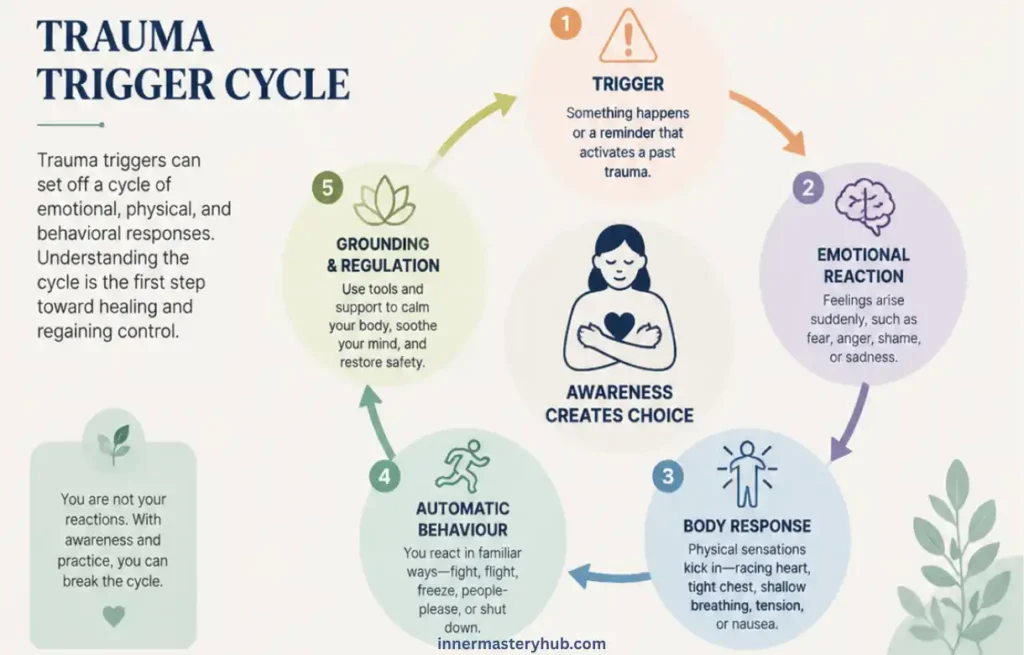
The Trauma Trigger Cycle
A common pattern after overwhelming experiences looks like this:
| Stage | What Happens | Example |
|---|---|---|
| Trigger | Something reminds you of an experience | Someone speaks in an angry tone |
| Interpretation | Your mind searches for meaning | “I am unsafe” |
| Emotional response | Feelings become intense | Fear, anger, shame |
| Body response | Physical changes occur | Heart racing, tension |
| Reaction | You respond automatically | Avoiding, arguing, shutting down |
| Recovery | You return to the present | Grounding and self-support |
Understanding this cycle creates an important pause between the trigger and the reaction.
How to Manage PTSD Triggers and Trauma Responses
Recognising patterns, staying in the now, and creating healthy coping mechanisms are all important aspects of managing PTSD triggers and trauma reactions. When symptoms are severe or chronic, these techniques can reduce emotional overload, but they cannot take the place of professional treatment.
People with trauma histories may notice reactions such as:
- Feeling suddenly unsafe
- Strong fear or panic
- Emotional numbness
- Intense anger
- Avoiding reminders
- Feeling disconnected from the present
These responses can feel confusing because the reaction may seem much stronger than the current situation.
1. Name What Is Happening
One of the first coping skills for trauma is identifying the reaction.
Instead of:
Try:
“I am having a strong reaction. Something may have triggered me.”
Naming the experience can create emotional distance and reduce shame.
A helpful practice:
Notice → Name → Normalize → Navigate
Example:
- Notice: “My body feels tense.”
- Name: “I feel afraid.”
- Normalize: “This reaction may have a reason.”
- Navigate: “What can help me feel grounded now?”
2. Stay in the Present Moment
During a trigger, the mind focuses strongly on past danger. A grounding statement can help you reconnect with the present moment.
Examples:
- “I am here, and this moment is different.”
- “I am experiencing a memory, not the original event.”
- “I can take this one moment at a time.”
- “I have choices now.”
This does not mean forcing yourself to feel positive. It means helping your mind recognize current reality.
3. Reduce Emotional Overwhelm Before Problem-Solving
When emotions are very intense, trying to analyze everything immediately doesn’t work.
First focus on your stabilization:
- Slow your breathing
- Sit somewhere comfortable
- Reduce overwhelming stimulation
- Drink water
- Contact a supportive person
- Use grounding exercises
After your emotional intensity decreases, you can reflect with a clear mind.
Grounding Exercises for Trauma Responses
Grounding exercises for trauma help you bring attention back to the present moment by using the senses, body awareness, and immediate surroundings. They are commonly used as coping tools for distress, anxiety, and trauma-related reactions.
Grounding does not erase your memories. Instead, it helps you recognize:
“I am experiencing something difficult, but I am in the present moment.”
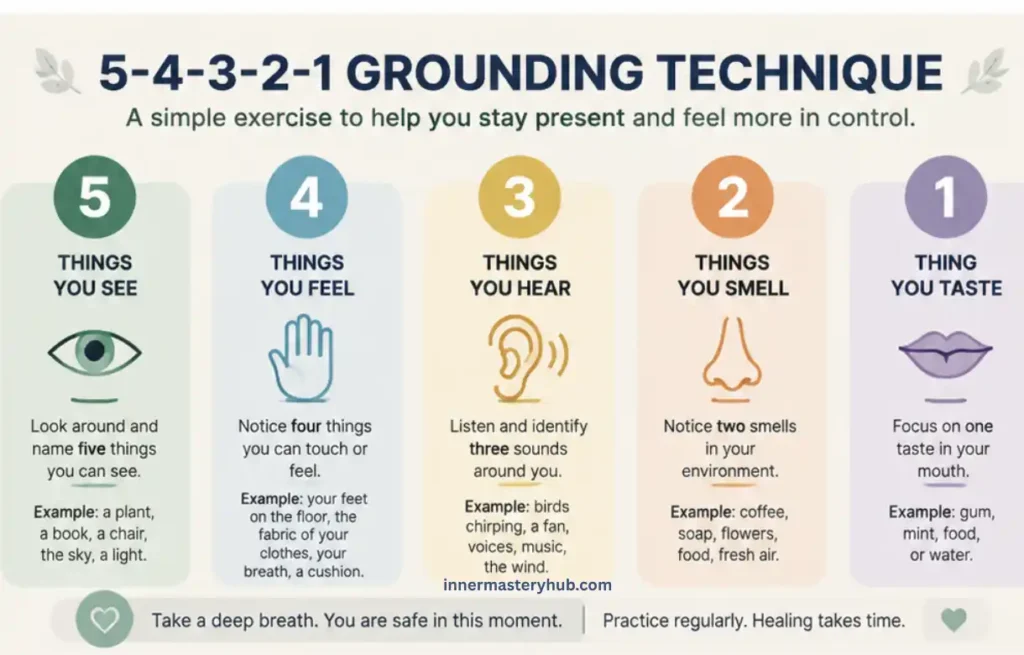
1. The 5-4-3-2-1 Grounding Technique
This grounding exercise uses your five senses.
Notice:
5 things you can see
Look around and name objects.
Example:
- A chair
- A window
- A book
- A plant
- A wall
4 things you can feel
Notice:
- Your feet on the floor
- The texture of clothing
- The chair supporting you
3 things you can hear
Identify:
- Sounds nearby
- Your breathing
- Background noises
2 things you can smell
Notice:
- A familiar scent
- The environment around you
1 thing you can taste
Notice:
- A drink
- A small piece of food
- The taste in your mouth
2. Body-Based Grounding
Body awareness can help reconnect attention with the present.
Try:
- Pressing your feet gently into the floor
- Holding a comforting object
- Stretching slowly
- Placing a hand on your chest or arm
- Noticing your breathing rhythm
The purpose is not to force calm but to create awareness and stability.
3. Orientation Exercise
Look around and remind yourself:
- What day is it?
- Where am I?
- What is happening right now?
- What choices do I have in this moment?
Example:
“I am sitting in my home. It is Monday morning. I am safe right now. I can decide what I need next.”
4. Breathing for Emotional Regulation
Slow breathing can be a useful calming practice for some people.
Try:
- Breathe in slowly.
- Pause briefly.
- Exhale slowly.
- Repeat several times.
If focusing on breathing feels uncomfortable, choose another grounding method. Not every technique works equally well for everyone.
5. Self-Compassion During Triggers
Many people respond to trauma reactions with self-criticism:
“Why am I still affected by this?”
A more supportive response:
“This reaction is difficult, but I can respond to myself with care.”
Self-compassion does not mean ignoring your problems. It means reducing the past shame while building healthy coping responses.
How to Feel Safe After Trauma
Rebuilding confidence in yourself, your surroundings, and relationships is the first step toward feeling safe following trauma. A stronger sense of stability may be produced by coping mechanisms like self-compassion, grounding, regular routines, and having supportive relationships. Learning that the present can differ from the past is what it means to be safe, not forgetting what happened.
Even when they are no longer in danger, some people who have had traumatic events nevertheless remain vigilant. This is possible because the body and mind have developed defence mechanisms. Gently educate yourself that safety may coexist with painful memories is a common part of recovery.
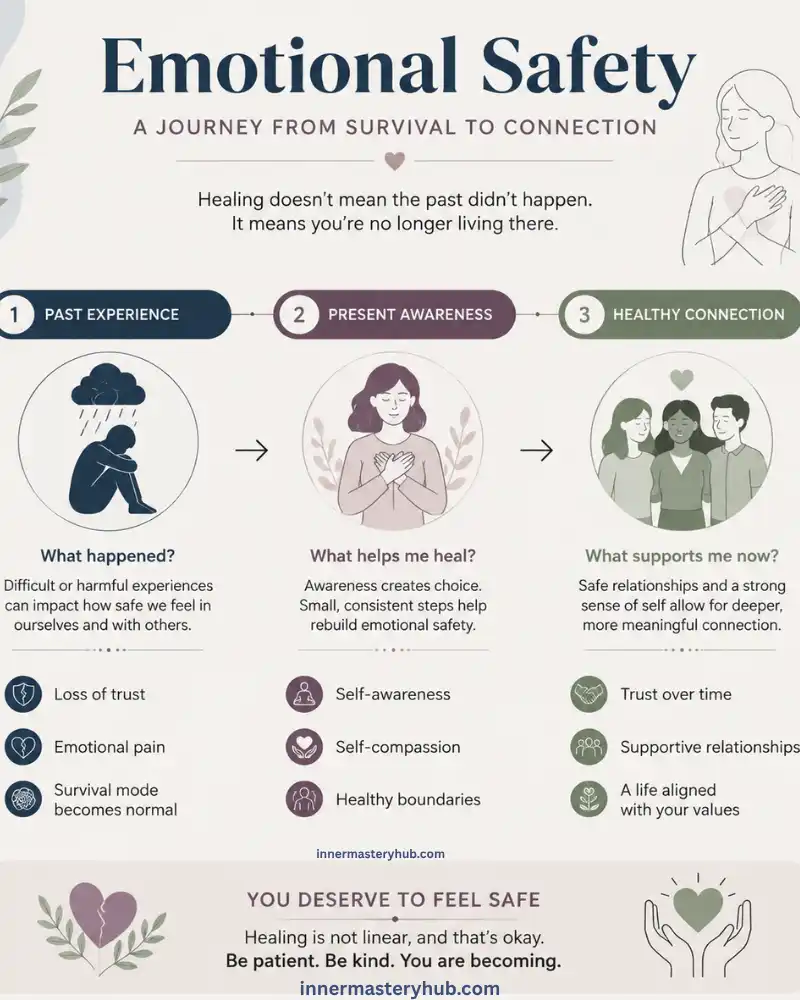
What Does Emotional Safety Mean After Trauma?
Emotional safety means feeling able to experience thoughts, feelings, and relationships without constantly expecting harm, rejection, or danger.
It does not mean:
- Never feeling afraid
- Never having difficult emotions
- Trusting everyone immediately
- Pretending the past did not happen
Instead, emotional safety may involve:
- Feeling able to express your needs
- Trusting your own decisions
- Recognizing when you are actually safe
- Setting healthy boundaries
- Knowing how to support yourself during difficult moments
Why Can Feeling Safe Become Difficult After Trauma?
Trauma can affect how people interpret safety, trust, and emotional experiences. Some people may become more sensitive to signals of danger following traumatic experiences. These responses can be defensive changes, but they may become tiresome when they continue in settings that are no longer harmful.
Research in trauma psychology suggests that stressful experiences can influence emotional regulation, memory, and responses to perceived threats2. However, trauma responses vary widely between individuals. Factors such as personal history, relationships, coping resources, and support systems can impact recovery.
The Difference Between Past Danger and Present Safety
One helpful skill is learning to separate:
| Past experience | Present reality |
|---|---|
| “I was hurt before.” | “I am here now.” |
| “Someone broke my trust.” | “I can decide who earns my trust.” |
| “I had no control then.” | “I have choices today.” |
| “My feelings were ignored.” | “My feelings matter now.” |
This does not negate events. It reminds you that the present may hold new chances.
Building Emotional Safety After Trauma
1. Create Predictability in Daily Life
A predictable routine can provide a sense of stability.
Helpful habits may include:
- Regular sleep and wake times
- Consistent meals
- Movement or exercise
- Time for relaxation
- Planned moments of connection
- A calming bedtime routine
Small routines can communicate:
“My life has structure. I can take care of myself.”
2. Build Trust With Yourself
After trauma, some people struggle to trust their own feelings, choices, or instincts.
You may notice thoughts like:
- “Am I overreacting?”
- “Can I trust my judgment?”
- “Maybe my needs do not matter.”
Building self-trust can involve:
- Listening to your emotions without judging them
- Keeping small promises to yourself
- Making choices based on your values
- Recognizing your progress
Self-trust grows through repeated experiences of showing yourself that you can respond with care.
3. Practice Healthy Boundaries
Boundaries help create emotional safety by clarifying what feels acceptable and what does not.
Examples:
Instead of:
“I have to explain myself until they understand.”
Try:
“I can communicate my needs without needing everyone to agree.”
Healthy boundaries may include:
- Saying no without excessive guilt
- Limiting contact with harmful situations
- Asking for respectful communication
- Taking time before responding during conflict
Boundaries are not punishments. They are ways of protecting wellbeing.
4. Develop Supportive Relationships
Safe relationships can support recovery by providing trust, respect, and emotional conhttps://innermasteryhub.com/emotional-wounds-of-adult-children/nection. However, rebuilding trust after trauma happens gradually and should not be rushed.
Supportive people often:
- Listen without judgment
- Respect boundaries
- Validate feelings
- Communicate honestly
- Allow space for growth
A healthy relationship does not require perfection. It requires safety, respect, and willingness to repair after difficulties.
Attachment and Feeling Safe
Attachment theory, developed by John Bowlby3 and expanded through research by Mary Ainsworth, suggests that early relationship experiences can influence expectations about closeness, trust, and emotional support.
However, attachment patterns are not permanent labels. People can develop new relationship experiences, learn healthier communication, and build greater emotional security throughout life.
5. Use Self-Compassion Instead of Self-Blame
Many people who have experienced trauma carry beliefs such as:
- “I should be over this.”
- “I am too sensitive.”
- “Something is wrong with me.”
A more compassionate approach:
“My reactions developed for a reason. I can learn new ways to respond.”
Self-compassion may help reduce shame and create a kinder internal relationship.
Practical Exercise: Creating a Personal Safety Plan
Write down answers to these questions:
When I feel overwhelmed, I notice:
- What emotions appear?
- What sensations do I feel in my body?
- What thoughts usually come up?
Things that help me return to the present:
- A grounding exercise:
- A person I can contact:
- A place where I feel comfortable:
- A phrase that supports me:
A reminder I need during difficult moments:
“I am experiencing a difficult moment, but I can support myself through it.”
Common Misconceptions About Feeling Safe After Trauma
| Myth | Reality |
|---|---|
| “If I still feel triggered, I have not healed.” | Recovery can include difficult moments while still making progress. |
| “Feeling safe means nothing bothers me anymore.” | Safety means having tools to respond when challenges appear. |
| “I should trust everyone again.” | Healthy trust is built gradually through consistent experiences. |
| “My reactions mean I am weak.” | Emotional responses often reflect attempts to protect yourself. |
When Feeling Unsafe May Need Additional Support
Consider seeking professional support if trauma-related reactions:
- Frequently interfere with daily life
- Affect relationships significantly
- Cause ongoing sleep problems
- Create intense fear or distress
- Lead to feeling hopeless or unable to cope
Trauma-informed therapy approaches may help some people process difficult experiences and develop additional coping skills.
Why Can Emotional Regulation Be Difficult After Trauma?
People who have experienced trauma may react differently to emotional experiences, stress, and threats. While some people may become emotionally detached, others may become extremely aware of potential threats. Although these behaviours may be protective reactions, they may become problematic if they persist in genuinely safe environments.
Common experiences may include:
- Feeling overwhelmed by small conflicts
- Reacting strongly to criticism
- Difficulty calming down after stress
- Feeling emotionally numb
- Struggling to identify feelings
- Avoiding situations that create discomfort
These reactions do not mean someone is “broken.” They may reflect learned responses developed during difficult experiences.
The Emotion Regulation Cycle
Understanding the cycle can help you notice where you have choices.
| Stage | What Happens | Example |
|---|---|---|
| Situation | Something happens | Someone does not respond to a message |
| Interpretation | Your mind gives it meaning | “They are rejecting me” |
| Emotion | A feeling appears | Fear or sadness |
| Body response | Physical changes occur | Tight chest, tension |
| Action | You react | Withdraw, argue, seek reassurance |
| Reflection | You understand the pattern | “This reminded me of feeling ignored before” |
1. Identify and Name Your Emotions
One of the most useful emotional regulation skills after trauma is learning to name what you feel.
Many people experience emotions as:
“I feel bad.”
But “bad” can mean many things:
- Hurt
- Fear
- Shame
- Anger
- Loneliness
- Disappointment
- Overwhelm
Try asking:
- What emotion am I feeling?
- Where do I feel it in my body?
- What might this emotion be trying to tell me?
Naming emotions can make them feel more manageable because you move from being overwhelmed by the feeling to observing it.
2. Create a Pause Before Reacting
A pause gives your mind and body time to move from automatic reaction toward intentional response.
During emotional intensity, try:
The STOP Practice
S — Stop
Pause before acting.
T — Take a breath
Allow your body a moment to settle.
O — Observe
Notice thoughts, emotions, and sensations.
P — Proceed
Choose your next step intentionally.
Example:
Automatic reaction:
“You do not care about me.”
Pause:
“I feel rejected right now. I want to understand what happened before responding.”
3. Practice Self-Soothing Skills
Self-soothing means using supportive actions to help yourself through emotional discomfort.
Examples:
Physical calming
- Taking a warm shower
- Holding a comforting object
- Sitting somewhere safe
- Stretching gently
Sensory grounding
- Listening to calming sounds
- Noticing pleasant smells
- Feeling textures around you
Emotional support
- Writing your thoughts down
- Talking with a trusted person
- Offering yourself compassionate words
Self-soothing is not avoiding emotions. It is creating enough safety to process them.
4. Challenge Trauma-Related Thoughts
After painful experiences, people may develop beliefs such as:
- “I cannot trust anyone.”
- “I am always going to be hurt.”
- “My needs do not matter.”
- “I must keep everyone happy.”
These thoughts may have developed as protection, but they may not always reflect the present.
Try asking:
| Thought | Reflection Question |
|---|---|
| “Everyone leaves me.” | Is this always true, or does it reflect past experiences? |
| “I am too sensitive.” | Am I responding to something that genuinely hurt me? |
| “I have no control.” | What choice do I have right now? |
This procedure is associated with cognitive reappraisal, a psychological strategy that modifies the interpretation of circumstances to affect emotional reactions.
Although its efficacy varies depending on the circumstance and individual characteristics, research on emotion regulation indicates that cognitive reappraisal may reduce negative emotional responses for many people4.
5. Build Emotional Awareness Through Journaling
Writing can help organize emotional experiences.
Try these prompts:
- What happened today?
- What emotion did I feel first?
- What did I need in that moment?
- Did this feeling remind me of something from the past?
- What would I say to a friend experiencing this?
The goal is not to analyze yourself endlessly. It is to create understanding.
6. Develop Emotional Flexibility
The ability to sense emotions without giving them total control is known as emotional flexibility.
For example:
Instead of:
“I feel afraid, so something bad must happen.”
Try:
“I feel afraid, and I can still decide what action supports me.”
Instead of:
“I feel angry, so I must react.”
Try:
“My anger is giving me information. I can choose how to express it.”
Emotional Regulation Exercise: The 90-Second Check-In
When emotions feel intense:
Step 1:
Pause and notice:
“Something is happening inside me.”
Step 2:
Identify:
- What am I feeling?
- What triggered this?
- What do I need?
Step 3:
Choose:
- A grounding technique
- A supportive action
- A healthier response
Remember:
A strong emotion is a signal. It is not always a command.
Key Insight
Many people resist their emotions in an attempt to control them.
But building a better relationship with emotions is frequently more important to emotional regulation than trying to control them.
The question changes from:
“How do I stop feeling this?”
to:
“How can I support myself while I am feeling this?”
Trauma Recovery Techniques That May Support Healing
Different approaches work for different people. Some commonly used supportive practices include:
Grounding practices
Helpful for:
- Feeling overwhelmed
- Returning attention to the present
- Managing triggers
Examples:
- Sensory grounding
- Breathing exercises
- Present-moment awareness
Journaling
Can help with:
- Organizing thoughts
- Identifying patterns
- Expressing emotions
Helpful prompts:
- What situation affected me today?
- What emotion did I notice?
- What did I need in that moment?
Movement and body awareness
Some people find gentle movement helpful for reconnecting with their bodies.
Examples:
- Walking
- Stretching
- Yoga
- Relaxation practices
Supportive relationships
Connection can help people feel understood and less isolated.
Supportive relationships often involve:
- Respect
- Honesty
- Emotional safety
- Healthy boundaries
Myth vs Reality: Recovering From Emotional Trauma
| Myth | Reality |
|---|---|
| Healing means forgetting the past | Recovery means changing your relationship with the past |
| Strong emotions mean you are failing | Difficult emotions can appear during growth |
| You should heal quickly | Recovery timelines vary greatly |
| You must forgive everyone to heal | Healing and forgiveness are separate choices |
| Coping skills solve everything | Coping skills support recovery but may not replace therapy |
When Recovery Feels Slow
Failure does not equate to slow progress. Small adjustments that accumulate over time frequently result in emotional healing.
Progress could appear as:
- Getting better more quickly after stress
- Early detection of triggers
- Clearly expressing needs
- Creating healthy limits
- Being kinder to yourself
A person doesn’t need to transform into an entirely different version of themselves. Increasing one’s connection to oneself is a common aspect of recovery.
The Difference Between Coping and Healing
| Coping | Healing |
|---|---|
| Managing difficult moments | Understanding and processing experiences |
| Reducing immediate distress | Building long-term emotional flexibility |
| Using practical tools | Developing deeper self-awareness |
| Getting through today | Creating healthier patterns over time |
Key Takeaways: Coping Skills for Trauma
- Tools for managing distress, triggers, and emotional overload are known as coping skills for trauma.
- There is no one-size-fits-all way to recover from trauma.
- You can re-establish a connection with the present by engaging in grounding activities.
- Understanding emotions instead of combating them is a key component of emotional management.
- After trauma, a sense of safety frequently emerges gradually through experiences that provide support.
- Avoiding every challenging feeling is not the same as healthy coping.
- Self-compassion can aid in emotional healing and reduce guilt.
- Relationships that provide support might be crucial to recovery.
- When symptoms of trauma interfere with day-to-day functioning, professional assistance may be beneficial.
- The goal of recovery is to increase resilience and choice rather than to become unaffected.
Reflection Questions
These questions are designed to encourage self-awareness:
1. What situations make you feel emotionally unsafe?
Notice:
- Certain places
- Relationship patterns
- Specific conversations
- Internal thoughts or memories
2. What happens inside you when you feel triggered?
Consider:
- What emotions appear first?
- What physical sensations do you notice?
- What thoughts automatically come up?
3. What are you afraid might happen during difficult moments?
Sometimes strong reactions are connected to deeper fears, such as:
- Being rejected
- Losing control
- Being misunderstood
- Being hurt again
4. When did you first notice these reactions?
Understanding when a pattern began may help you understand what it is connected to.
5. What helps you feel grounded and supported?
Think about:
- People you trust
- Places where you feel comfortable
- Activities that help you reconnect with yourself
People Also Ask
What are the best coping skills for trauma?
The best coping methods differ by person. Grounding, emotional awareness, breathing, supporting connections, healthy routines, and self-compassion are common methods. These tactics may help manage distress and enhance emotional regulation, but they are not a replacement for professional treatment when needed.
How do you calm a trauma response?
Grounding, slow breathing, noticing your surroundings, and being present are all options. It may also help to examine what caused the response and offer yourself reassurance rather than condemnation. Professional help may help with overwhelming or frequent trauma responses.
What grounding exercises help with trauma?
Sensory grounding exercises might help some people reconnect with the present. Grounding with 5-4-3-2-1, naming objects, noticing physical sensations, and describing your environment are examples. Each person responds differently to techniques.
How do you deal with trauma triggers?
Managing trauma triggers frequently requires noticing early warning indicators, identifying the trigger, grounding yourself, and adopting a helpful response. The idea is not to eradicate all reminders but to build healthy methods of responding when tough emotions occur.
Can coping skills heal trauma?
Coping skills can help trauma survivors control emotions, lessen overwhelm, and feel protected. Coping abilities may not heal all trauma victims. Some benefit from trauma-focused professional help.
How can I feel safe after trauma?
Predictable routines, supportive relationships, appropriate boundaries, and self-trust help trauma survivors feel safe. Safety means building confidence to support yourself through challenging times, not feeling fearful.
Further Reading
Books
van der Kolk, B. A. (2014).
The Body Keeps the Score: Brain, Mind, and Body in the Healing of Trauma.
Viking.
Herman, J. L. (1992).
Trauma and Recovery: The Aftermath of Violence—From Domestic Abuse to Political Terror.
Basic Boo
- Webb, T. L., Miles, E., & Sheeran, P. (2012).
Dealing with feeling: A meta-analysis of the effectiveness of strategies derived from the process model of emotion regulation. Psychological Bulletin, 138(4), 775–808.
https://doi.org/10.1037/a0027600 ↩︎ - The long-term costs of traumatic stress: Intertwined physical and psychological consequences. World Psychiatry, 9(1), 3–10.
https://doi.org/10.1002/j.2051-5545.2010.tb00254.x ↩︎ - Bowlby, J. (1969).
Attachment and Loss: Vol. 1. Attachment.
New York: Basic Books. ↩︎ - The emerging field of emotion regulation: An integrative review. Review of General Psychology, 2(3), 271–299.
https://doi.org/10.1037/1089-2680.2.3.271 ↩︎
Written By Mehwish Qurayshi
Mehwish Qurayshi is a Trauma-Informed Emotional Wellness Counsellor trained through NICABM’s Treating Trauma Master Series, which includes NBCC-approved education in Trauma Treatment and Emotional Wellness & Emotional Intelligence – Sourcecode Academia. She has over five years of experience providing emotional wellness counselling, helping individuals heal from trauma, regulate emotions, and build healthy relationships.