
13 Painful Signs Of The Invisible Divorce But You’re Still Married

Title
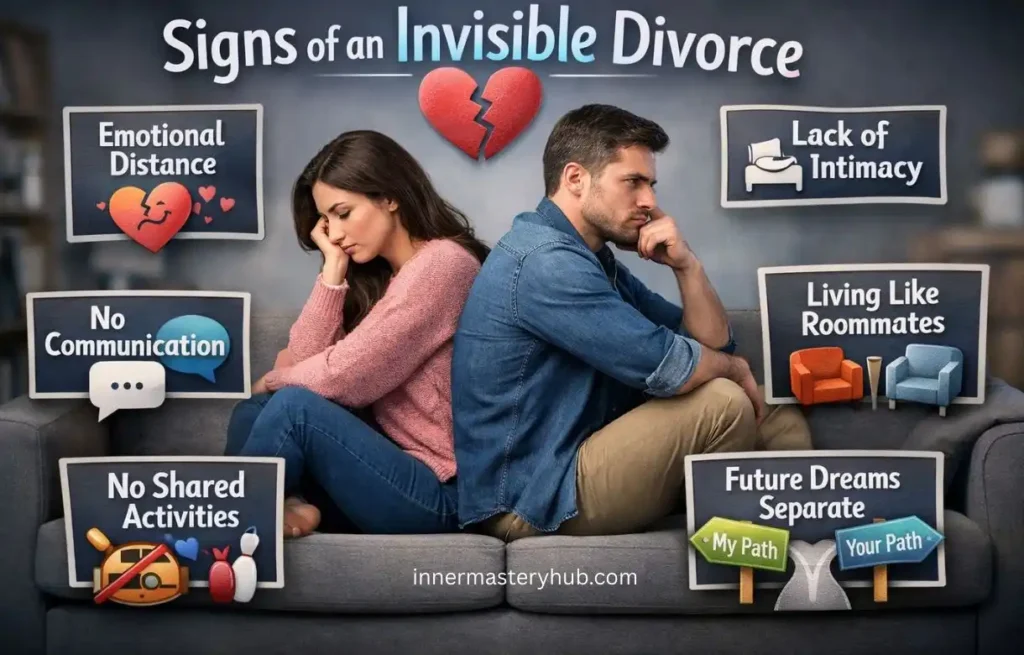
The invisible divorce is a silent emotional disconnection in relationships where partners remain together physically but lose intimacy, often driven by unmet emotional needs, poor emotional regulation, and unconscious withdrawal patterns.
There are no court documents or closed doors when the invisible divorce happens. It manifests when you stop expressing yourself, when you begin to live side by side rather than together, and when you feel safer in silence than in being honest.
Something vital has vanished, even though you still share a house, a bed, and even routines. You can tell when a discussion seems meaningless, when love seems forced, and when spending time together feels more burdensome than spending time alone. Although you don’t say it out loud, you know the marriage has become unresolved and unspoken. When your marriage still exists on paper, while emotionally, it already feels over?
The majority of people believe that divorce starts when someone begs for it or when treachery becomes apparent. The lengthy internal unraveling that takes place first is typically overlooked. You might think that a partnership is unbroken as long as there is no yelling, cheating, or legal action. However, something quite different is taking place on the inside. When unfulfilled needs go unaddressed, bitterness replaces Curiosity, and emotional safety gradually declines as the unseen divorce unfolds.
What is the invisible divorce in a relationship?
The invisible divorce is when two people stay together physically but disconnect emotionally. They stop sharing feelings, stop understanding each other, and begin living parallel lives under the same roof.
At first, it’s small things. A missed response. A tired conversation. A delayed reaction. But your mind interprets it the other way.
You think: “They don’t care.”
That thought creates emotion, hurt, rejection, and distance.
That emotion changes behavior, and you withdraw.
And that behavior shapes the entire relationship.
This pattern aligns with cognitive behavioral models explained in research by the American Psychological Association1:
Thoughts → Emotions → Behaviors → Relationship outcomes
Why does the invisible divorce happen even in “good” relationships?
It happens because emotional needs go unspoken while both partners assume things are “fine.” Over time, emotional neglect replaces emotional connection.
Many people misunderstand the problem.
They think:
- “We don’t fight, so we’re okay.”
But what’s really happening is:
- You’ve stopped engaging emotionally.
According to Esther Perel,
“The quality of your relationships determines the quality of your life.”
But quality is not built on presence alone. It is built on emotional responsiveness.
The Hidden Psychological Process Behind Emotional Drift
The invisible divorce follows a quiet internal loop:
- A partner doesn’t respond emotionally
- You interpret it as rejection
- You feel hurt or unsafe
- You withdraw to protect yourself
- They feel your withdrawal and pull back too
This loop repeats. But no one talks about it.
Research from the National Institutes of Health shows emotional disengagement is strongly linked to long-term relationship dissatisfaction2.
What are the signs of an invisible divorce?
Signs include emotional numbness, lack of meaningful conversations, avoidance, feeling lonely together, and reduced empathy between partners.
Key Signs to Notice
- You stop sharing your inner thoughts
- Conversations feel functional, not emotional
- You feel safer alone than with your partner
- There is no curiosity about each other
- Silence becomes comfortable, but empty
This is not Peace. It is a disconnection.
13 Signs That Reveal the Inner Breakdown of The Invisible Divorce
1. You Stop Explaining Yourself
It begins when you discover that expressing your emotions doesn’t make a difference. A minor argument that doesn’t get resolved could be the trigger. “They don’t really want to understand me” is how you read this on the inside. Emotionally, irritation transforms into silent surrender. The result is separation.
You start suppressing your thoughts, not because you’re at ease, but because you’re worn out. Over time, your choices are shaped by this silence, which affects how much of yourself you let into the relationship. You practice talking to people in your brain but never actually say them. And your sense of agency diminishes when your voice seems ineffective.
2. You Feel Lonely Even When They’re Next to You
The issue is emotional unavailability, not just physical absence. You take their emotional diversion as rejection. When even in shared spaces, that interpretation creates loneliness, emotional self-defense is the result. Loneliness becomes the norm when you stop reaching out. This silent pain starts to affect your decisions, including where you look for solace and approval.
You feel oddly invisible when you browse on your phone next to them. Being alone is not the cause of loneliness; rather, it is the result of not being satisfied.
3. Small Issues Feel Pointless to Bring Up
Multiple experiences of being downplayed serve as the trigger. You think to yourself, “It’s not worth the effort.” When Hopehy, Emotional detachment results replace Hope. Big things don’t matter when little things don’t. You learn to expect less as a result of this degradation, which quietly influences your decisions.
You let go of things that used to be really important, and Grief for something you no longer think you can have is often indicated by indifference.
4. You Live More Like Roommates Than Partners
Every day, life begins functioning. The trigger lacks emotional check-ins and is regular. You see this as a logistical cooperation. The relationship becomes emotionally neutral. As a result, the relationship functions well but feels hollow. This dynamic influences your decisions, particularly the amount of emotional effort you expend.
Chores, bills, and schedules are the main topics of conversation when Survival depends on function rather than closeness.
5. Affection Feels Forced
Routine closeness without emotional presence could be the cause. On the inside, you see it as a duty rather than a passion. When numbness takes over emotionally, causing Detachment from physical intimacy. This discomfort influences your choices.
When hugs are fleeting and transactional in real life, being physically close without emotional security feels empty.
6. You Avoid Conflict to Keep the Peace
Conflict once promised resolution, but now it drains you. You see conflicts as meaningless. Emotionally, fear of fatigue replaces Hope. The Hope is emotional repression. Avoidance starts to influence your decisions, favoring calm over truth. You agree openly but disagree within, and your Peace without honesty leads to emotional isolation.

7. You Fantasize About a Different Life
The cause in this case is chronic unhappiness. Internally, you interpret fantasies as relief as opposed to betrayal. But emotionally, longing is combined with guilt. These inner worlds shape your choices, defining how present you are in reality. You envision yourself alone.
8. You Feel Relieved When They’re Not Around
Calm, not craving, is the result of absence. That comfort means freedom to you. Emotionally, connection is replaced by comfort. A preference for distance results from this. That relief deepens separation by influencing your decisions.
You prefer spending time alone rather than with others, and this relief indicates the discharge of emotional stress.
9. You No Longer Share Inner Thoughts
The trigger is emotional risk without a payoff. Internally, you determine that it is safer to remain cautious. Where Vulnerability limits emotional functioning, the outcome is emotional privacy. This guardedness influences your trust-related choices. Your inner life feels secluded, even secretive. When Vulnerability is perceived as hazardous, intimacy dies.
10. Resentment Replaces Curiosity
Frustration stems from repeated disappointments. You see behavior as deliberate rather than human. Resentment grows emotionally. Judgment, not comprehension, is the issue. Your decisions are influenced by that perspective, especially empathy.
Rather than asking questions, you make assumptions. When Hope wanes, resentment increases, and Curiosity demands Hope.
11. You Feel Emotionally Older Than the Relationship
The trigger carries emotional weight alone. You view this as growing out of the marriage. Emotional exhaustion sets in as emotional detachment. This fatigue influences your decisions, including the decision to withdraw. In reality, you feel wiser but more lonely because Growth without connection causes imbalance.
12. You Protect Your Energy Instead of the Relationship
Past emotional depletion causes self-preservation. You see protection as necessary. Your emotions and boundaries become rigid. As a result, investment declines, and self-focus influences your decisions about how much effort to put in. You start to contribute less because it is too expensive. When reciprocity is removed, self-protection increases.
13. You Feel Done, But Don’t Know When It Happened
There is only accumulation, not a single trigger. You see numbness as a conclusion on the inside. Grief blends with clarity on an emotional level. Emotional closure without dialogue becomes your reality. This inevitability influences your decisions. Only the absence can be identified, not the end, because Endings occur gradually
How does emotional regulation connect to the invisible divorce?
Poor emotional regulation leads to avoidance, shutdown, or reactive behavior, which slowly erodes emotional intimacy and creates distance between partners.
When emotions feel overwhelming, you try to control them.
You might:
- Suppress feelings
- Avoid conversations
- Stay “neutral” to prevent conflict
But emotional suppression is not neutrality. It is a distance.
As Daniel Goleman explains in emotional intelligence research, unprocessed emotions don’t disappear; they shape behavior3.
Why does it feel harder to reconnect over time?
Because emotional distance becomes normalized and both partners adapt to living without connection, reconnection feels unfamiliar and risky.
At first, you notice the gap.
Then you adjust to it.
Eventually, you stop expecting more.
This is where the invisible divorce becomes stable.
Psychologically, your brain protects you by lowering expectations. This is called emotional adaptation.
But adaptation is not healing. It is Survival.
What mistakes make the invisible divorce worse?
Ignoring emotional needs, avoiding difficult conversations, assuming your partner “should know,” and focusing only on external responsibilities worsen emotional disconnection.
Common Mistakes
- Waiting for the other person to change
- Avoiding Vulnerability
- Prioritizing routine over connection
- Believing time will fix things
- Replacing emotional closeness with distractions
These actions feel safe. But they deepen the distance.
Is the invisible divorce the same as falling out of love?
No, the invisible divorce is not necessarily falling out of love. It is the result of emotional disconnection, not the absence of love itself.
Love can exist without expression.
But without expression, love becomes invisible.
And what is not felt begins to feel like it is gone.
As Erich Fromm wrote, “Love is not something natural… it requires discipline and awareness.”
Can the invisible divorce happen without either partner realizing it?
Yes, it happens unconsciously as both partners slowly adapt to emotional distance without recognizing the loss of connection.
This is why it is dangerous.
Because nothing feels “wrong enough” to fix.
You drift.
And drifting feels normal, until it feels empty.
What does the invisible divorce reveal about your inner world?
It reflects unmet emotional needs, fear of Vulnerability, and patterns of self-protection that limit connection.
The invisible divorce is not just about the relationship.
It is about:
- How you handle emotions
- How safe do you feel being seen
- How you respond to rejection
Because connection is not only about two people.
It is about two emotional systems interacting.
Conclusion
The invisible divorce is about emotional realities over formal resolutions. Long before the marriage’s status changes, it transforms when your inner world no longer feels shared. Acknowledging these indicators implies clarity.
You stop criticizing yourself for feeling aloof for no apparent reason once you realize the signs of invisible divorce. You witness how your marriage gradually changed due to internal perceptions, emotional reactions, and subtle repercussions. This awareness changes your perception of reality, but it does not require action. You realize that the distance was neither unexpected nor imagined. It was constructed inside of you, moment by moment.
Invisible divorce is fundamentally about agency. You automatically regain control by withdrawing when you believe your feelings are no longer critical. This is the psyche defending itself; it is not a sign of weakness. The ability to both influence and be impacted is what gives partnerships meaning. The self starts to separate to survive when that mutual influence fades.
FAQs
What is the invisible divorce?
Advice such as “try harder,” “date again,” or “communicate more” is predicated on the relationship being emotionally secure. However, the emotional significance, rather than the effort, is the problem with the unseen divorce.
What causes the invisible divorce?
Surface-level solutions seem hollow when your inner perception tells you that being open causes suffering or apathy. Research in relationship psychology indicates that responsiveness and emotional safety are more important than communication frequency.
Is the invisible divorce common in marriages?
Advice remains theoretical and unhelpful if it doesn’t address the internal narrative you’ve developed about being invisible or unsupported.
How do you know if you are in an invisible divorce?
You may feel lonely despite being married, avoid deep conversations, stop sharing emotions, or feel relieved when your partner isn’t around. If emotional closeness is gone but the marriage continues, you may be experiencing an invisible divorce.
Can the invisible divorce happen without fighting?
Yes. In fact, many invisible divorces happen in calm households. There may be little conflict because both partners have emotionally withdrawn. Silence replaces arguments, and avoidance replaces emotional engagement.
Can the invisible divorce happen without fighting?
Not always. The invisible divorce shows emotional disconnection, not necessarily the end of a relationship. Some couples rebuild if emotional safety returns. Others remain disconnected for years. Awareness helps you understand what has already changed internally.
Why does the invisible divorce hurt so much?
It hurts because the loss is unclear and unacknowledged. There is no official ending, yet emotional intimacy is gone. This creates confusion, loneliness, and Grief without closure, which can be harder than an actual breakup.
Can one partner feel the invisible divorce while the other doesn’t?
Yes. One partner may emotionally detach first, while the other believes everything is fine. This mismatch often deepens the invisible divorce because the emotionally disconnected partner feels unseen and misunderstood.
Is the invisible divorce the same as emotional neglect?
They are closely connected. Emotional neglect often leads to the invisible divorce. When emotional needs are repeatedly ignored, you protect yourself by withdrawing, which slowly transforms the relationship into emotional separation.
Why do people stay in an invisible divorce for years?
People stay because of fear, financial security, children, social pressure, or hope that things will improve. Emotional disconnection feels safer than conflict, even though it quietly drains happiness over time.
- American Psychological Association. (2020). Cognitive behavioral therapy. https://www.apa.org/ptsd-guideline/patients-and-families/cognitive-behavioral ↩︎
- Finkel, E. J., Simpson, J. A., & Eastwick, P. W. (2017). The psychology of close relationships: Fourteen core principles. Annual Review of Psychology, 68, 383–411. https://doi.org/10.1146/annurev-psych-010416-044038 ↩︎
- Goleman, D. (1995). Emotional intelligence: Why it can matter more than IQ. Bantam Books. ↩︎
Written By Mehwish Qurayshi
Mehwish Qurayshi is a Trauma-Informed Emotional Wellness Counsellor trained through NICABM’s Treating Trauma Master Series, which includes NBCC-approved education in Trauma Treatment and Emotional Wellness & Emotional Intelligence – Sourcecode Academia. She has over five years of experience providing emotional wellness counselling, helping individuals heal from trauma, regulate emotions, and build healthy relationships.