
22 Places you should keep your mouth shut
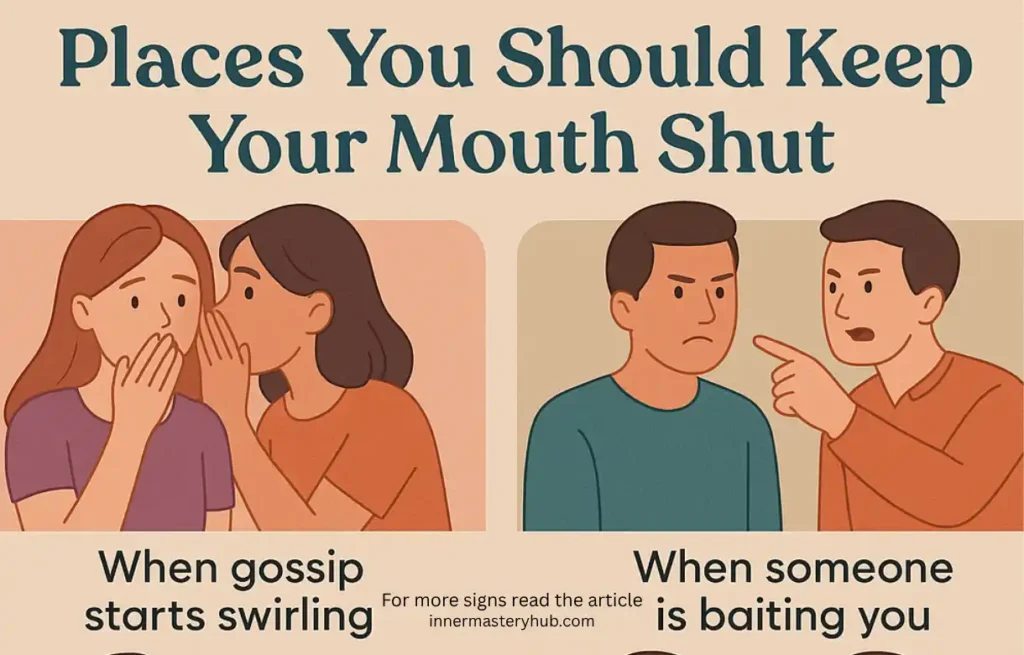
Places you should keep your mouth shut are settings where speaking impulsively can damage relationships, reputation, or safety. Examples include heated arguments, work meetings without facts, legal situations, gossip, and times when emotions are high. Silence protects credibility, trust, and self-control.
A moment where words just come out, and instantly, something feels off. Not because what you said was completely wrong, but because deep inside, you knew it wasn’t the right moment.
That’s the quiet struggle behind places you should keep your mouth shut. It’s not about being silent all the time. It’s about understanding when speaking becomes self-sabotage.
You wonder:
“Why do I say things I later regret?”
The common misunderstanding is that people think the problem is “talking too much.” But the real issue is deeper. It’s emotional regulation.
Because what actually happens is subtle:
A trigger appears → you interpret it quickly → emotion rises → words follow → consequences unfold.
As Daniel Goleman, who popularized the concept of emotional intelligence, suggests, “Self-regulation is the ability to manage disruptive emotions before they control behavior.”
And yet, in real life, that gap between emotion and response feels almost invisible.
Why Do You Speak When You Should Stay Silent?
You speak impulsively because your brain reacts faster than it reflects. Emotional triggers activate the amygdala, leading to quick reactions instead of thoughtful responses.
The Inner Process
- You feel challenged → your brain reads it as a threat
- You interpret it personally → emotion rises
- You react verbally → defensively
- The outcome → regret, tension, or loss of trust
Research supports this. A study in Nature Reviews Neuroscience shows that emotional responses often bypass rational thinking during stress1.
So it’s not about lack of intelligence. It’s about unmanaged emotional speed.
What Are the Key Places You Should Keep Your Mouth Shut?
You should stay silent in emotionally charged situations, when you lack full context, during gossip, in hierarchical environments, and when someone is vulnerable. Silence in these moments prevents damage and builds trust.
Now let’s go deeper into each.
1. When your heart is racing in a conflict, you need to keep your lips shut
You’ve sensed the heat building in a situation and the impulse to react quickly. That is precisely the time to keep your mouth shut. Your capacity to hear your spouse and think clearly is compromised when you’re psychologically “flooded.” You are more likely to say regrettable things and absorb information incorrectly if your heartbeat floods during a fight.
In this situation, you may take a moment to calm your body before responding immediately. A twenty-minute reset, some deep breathing, or a little break can keep a conflict from becoming out of control. When your system is stable, and a connection is essential, rather than losing the argument, you aim to come back later to clear the air.
2. In negotiations and high-stakes talks, after you’ve made a key point
In negotiations, keeping your mouth shut improves results when you need to stay silent. You can use Short, intentional pauses, just a few seconds, to interrupt zero-sum thinking and help both parties come up with more creative, win-win agreements. Stop once you’ve spoken what has to be said. Let the heavy lifting be done by stillness. You avoid talking yourself into making unnecessary concessions, while the other person usually fills the silence with insightful information.
When you delay, it shows assurance, inspires reflection, and reduces the risk of a weak counteroffer. Hold your ground and mentally count “one-one-thousand, two-one-thousand, three-one-thousand” if you find the stillness between intervals unsettling.
3. When gossip starts swirling
Negative gossip has a price, although some office chat seems harmless. According to research, being around gossip and unfavourable social cues increases tension, strain, and depressed symptoms. It can also prevent organised behaviour that keeps teams moving forward. Avoid adding to the rumours and don’t be the one who spreads them. Your reputation for caution will spread more quickly than any rumour you choose not to share.
Another reason you need to keep your lips shut is that gossip damages trust because it is perceived as less moral and competent. You want to be the coworker that people rely on for good judgment rather than flashy opinions.
4. When you’re exhausted
Alcohol and sleep deprivation affect perceptions and emotional regulation. Your brain’s emotion centres fire more furiously, and your prefrontal “brakes” don’t control as well when you’re sleep-deprived. When combined with texting, disagreements, or relationship decisions, that is a poor combination.
Make it clear: avoid discussing sensitive issues after midnight or after inadequate sleep. Connection, not shrewd comebacks you’ll later regret, is what you want. Here, keeping your mouth shut is wisdom at work.
5. When kids are listening
Youngsters are observant of how adults resolve disputes. Children who see aggressive interparental conflict are more likely to experience insecurity and unpleasant emotional reactions. They pick up on patterns of harsh words, loud voices, and cold silence and internalise them. Hold the queue if there are young ears around. Postpone the challenging conversation and ensure your words are transparent and impartial. Your job is to safeguard developing minds, not avoid issues.
6. When you don’t know the whole story
You are driven to act quickly to repair the situation, clear the record, or stand up for someone. However, if you don’t have context, your words may get inflexible around the incorrect image. Quick judgments can harden into stubborn stances, and pride keeps you from giving in.
Hold your tongue, listen for the timeframe, the details, and anything that’s still unclear, then ask two or three clarifying questions. You’ll notice that your initial take softens. You engage with the truth rather than battle a shadow. Because you choose curiosity over confidence, that change alone can save a relationship.
7. When someone is baiting you
Antagonists take advantage of your reaction. They keep you dancing and move the goalposts if you give them the chance. I used to try to make sense of myself to people who didn’t want to. It was never successful. Refusing to start with “I’m not having this conversation” was effective. After that, I moved on. Here, keeping your mouth shut is a boundary in action, not a sign of surrender.
8. When feedback stings
Although defensiveness is mostly driven by adrenaline, it feels like the truth. Your lips come alive with explanations, your jaw locks, and your chest tightens. You lose the lesson and defend your ego if you speak at that time. Instead, be silent, make notes, and enquire, “Is it possible for me to sit with this and respond tomorrow?” Sift for the useful 10 per cent later. Your responses will be more composed, and others will realise that they can be honest with you, which will strengthen all of your relationships.
9. When anger is peaking
Pointed fingers, fast respiration, and raised voices are all signs of danger. I paid for the strong lines I said in that state. Most likely, you have done the same. Before attempting to make a point, take a step back, breathe deeply, and let your body settle. The objective is to be fair, not to win. Instead of hurling general labels that sting, you can name particular behaviours when your nervous system is relaxed.
10. Early in Marriage and Friendship
Oversharing can feel like honesty, but without trust, it reads as pressure. Match the other person’s level. Share a little, listen a lot, and let warmth build layer by layer. When you pace yourself, you avoid the morning-after vulnerability hangover that comes from saying too much too soon to someone who hasn’t earned it yet.
11. When someone needs to vent
You want to assist, so you search for solutions. However, prompt advice is rejected with the response, “You don’t get me.” Consider giving someone a moment to think, nodding silently, and politely asking, “Do you want me to help think it through, or just listen?” That pause acknowledges their sentiments and keeps the connection alive.
12. When timid criticism flies
Not every comment is worthy of your time and effort. The wisest course of action is to ignore remarks that are obviously intended to cause pain. Don’t give away your attention; it’s a reward. Maintain a silent dignity. Determine later if a boundary negotiation is required. Most of the time, keeping your mouth shut ends the game.
13. On social media during heated cycles, you.
You might want to dive right in; a hasty decision can haunt you for years. Think about who your remarks are helping, pause, read more, and wait for a news cycle. If you must communicate, be human and factual. The best course of action is to keep things private by keeping your mouth shut and protecting details.
14. After asking a challenging question
Nerves take over, and you start talking again after you finally pose the difficult question during a meeting or negotiation. Now is the time to stop. Answers that you would never hear if you fill the void are made possible by keeping your mouth shut. Mentally count to three before asking again.
15. Before sending sensitive texts or emails
In their mind, the joke that seems good in yours is cold or cruel. Hold the message overnight or change to a call if it’s sensitive. “Would I be OK if this got forwarded?” ask yourself. Don’t press submit if the response is no. You’ll safeguard both your record and your relationships.

16. When someone else owns the moment
When a friend offers excellent news, you are compelled to share a similar story. Don’t give in. Give their victory some breathing room, one more question. Before you add anything, join them in celebrating. When you create space for their happiness without taking centre stage, you’ll realise how much closer you feel.
17. When “Keeping it real” would just wound
Honesty is a tool, not a weapon. If your comment can’t help, heal, or move things forward, skip it. I’ve learned that “just being honest” hides a desire to vent frustration without owning it. When you choose kindness over a harsh truth no one asked for, you protect both the bond and your integrity.
18. When you feel pressured to correct someone else’s narrative
People are providing more than just facts when they tell you what something means to them. You might be correct, but you could still cause harm if you jump in with “Actually.” First, try repeating the language: “So for you, it meant…” Then ask whether they would like a different perspective. Instead of stealing meaning, you become a partner in it.
19. When your values are being tested in the wrong venue
Some confrontations are more about asserting power than about values; you need to keep your lips shut. Know the difference. When you have the energy to stand up, save your most significant beliefs for discussions with people who can hear them and where they can make a difference. You save your strength for the important moments by keeping your mouth shut here.
20. When you’re tempted to correct minor details.
Interrupting a story to correct minor details yields no benefits. Consider whether the point gets modified by the revision. If not, ignore it. In a small quantity, precision is less valuable than what is happening. When accuracy really counts, save your credibility.
21. When your plan needs a private start
During the first week, new routines and initiatives are sensitive. Talking about them too much can lead to unwarranted pressure and a false sense of progress. Keep calm, complete the repetitions, and then share once the tempo is authentic. Your preview won’t be as persuasive as your results.
22. When you’re going to say something you can’t take back
That sentence is familiar to you. It feels like a match on your tongue. You cannot take anything back after you’ve let it out. Press your lips together, inhale through your nose, and wait until you sense the heat. You’ll be glad you didn’t start the fire when it goes out.
How to practice” wise silence” without stonewalling
When keeping your mouth shut is intentional and combined with action, it can be pretty effective. You’re buying time to react correctly, not shutting down. When you need to keep your lips shut, use this easy three-step rhythm:
Take note of your internal condition first. Are you exhausted, angry, or is your heart racing? Those are warning signs that your remarks could cause harm. The conclusion drawn from studies on alcohol, sleep, and rage is the same: control your body first.
Second, make a gesture. “I want to get this right. Can we come back to it in twenty minutes?” is a brief line. Maintains assurance when you take a break. You’re picking a better time, not avoiding it.
When you’re upfront and patient about delays, your friends, teammates, and partners respond nicely.
Third, fix and return. Return with listening skills rather than lectures after the pause. According to studies on listening and cooperative problem-solving, when people feel completely heard, they become closer and more collaborative.
How does this build your self-development and relationships?
When you avoid impulsive speech and keep your lips shut, it improves your decision-making and reputation. Your calmness adds value in talks. Your discipline builds trust at work, and calmness creates a safer environment for the people you care about at home. You develop patience, perspective-taking, and emotional control, all significant components of maturity, each time you decide to keep your mouth shut when it matters.
Additionally, you’ll feel more in charge, notice more, understand more, and make better decisions when you stop responding to every spark. The tone of your relationships will shift toward respect and less drama. That’s consistent discipline in the areas where you should keep your mouth shut, not luck.
What Are the Emotional Triggers That Make You Speak?
Common triggers include feeling disrespected, misunderstood, or ignored, as well as feeling anxious. These emotions push you to react instead of respond.
Trigger → Reaction Pattern
- Feeling ignored → you interrupt
- Feeling attacked → you defend
- Feeling insecure → you over-explain
But the real issue is not the situation.
It’s the meaning you attach to it.
Why Is Silence Powerful in Emotional Moments?
Silence allows emotional intensity to settle, giving your brain time to process instead of react. It protects both your dignity and the relationship.
Psychological Insight
When emotions spike:
- Your prefrontal cortex (logic center) slows down
- Your amygdala (emotional center) takes over
Pausing restores balance.
A study in Psychological Science highlights that emotional regulation improves decision-making and social outcomes2.
What Happens When You Speak Without Full Information?
Speaking without a complete context leads to misunderstandings, damaged credibility, and incorrect judgments that are hard to reverse.
The Hidden Cost
You assume → you speak → you’re corrected → trust drops.
People remember how often you’re wrong, not how confident you sounded.
Real Example
In workplaces, premature opinions often signal insecurity rather than confidence.
What Are Common Mistakes People Make About Silence?
People confuse silence with weakness, suppression, or lack of confidence. In reality, intentional silence reflects control and awareness.
Misunderstandings
- Silence = fear (wrong)
- Silence = wisdom (context matters)
- Speaking = strength (not always)
The Truth
Silence is not absence.
It’s an intentional presence without reaction.
How Does Emotional Regulation Connect to Silence?
Emotional regulation allows you to pause between feeling and speaking. That pause is where better decisions are made.
Research Insight
A meta-analysis in the Journal of Personality and Social Psychology shows emotional control improves relationships and outcomes3.
Inner Shift
Instead of reacting, you begin noticing:
- What you feel
- Why do you feel it
- Whether speaking helps
When Should You Keep Your Mouth Shut in Arguments?
Stay silent when emotions are high and logic is low. Speaking in anger often escalates conflict and damages relationships rather than resolving issues.
What’s Really Happening
In heated arguments:
- You’re not listening, you’re preparing replies
- You aim to win, not understand
- Words become weapons
John Gottman, a leading relationship researcher, found that criticism and defensiveness predict relationship breakdown with over 90% accuracy4.
Common Mistake
You think speaking more will fix the issue.
But actually, silence creates space for clarity.
Quick self-checks you can use today.
Ask yourself these short questions in the moment:
- Am I physically calm enough to be fair? If not, step away and reset your body first.
- Could this email or text be misunderstood? If yes, switch to a call or wait.
- Am I about to post something I wouldn’t want a manager to see? If yes, don’t post.
- Is this person asking for advice, or just presence? If its presence, listen longer.
- Is my story about to take over their moment? If so, hold it and celebrate them first.
Why Should You Stay Silent Around Gossip?
Engaging in gossip harms your reputation more than the person being discussed. Silence signals integrity and emotional maturity.
What People Don’t Realize
When you participate in gossip:
- Others assume you talk about them, too
- Trust quietly erodes
A study in Social Psychological and Personality Science shows that gossip strongly shapes social reputation5.
Internal Pattern
You join gossip to feel included.
But it costs you credibility.
When Is Silence Better Than Advice?
Silence is better when someone is vulnerable and seeking understanding, not solutions. Listening builds a deeper connection than fixing.
Emotional Reality
When someone opens up:
- They want to feel heard
- Not corrected or analyzed
As Carl Rogers emphasized, empathy, not advice, creates healing.
Common Mistake
You think helping means solving.
But often, helping means holding space.
Why Should You Keep Your Mouth Shut in Power Dynamics?
In hierarchical situations, speaking impulsively can harm your position. Strategic silence shows awareness and control.
Workplace Insight
In meetings:
- Over-speaking signals insecurity
- Thoughtful silence signals authority
Research in organizational psychology suggests perceived competence increases when communication is concise6.
Conclusion
Understanding places you should keep your mouth shut isn’t about silence as a rule. It’s about awareness.
You begin to see that not every moment requires your voice.
Sometimes, speaking is driven by discomfort, not necessity.
Sometimes, silence is not avoidance, but alignment.
The shift happens when you realize:
You don’t need to respond to everything you feel.
And in that space between emotion and expression, something changes.
Not outside, but inside you.
FAQs
What are the benefits of keeping your mouth shut when necessary in arguments?
You reduce defensiveness, cut out rash comments, and maintain the focus of problem-solving. The value of brief pauses is highlighted by both relationship and negotiation literature.
When is keeping your mouth shut better than speaking in relationships?
When your partner wants to vent, when emotions are running high, and when giving advice could feel like pressure. Intentional, shared quiet can convey intimacy; antagonistic silence is detrimental.
Is keeping your mouth shut the same as stonewalling?
No. The phrase “I need 20 minutes” refers to a brief period of wise stillness, followed by re-engagement. Withdrawing to exert control or to punish is known as stonewalling and is associated with worse outcomes.
How does keeping your mouth shut help in negotiations and meetings?
It motivates disclosures, prevents over-conceding, and increases the production of shared value. Wait 3–5 seconds after asking.
When should you not keep your mouth shut?
When there are concerns about safety, morality, or the law, when keeping quiet will allow harm to occur, and when prompt correction stops actual harm.
How do I stop oversharing with new people?
Common recommendations throughout top list posts include matching the other person’s level of transparency, using time-bound responses, and saving more in-depth information for later.
What should I do when gossip starts at work?
Instead of adding more details, focus on tasks or make an excuse. Career capital is your reputation for discernment.
Is it OK to keep your mouth shut on social media during a public controversy?
Indeed. Credibility and relationships are safeguarded by waiting for data and selecting a better location—this warning keeps coming up.
Why do experts say “don’t speak first” after you make an offer or ask a big question?
Because the opposing party often negotiates against itself or discloses priorities. Value emerges when there is silence.
How can I practice healthy silence daily?
Employ the “pause protocol”: take a deep breath, identify your condition, request some time, and then purposefully return. Micro-pauses are supported by both negotiation research and leaders’ manuals.
- LeDoux, J. E. (2000). Emotion circuits in the brain. Annual Review of Neuroscience, 23(1), 155–184.
https://doi.org/10.1146/annurev.neuro.23.1.155 ↩︎ - Gross, J. J. (2015). Emotion regulation: Current status and prospects. Psychological Science, 26(1), 1–26.
https://doi.org/10.1177/0956797614547392 ↩︎ - Gross, J. J., & John, O. P. (2003). Individual differences in two emotion regulation processes. Journal of Personality and Social Psychology, 85(2), 348–362.
https://doi.org/10.1037/0022-3514.85.2.348 ↩︎ - Gottman, J. M. (1994). Why marriages succeed or fail: And how you can make yours last. New York: Simon & Schuster. ↩︎
- Feinberg, M., Willer, R., Stellar, J., & Keltner, D. (2012). The virtues of gossip: Reputational information sharing as prosocial behavior. Journal of Personality and Social Psychology, 102(5), 1015–1030.
https://doi.org/10.1037/a0026650 ↩︎ - Judge, T. A., Bono, J. E., Ilies, R., & Gerhardt, M. W. (2004). Personality and leadership: A qualitative and quantitative review. Journal of Applied Psychology, 89(5), 765–780.
https://doi.org/10.1037/0021-9010.89.5.765 ↩︎