
People Stuck in Survival Mode Repeat These 11 Daily Patterns
Medically reviewed by Dr. Usama, MBBS
Medical Doctor | Reviewed August 2026
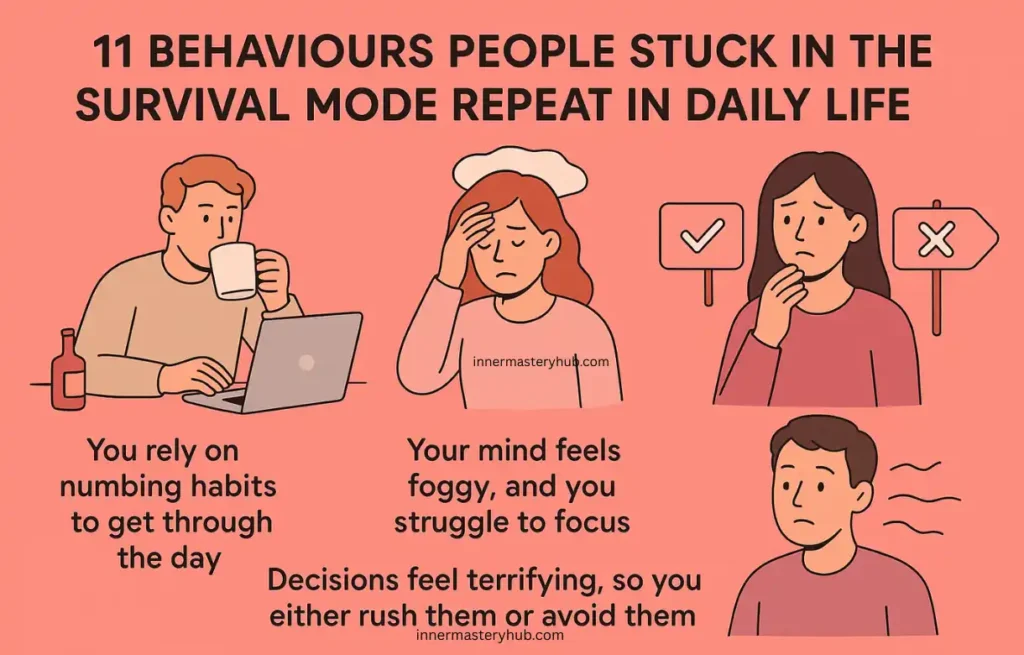
“Survival mode” is an informal term rather than a medical diagnosis. It is commonly used to describe patterns associated with prolonged stress, hypervigilance, emotional shutdown, and difficulty feeling safe or relaxed. These experiences can also occur in anxiety, trauma-related conditions, burnout, and other forms of chronic stress.
Survival Mode at a Glance
| Question | Quick Answer |
|---|---|
| What is survival mode? | An informal term for patterns linked with prolonged stress |
| Common signs | Hypervigilance, exhaustion, numbness, difficulty relaxing |
| Is it a diagnosis? | No |
| What can contribute? | Chronic stress, trauma, burnout, ongoing uncertainty |
| What may help? | Sleep, boundaries, grounding, support, gradual stress reduction |
| When to seek help | When symptoms persist or interfere with daily life |
What Does It Mean to Be Stuck in Survival Mode?
When you’re in survival mode all the time, it can feel like you’re just getting by rather than living each day to the fullest. Even when nothing essential is happening, you can wake up tense, anticipate issues, find it difficult to unwind, or feel emotionally shut down.
“Survival mode” is not a medical diagnosis; rather, it is an informal term. Patterns associated with prolonged stress, hypervigilance, emotional numbness, and trouble returning to a calmer baseline are frequently described by this term.
These encounters may include:
- feeling tense or vigilant all the time
- Having trouble sleeping
- Strongly responding to minor issues
- Feeling detached or emotionally numb
- Anticipating danger, rejection, or criticism
Long-term stress can change your perception of the world and your response time. What feels dangerous can also be influenced by past experiences, particularly if stress, uncertainty, or challenging relationships have persisted for a long time.
This does not imply that your personality has altered irreversibly. It can indicate that some stress reactions are now automatic or well-known.
Creating a pause between a stressful situation and your response can support emotional regulation. Over time, responses can become more intentional with techniques such as calming down, recognizing your emotions, grounding yourself in the moment, and assessing whether a situation is truly threatening.
Instead of thinking, “Something is wrong with me,” it could be more beneficial to inquire:
“What stress pattern is being triggered here, and what would enable me to react more clearly and safely?”
11 Signs You May Be Stuck in Survival Mode
1. You Constantly Scan for Possible Threats
Long-term stress can make you exceptionally aware of potential issues. Hypervigilance describes an unusually heightened state of alertness to possible threats.. Even when nothing visible is wrong, you may detect changes in tone, intently observe facial expressions, reread communications, or struggle to unwind.
Prolonged stress can affect brain and body systems involved in threat detection, attention, memory, and physiological stress responses, according to research on chronic stress1. Sleep, energy, immune system performance, and other areas of health can all be impacted by prolonged activation of stress mechanisms.
Redirecting focus to the here and now is a sensible solution. Stop, feel your feet on the ground, and list three neutral objects in your immediate environment. Grounding activities can help stop continuous threat monitoring and reduce immediate anxiety.
2. You Stay Busy Because Slowing Down Feels Uncomfortable
Even though you seem to be quite productive, constantly working, lending a hand, organizing, or finishing another task, you may experience restlessness or guilt when you stop. Continuous activity might become a comfortable coping mechanism for uncertainty or uncomfortable emotions during prolonged stress.
Numerous bodily systems are impacted by chronic stress, which is linked to issues with immunity, metabolism, sleep, cardiovascular health, and general physical health2.
Start with brief pauses rather than relaxing for extended periods. Stretch in between jobs, have a cup of tea without multitasking, or go for a quick walk without your phone. Slowing down can eventually feel more doable if you take short, deliberate breaks.
3. You Feel Emotionally Numb or Disconnected
Not everyone who is under a lot of stress feels nervous or activated all the time. Even though they continue to work and handle their daily obligations, some people report feeling flat, detached, emotionally numb, or removed from what is happening around them.
In trauma-related disorders like PTSD, emotional numbness is particularly well-documented and can coexist with hyperarousal, detachment, and trouble feeling happy feelings. However, numbness shouldn’t always be linked to “survival mode” because it can also result from depression, burnout, dissociation, and other types of psychological discomfort3.
Reconnecting with common sensory sensations, such as the warmth of a shower, the flavor of food, or the sounds around you, could be a gentle place to start. A professional evaluation could be beneficial if numbness is chronic or substantially interferes with day-to-day activities.
4. You Say “Yes” to Keep the Peace
People-pleasing may have become a common coping strategy if you frequently agree to things you don’t want to do, apologize when you haven’t done anything wrong, or worry about upsetting others.
This is frequently referred to as a “fawn” response in trauma-informed terminology; however, that is not an official diagnostic term. Some people find that making other people happy helps them cope with conflict, rejection, and uncertainty.
Ignoring your own needs regularly can eventually wear you out or make you resentful.
A practical next step is to use clear, low-conflict boundaries:
“I’d like to help, but I can only do X, not Y.”
or:
“I need some time to think about that before I answer.”
The goal is not to become confrontational. It is to practice expressing your limits more honestly.
5. You Procrastinate, Freeze, or Struggle to Start Tasks
People are not always more active when under prolonged stress. Even when you know a task is necessary, it can be challenging to start, organize, or complete it.
High levels of stress can impair cognitive flexibility, working memory, attention, and planning, making daily tasks more difficult to complete4. If beginning a project seems daunting, you can spend a lot of time staring at it, go mentally blank, or turn to your phone.
Divide the work into manageable chunks rather than criticizing yourself.
Rather than:
“Finish the entire project.”
try:
“Open the document and write one rough paragraph.”
or:
“Set a 10-minute timer and begin.”
Breaking tasks into smaller steps can reduce overwhelm and make it easier to get started.
6. Your Basic Needs Keep Falling to the Bottom of the List
Sleep, food, hydration, mobility, and medical needs may start to seem less important than everything else you have to deal with when stress becomes chronic.
You might ignore your thirst, skip meals, stay up too late, or ignore discomfort because you’re too busy to stop. Sleep issues, headaches, tense muscles, digestive disorders, changes in appetite, and other bodily impacts are linked to chronic stress.
Persistent or worsening physical symptoms should be evaluated by a healthcare provider because there are numerous other possible causes.
A practical starting point is to choose one basic need to protect consistently, such as:
- drinking water with meals
- eating regularly
- going to bed at a more consistent time
- taking a short walk each day
Small routines are often easier to maintain than trying to change everything at once.
7. Small Problems Trigger Strong Reactions
Even though you want to remain composed, a minor remark, a delay, or a conflict can suddenly seem much more significant than anticipated. The intensity of your reaction may leave you feeling confused later.
Your ability to cope with stress may seem diminished over extended periods. Because you are already under a lot of stress, small irritations could generate more intense emotional reactions.
Notice your early warning signs, such as:
- racing thoughts
- tight shoulders
- a clenched jaw
- shallow breathing
- an urge to react immediately
Slow breathing, grounding, or stepping away briefly may help reduce immediate distress and give you more time to respond thoughtfully.
8. Decisions Feel Overwhelming
Even routine decisions can feel abnormally high stakes when you are under constant stress. You can make snap decisions only to end the discomfort or to put off deciding out of fear of choosing a poor option.
Prolonged stress may impair working memory, cognitive flexibility, and decision-making, making it more difficult to weigh options, according to research5.
Instead of telling yourself:
“If I choose wrong, everything will fall apart.”
try:
“Most decisions can be adjusted later.”
You can also reduce decision fatigue by pre-deciding small routines, such as meals, exercise times, or simple daily priorities.
9. Your Mind Feels Foggy
Long-term stress can make learning, memory, and focus more difficult than usual. You might find it difficult to arrange your thoughts, forget appointments, reread the same paragraph, or lose track of conversations.
Chronic stress has been linked in studies to alterations in memory, attention, and other cognitive processes, although these problems do not imply a decline in intelligence6.
Try reducing unnecessary mental load:
- keep fewer tabs open
- silence non-essential notifications
- write down important tasks
- focus on a short list of priorities
- take breaks between demanding activities
Many medical and psychological illnesses can create similar symptoms, so if memory or concentration issues are severe, ongoing, or getting worse, think about talking to a healthcare provider.
10. You Rely on Numbing or Distraction Habits
Scrolling, binge-watching, overeating, drinking, gaming, shopping, and other behaviors may be your go-to short-term diversion or respite from stress.
Different people may use these behaviors for different reasons. They can occasionally offer a brief reprieve from feelings of unease, weariness, loneliness, or anxiety. The issue arises when they start causing more problems or become your primary coping mechanism.
Instead of attempting to break every habit right away, combine it with one better coping mechanism, like:
- taking a short walk
- stretching
- journaling
- listening to calming music
- calling someone supportive
- using slow breathing or grounding
If alcohol, substances, eating, gambling, or another behavior feels difficult to control, professional support may be appropriate.
11. You Withdraw From People Even When You Feel Lonely
Social interaction can feel draining if you’re under a lot of stress. Even though a part of you still desires connection, you might cancel plans, stop responding to messages, feel emotionally distant from people, or isolate yourself.
When you feel overburdened, humiliated, distrustful, or emotionally spent, withdrawal may offer some solace. Ongoing seclusion, however, can worsen loneliness and limit access to social support.
You don’t have to start interacting with people all of a sudden. Start with one or two folks who are easygoing and encouraging.
You might say:
“I’m okay, but I’ve been more tired than usual.”
or:
“I’m trying to look after myself better, so I may be slower to reply.”
Small, honest interactions can help you maintain connection without pushing yourself beyond what feels manageable.
Why Can People Feel Stuck in Survival Mode?
When stress, uncertainty, or emotionally taxing situations persist over an extended period, people may feel trapped in survival mode. Even when the immediate tension has lifted, the body and mind may become more alert to potential dangers over time, making it more difficult to unwind.
A common pattern looks like this:
Trigger → Interpretation → Emotion → Response
For example:
- A stressful event happens (trigger)
- Your brain interprets it as danger
- You feel fear, anxiety, or urgency
- Your body reacts (fight, flight, freeze)
When this pattern is repeated frequently, certain responses can become automatic.
Factors that may contribute include:
This is linked to:
- Chronic stress
- Childhood trauma
- Emotional neglect
- Burnout
- Ongoing uncertainty or conflict
Prolonged stress may affect brain areas involved in threat detection, attention, memory, and emotional regulation, according to research. It is more accurate to mention that long-term stress can affect how strongly a person reacts to perceived dangers and how quickly they return to a calmer state rather than simply asserting that stress “rewires the amygdala.”7
How Survival Mode Relates to Chronic Stress and Nervous System Regulation
Long-term stress can make it harder for the body to return to a state of calm. Even in situations without an immediate threat, you could be uptight, vigilant, or emotionally detached. Informally, these experiences are sometimes referred to as “survival mode.”
Systems related to threat detection, emotional control, attention, and the stress response can be impacted by prolonged stress. Anxiety, hypervigilance, trouble unwinding, impatience, or emotional numbness could emerge from this.
Although “fawn” is not a recognized diagnostic term, people occasionally refer to these protective tendencies as fight, flight, freeze, or fawn responses.
It is more accurate to consider survival mode as an informal description of patterns that can develop when chronic stress makes it difficult to feel calm, safe, and emotionally regulated, rather than as a personality trait or a medical diagnosis.
What does Survival Mode feel like emotionally?
Survival Mode feels like constant tension, emotional numbness, irritability, and an inability to relax fully. You may feel disconnected from joy, while your mind remains busy scanning for problems or threats.
Emotional Experience Breakdown
You might notice:
- You overthink simple decisions
- You feel restless even during calm moments
- You struggle to feel joy or presence
- You react quickly, then regret it
This is because your nervous system is prioritizing safety over happiness.
When Survival-Mode Patterns Start to Feel Like Part of Your Personality
You may grow so accustomed to long-term stress patterns that you start to characterize them as an aspect of your identity. You may consider:
- “I’m just a nervous person.”
- “I’m never able to unwind.”
- “I have to be busy all the time.”
However, recognizable patterns do not always indicate enduring personality qualities. They might represent routines, coping mechanisms, or stress-reduction techniques that evolved over time.

How to Start Recovering From Survival-Mode Patterns
Rather than pushing yourself to “think positively” or become more productive, recovering from long-term stress patterns typically starts with little, persistent improvements.
Some useful fundamentals are:
- getting regular sleep
- eating regular meals
- practicing slow breathing or grounding
- taking breaks from constant stimulation
- spending time with supportive people
- setting clearer boundaries, including gentle physical activity
Over time, these behaviors can help manage stress, although recovery is rarely instantaneous.
If you can identify multiple survival-mode patterns in yourself, start with one. It could include being overly busy all the time, saying yes when you really want to say no, isolating yourself from others, or using distraction to avoid unpleasant emotions.
Consider this:
- What appears to set off this behaviour?
- Does it provide me with any immediate relief?
- How much is it costing me now?
- What would be a better course of action?
Small, recurring modifications, rather than drastic overnight decisions, frequently lead to substantial improvements in my work. A person can start by relaxing guilt-free for 10 minutes, postponing an automatic “yes,” asking for help, or sensing stress before reacting.
During hard times, old patterns may reemerge. It doesn’t erase progress. We want to recognize patterns earlier and respond more flexibly.
See a mental-health or medical professional if persistent anxiety, emotional numbness, sleep issues, trauma symptoms, substance use, or trouble functioning are hurting everyday life. Professional aid can identify the cause of symptoms and suggest treatment or support.
A Real-Life Example of Survival Mode
Professional 34-year-old Anna rarely slowed down. Even after work, she was busy with housework, texts, planning, and checking what was next.
She considered herself “productive,” yet staying busy had become a means to cope with uncertainty and discomfort.
Anna learned to stay prepared and watchful from growing up in an unpredictable environment. Slowing down as an adult was uncomfortable, even when nothing critical was happening.
Anna’s experience shows how productivity, perfectionism, and the drive to be busy can mask long-term stress.
Common Mistakes When You Feel Stuck in Survival Mode
It’s a prevalent misconception that survival mode is solely a mental issue. Positive thinking or productivity techniques alone might not be sufficient, as prolonged stress can affect thoughts, emotions, behaviors, and bodily stress responses.
You might try:
- relying only on positive thinking
- pushing harder through exhaustion
- criticizing yourself for stress reactions
- expecting immediate recovery
- assuming every symptom is caused by “survival mode”
These approaches can help in some situations, but they may not address the full pattern when stress has become persistent.
A more useful question is not simply:
“How do I think more positively?”
“What is keeping me stressed, and what would help me feel more regulated, supported, and able to respond differently?”
Rest, adaptable thinking, emotional control, and long-term planning may be more difficult for someone who experiences persistent feelings of overwhelm or danger. Rather than only changing one’s perspective, recovery often requires both practical and psychological support.
How Is Emotional Regulation Connected to Survival Mode?
Instead of automatically responding to stress, practicing emotional regulation might help you respond more adaptively. It does not involve repressing feelings or making oneself feel at ease. It involves recognizing your emotions, identifying what might be causing the reaction, and choosing an appropriate response.
The Inner Process
A stressful moment may follow this pattern:
- Something happens.
- You interpret it through past experiences and current stress.
- Emotions such as fear, anger, shame, or urgency arise.
- Your body and behavior respond.
- Regulation skills can help you pause and reassess what is happening.
Identifying emotions, slowing your breathing, grounding yourself in the present, and checking whether the situation actually requires an urgent response may help reduce distress.
Research on emotion regulation reveals that emotion management affects stress, well-being, and psychological functioning. Instead of claiming that emotional regulation “teaches the brain that the environment is safe,” it helps people manage stress and analyze situations8.
When to Seek Professional Support
Consider professional help if stress-related symptoms persist, intensify, or interfere with daily life. This may include anxiety, emotional numbness, sleep issues, concentration issues, panic, substance use, trauma symptoms, or unexplained physical symptoms. Various causes of these encounters can be identified through careful assessment.
Key Takeaways
- Survival mode is not a diagnosis but an informal name.
- It describes extended stress, hypervigilance, weariness, numbness, and trouble relaxing.
- Chronic stress affects mood, sleep, focus, behavior, and health.
- Minimal, persistent routines can reduce stress.
- Seek expert care for severe, persistent, or disruptive symptoms.
People Also Ask About Survival Mode
What does it mean when people are stuck in Survival Mode?
People’s bodies and minds remain extremely vigilant when they are trapped in Survival Mode. You’re anxious, tense, and constantly on edge because you think something negative may happen. Instead of appreciating the day or making peaceful plans for the future, daily life becomes about getting by.
How do you know if you are one of the people stuck in Survival Mode?
You feel numb, nervous, or exhausted all the time. You overthink, struggle to relax, and react aggressively to tiny issues. You might be busy all the time, avoid decisions, or rely on numbing habits. If this feels like your regular existence, you could be trapped in Survival Mode.
Can people stuck in Survival Mode still function normally?
You may appear to be doing well on the outside: you work, take care of people, respond to communications, and carry on. You feel stiff, hollow, or exhausted on the inside. You are not thriving, but you are functioning. Instead of feeling creative, in the moment, and connected to what truly matters to you, you get by.
How can you calm your nervous system if you are stuck in Survival Mode?
Regular sleep, moderate movement, slow breathing, grounding, predictable routines, and supportive relationships can help regulate stress. Different approaches work for different people, and persistent symptoms may require professional support.
How long does it take to get out of Survival Mode?
There isn’t a set time. Your past and present stress levels, support network, and routines all play a role. While some people recover in a matter of weeks, others may need months or more. What matters is consistency: little everyday behaviors that convince your body, “I’m safe now.”
Can therapy help people stuck in Survival Mode?
You can explore stress, trauma, and old habits in an atmosphere of safety with therapy. A competent therapist teaches you healthy coping mechanisms, boundaries, and how to manage your nervous system. One of the best ways to transition out of Survival Mode is to feel safe.
Do people stuck in Survival Mode always feel anxious?
Not always. Some people feel anxious and wired. Others feel flat, numb, or disconnected, like they are on autopilot. Both are forms of being trapped in Survival Mode. Your body is either braced for action or shutting down to cope. Either way, you don’t feel fully present or relaxed in your own life.
What first step should you take if you realize you are stuck in Survival Mode?
Start by noticing your patterns without judging yourself. Pick one small area to support yourself better, like sleep, food, water, or a short daily walk. You can also talk to a trusted person or therapist. The first key step is admitting you deserve more than to survive.
Is Survival Mode the same as anxiety?
No. “Survival mode” is an informal description, while anxiety is a recognized psychological symptom and may also occur as part of an anxiety disorder. The experiences can overlap, but the terms are not clinically interchangeable.
Can Survival Mode affect physical health?
Prolonged stress is associated with sleep problems, fatigue, headaches, digestive symptoms, cardiovascular effects, and changes in immune functioning. These symptoms can also have many other causes.
How long does it take to get out of Survival Mode?
There is no fixed timeline. How long stress-related patterns last depends on their causes, duration, current circumstances, health, available support, and whether professional treatment is needed.
Is Survival Mode linked to trauma?
Trauma can contribute to hypervigilance, avoidance, emotional numbness, or difficulty relaxing, but it is not the only possible cause. Chronic stress, anxiety, burnout, ongoing adversity, and other health conditions can produce similar experiences.
Medically reviewed by Dr. Usama Qureshi, MBBS
Medical Doctor | Reviewed August 2026
Dr. Usama Qureshi, MBBS, is a medical doctor who reviews health-related content for Inner Mastery Hub to ensure medical accuracy. His review focuses on ensuring that medical terminology, health claims, and discussions of symptoms and treatment are appropriately represented and supported by reliable evidence.
- McEwen, B. S. (2007). Physiology and neurobiology of stress and adaptation: Central role of the brain. Physiological Reviews, 87(3), 873–904. https://doi.org/10.1152/physrev.00041.2006 ↩︎
- McEwen, B. S. (2008). Central effects of stress hormones in health and disease: Understanding the protective and damaging effects of stress and stress mediators. European Journal of Pharmacology, 583(2–3), 174–185. https://doi.org/10.1016/j.ejphar.2007.11.071 ↩︎
- Litz, B. T., & Gray, M. J. (2002). Emotional numbing in posttraumatic stress disorder: Current and future research directions. Australian and New Zealand Journal of Psychiatry, 36(2), 198–204. https://doi.org/10.1046/j.1440-1614.2002.01002.x ↩︎
- Plieger, T., & Reuter, M. (2020). Stress & executive functioning: A review considering moderating factors. Neurobiology of Learning and Memory, 173, 107254. https://doi.org/10.1016/j.nlm.2020.107254 ↩︎
- Pabst, S., et al. (2022). Effects of psychological stress and cortisol on decision making and modulating factors: A systematic review. European Journal of Neuroscience. https://doi.org/10.1111/ejn.15721 ↩︎
- Lupien, S. J., McEwen, B. S., Gunnar, M. R., & Heim, C. (2009). Effects of stress throughout the lifespan on the brain, behaviour and cognition. Nature Reviews Neuroscience, 10(6), 434–445. DOI: 10.1038/nrn2639. ↩︎
- American Psychological Association. (n.d.). Stress effects on the body. American Psychological Association. ↩︎
- Gross, J. J. (2013). Emotion regulation: Taking stock and moving forward. Emotion, 13(3), 359–365. https://doi.org/10.1037/a0032135 ↩︎
Written By Mehwish Qurayshi
Mehwish Qurayshi is a Trauma-Informed Emotional Wellness Counsellor trained through NICABM’s Treating Trauma Master Series, which includes NBCC-approved education in Trauma Treatment and Emotional Wellness & Emotional Intelligence – Sourcecode Academia. She has over five years of experience providing emotional wellness counselling, helping individuals heal from trauma, regulate emotions, and build healthy relationships.