
Introverted Women in Emotional Relationships: Needs, Patterns, and Attachment Style

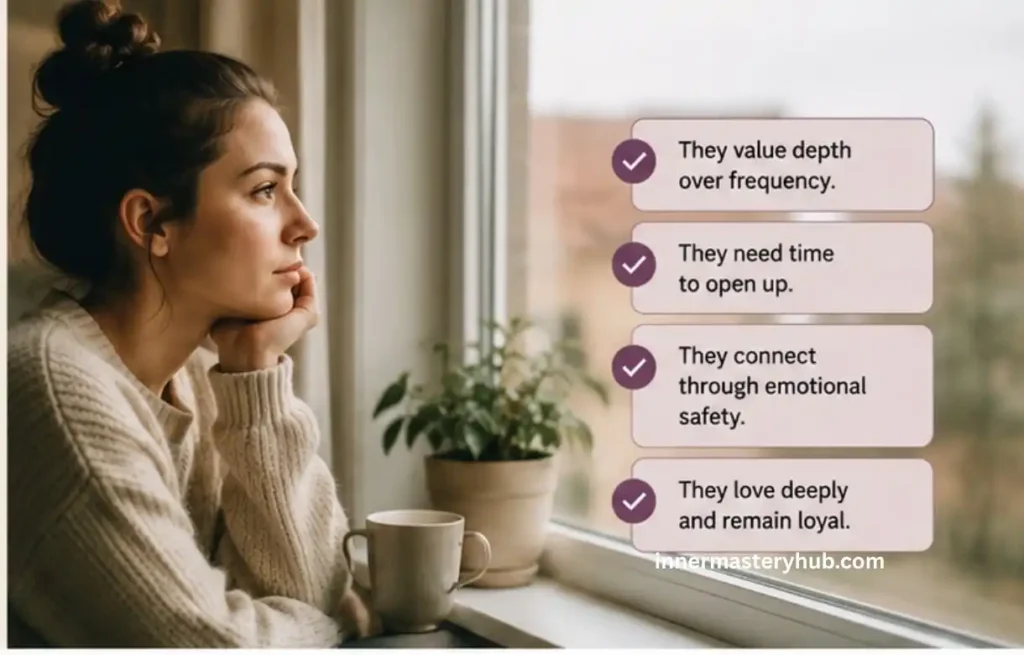
Introverted women in emotional relationships process feelings internally before expressing them, leading to behaviors like silence, reflection, and a need for space. These patterns are linked to temperament, emotional regulation, and attachment style rather than emotional disinterest. Emotional safety significantly influences how deeply they connect and express love.
Introverted Emotional Style vs Misinterpretation
| Behavior | Internal Reality | External Misinterpretation |
|---|---|---|
| Silence | Processing emotions | Disinterest |
| Distance after conflict | Self-regulation | Emotional withdrawal |
| Slow responses | Thoughtful processing | Lack of care |
| Need for space | Nervous system reset | Rejection |
| Low verbal expression | Internal emotional depth | Emotional detachment |
What does it mean when an introverted woman is in an emotional relationship?
Introverted women form deep emotional bonds, but they process them differently. Emotional relationships for introverted women are more internal, slow-building, and highly sensitive to emotional tone rather than external intensity.
In many cases, you may notice that:
- They think deeply before responding
- They need emotional space after intensity
- They value emotional depth over frequent interaction
But beneath this surface behavior, something more important is happening: their nervous system is constantly evaluating safety, meaning, and emotional predictability.
A common misunderstanding is that introverted women in emotional relationships are unavailable. In reality, many are emotionally rich but process their feelings internally before expressing them.
Why do introverted women in emotional relationships process differently?
Because their emotional processing system is more internal than external, healthy relationships for introverted women often require intentional space and independence, a dynamic also reflected in Solo Social Outdoor Activities for Introverts, where solitude is framed as a restorative necessity rather than avoidance.
Introverted women in emotional relationships move through this cycle:
Trigger → Internal reflection → Emotional meaning → Response decision → Controlled expression
While this happens, they may appear quiet or distant, but internally they are:
- analyzing emotional safety
- replaying conversations
- assessing trust signals
- regulating emotional intensity
Why this matters psychologically
Research on emotion regulation shows that people differ in how they regulate emotions; some express them externally, while others process them internally before responding1.
This is not suppression. It is a regulation.
Emotional needs of introverted women in relationships
In most cases, introverted women in emotional relationships need safety before emotional intensity.
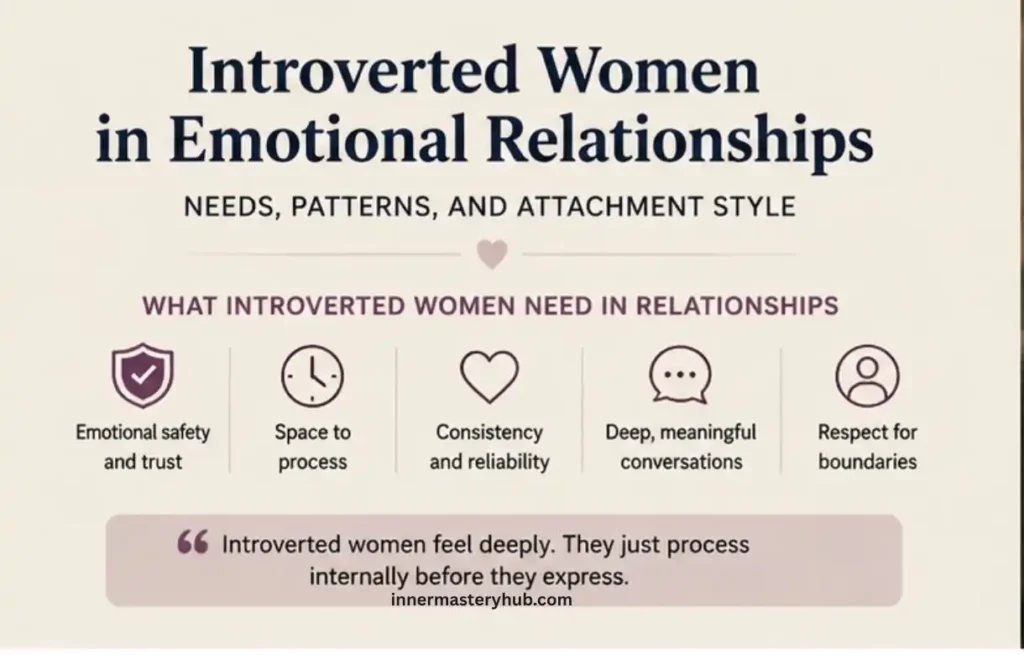
Their core needs include:
- Predictability in emotional behavior
- Space to process feelings internally
- Gentle communication (not emotional pressure)
- Deep one-on-one connection rather than group dynamics
- Respect for silence without interpretation
When these needs are met, emotional closeness increases naturally.
But when they are not, withdrawal can occur, not as rejection, but as self-regulation.
Attachment style of introverted women
Introverted women’s attachment style reflects how they behave in relationships.
Introversion itself is not an attachment style, but it often interacts with attachment patterns such as:
1. Secure attachment
- Comfortable with closeness and space
- Communicates needs calmly
- Balances independence and intimacy
2. Anxious attachment
- Overthinks emotional distance2
- Seeks reassurance more frequently
- May struggle with silence or ambiguity
3. Avoidant tendencies
- Needs emotional autonomy
- Withdraws under emotional pressure
- Values self-regulation over external reassurance
Attachment theory explains that early relational experiences shape how safe connection feels in adulthood. This is why two introverted women in emotional relationships can behave very differently in love3.
Common emotional patterns of introverted women in relationships
Based on relational psychology, common patterns include:
Emotional processing pattern
- Feel first internally
- Understand later cognitively
- Express last, sometimes indirectly
Conflict pattern
- Pause before responding
- Withdraw to regulate emotions
- Return after clarity forms
Connection pattern
- Prefer depth over frequency
- Feel overwhelmed by emotional intensity without space
- Bond strongly through emotional safety
These patterns are not dysfunctional. They are regulatory strategies.
Why is silence often misunderstood in introverted women?
Silence does not always mean emotional distance. There are recurring emotional patterns among introverted women in emotional relationships. Because emotional stability in relationships depends on personal time to recharge, introverted women rely on solitary activities that support emotional balance and self-regulation.
In many cases, silence is:
- processing time
- emotional regulation
- mental organization of thoughts
However, partners may interpret it as rejection, which creates relational tension.
This misunderstanding often activates a loop:
Partner anxiety → pressure for response → introverted withdrawal → increased misunderstanding
Over time, this cycle can strain emotional trust if not communicated clearly.
Emotional sensitivity and nervous system response
In most cases, introverted women are more sensitive to emotional stimulation.
This is not weakness; it is nervous system responsiveness.
When emotional intensity rises, their nervous system may shift into:
- withdrawal (to reduce stimulation)
- reflection (to process meaning)
- emotional pause (to regain balance)
Trauma-informed research shows that the nervous system prioritizes safety before connection. This means emotional closeness depends heavily on perceived emotional safety, not just compatibility4.
How introverted women experience love differently
Love is experienced internally before it is expressed externally.
Introverted women in emotional relationships often:
- feel deeply but slowly express it
- show love through presence rather than constant communication
- value emotional depth over verbal intensity
- prefer meaningful connection over frequent interaction
Love is not less; it is quieter, more internal, and more reflective.
Why emotional overwhelm happens in relationships
Emotional overwhelm is common when intensity exceeds processing capacity.
When emotional input is high, introverted women may experience:
- mental fatigue
- withdrawal urges
- reduced verbal expression
- need for solitude
This happens because emotional processing is happening internally, not externally.
The brain prioritizes:
Safety → Clarity → Expression
If safety feels disrupted, expression slows down.
What supports healthy emotional connection?
In relationships, introverted women express themselves in subtle, indirect ways, reflecting emotional reserve and depth in their communication.
In most cases, emotional safety improves connection more than emotional intensity.
Healthy relational conditions include:
- space without punishment
- calm communication during conflict
- respect for silence
- emotional consistency
- patience during processing time
When these conditions exist, introverted women become deeply emotionally engaged and loyal in relationships.
Key Takeaways
- Introverted women process emotions internally, not externally
- Silence often means regulation, not rejection
- Attachment style strongly influences relationship behavior
- Emotional safety is more important than emotional intensity
- Misinterpretation is the biggest source of conflict
- Love is often deep but internally expressed
- Nervous system regulation shapes emotional responses
- Space improves connection, not distance
Conclusion
Introverted women in emotional relationships are misunderstood because their emotional process is internal, slow, and highly reflective. What looks like distance is regulation. What looks like silence is often processing.
When emotional safety is present, these relationships tend to become deeply meaningful, stable, and emotionally rich. The real shift happens when behavior is no longer interpreted as rejection but understood as emotional processing.
People Also Ask
Do introverted women in emotional in relationships feel distant?
No. Introverted women are not emotionally distant; they often process emotions internally before expressing them. Their silence usually reflects reflection and regulation, not a lack of interest or emotional connection.
Why do introverted women need space in relationships?
They need space to regulate emotional stimulation and process thoughts internally. This helps them return to the relationship with clarity and emotional balance.
Do introverted women fall in love deeply?
Yes. Introverted women often experience deep emotional attachment, but it may be expressed quietly through consistency, presence, and internal reflection rather than frequent verbal expression.
How do introverted women show love?
They show love through emotional presence, loyalty, deep listening, and meaningful connection rather than constant communication or outward emotional intensity.
Can introverted women struggle with communication?
Yes, especially during emotional overwhelm. They may need time to process before responding, which can be misunderstood as avoidance.
Is introversion the same as social anxiety?
No. Introversion is a personality trait, while social anxiety is a fear-based emotional condition involving distress in social situations.
- Gross, J. J. (2015). Emotion regulation: Current status and prospects. Stanford University. ↩︎
- National Institute of Mental Health (NIMH). Attachment and anxiety-related research overviews. ↩︎
- Bowlby, J. (1988). A Secure Base: Parent-Child Attachment and Healthy Human Development. ↩︎
- Porges, S. W. (2011). The Polyvagal Theory: Neurophysiological Foundations of Emotions, Attachment, Communication, and Self-Regulation. Norton. ↩︎
Written By Mehwish Qurayshi
Mehwish Qurayshi is a Trauma-Informed Emotional Wellness Counsellor trained through NICABM’s Treating Trauma Master Series, which includes NBCC-approved education in Trauma Treatment and Emotional Wellness & Emotional Intelligence – Sourcecode Academia. She has over five years of experience providing emotional wellness counselling, helping individuals heal from trauma, regulate emotions, and build healthy relationships.