
Women Who Appear Strong on the Surface Show 11 Behaviors

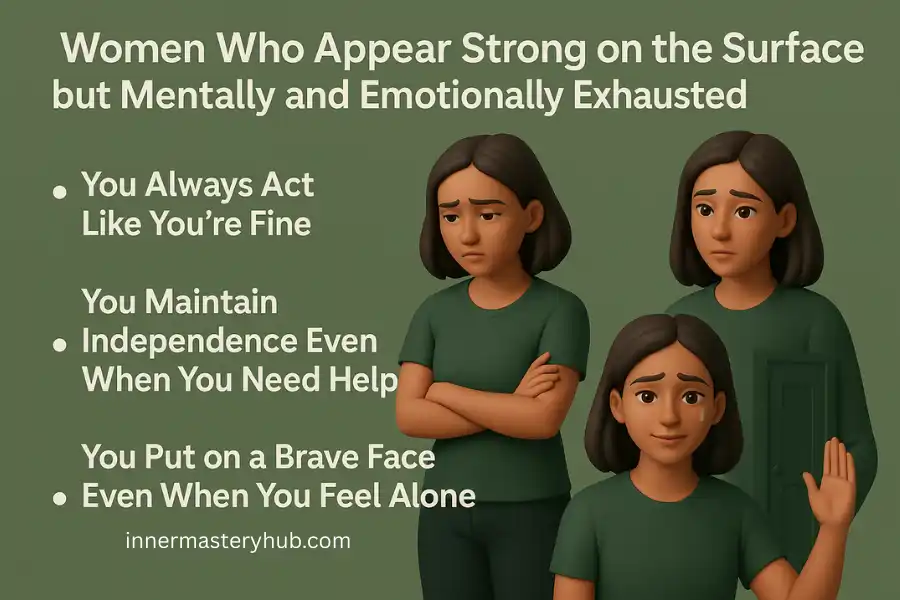
Women Who Appear Strong on the Surface often function well externally while hiding emotional exhaustion, anxiety, and burnout. This strength is usually a Survival response shaped by stress and emotional suppression, not true inner calm. Real healing begins when emotional awareness replaces constant over-functioning and silent endurance.
When you think of women who appear strong on the Surface, you might picture someone who carries herself with confidence, handles responsibilities without complaint, and rarely shows signs of inner struggle. But strength can sometimes be a carefully managed appearance rather than an internal state.
Over the years of observing human behavior, listening to clients, and reviewing research on stress, emotional labor, and burnout, it has become clear that many strong women live with an inner exhaustion they rarely talk about. When you have always been the reliable one, you learn to keep going even when your mind and emotions feel overwhelmed.
You may even hide how tired you are because you believe vulnerability will disappoint people who depend on you. This quiet burnout develops slowly until the gap between how you appear and how you actually feel widens enough to feel lonely.
Why do women who appear strong on the Surface hide their emotions?
Many strong women who appear strong on the Surface hide emotions, maintaining stability around them. They learn to stay composed to avoid burdening others. Over time, this becomes a habit that protects them emotionally, even though it often leads to inner exhaustion and loneliness.
What Does It Mean When Women Appear Strong on the Surface?
Women Who Appear Strong on the Surface are the ones who function well externally but experience internal emotional strain, stress suppression, or burnout. They manage responsibilities but may disconnect from their emotional needs to maintain control or stability.
This pattern is often linked with:
- Emotional masking (hiding true feelings)
- High-functioning anxiety
- Trauma-based coping strategies
- Over-responsibility in relationships or work
- Nervous system hyperactivation
Psychologically, this is not a personality type. It is a Survival pattern shaped by repeated emotional experiences.
Cause
- Childhood emotional invalidation
- Early responsibility or caregiving roles
- Cultural pressure to “stay strong.”
- Fear of being a burden
- Past relational trauma or betrayal
Effect
- Chronic fatigue despite functioning well
- Emotional numbness or detachment
- Anxiety that feels “normal.”
- Difficulty asking for help
- Sudden emotional breakdowns in private
Example
A woman may manage a demanding job, family needs, and social expectations without complaint. But at night, she feels drained, overstimulated, and emotionally disconnected from herself.
Why Do Women Appear Strong on the Surface but Feel Overwhelmed Inside?
This happens because the nervous system adapts to emotional pressure by prioritizing function over feeling. Over time, the body learns to suppress emotional signals to maintain stability and avoid conflict or rejection.
Trigger → Interpretation → Emotion → Consequence
A simple internal cycle often looks like this:
- Trigger: Someone needs help, or expectations increase
- Interpretation: “I have to handle this. No one else will.”
- Emotion: Anxiety, pressure, quiet resentment
- Consequence: Over-functioning and emotional suppression
This pattern becomes automatic. It is not a conscious choice.
What Psychology Research Suggests
Research from the American Psychological Association highlights that chronic stress can lead to emotional dysregulation and burnout when the stress response system stays activated for long periods1.
Harvard Medical School also explains that prolonged stress affects brain regions responsible for emotional regulation, including the amygdala and prefrontal cortex (Harvard Health2.
The Hidden Psychology Behind Emotional Strength
Emotional strength that appears effortless is often built on long-term emotional adaptation rather than genuine internal calm. It is frequently linked with Survival responses such as fawn behavior, hyper-independence, or emotional suppression.
Common Internal Patterns
1. Emotional Suppression
- Feelings are minimized or ignored
- “I will deal with it later” becomes the default
- Emotions get stored in the body
2. Hyper-Responsibility
- Feeling responsible for others’ emotions
- Difficulty saying no
- Over-functioning in relationships
3. Nervous System Overdrive
- Constant alertness
- Difficulty resting without guilt
- Feeling “on” all the time
Cause
These patterns often develop when emotional safety is inconsistent. The nervous system learns that control equals safety.
Effect
- Burnout disguised as productivity
- Loss of emotional identity
- Difficulty feeling joyfully
- Relationship imbalance
Example
A woman may always be the “strong one” in her family. But internally, she feels like she cannot stop or everything will collapse.
What Mistakes Do Women Who Appear Strong on the Surface Often Make?
The most common mistake is assuming that emotional suppression equals emotional mastery. In reality, avoiding emotions does not resolve them; it only delays emotional processing and increases internal stress.
Common Mistakes
- Ignoring early signs of burnout
- Believing asking for help is a weakness
- Normalizing exhaustion
- Over-identifying with being “the strong one.”
- Avoiding emotional vulnerability
Cause
Societal reinforcement often rewards silent endurance and penalizes emotional expression, especially for women.
Effect
- Delayed emotional breakdowns
- Increased anxiety or depressive symptoms
- Loss of self-connection
- Physical symptoms like headaches or fatigue
Example
A woman keeps managing everything until her body eventually forces rest through illness or emotional shutdown.
11 Reasons Women Who Appear Strong On the Surface May Actually Be Draining Underneath
1. You Always Act Like You’re Fine Even When You’re Not
Pretending everything is well is one of the most prevalent behaviors of women who appear strong on the Surface. You take this action because you’ve discovered that people value your strength over your suffering. This eventually becomes your reflexive reaction.
You start ignoring your emotions to be productive, even when you are mentally overburdened. You undoubtedly know this, but you continue because you don’t want to burden other people. You feel bad when you finally acknowledge that you’re worn out. The first step to true power is realizing your emotional truth, since this loop eventually becomes suffocating.
2. You Take Care of Everyone Before Yourself
You hardly ever prioritize your needs if you’re being honest. You take on the role of carer because it seems natural to you. Women frequently feel accountable for preserving harmony in their friendships, families, and workplaces. Although this duty is admirable, it becomes exhausting when it is done all the time. Even on days when you are at your lowest, you may still find yourself providing support.
When you do sit down at night, you don’t feel content; you feel relatively empty. Reclaiming your energy requires recognizing that taking care of yourself is not selfish but essential, particularly after years of serving as others’ emotional support system.
3. You Struggle to Say No, Even When Your Plate Is Full
It feels like a letdown to say no. Refusing a request feels wrong because you’ve built your identity around being trustworthy. Strong-looking women frequently say “yes” out of habit rather than desire. However, every “yes” depletes your energy until you feel fatigued.
Constant people-pleasing increases mental exhaustion because you’re constantly observing other people’s reactions. You’ve been pouring from an empty cup if you’ve experienced resentment without knowing why. Having boundaries strengthens the parts of yourself that require rest rather than weakening you.
4. You Keep Your Emotions Controlled to Avoid Breaking Down
Losing control is terrifying when you’re emotionally spent. You might suppress your tears to such an extent that you can’t remember the last time you actually shed a tear. You worry that you won’t get back together fast enough if you let yourself fall apart.
Women who depend on emotional self-control discovered early in life that their emotions upset other people, so they adjusted by maintaining their composure. The issue is that repressed feelings build up rather than go away. Emotional avoidance increases anxiety and burnout. Allowing yourself to feel is a much-needed release for your mind; it is not a sign of weakness.
5. You Give Advice You Don’t Follow Yourself
When things get tough, people turn to you because you’re the wise friend. Helping others comes naturally to you, so you provide guidance with clarity. However, you feel lost in your personal challenges.
Supporting others seems easier than helping yourself, which causes this disconnect. Even though you’re emotionally spent, you continue to lend a hand because it strengthens your position as the strong one.
If you’ve ever wondered why you keep advising that you can’t seem to put into practice, it’s because it’s much more challenging to rely on your own strength when you’re exhausted. You should be treated with the same kindness that you freely extend to others.
6. You Stay Busy to Avoid Confronting How You Feel
Busyness is a shield many strong-looking women use on the Surface. To avoid having to deal with the feelings you’ve avoided, you pack your schedule full of obligations, duties, and commitments. Avoidance behaviors: Being busy all the time can momentarily divert your attention from internal suffering, but over time, it can lead to emotional exhaustion.
Your mind is attempting to flee emotional overload if you experience anxiety during quiet times or find yourself reaching for a new task as soon as you complete one. Because it makes you slow down and confront what you’ve been hiding, rest, which ought to be consoling, becomes uncomfortable.
7. You Downplay Your Achievements and Struggles
You dislike being the center of attention. You downplay compliments you receive. You also minimize the pain that something causes you. This quiet shrinking stems from the conviction that you must remain unaffected, competent, and modest. This is how many emotionally spent women manage their expectations.
You run no risk of disappointing anyone if you remain self-sufficient. However, this habit eventually leads you to believe that your feelings and accomplishments are meaningless. Continually downplaying oneself lowers self-esteem and raises internal stress.
8. You Maintain Independence Even When You Need Help
Being independent feels like a part of who you are. Because it seems risky to rely on others, you solve problems on your own. You may have discovered at some point that seeking help led to disappointment.
Even when they are overwhelmed, women who appear strong on the Surface frequently say, “I’ve got it.” Sadly, emotional depletion gets worse with isolation. Social support lowers stress and improves mental health, but only if you let yourself receive it. Asking for support is a step towards healing, especially if you’ve spent years thinking you have to handle everything on your own. It doesn’t make you weak.
9. You Hold Yourself to Unrealistically High Standards
You cling to perfectionism because it gives you a sense of control, even though it is draining. You may feel pressure to excel in all spheres of your life, including your career, relationships, family, and personal goals. You become harsh on yourself when you fail.
Perfectionistic tendencies dramatically raise the risk of burnout, particularly for women who play multiple roles. Although you believe that having high standards makes you successful, they also keep you from being content. Giving yourself space to breathe, develop, and be human is what it means to let go of perfection, not to give up on your goals.
10. You Appear Calm but Feel Overwhelmed Internally
People say you’re reasonable, calm, and patient. They are blind to the continual chatter in your mind. You’re considering obligations, potential issues, people’s expectations, and the next course of action.
Chronic overthinking depletes mental energy in the same way that physical effort depletes the body due to cognitive load. Even if you put on a calm exterior to hide your inner turmoil, the imbalance will eventually catch up to you. Reducing the mental clutter you carry around daily is the key to true calm, not just looking composed.
11. You Put on a Brave Face Even When You Feel Alone
Silent loneliness is one of the most devastating traits of women who appear strong on the Surface. People may surround you, but because you don’t express who you really are, you may feel emotionally isolated. You may believe that expressing your emotions will alter how people perceive you or that they won’t understand you. You gradually become tired of this emotional seclusion.
Humans are wired for connection; it shows that meaningful emotional expression strengthens relationships and improves mental health. Instead of trying to handle everything on your own, you can find real support when you let yourself be vulnerable.
What Happens in the Nervous System?
The nervous system shifts into a chronic Survival state, often activating sympathetic (fight/flight) responses while suppressing parasympathetic rest responses, leading to emotional fatigue and physical exhaustion.
Polyvagal Theory Insight
According to polyvagal theory, the body responds to stress through different states of safety and threat regulation. Chronic stress can lock the system in Survival Mode.
Research from Stephen Porges’ work explains how prolonged threat perception disrupts emotional regulation and social engagement systems3.
Effect
- Difficulty relaxing
- Emotional numbness
- Overthinking
- Sleep disturbance
Why Strength Can Become Emotional Isolation
When strength is consistently used as a coping strategy, it can unintentionally create emotional isolation because others stop offering support, and the individual stops asking for it.
Cause
- Being praised for resilience
- Lack of emotional reciprocity
- Fear of vulnerability rejection
Effect
- Feeling unseen
- Emotional loneliness
- Internal pressure to stay composed
Example
People say, “You are so strong,” but no one asks, “Are you okay?” anymore.
What Real Emotional Strength Actually Looks Like
Real emotional strength is not constant control. It is the ability to feel emotions without being overwhelmed by them and to respond rather than suppress them.
Definition
Healthy emotional strength includes:
- Emotional awareness
- Nervous system regulation
- Boundaries
- Self-compassion
Cause of Healthy Shift
- Safe relationships
- Emotional validation
- Awareness of internal patterns
Effect
- Reduced anxiety
- More authentic relationships
- Stable emotional energy
Conclusion
Women who appear strong on the Surface struggle more than anyone realizes. If you recognize these behaviors in yourself, it doesn’t mean you are failing; it means you’ve been trying to survive in the only way you knew how.
You don’t lose your strength because you’re exhausted. However, true strength develops when you accept your emotional exhaustion, relax, and choose support over solitude. You start letting go of the burden you’ve been carrying for too long as soon as you allow yourself to feel, slow down, and be truthful.
Ultimately, the strongest women are those who learn to take care of themselves with the same commitment that they give to everyone else, rather than those who disguise their weakness. That is the real power of women who seem strong on the outside, and you should fully experience that strength for yourself as well as for other people.
FAQs
What are the signs that a strong woman is mentally exhausted?
She keeps busy to avoid thinking, rarely asks for help, downplays her struggles, feels overwhelmed inside, and stays calm outside. She may have trouble sleeping, feel emotionally detached, or experience burnout. These subtle signs show she needs rest and emotional support.
How can you support a woman who appears strong but is struggling?
Offer consistent emotional presence, listen without judgment, and gently remind her she doesn’t need to carry everything alone. Encourage rest, small boundaries, and honest conversations. Even simple reassurance can help her feel safe enough to open up when she’s ready.
What causes women to push themselves beyond their emotional limits?
Cultural expectations, perfectionism, childhood conditioning, caregiving roles, and fear of disappointing others all contribute. Many women who appear strong on the Surface grow up believing they must be reliable at all times. This pressure keeps them overextending themselves long after they’re emotionally drained.
Can a woman be strong and still emotionally exhausted?
Yes. Strength and exhaustion can exist together. A woman may appear confident and capable while silently managing stress, anxiety, or emotional overload. Hidden strength often comes from years of coping, not from a lack of difficulties. Many strong women carry unspoken burdens.
Why do strong women struggle with saying no?
They want to avoid conflict, maintain harmony, and support the people they care about. Saying no feels like letting others down. Over time, this creates emotional burnout because they take on more than they can realistically handle, at the expense of their own well-being.
What happens when a woman who appears strong reaches emotional burnout?
She may feel numb, irritable, withdrawn, or overwhelmed. Tasks she once managed easily become harder. She might lose motivation or struggle with concentration. Emotional burnout can also affect relationships and physical health, making rest and support crucial for recovery.
How can emotionally drained women begin to heal?
Healing begins with acknowledging exhaustion, allowing emotions to surface, practicing small boundaries and taking breaks, asking for support, journaling, and reducing unrealistic expectations. Over time, these steps rebuild emotional energy and restore balance, making strength feel natural again rather than forced.
Why do strong women fear vulnerability?
Vulnerability feels unsafe when you’re used to being the dependable one. Many fear judgment, rejection, or losing control. They worry their struggles will change how others see them. Learning that vulnerability builds deeper connections can help them feel more supported and understood.
Why do Women Who Appear Strong on the Surface hide their emotions?
Women Who Appear Strong on the Surface often hide emotions because they fear being a burden, dislike appearing weak, or have learned to rely on themselves. They stay composed to protect their peace, maintain control, and avoid judgment. Strength becomes their shield, even when they quietly struggle inside.
What signs show that Women Who Appear Strong on the Surface are actually struggling?
Women Who Appear Strong on the Surface may isolate themselves, overwork, avoid asking for help, or joke about stress. They stay busy to distract from pain. Even when exhausted, they still show up for others. Their silence, forced calmness, and subtle emotional distance are often hidden signals of struggle.
Why do Women Who Appear Strong on the Surface avoid asking for help?
Women Who Appear Strong on the Surface avoid asking for help because they’re used to being the responsible one. They fear disappointing others, losing independence, or being misunderstood. They believe handling everything alone proves strength. Asking for help feels vulnerable, even though they often need support more than people assume.
How can you support Women Who Appear Strong on the Surface?
Support Women Who Appear Strong on the Surface by simply checking in, listening without judgment, offering help without waiting to be asked, and reminding them they’re allowed to rest. Encourage honesty, validate their feelings, and give them a safe space to express vulnerability. Small acts of care make a big difference.
- American Psychological Association. (n.d.). Stress effects on the body. https://www.apa.org/topics/stress ↩︎
- Harvard Health Publishing. (n.d.). Understanding the stress response. Harvard Medical School. https://www.health.harvard.edu/staying-healthy/understanding-the-stress-response ↩︎
- Porges, S. W. (n.d.). Polyvagal theory. In ScienceDirect Topics. Elsevier. https://www.sciencedirect.com/topics/neuroscience/polyvagal-theory ↩︎
Written By Mehwish Qurayshi
Mehwish Qurayshi is a Trauma-Informed Emotional Wellness Counsellor trained through NICABM’s Treating Trauma Master Series, which includes NBCC-approved education in Trauma Treatment and Emotional Wellness & Emotional Intelligence – Sourcecode Academia. She has over five years of experience providing emotional wellness counselling, helping individuals heal from trauma, regulate emotions, and build healthy relationships.