
How to Overcome a Sheltered Upbringing and Build Confidence as an Adult


overcome a sheltered upbringing by gradually exposing yourself to new experiences, making independent decisions, and learning to tolerate uncertainty. Building emotional resilience takes time, but small challenges can increase confidence, adaptability, and self-trust, helping you navigate adulthood with greater ease.
Healthy Protection vs. Sheltered Upbringing
| Sheltered Childhood | Healthy Independence |
|---|---|
| Fear of mistakes | Learns from mistakes |
| Needs reassurance | Trusts own judgement |
| Avoids uncertainty | Tolerates uncertainty |
| Depends on parents | Makes own decisions |
While many people view a sheltered upbringing as a benefit, others may find it difficult to deal with the difficulties of the real world. It makes sense if you feel unprepared to handle life’s challenges if you were raised in a limiting atmosphere with little exposure to different events.
According to developmental psychology research, experience, independence, and repeated exposure to difficulties are the building blocks of resilience and confidence1. By gradually stepping outside of their comfort zones, developing useful life skills, increasing emotional intelligence, developing positive connections, and learning to accept uncertainty, people can overcome the negative impacts of a sheltered upbringing. Although growth is usually gradual, significant change is possible at any age.
Quick Summary
- A sheltered upbringing limits one’s freedom.
- Repeated experience builds confidence.
- Small setbacks develop resilience.
- Therapy will speed up the healing process.
- Growth is possible at any age.
What Does It Mean By a Sheltered Upbringing?
In summary, a sheltered childhood means being shielded from the experiences, difficulties, obligations, or opinions that many peers face throughout their development. This can occur in loving families as well as controlling environments.
Common characteristics include:
- Insufficient social interaction
- Limited autonomy
- Limited chances to take chances
- Strong parental supervision
- Defense against disappointment or failure
- Insufficient exposure to different perspectives
- Strict observation of friendships or activities
There is nothing intrinsically dangerous about shelter. Overly protective parenting provide for their children out of true love and care. While over protection limits the development of critical life skills, issues arise.
What Are the Signs That a Sheltered Upbringing Is Affecting You?
Yes, many adults recognize the effects of a sheltered upbringing long after childhood.
Common signs include:
Social Challenges
- Difficulty initiating conversations
- Fear of judgment
- Social anxiety
- Feeling behind peers socially
- Trouble reading social dynamics
Emotional Challenges
- Fear of making mistakes
- Low tolerance for uncertainty
- Excessive self-doubt
- Perfectionism
- Fear of failure
Practical Life Challenges
- Difficulty making decisions
- Limited problem-solving confidence
- Financial inexperience
- Hesitation when facing new situations
- Dependence on others for reassurance
Relationship Challenges
- Difficulty setting boundaries
- Fear of conflict
- Strong need for approval
- Challenges with emotional attachment
- Difficulty trusting personal judgment
Not everyone experiences all of these signs. The impact varies based on family dynamics, temperament, culture, and life experiences.
Why Does a Sheltered Upbringing Affect Confidence?
Experience is what builds confidence. According to psychologist Albert Bandura’s theory of self-efficacy, people gain confidence by overcoming obstacles2. Children may lose out on learning opportunities if they are consistently shielded from difficulties:
- I can solve problems.
- I can recover from mistakes.
- I can handle uncertainty.
- I can adapt when things go wrong.
Adulthood can seem overwhelming without these experiences since everyday challenges can appear hazardous. It is through enduring discomfort that one develops confidence, not by avoiding it.
Can a Sheltered Upbringing Affect Emotional Intelligence?
Yes, in some cases it can.
Emotional intelligence involves:
- Self-awareness
- Emotional regulation
- Empathy
- Social awareness
- Relationship management
People may not have as many opportunities to practice these abilities when they are not exposed to a variety of social circumstances, but emotional intelligence is still quite trainable throughout life. Research shows that emotional intelligence can be increased by:
- Reflection
- Therapy
- Coaching
- Mindfulness practices
- Social experience
- Intentional relationship-building
What Psychological Effects Can Result From Overly Protective Parenting?
Overprotection typically makes anxiety worse rather than better.
Researchers have discovered connections between overly protective parenting and:
- Increased anxiety3
- Lower self-confidence
- Reduced resilience
- Greater dependency
- Avoidance behaviors
- Fear of uncertainty
This happens because the nervous system never learns an important lesson: challenges can be both uncomfortable and manageable. Resilience increases when people encounter minor obstacles regularly.
How Do You Start Overcoming a Sheltered Upbringing?
Expand your comfort zone gradually.
Step 1: Identify Limiting Beliefs
Common beliefs include:
- I can’t handle difficult situations.
- I’ll embarrass myself.
- Other people know more than I do.
- Making mistakes is dangerous.
Ask yourself:
- Is this belief based on evidence?
- Who taught me this belief?
- What experiences challenge this belief?
Step 2: Build Independence Through Small Decisions
Practice making decisions without seeking reassurance.
Examples:
- Choosing a restaurant
- Planning a weekend activity
- Managing a personal budget
- Taking a class independently
Small decisions create psychological momentum.
Step 3: Learn Practical Life Skills
Confidence follows competence. Focus on skills such as:
- Financial literacy
- Time management
- Communication
- Conflict resolution
- Career development
- Problem-solving
Each skill reduces dependence on others.
How Can You Become More Socially Confident?
Yes, social confidence can be learned. Most socially confident people were not born confident. They gained experience through repeated interactions.
1. Start Small
Try:
- Greeting strangers
- Making brief conversation
- Asking questions
- Participating in group activities
2. Be Curious
Instead of asking:
“What do they think of me?”
Ask:
“What can I learn about this person?”
Curiosity reduces social anxiety.
3. Accept Awkward Moments
Social mistakes are normal.
People generally remember their own mistakes far more than yours.
How Do You Develop Independence as an Adult?
Practice responsibility before you feel fully ready. Waiting to feel confident often delays growth.
Instead:
- Take ownership of decisions.
- Solve small problems independently.
- Accept reasonable risks.
- Learn from outcomes.
- Repeat consistently.
Independence develops through action, not preparation alone.
Can Therapy Help You Overcome a Sheltered Upbringing?
Yes, therapy can be extremely helpful. A qualified therapist can help identify:
- Fear-based thinking patterns
- Anxiety responses
- Relationship difficulties
- Emotional regulation challenges
- Attachment concerns
Evidence-based approaches may include:
- Cognitive Behavioral Therapy (CBT)
- Acceptance and Commitment Therapy (ACT)
- Exposure-based interventions
- Emotion-focused therapy
- Attachment-focused approaches
Therapy provides a safe environment to practice new ways of thinking and relating.
How Does a Sheltered Upbringing Affect Relationships?
In some cases, it can influence relationship patterns. Common challenges include:
- Fear of abandonment
- Difficulty establishing boundaries
- Excessive people-pleasing
- Emotional dependency
- Conflict avoidance
These patterns stem from limited opportunities to develop autonomy and interpersonal confidence.
Healthy relationships require:
- Emotional regulation
- Self-awareness
- Mutual respect
- Independent identity
- open communication
These skills can be developed over time.
The Struggles of a Sheltered Upbringing
Intellectual, social, and emotional limits result from a sheltered childhood. Let’s say your childhood was filled with rigid restrictions, overly protective parents, and little exposure to the outside world. If so, you might feel uncertain in new circumstances. Critical thinking, decision-making abilities, and social confidence are often challenging for sheltered people to gain.
For example, a Journal of Adolescence study shows that young adults who experience over protective parenting may become less independent and have worse self-esteem. You might find it difficult to take chances or trust your judgment while making decisions in these circumstances.
If you’ve grown up in a sheltered environment, you might find that:
You can be nervous in new social situations or lack the courage to strike up informal chats.
Making decisions is difficult. When important choices need to be made, a lack of experience making independent decisions may cause you to doubt your abilities.
Resistance to risk is widespread. You may be reluctant to venture outside of your comfort zone due to a fear of failing and making mistakes.
Narrow perspective. You could find it difficult to understand alternative viewpoints if you are not exposed to a variety of cultures, concepts, and experiences.
These restrictions could hinder your professional, personal, and interpersonal development, making you feel stuck or even cut off from other people. The good news is that it is very possible to overcome the disadvantages of a sheltered upbringing with deliberate effort.
How a Sheltered Upbringing Holds You Back
Living in a sheltered and constrained environment can have several negative effects. The cycle of feeling unprepared for life’s challenges might persist if deliberate measures are not taken to break it.
Because you haven’t had much exposure to the wider world, you could find it difficult to connect with people outside of your immediate circle. Even when people are around you, a lack of social engagement might make you feel isolated or disengaged. Feelings of loneliness or inadequacy may result from this, particularly in circumstances that call for a certain amount of social skill.
A sheltered childhood can also hinder your personal growth. You may not know how to deal with the real-life consequences of your actions if you have not been allowed to explore your potential, fail, and learn from those mistakes. Uncertain about the morality of your decisions, you could continuously look to other people for approval.
Over time, the stress of not knowing how to handle adult responsibilities or understand life’s complexities can also intensify. As an adult, you may begin to observe that others are making more progress than you in areas such as relationships, profession, and personal development. This discrepancy can heighten anxiety and dissatisfaction.
It can get harder to take on new tasks and experiences the longer you stay in this condition of limitation. But the secret to going forward is to acknowledge this as the first step.
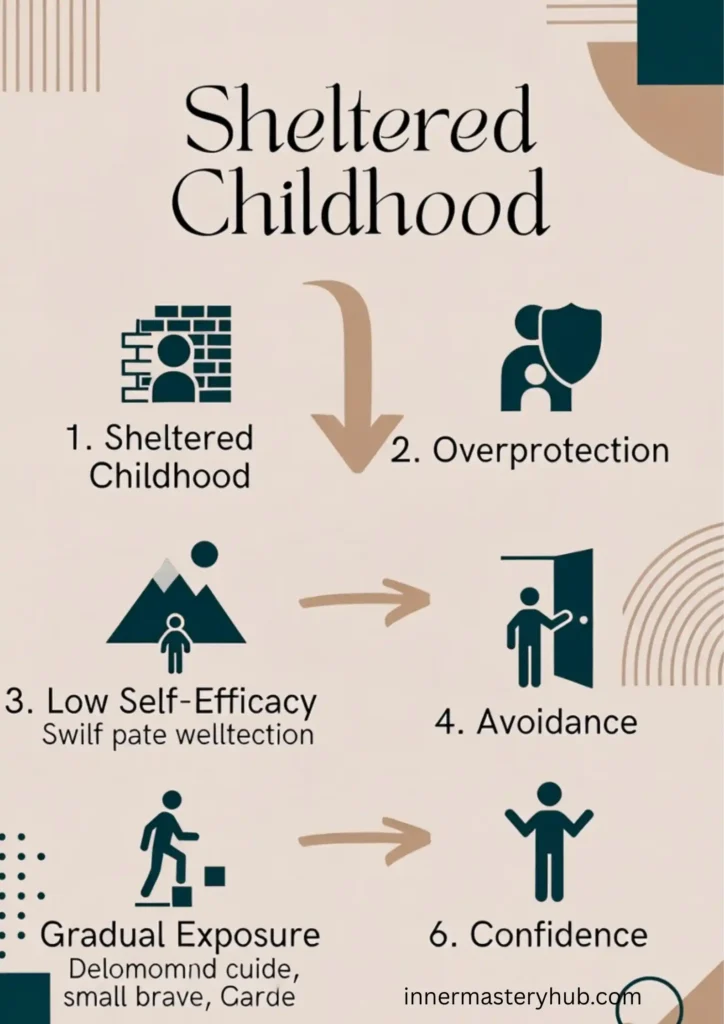
How to Overcome a Sheltered Upbringing
Although it can seem daunting, overcoming a sheltered childhood is a process that calls for perseverance, mental adjustments, and an openness to learning. Allow me to walk you through doable strategies to broaden your outlook on life, boost your self-esteem, and move through the world with a sense of empowerment.
1. Challenge Your Comfort Zone
To overcome a sheltered upbringing, you must first push yourself beyond your comfort zone. This involves intentionally seeking out unfamiliar experiences, even if they are first unsettling. You can gradually broaden your horizons by taking small steps like taking up a new pastime, visiting a new location, or interacting with people with diverse backgrounds.
For instance, start by going to social gatherings with a friend if you’re nervous about meeting new people or speaking in front of an audience. You’ll notice that these interactions get easier and more organic with time. Experiencing new social situations might boost your confidence and social skills, according to research4.
2. Develop Emotional Independence
If you grew up in a sheltered environment, you probably relied a lot on other people for decision-making and emotional support, such as family or close friends. Developing emotional independence, the capacity to make choices and handle difficulties without continuously looking for approval or direction, is necessary to overcome this.
Make tiny decisions on your own first. Plan a day trip without consulting others, for example, or decide what to buy based on your personal preferences rather than recommendations from others. You will become more self-assured in your capacity to manage life’s obstacles on your own by strengthening your decision-making muscles.
3. Expose Yourself to Different Perspectives
One of the biggest drawbacks of a sheltered childhood is a restricted outlook. You have to open yourself up to different opinions and experiences to do this. This doesn’t imply you have to travel worldwide (though it can definitely help). But it does require reading books, watching documentaries, or doing activities that expand your understanding of different cultures, societal issues, es and worldviews.
Spend time reading works from authors who come from different walks of life. For example, by reading memoirs or novels written by people from different cultural backgrounds, you can learn about experiences that you may never have thought of. Exposure to different points of view helps you develop empathy and a more complex knowledge of the world around you.
4. Risk-Taking in Safe Environments
Taking chances is not diving into the deep end without preparedness. Start by taking small, planned risks. For example, if you are frightened of public speaking, give a short presentation to a group of friends or coworkers you trust. As you get more confident, slowly increase the difficulty of the situations you take chances in.
This can help you to build resilience and decrease fear. With time, you get more comfortable with failure as part of the natural learning process. Engaging in risk-taking activities can help build resilience and increase self-esteem3, according to the American Psychological Association5.
5. Build a Supportive Network
You don’t have to do it all alone to get out of a sheltered childhood. You want to be among people who make you grow and try new things. These can be mentors, friends, ds or people in the community who understand what you are trying to achieve and can give you positive feedback.
Think about becoming a member of groups or clubs that match your interests or principles. Interacting with people who have had different life experiences than you is a way to learn new things and make relationships that help you grow. When facing new challenges, a network of like-minded people can provide the encouragement you need.
6. Learn From Failure and Setbacks
To get past a sheltered upbringing means to avoid failure at any cost. It could cause you to be too cautious and hesitant when opportunities come along. Therefore, you have to adjust your relationship with failure to effectively counteract the impacts of a sheltered childhood. Understand that failures and errors are part of the learning and growing process.
In your everyday life, work on changing how you view failure. Please don’t see it as a setback, but rather as a chance to learn some great lessons. Whether it’s a failed project at work or a complicated social connection, think about what went wrong and what you may do differently next time.
7. Invest in Continuous Learning
It takes a lifetime to undo the damage from a sheltered childhood, and education is the way to broaden your horizons and your skills. Whether it’s formal schooling, online courses, or self-guided research, make a habit of learning new things regularly
For example, enrolling in classes in areas that are new for you can help you develop new skills and feel more prepared to meet new difficulties. Spending just a few minutes a day learning something new can slowly boost your confidence and help you break away from the restrictions of a sheltered upbringing.
What Are Common Mistakes People Make When Trying to Change?
Trying to change too much too quickly.
Common mistakes include:
1. Expecting Instant Transformation
Growth is usually gradual.
2. Avoiding All Discomfort
Discomfort is often a sign of learning.
3. Comparing Yourself to Others
You are comparing your beginning to someone else’s years of experience.
4. Replacing Dependence With Isolation
Healthy independence still includes support and connection.
5. Seeking Perfection
Progress matters more than perfection.
What Are Practical Daily Habits That Build Confidence?
Small daily actions create lasting change.
Try:
Daily Exposure Challenge
Do one mildly uncomfortable thing each day.
Examples:
- Speak up in a meeting
- Ask a question
- Visit a new place
- Try a new activity
Reflection Journal
Record:
- What challenged me today?
- What did I learn?
- What did I handle better than expected?
Decision Practice
Make one decision daily without seeking reassurance.
Expand Your Environment
Explore:
- New communities
- Classes
- Volunteer opportunities
- Professional networks
Novel experiences accelerate growth.
What Does Successful Growth Look Like?
The short answer is not becoming fearless. Successful growth looks like:
- Acting despite uncertainty
- Recovering from setbacks
- Trusting your judgment
- Building healthy relationships
- Managing emotions effectively
- Trying new experiences
- Making independent choices
The point is not perfection but adaptability.
Real-World Example
Consider a young adult raised in a highly protective environment who avoided social situations and relied heavily on family for decision-making.
Instead of attempting dramatic changes, they:
- Joined a community group
- Learned budgeting skills
- Started making independent purchases
- Practiced initiating conversations
- Worked with a therapist on anxiety
Over time, confidence increased because experience replaced uncertainty. The transformation came from repeated action, not a sudden breakthrough.
Key Takeaways
- A sheltered upbringing might impact confidence, independence, and social development.
- In most instances, these effects are explainable and reversible.
- Protection does not build confidence; experience does.
- Emotional intelligence can be learned during maturity.
- Small difficulties generate more resilience than avoiding discomfort.
- You learn independence by practicing it and being responsible.
- Social confidence is a talent you can master.
- Therapy can help with anxiety, attachment issues, and limiting beliefs.
- In general, progress is incremental rather than dramatic.
- Growth starts when you believe in yourself enough to try.
Overcoming a sheltered upbringing
Getting past a sheltered upbringing does not mean criticizing your parents or rejecting your history. It’s about identifying where abilities were underdeveloped and deliberately developing them now.
Many people who were raised in very safe situations become very tough once they begin to expand their comfort zones. They find that you can survive mistakes, you can deal with uncertainty, and confidence comes with action.
Your upbringing may have set your beginnings, but it does not dictate your destination. With self-awareness, practice, positive relationships, and a willingness to tackle manageable problems, you can build the independence, emotional resilience, and confidence you need to succeed.
People Also Ask
What is a sheltered upbringing?
Sheltered Upbringing:g A sheltered upbringing is an environment for a child that is protected and isolated so that the youngster is not exposed to a lot of different experiences and struggles.
How do you overcome a sheltered upbringing in adulthood?
Children who have had a sheltered upbringing may have difficulty being independent, making decisions,ns and socializing because they have not been exposed to many real-life circumstances as children.
Can therapy help overcome the effects of a sheltered upbringing?
Yes, therapy can help a person to learn about the effects of a sheltered upbringing and create ways of coping, building confidence and independence.
What are the everyday struggles of a sheltered upbringing?
Signs are problems with decision-making, fear of failure, poor social skills, and lack of expertise in tackling everyday problems.
How can one build social skills after a sheltered childhood?
Participating in social activities, practicing communication, and receiving feedback can all aid in the development and improvement of social skills.
Is it possible to become independent after a sheltered upbringing?
Definitely. People can learn independence by being purposeful, goal-setting, and gradually taking on more responsibility.
What role does exposure to new experiences play?
New experiences broaden your horizons, improve your capacity to face challenges, and help you adjust to varied situations, contributing to your personal growth.
Can reading books help overcome the effects of a sheltered upbringing?
Yes, reading different kinds of stuff might give you some good ideas, broaden your perspective, and teach you some useful techniques for self-improvement.
How vital is self-reflection in this journey?
It’s so important to be able to self-reflect, to understand your past, to see patterns, and to try and change.
Are there support groups for individuals to overcome a sheltered upbringing?
Yes, support groups provide a community where people may share experiences, support one another and learn from each other.
- American Psychological Association (APA). Parenting, resilience, and child development research. ↩︎
- Bandura, A. (1977). Self-efficacy: Toward a Unifying Theory of Behavioral Change. ↩︎
- Ginsburg, G. S., et al. (2009). The relation between parenting and childhood anxiety. ↩︎
- Rose-Krasnor, L. (1997). The nature of social competence: A theoretical review. Social Development, 6(1), 111–135. https://doi.org/10.1111/j.1467-9507.1997.tb00097.x ↩︎
- American Psychological Association. (n.d.). Building your resilience. https://www.apa.org/topics/resilience/building-your-resilience ↩︎
Written By Mehwish Qurayshi
Mehwish Qurayshi is a Trauma-Informed Emotional Wellness Counsellor trained through NICABM’s Treating Trauma Master Series, which includes NBCC-approved education in Trauma Treatment and Emotional Wellness & Emotional Intelligence – Sourcecode Academia. She has over five years of experience providing emotional wellness counselling, helping individuals heal from trauma, regulate emotions, and build healthy relationships.