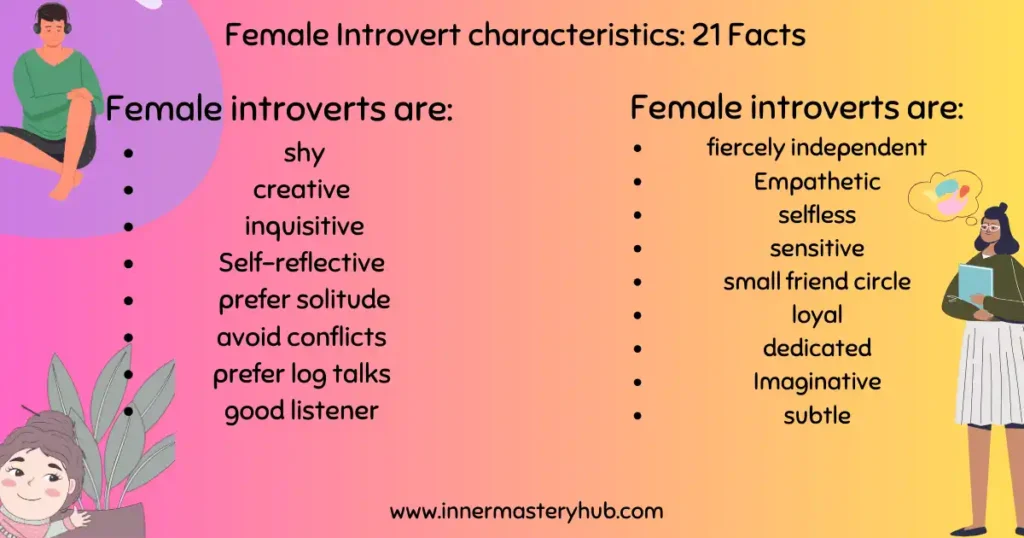
Female Introvert Characteristics: 21 Emotional Patterns Behind Quiet Personalities

21 Incredible Facts Of Understanding The Female Introvert Characteristics

Female introvert characteristics include deep emotional processing, sensitivity to overstimulation, internal reflection, emotional intelligence, and a strong need for meaningful connection and nervous system recovery rather than constant social stimulation.

What are Female Introvert Characteristics?

An introverted woman finds emotional balance and mental clarity in quieter environments and internal reflection rather than constant external stimulation.

The way introverted women regulate social interaction, emotions, and energy internally rather than externally is reflected in their personality traits. These characteristics include a desire for seclusion to rejuvenate, an inclination toward meaningful conversation, strong emotional regulation, and introspection.

Shyness or weakness is not a characteristic of introversion. Rather, it is a natural personality trait that prioritizes internal experiences over external stimuli.

Research suggests that introverts have greater sensitivity to dopamine stimulation, which can make busy social environments feel overwhelming more quickly1.

Because of this, introverted women often:

  • Need alone time after socializing
  • Think before speaking
  • Feel emotionally exhausted in chaotic environments
  • Prefer deeper emotional connections
  • Notice emotional details others miss

Example

A female introvert may enjoy spending time with friends but still feel mentally drained afterward. This is not a dislike. It is nervous system overload.

Carl Jung, a psychologist who first proposed the idea of introversion, clarified:

“Introversion is normally characterized by a hesitant, reflective, retiring nature.”

But while society celebrates loud confidence, the female introvert experiences the world in a quieter, deeper way.

Signs of an introverted woman

An introverted woman finds life and calm in solitude. Quiet, reflective moments are more appealing to her than hectic, noisy ones. She cherishes genuine relationships, which is why she may appear reserved to others. To rest and reflect, she would rather be by herself.

It isn’t that she dislikes people; it’s that she feels overstimulated by the outer world. If you observe her retreating, know that she merely wants a moment to let go and find inner tranquility.

Introversion is a temperament characterized by:

  • Preference for low-stimulation environments
  • Energy gained from solitude
  • Reflective thinking before action
  • Deep emotional processing

A foundational study by Hans Eysenck suggests that introverts have higher baseline cortical arousal, meaning their brains respond more intensely to stimulation2.

Research also supports this. Studies on introversion show that introverts process stimulation more deeply through increased cortical activity, which means social interaction can feel mentally exhausting more quickly than for extroverts3. The nervous system is not failing. It is processing more information at once.

The Silent Question Many Women With Introverted Characteristics Carry

You may have asked yourself:

“Why do I feel drained after social interaction while others seem energized?”

Many introverted women quietly struggle with this question.

  • You attend social events.
  • You try to participate in conversations.
  • But later, you feel emotionally exhausted.

This experience is common among women with introverted personalities. Because introverts’ brains process stimuli differently, social environments require more cognitive energy.

Research by Cain and Aron & Aron4 indicates that introverts tend to be more sensitive to stimulation, meaning they process experiences more deeply.

So what appears from the outside as “quietness” is intense internal processing.

Why are female introverts emotionally self-aware?

Because they spend more time in introspection, female introverts develop strong emotion regulation skills. They can examine their feelings before expressing them, thereby fostering composed reactions and thoughtful dialogue.

The capacity to regulate emotional responses constructively is known as emotional regulation.

Because their minds naturally go through a delicate process, introverted women sometimes hesitate before answering:

Trigger → Interpretation → Emotion → Response

For example:

  • Someone criticizes their work
  • They internally analyze the comment
  • They process the emotional impact
  • Then they respond thoughtfully

This pattern leads to calm communication, but it can also create internal emotional pressure if feelings are not expressed.

Research supports this.

A study in Personality and Individual Differences found that introverts exhibit greater internal emotional monitoring, thereby improving emotional awareness5.

Why Do Female Introverts Feel Emotionally Intense?


Female introverts experience emotions more deeply because they process experiences internally before expressing them. This creates strong emotional awareness but also internal overwhelm.

Here’s the inner process:

  • A comment is made.
  • You interpret it deeply.
  • You replay it mentally.
  • Emotion builds internally.
  • Outwardly, you stay quiet.

This is emotional regulation at work.

According to Gross6, emotional regulation involves monitoring and modifying emotional reactions. Introverts tend to use cognitive reappraisal, meaning they think through their feelings rather than immediately expressing them.

But while this builds resilience, it also creates internal pressure.

Why Do Introverted Women Often Feel Misunderstood?

Introverted women feel misunderstood because society rewards visible confidence, fast communication, and social energy. Quiet emotional processing is frequently mistaken for weakness, coldness, or lack of confidence.

This misunderstanding starts early.

A young introverted girl may hear:

  • Why are you so quiet?
  • You need to speak up more.
  • You’re too sensitive.
  • Don’t overthink everything.

Over time, she begins interpreting her natural emotional style as a personal flaw.

But internally, something else is happening.

Misunderstanding vs Reality

MisunderstandingWhat Is Actually Happening
She’s cold.She’s emotionally cautious.
She’s shy.She’s internally processing first.
She’s distant.She’s emotionally overwhelmed.
She doesn’t care.She cares deeply but quietly.
She’s antisocial.She values meaningful connection over stimulation.

When an introverted woman enters overstimulating environments, her brain processes more emotional and sensory information simultaneously. While others move quickly through conversations, she may still be emotionally processing tone, tension, body language, and meaning.

That internal depth creates emotional exhaustion.

According to research published in the Journal of Personality and Social Psychology, introverts show stronger responses to internal processing and reflection than extroverts7.

The Hidden Emotional Cycle

The process looks like this naturally:

  • A crowded or emotionally intense situation happens
  • The introverted woman internally analyzes the experience deeply
  • Emotional overstimulation builds quietly
  • She withdraws to recover
  • Others interpret the withdrawal personally
  • She feels guilt or shame for needing space

This cycle creates emotional confusion in relationships.

Are Female Introverts Emotionally Sensitive?

Yes, many female introverts experience high emotional sensitivity because they process emotional information deeply and internally. This does not mean they are weak. It means emotional experiences stay active in their nervous system longer.

Emotional sensitivity is one of the most misunderstood characteristics of female introverts.

Sensitive introverted women often:

  • Absorb emotional tension in rooms
  • Feel emotionally affected by criticism longer
  • Need time to process conflict
  • Feel overwhelmed by emotional chaos
  • Experience stronger emotional attachment patterns

In my work with trauma-informed healing clients, I see introverted women confuse emotional overwhelm with emotional weakness. But most are actually experiencing nervous system overload, not emotional instability.

There is also a strong connection between introversion and patterns of emotional regulation.

Research from Harvard Medical School explains that chronic overstimulation increases stress hormones and emotional fatigue in highly sensitive individuals8. Over time, emotional exhaustion affects self-worth, relationships, and anxiety levels.

Emotional sensitivity means processing emotional experiences deeply rather than quickly dismissing them.

Cause

The brain remains emotionally engaged longer after stimulation or conflict.

Effect

This can lead to:

  • Overthinking
  • Emotional burnout
  • Fear of rejection
  • Avoidance of conflict
  • Social exhaustion

Example

A small criticism at work may stay in her mind for hours, while others move on quickly.

Do Female Introverts Have Social Anxiety?

Not always. Introversion and social anxiety are different psychological experiences. Introverts may enjoy social interaction but become mentally drained afterward, while social anxiety involves fear of judgment or rejection.

This confusion matters because many women incorrectly label themselves as socially broken.

Introversion = energy depletion from stimulation.
Social anxiety = fear-based distress around social evaluation

Cause

Social anxiety usually develops from fear conditioning, criticism, trauma, or negative social experiences.

Effect

A socially anxious person avoids interaction mainly because of fear.

An introvert may avoid interaction simply because they feel overstimulated.

Example

An introverted woman may enjoy meaningful conversations with close friends but avoid loud parties because they feel emotionally exhausting.

Research from the American Psychological Association shows social anxiety involves heightened fear responses linked to perceived social threats9.

Why Do Introverted Women Overthink So Much?

Introverted women overthink because they naturally process information internally and deeply. Their minds continue analyzing conversations, emotions, social interactions, and possible outcomes long after events end.

This internal processing becomes exhausting when combined with emotional sensitivity.

One conversation can replay repeatedly:

  • Did I say too much?
  • Did they misunderstand me?
  • Why did their tone change?
  • Did I upset them?

Overthinking is rarely just “thinking too much.” It is an attempt to create emotional safety.

The Psychological Process

When uncertainty arises, the nervous system seeks control through analysis. The brain believes deeper thinking may prevent future emotional pain.

But instead, it creates:

  • Emotional exhaustion
  • Anxiety
  • Self-doubt
  • Sleep disruption
  • Emotional withdrawal

In emotionally sensitive introverts, this pattern intensifies.

Core Characteristics of a Female Introvert

Deep Internal Reflection


One of the most salient characteristics of female introverts is deep internal reflection. Introverted women naturally analyze experiences, conversations, and emotions in detail before reacting.

Because their attention moves inward, they often:

  • replay conversations
  • evaluate decisions
  • search for meaning in events

This reflection builds self-awareness and emotional intelligence.

But it can also lead to overthinking, especially when social expectations pressure them to be more outgoing.

She is subtle, sensitive, and selfless.

It’s easy to overlook the quiet strength of female introverts. Subtle, sympathetic, and genuinely selfless, they are. They have an acute sense of detail, noticing small details that others would overlook and appreciating beauty in everything.

They are susceptible to and aware of others’ emotions. They are the ones who provide a sympathetic ear or a shoulder to weep on when someone needs assistance. They have a profound knowledge and empathy.

Women with introverted characteristics can be very forgiving.

As a feminine introvert, you may find yourself incredibly forgiving. When someone makes a mistake, one usually accepts it and moves on. You can forgive others when you understand their motivations.

This doesn’t mean that others should ignore you. You know when to defend yourself. But instead of holding resentment, you decide to forgive because you value peace. This can help you feel better and maintain harmony in your relationships. It is a strength that brings comfort to both you and those around you.

High Emotional Sensitivity


Female introverts display heightened emotional sensitivity, meaning they notice subtle emotional signals in people and environments.

They may detect:

  • tone changes in conversation
  • emotional tension in a room
  • subtle body language

This sensitivity is linked to highly sensitive personality traits described by psychologist Elaine Aron.

While this creates empathy and emotional intelligence, it also means that overwhelming environments can cause mental fatigue.

The Female Introvert Personality Is Usually Categorized As Shy.

Because introverts are frequently misunderstood and dismissed, the statement “The Female Introvert Is Usually Categorized As Shy” can be depressing and upsetting for both male and female introverts. Shyness and introversion are not synonymous, despite their frequent conflation in popular culture.

Women with introverted characteristics can be very empathetic

Because of their sensitivity, female introverts are sometimes perceived as distant. Because they are strongly connected to their inner selves, they have heightened self-awareness and can readily understand others’ emotions.

They offer comfort and empathy due to their meditative nature and environmental sensitivity. They can listen and empathize with others’ hardships, making them good listeners and supporters.

The Female Introvert Can Be Very Creative

Even if they aren’t conscious of it, female introverts possess extraordinary creative potential. People sometimes forget that introverts’ inner world is vibrant and colorful, even though they are quiet. You generate unique and insightful ideas by spending substantial time thinking and reflecting.

You excel at any creative expression you choose to pursue, whether it be through writing, art, or music. You can communicate your innermost feelings and establish deeper connections with others through it.

The Women With Introverted Characteristics Carry Love for Nature and Animals

Animals and the natural world are typically very dear to introverted women. They are drawn to the simplicity and tranquility of the natural world for some reason. Taking a peaceful stroll through the forest, caring for a garden, or spending time with a pet can all be quite calming.

Introverted women offer an ideal respite from the bustle and responsibilities of daily life. They can refuel and connect with the world in nature or in the presence of animals. Therefore, it should come as no surprise to you if you know an introverted woman who finds that her favorite times are spent in the peace of nature.

They need time to think things through

As an introvert, you want to consider things out slowly. It’s not that you’re slow; you like to think things through before you react or choose a course of action. Given your thorough consideration, this can be a significant help when you need to solve an issue or make a decision.

People may occasionally rush you or ask why you’re quiet, but that’s just how you do things. You need to give yourself time to consider. It gives you greater confidence in your choices and ensures you’re entirely at ease with the course you choose.

Careers and strengths

Women with introverted characteristics have good instincts.

You have excellent instincts. Usually, you can quickly identify when something is wrong. Because these feelings are true, you have faith in them. It’s as if you have an internal radar that alerts you to problems or positive developments. This helps you avoid trouble and make informed choices.

Female introverts are fiercely independent.

As an introverted lady, you balance socializing and solitude. This helps stress management and decision-making. You’re strong and independent naturally. You know your worth. You stick to your preferences, even if they go against the crowd.

You respect close friendships but don’t let them define you. You connect with others while being yourself. You appreciate solitude and quiet. You demonstrate the possibility of independence and genuine connection simultaneously.

Strong Observation Skills


Introverted women tend to observe before participating, allowing them to notice details that others overlook.

They may notice:

  • group dynamics
  • emotional shifts
  • behavioral patterns

This ability strengthens analytical thinking and empathy.

Women With Introverted Characteristics can make outstanding leaders.

It may come as a surprise to learn that introverted women make excellent leaders. Silence is a strength in leadership, despite some viewing it as a weakness. Research indicates that introverts such as Lincoln and Gandhi were effective leaders because they were considerate and good listeners. They were adept at empowering their groups.

You may feel comfortable taking the lead if you’re an introverted woman. You’re skilled at connecting with others, listening, and making thoughtful decisions.

The Quiet Leader within Women With Introverted Characteristics


Introverted women thrive in leadership roles when they are allowed to lead authentically.

A 2011 study published in the Academy of Management Journal found that introverted leaders outperform extroverted leaders when managing proactive teams10.

What Careers Suit Female Introverts Best?

Female introverts thrive in careers that allow deep focus, meaningful work, creativity, emotional intelligence, and reduced overstimulation.

This does not mean introverted women cannot lead.

Many become exceptional leaders because they:

  • Listen carefully
  • Observe emotional dynamics
  • Think deeply before acting
  • Build trust slowly
  • Make thoughtful decisions

According to research published in the Academy of Management Journal, introverted leaders perform exceptionally well in proactive teams because they encourage others’ ideas rather than dominating conversations11.

Careers Suited for Introverted Women

  • Therapist
  • Writer
  • Graphic designer
  • Researcher
  • Counselor
  • Psychologist
  • Artist
  • Strategist
  • UX designer
  • Coach
  • Editor
  • Social media manager
  • Nutritionist

The healthiest career for an introverted woman is not necessarily the quietest one. It is the one that respects her nervous system capacity.

Female Introvert Characteristics

They find comfort in structure and routine.

A regimented schedule is typically comforting to female introverts, serving as a comfortable safety net. It helps individuals manage their energy levels throughout the day by letting them know what to expect and when. Their fondness for routine does not imply they are uninteresting; rather, it suggests they are organized and disciplined.

It helps create an environment where people feel safe enough to let their ideas and creativity flourish. They may concentrate on their hobbies and passions when they follow a familiar routine, rather than feeling overburdened by numerous sudden changes.

How Does Trauma Affect Female Introvert Characteristics?

Trauma can intensify introverted behaviors because the nervous system becomes more protective, hyperaware, emotionally cautious, and overstimulated. This is extremely important to understand.

Sometimes a woman is naturally introverted. Sometimes trauma increases emotional withdrawal. Sometimes both exist together.

Trauma survivors often:

  • Avoid overstimulation
  • Fear of emotional unpredictability
  • Become hypervigilant
  • Need emotional control to feel safe
  • Withdraw after emotional stress

This can resemble introversion externally. But internally, fear may be driving the behavior.

Emotional Regulation and Nervous System Healing

Trauma-informed healing focuses on helping the nervous system feel safe enough to reconnect emotionally without overwhelm.

In my experience working with emotional regulation clients, many women with introverted characteristics blame themselves for needing rest, space, or slower emotional processing. But often their nervous system has spent years stuck in Survival Mode.

According to research by van der Kolk, trauma changes how the brain processes stress, emotion, and safety signals12.

Understanding this removes shame.

Relationships Of An Introverted Woman

They’re attracted to intelligent men.

If you’re an introverted woman, intelligence is beautiful in a partner. You love deep, meaningful conversations, sharing knowledge, and intellectually challenging each other. A man who’s open to new ideas and eager to explore complex thoughts can really catch your interest.

Such a person brings new insights and perspectives, encouraging you to grow and view the world in a different light. This kind of intellectual connection is vital for you. It’s not just about smart talk; it’s about finding someone who matches your depth and curiosity.

The Female Introvert Finds Small Talk Uncomfortable

Small talk makes you uncomfortable. It can be exhausting, and it doesn’t really seem to matter. You enjoy discussing significant topics. You could feel uncomfortable making small talk at gatherings. Many people, particularly introverts, share this feeling. Try to focus the conversation on subjects that are important to you. You feel more comfortable and can interact with people more effectively.

The Female Introvert personality Detests Conflict

You dislike confrontation. You feel uneasy about it. You choose to remain silent or take a back seat when things get heated. You would want a peaceful resolution. You attempt to find common ground or resolve a heated disagreement. This does not mean that you should not advocate for what is right.

Subscribe to get the latest articles!

The Female Introvert entails Loyalty.

Loyalty is particularly important to introverted women. You consistently demonstrate your commitment to your partner, family, or friends. This devotion comes from your deep emotional intelligence. You place great importance on your relationships and are highly attuned to others’ needs and feelings.

You are therefore prepared to take charge and stand by the people you care about, even if it is unselfish. Loyalty is more than just a term; it’s a vital part of who you are. You weather the storms and maintain your ties.

What Are the Most Common Female Introvert Characteristics in Relationships?

Female introverts usually value depth of Loyalty, trust, emotional safety, and meaningful communication in relationships. They struggle with emotionally draining dynamics, inconsistent behavior, and surface-level connection.

Many introverted women want closeness deeply. But they also fear emotional overwhelm.

This creates internal conflict.

They may:

  • Pull away when emotionally overloaded
  • Need space after arguments
  • Struggle expressing emotions immediately
  • Avoid emotionally chaotic people
  • Feel deeply attached but emotionally cautious

Unfortunately, partners sometimes misread this behavior as emotional distance.

But usually, the introverted woman regulates her emotions internally before responding.

Relationship Psychology Behind It

In emotionally intense situations, introverted women move inward first. They process before reacting. While extroverted personalities may release emotions externally through talking, introverts regulate internally.

This difference creates misunderstanding in relationships.

Common Mistakes Partners Make

  • Forcing immediate emotional conversations
  • Interpreting silence as rejection
  • Assuming withdrawal means lack of love
  • Pressuring constant communication
  • Invalidating emotional processing needs

According to attachment theory research, emotional safety strongly influences communication patterns and emotional regulation13.

Example

After a conflict, an introverted woman may need some quiet time before reconnecting emotionally. Without understanding this, partners may assume abandonment or emotional detachment.

Why Society Misinterprets Female Introvert Characteristics

Modern culture rewards:

  • loud confidence
  • constant networking
  • visible social presence

As a result, introverted women may feel pressured to behave like extroverts.

But psychological research shows that introversion is not a limitation.

Instead, it supports:

  • creativity
  • deep thinking
  • empathy
  • problem solving

The Inner Psychological Process of an Introverted Woman

When an introverted woman enters a busy environment, several internal processes occur.

First, the brain receives large amounts of sensory information.

Second, the mind begins to interpret these signals in depth.

Because introverts process stimulation more intensely, emotional awareness increases.

Naturally, this leads to mental fatigue.

This does not mean weakness.

It simply reflects a different pattern of neural processing.

Research suggests that introverts show higher cortical arousal, meaning their brains respond more strongly to stimulation14.

How Can Female Introverts Reframe Their Inner Struggle?


The shift occurs when introversion is seen as a form of regulation rather than a limitation.

Instead of asking,
“Why am I not more outgoing?”
Ask,
“How does my depth create value?”

Because your mind:

  • Notices patterns others miss
  • Feels nuance
  • Processes complexity

That’s not a weakness. That’s cognitive strength.

Common Mistakes Introverted Women Make

Many introverted women misunderstand their own personality traits.

Some common mistakes include:

1. Forcing Extroverted Behavior

Trying to act constantly outgoing creates emotional exhaustion.

2. Suppressing Emotional Expression

Because they process internally, some introverts struggle to express feelings openly.

3. Interpreting Solitude as Isolation

Solitude is healthy for introverts, but isolation can become harmful if relationships are avoided completely.

Understanding these differences creates a healthier emotional balance. These perspectives show that quiet personalities contain deep intellectual and emotional power.

Why Female Introvert Characteristics Are Strengths

Introverted women develop abilities that are essential in modern society:

  • emotional intelligence
  • deep focus
  • analytical thinking
  • empathy
  • creativity

Because they process experiences deeply, they produce thoughtful decisions and meaningful ideas.

Key Takeaways for Female Introvert Characteristics


If you recognize these characteristics of female introversion in yourself, this does not mean something is wrong.

What you experience internally, reflection, emotional depth, and careful communication, is simply a different way of interacting with the world.

However, misunderstandings arise when society measures personality using extroversion-based standards.

When you understand your internal process, the struggle changes.

  • Solitude becomes restoration, not loneliness.
  • Reflection becomes clarity, not overthinking.
  • Quietness becomes strength, not absence.

And slowly, the question shifts from:

“Why am I different?”

to

“How can I use this depth wisely?”

People Also Ask

What attracts an introverted woman?

An introverted woman is attracted to honesty, emotional safety, and respect for her space, which aligns with natural Female Introvert Characteristics. She values deep talks, kindness, and consistency. Loud behavior and pressure can push her away, while patience and genuine interest help her feel secure.

How do female introverts handle stress?

Female introverts handle stress by stepping back from noise and social pressure. Quiet time, routines, and reflection help them calm their mind. They process stress internally and recover best through rest, solitude, and familiar environments.

How do Women With Introverted Characteristics communicate their feelings?

Introverted women communicate their feelings carefully and honestly. They prefer private conversations, writing, or calm moments. They think before speaking and choose words that clearly reflect their emotions, without drama or loud expression.

What are some facts about introverted girls?

Introvert girls enjoy quiet time, think deeply, and prefer meaningful relationships. They listen more than they speak, feel emotions deeply, and recharge in solitude or in calm environments.

Is introversion linked to trauma?

Not always. Introversion is a natural personality trait, while trauma is a psychological wound. However, trauma can intensify withdrawal, emotional caution, and overstimulation, which may resemble introverted behavior externally.

  1. Depue, R. A., & Collins, P. F. (1999). Neurobiology of the structure of personality: Dopamine, facilitation of incentive motivation, and extraversion. Behavioral and Brain Sciences, 22(3), 491–517. https://doi.org/10.1017/S0140525X99002046 ↩︎
  2. Eysenck, H. J. (1967). The biological basis of personality. Charles C. Thomas. ↩︎
  3. ↩︎
  4. Aron, E. N., & Aron, A. (1997). Sensory-processing sensitivity and its relation to introversion and emotionality. Journal of Personality and Social Psychology, 73(2), 345–368. ↩︎
  5. Gross, J. J., & John, O. P. (2003). Individual differences in emotion regulation processes. Journal of Personality and Social Psychology, 85(2), 348–362. ↩︎
  6. Gross, J. J., & John, O. P. (2003). Individual differences in emotion regulation processes. Journal of Personality and Social Psychology, 85(2), 348–362. ↩︎
  7. Lucas, R. E., & Diener, E. (2001). Understanding Extraverts’ Enjoyment of Social Situations. Journal of Personality and Social Psychology. ↩︎
  8. Harvard Medical School, Stress and Emotional Regulation Research
    https://www.health.harvard.edu ↩︎
  9. American Psychological Association — Social Anxiety Research
    https://www.apa.org ↩︎
  10. A 2011 study published in the Academy of Management Journal found that introverted leaders outperform extroverted ones when managing proactive teams ↩︎
  11. Grant, A., Gino, F., & Hofmann, D. (2011). Reversing the Extraverted Leadership Advantage. Academy of Management Journal. ↩︎
  12. van der Kolk, B. (2014). The Body Keeps the Score.
    https://www.besselvanderkolk.com ↩︎
  13. Bowlby, J. (1988). A Secure Base: Parent-Child Attachment and Healthy Human Development.
    https://www.basicbooks.com ↩︎
  14. Eysenck, H. J. (1967). The biological basis of personality. Springfield: Thomas. ↩︎

Sign up to receive our latest articles and emotional intelligence toolkits

We don’t spam! Read our privacy policy for more info.

RELATED POST

Leave a Reply

Your email address will not be published. Required fields are marked *