
Feeling “What’s Wrong With Me?”, 11 Ways to Find Out Why

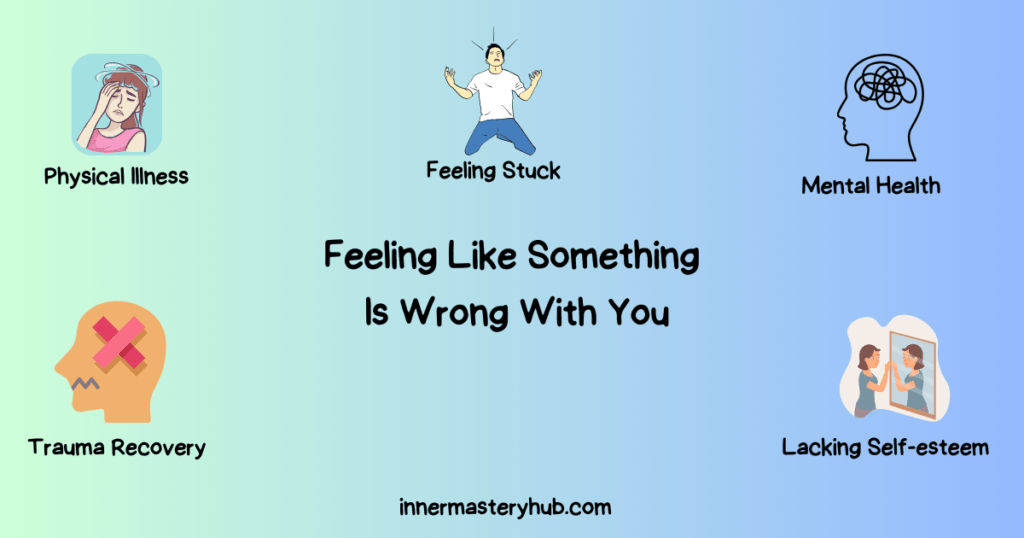
Most people who wonder “What’s wrong with me?” aren’t fundamentally broken. The question usually arises from emotional overload, negative self-talk, self-blame, cognitive distortions, unresolved trauma, or low self-esteem rather than a real personal flaw.
“What’s wrong with me?”
You may whisper this question to yourself after a mistake, a failed relationship, or a day when your emotions feel too heavy. You might look at others and think they have everything together while you are quietly struggling inside.
But the real issue is rarely what you think.
Often, this question appears when your emotional regulation, self-perception, and inner narrative become misaligned. Your mind interprets events in ways that create shame, confusion, or self-doubt. Then those interpretations shape the emotions you feel.
Then the cycle repeats: something happens → your brain interprets it personally → emotions get stronger → you believe something must be wrong with you.
But psychological research reveals that something quite different is afoot. The question ‘What’s wrong with me?’ is seldom a question of personal failure. More typically, it is about how your brain interprets emotion, meaning, and identity. To know that the inner process alters everything.
Common Reasons for Thinking “What’s wrong with me?”
My pain gives me a sense of my concerns. Many people go to a psychiatrist with this wrong notion. It is due to Trauma or bad childhood experiences.
Sometimes this idea was assumed because we were abused as children, and our physical and emotional needs were not satisfied. We may have been called selfish for “asking too much” or informed that we couldn’t have what we wanted because we didn’t “earn it.”
When we are hurt or abused, as children, we may blame ourselves. This can lead to self-abandonment as we give up our own wants to make others happy.
We are experts at concealing our feelings, particularly the taboo feelings, such as anger and sadness. We might people-please and be a ‘nice little boy or girl’ for us to be loved and accepted. All of these distance us from sincerity. We may live our lives the way others want, but we are never happy. Some people develop depression, eating disorders, addictions, anxiety, or disease as a means of coping.
Why Do People Ask “What’s Wrong With Me?”
When emotional responses seem unclear or overwhelming, people ask themselves, “What’s wrong with me?” Research reveals this is usually not because there is something inherently wrong with the person, but rather negative self-interpretation, poor emotional management, or cognitive biases.
Your mind is trying to interpret this feeling. If it can’t find a clear explanation, it blames itself.
What Does “What’s Wrong With Me” Mean Psychologically?
Psychologically, “What’s wrong with me?” is a kind of self-evaluative misery, in which the sufferer reads emotional discomfort as an indicator of personal deficit. Emotions are not messages, but what is evidence of a lack in the brain.
Self-evaluative distress
A mental state where you interpret emotional struggles as evidence that something is fundamentally flawed within you. This interpretation develops through experiences such as:
- repeated criticism
- emotional neglect
- unrealistic expectations
- comparison with others
- perfectionism
Because the brain seeks explanations, it creates a narrative:
“Something must be wrong with me.” But this narrative is just an interpretation, not reality.
Psychologist Dr. Kristin Neff, known for research on self-compassion, explains that harsh self-judgment appears when people believe suffering means personal failure1.
“With self-compassion, we give ourselves the same kindness we’d give to a good friend.”
— Kristin Neff
When that kindness is missing, the mind turns inward with blame.
Why Does Your Brain Turn Problems Into Self-Blame?
Your brain turns problems into self-blame because humans are wired to search for control and explanation. Blaming yourself creates a sense of predictability, even when the conclusion is painful.
The Hidden Psychological Sequence
Your emotional experience unfolds like this:
- Trigger
Something happens: a rejection, mistake, or criticism. - Interpretation
Your mind explains it personally.
“I messed everything up.” - Emotion
Shame, anxiety, and sadness appear. - Consequence
You withdraw, overthink, or criticize yourself.
Eventually, the mind summarizes the whole experience with a single question:
“What’s wrong with me?”
Psychologist Aaron Beck, the founder of cognitive therapy, described this as a cognitive distortion in which thoughts exaggerate personal responsibility or negativity.
Research confirms that distorted thinking patterns strongly correlate with depression and anxiety2.
How Emotional Regulation Makes You Feel Something Is Wrong With You
Emotional regulation is the ability to understand and manage emotions. When this skill is weak or disrupted, emotions can feel overwhelming, leading people to question themselves. The psychological ability to monitor, evaluate, and adjust emotional reactions.
According to Gross, emotional regulation involves processes that influence which emotions we feel, when we feel them, and how we express them3.
When regulation struggles occur:
- Emotions feel unpredictable
- Reactions feel stronger than expected
- Shame appears quickly
- People assume something is wrong internally
But emotional regulation skills develop over time. They are not fixed traits. That means your emotional reactions are learned responses, not personal defects.
Why Do You Feel Different From Everyone Else?
Feeling different from others comes from social comparison and invisible struggles. You see others’ public lives while experiencing your private thoughts.
The Comparison Illusion
Humans constantly compare themselves with others. But the comparison is unfair because:
- You see others’ highlights
- You feel your own struggles
- You assume everyone else is stable
Sociologist Charles Cooley described this in the Looking-Glass Self Theory, where identity forms partly through imagined judgments from others4. This means your self-image depends on what you think others think about you. But those assumptions are frequently inaccurate.
What Common Mistakes Do People Make When Asking “What’s Wrong With Me?”
The biggest mistake people make is assuming their emotional pain means they are broken. In reality, emotional discomfort often signals unmet psychological needs, unresolved experiences, or learned thinking patterns.
Many people believe:
- Strong emotions mean weakness
- Mistakes define identity
- Overthinking means something is wrong mentally
- Emotional sensitivity is a flaw
But psychological research shows the opposite. Emotions are adaptive signals, designed to guide your attention and behavior. Neuroscientist Antonio Damasio demonstrated that emotions play a key role in decision-making and reasoning5. Without emotions, people struggle to make even simple choices.
So emotional discomfort is not a malfunction. It is a communication system of the mind.
Is Something Actually Wrong With You?
Most of the time, there is nothing wrong with you. The feeling arises from interpreting emotional cues as judgements about identity.
Your mind may be confused:
- temporary emotions
with - permanent identity
But emotions are states, not definitions.
Psychologist Carl Rogers believed psychological distress appears when a person’s self-image conflicts with lived experience6.
“The curious paradox is that when I accept myself just as I am, then I can change.”
— Carl Rogers
The problem is rarely the person.
The problem is how the person understands themselves.
When the Mind Turns Stress Into Self-Blame
A university student fails an exam.
Initial event:
One failed test.
Interpretation:
“I’m not smart enough.”
Emotion:
Shame and anxiety.
Behavior:
Avoid studying; withdraw socially.
Final belief:
“What’s wrong with me?”
But the exam was not the real issue.
The interpretation created the emotional spiral.
When the interpretation changes, the emotional meaning shifts as well.
Why This Question Appears During Emotional Overload
The question “What’s wrong with me?” appears when the brain experiences emotional overload and tries to make sense of discomfort quickly.
During stress:
- The brain prioritizes quick explanations
- Self-criticism becomes the fastest explanation
- Emotional reasoning replaces rational thinking
This is why the question appears during:
- burnout
- heartbreak
- anxiety
- identity crises
- life transitions
The mind wants clarity. But clarity requires reflection, not self-blame.
Why You May Feel Like “What’s wrong with me?”
We’ll start by assessing the causes, then explain ways to manage “What’s wrong with me?” There are many reasons you feel “what’s wrong with me,” from brief setbacks to long-term physical or mental issues. Check if any of these items resonate.
1. Thoughts Can Be Wrong
When we think, “What’s wrong with me?” our thoughts can be inaccurate. Negative biases might make us believe false things about ourselves.
Here are some ways to relieve bad feelings when we feel off:
- “I’m not good enough.”
- “I’m a failure.”
- “No one loves me.”
- “I’m worthless.”
- “I’m a burden to others.”
These notions are often based on experience, but not necessarily true. For instance, if we were teased as a child, we would feel inadequate. But that’s just a concept, not an actuality.
Remember, thoughts are not facts. We may wonder, ‘What’s wrong with me?’ But that is false. We can transform our negative thoughts and create a more realistic, positive self-image.
2. Feeling Stuck
When you wonder, “What’s wrong with me?” you often feel stuck. Negative ideas and feelings may keep you stuck.
Some reasons we may feel stuck when we wonder what’s wrong:
- We may be afraid of change. Even positive change is frightening. We may be afraid of the unknown, or of losing what we have.
- We might have to adapt. If we are to change, perhaps we need a starter. We might have felt helpless.
- We may have negative or unsupportive persons in our lives. The company we keep influences our mood and mindset. Negative or unsupportive people can make it hard to feel hopeful about ourselves and our future.
These thoughts can be disturbing, but we will soon see how you can cope.
3. Change What Needs To Be Changed In Yourself
Change can be hard. Change can be empowering. We are taking responsibility and making our lives better, and that is empowering. It builds self-esteem because we see ourselves as capable of change. It’s hard because change is never easy. It’s about changing old habits, getting out of our comfort zone and dealing with obstacles inside and outside.
4. Mental health issues
Mental health issues can be taxing, with walls whispering self-doubt at every step. Anxiety does wonderful things to your self-image. A persistent voice telling you you’re too anxious, too worried, too much. You could think something is amiss with you.
Anxiety, depression, or other mental health difficulties can leave us feeling weak, broken, or insufficient. We may use our “flaws” as a way to prove our worthlessness.
5. Experiencing Physical Illness
Physical illness can strike at the heart of our self-image. I was diagnosed with a chronic illness, and my world turned upside down. And then my body felt weird. The symptoms, the drugs and the constraints kept telling me, “What’s wrong with me? I felt like my body was turning against me and ruining my self-esteem.
One of the most important ways in which physical disease influences self-image is through alterations in self-perception. Our sickness may assist us in perceiving our limitations and misery. This can make us feel less able, less attractive, or different from our pre-illness selves.
6. Feeling Overwhelmed
It’s hard to think when you have that overwhelming sense that something is wrong.
Think about managing work, family, and personal goals while a wave of enormous tension rolls over you. You may feel totally unprepared for even the simplest of jobs. You feel like you are not good enough, that you are not as capable as other people. In the midst of the turmoil, it’s impossible to find serenity, with your self-doubt always seeming to be simmering.
7. Lacking Self-esteem
You constantly doubt your ability and feel unworthy of praise. You may be at a party, but you’re distracted by the idea of others judging you.
Many reasons can lower self-esteem, including:
- Negative childhood experiences
- Criticism from others
- Bullying
- Perfectionism
- Unrealistic expectations
- Mental health conditions, such as depression and anxiety
8. Personal Relationship Issues
If you are already feeling off, problems with personal connection can feed your insecurities. Imagine always having to second-think your actions and words when with friends and family. You may assume they are secretly evaluating you, don’t like you, or that you are not good enough to maintain these relationships.
Self-doubt might lead you to withdraw from social situations and suppress your thoughts and feelings, which can cause you to feel distant from your loved ones.
Difficulties in forming human connections can lead to rejection, sadness, concern, and self-criticism. It is very important to remember that these feelings can be your troubles, not the truth.
9. Experiencing Trauma
Think about a serious occurrence, an accident, or a terrible loss. You may also have recurring nightmares, intrusive thoughts about the event, or intense anxiety.
These encounters can make you doubt your sanity and think something is wrong with you. It’s like you’re in a maze, fighting symptoms that make you feel like you’re losing control.
It’s important to know these symptoms are not who you are. Those are normal trauma responses and cognitive processing.
10. Problems at Work
Imagine yourself at work, besieged with self-doubt, worry, and a strong sense of inferiority. You might find it hard to concentrate because you’re worried that your co-workers are judging you or talking about your weaknesses. These feelings can create a war zone of self-criticism at work, where each day is a test of self-worth.
Problems at work can lead to major consequences. Stress can mean sleepless nights and poor self-talk. This can impact your personal life and well-being, leading to strained relationships and feelings of isolation.
11 Ways to Feel Better when feelings like “what’s wrong with me?” hit you
Whatever the cause of the feeling that something is not right with you, there are steps you may take to reduce it. The specific cause will determine the coping strategy you apply.
1. Practice Self-Care
Taking care of your physical, mental, and emotional well-being is self-care. You must practice self-care to be your best and live a satisfying life.
Self-care takes various forms. Here are some ideas:
Take care of your health by getting enough sleep, eating a balanced diet, and exercising regularly.
Establish clear boundaries to safeguard your time and energy. Say no to overwhelming responsibilities and yes to self-care.
Schedule time for hobbies and activities that offer you delight. Painting, playing an instrument, or trekking can refresh you.
Prioritize self-reflection by regularly evaluating goals, values, and aspirations. Self-reflection helps you make real choices.
Disconnect: Taking pauses from screens and technology is crucial in the digital age. A break from technology can reduce stress and improve attention.
2. Coping With Anxiety
How to cope with anxiety: Here are some tips:
- Deep breathing exercises can soothe your nervous system.
- Exercise regularly to reduce stress.
- Maintain a balanced diet and limit caffeine and sugar.
- Get enough sleep for mental and emotional health.
- Notice your erroneous thoughts and replace them with rational ones.
- Set achievable goals and break them down into smaller steps.
- Establish a daily schedule for predictability.
- Consider anxiety-reducing vitamins or drugs if advised.
3. Coping With Depression
Depression is a treatable condition, and time and support make recovery possible. Here are some steps on how to cope with feelings of depression:
- Maintain adequate hygiene and self-care.
- Record emotions, triggers, and progress in a journal.
- Consult a therapist or psychiatrist.
- Build family and friend support.
- Exercise regularly to increase mood and vitality.
- Get enough sleep and stick to it.
- Minimize alcohol and recreational drug use.
- Relax with deep breathing and increasing muscle relaxation.
4. Schedule a Time to Worry
By scheduling time to worry, cognitive behavioral therapy (CBT) can help you stop worrying about situations beyond your control. You worry about whatever you’re worried about occasionally instead of all day.
Follow these steps to plan worry time:
- Choose a time and place where you will not be interrupted.
- Set a timer for 15-30 minutes.
- During your worry time, write down everything you are worried about.
- Once the timer goes off, stop worrying and continue your day.
5. Observe Your Body
Body observation is the process of noticing physical experiences without judgement. It can help you to become more aware of your body, to cope with stress, and to catch health problems.
How to proceed:
Be there. Focus on your body and sensations.
Maintain consistency. Monitor your body for a few minutes each day.
Once comfortable, scan your body from head to toe while practicing breath awareness. Feel every aspect of your body. This could be heat, cold, tension, relaxation, discomfort, or anything else.
Brain fog. To declutter, write everything on a to-do list or action plan.
Restless. If you can’t sit still, try strolling, yoga, high-intensity interval training, or treadmill walking.
Tense/uneasy. Deep breathing, meditation, and PMR are advised.

6. Make an Action plan
Here’s a concise action plan for coming out of a negative mindset or circumstances:
- Define achievable goals.
- Break goals into achievable steps.
- Try problem-solving.
- Inspiration comes from success stories.
- Strengthen familial, friend, and romantic relationships.
- Develop hobbies like knitting, sports, or exercise to release endorphins and boost self-esteem.
- Read self-help books on your interests.
- Having a partner who holds you accountable helps you progress.
7. Gain a Fresh Perspective
Set realistic goals. Break ambitions into manageable steps. Attempt the problems.
Success stories are inspiring. Strengthen bonds with friends, family, and love partners.
Take up knitting, athletics, or other physical activities to release endorphins and increase your self-esteem.
Read self-help books about managing interest. A partner who keeps you honest helps you grow.
8. Accept Happiness
Accepting sadness changes our mood. We think we’ll always be joyful, but life has ups and downs. Remember that melancholy is normal and not a sign of weakness.
Avoid self-criticism and be nice. In those times, be kind to yourself. Unhappy people typically share the truth or recommend change. Accept it, find its cause, and get therapy. By seeing sorrow as temporary, you can build resilience and endure life’s unavoidable challenges.
9. Relaxation Techniques
Relaxation techniques are:
- Valuable tools for reducing stress.
- Promoting a sense of calm.
- Improving your mental health.
Here are some relaxation techniques to try:
Deep breathing. Carefully inhale through your nose for 4, hold for 4, then slowly exhale through your mouth. Repeat often.
Progressive Muscle Relaxation: Tense and relax each muscle group from the bottom up. This reduces physical strain.
Be mindful or meditate. Sit or lie down in a quiet place and focus on breathing, a word, or a soothing image. Focus on the now and ignore your rushing thoughts.
Visualization. Imagine a peaceful place with your eyes closed. Imagine a serene setting to reduce stress and anxiety.
Journaling. Write down your ideas and feelings to relieve tension and serve as a substitute for treatment.
Use essential oils like lavender, chamomile, or eucalyptus for aromatherapy to create a relaxing ambiance.
Nature Walks. Being in nature is relaxing. Clear your head by walking in a park or on the beach.
10. Change that needs to be changed
Change is personal and involves introspection and determination. It starts with recognising the characteristic, habit, or behaviour you want to change and understanding why.
After setting a goal, divide it into achievable parts and set a reasonable deadline. Support from friends, family, or a mentor may motivate and hold you accountable.
Self-education regarding your desired change is essential. This knowledge gives you the skills and insights to shift. Change takes time and persistence, so be patient.
11. Spend Time With Your Loved Ones
It’s precious and rewarding. Spending time with family creates a connection. We are shaped by our families, our friends, and our romances. Meaningful conversations build support, excitement, and memories.
They can bring solace in sorrowful days and happiness in joyful days. The warmth and intimacy of these experiences can also be comforting and offer a sense of connection in a chaotic environment. Time spent with those we love is proof of how important these relationships are to us and a reminder to respect them.
The Real Shift Behind the Question “What’s Wrong With Me?”
When you say, “What’s wrong with me?”, your mind is seeking to solve emotional discomfort. But the mistake is thinking that the pain means there is anything wrong with you. Usually, there is nothing wrong with you.
What’s really happening is a complex process of internal interpretation, emotion control, and identification.
When this process is clear, the question starts to shift. Instead of questioning yourself, “What’s wrong with me?” You start requesting something more specific: “What does my mind want to say?”
That alone can change your understanding of your inner world.
Key Takeaways
- Nothing is inherently wrong with you.
- Emotional pain is not proof of personal failure.
- Self-blame often comes from learned thinking patterns.
- Emotional regulation can be improved.
- Self-compassion reduces shame and promotes resilience.
This article integrates findings from cognitive psychology, emotion regulation research, self-compassion research, and trauma-informed counselling.
People Also Ask
What are some quick ways to feel better?
Deep breaths, drinking water, stretching or taking a brief stroll might help you feel better fast. Improve your mood by listening to music, talking to a buddy, or taking a break from screens. Simple things you may do to quiet your thoughts and get back to positive energy.
What are natural ways to feel better?
Some strategies to feel better naturally include good foods, time in sunlight, meditation and sleeping well. Nature walks or gardening can also help lift your mood. Eat healthy foods and stay hydrated to help regulate your emotions. These easy routines will make you mentally and physically healthy in a natural way.
Why do I constantly think something is wrong with me?
The concept frequently arises from negative self-talk, prior criticism, or perfectionism. The brain, unable to understand emotional suffering, will often blame the self. Cognitive behavioural research demonstrates that these patterns are acquired ways of thinking, not facts.
Why do I feel broken inside?
Feeling broken often comes from unresolved emotional experiences or chronic self-criticism. Psychologists note that this feeling usually reflects unmet emotional needs rather than actual psychological damage.
Why do I feel like everyone else is normal except me?
This is because of social comparison. You witness the outward behaviour of others, but feel your inner thoughts. That is why it can seem like everyone else is emotionally stable.
Does anxiety make you feel like something is wrong with you?
Yes, yes. Anxiety leads to more self-monitoring and rumination. The brain hunts for faults, often misidentifying natural emotional reactions as personal failings.
Is it normal to ask “what’s wrong with me”?
Yes. Many people ask this question during periods of stress, identity change, or emotional overwhelm. It is a common psychological response when emotions feel confusing or difficult to control.
Why does my brain blame me?
When anything goes awry, your brain hunts for an explanation. Blaming yourself might give you a false sense of control. It’s simpler to think that you caused the problem than to accept uncertainties or circumstances beyond your control.
Why do I feel broken?
The feeling of being shattered is commonly caused by unresolved emotional distress, constant self-criticism, trauma, or low self-esteem. These experiences can lead you to feel that there is something wrong with you, when in fact your behaviours are normal reactions to stressful situations.
Why do I feel different from everyone else?
You may feel different when you compare your own challenges with public lives. You can’t see their secret fears and insecurities and it’s tempting to wrongly assume everyone else is surviving better than you.
- Neff, K. D. (2011). Self-compassion: The proven power of being kind to yourself. William Morrow. ↩︎
- Beck, A. T. (1976). Cognitive therapy and emotional disorders. International Universities Press. ↩︎
- Gross, J. J. (2015). Emotion regulation: Current status and prospects. Psychological Inquiry, 26(1), 1–26. https://doi.org/10.1080/1047840X.2014.940781 ↩︎
- Sage Reference – Looking-Glass Self
↩︎ - Damasio, A. (1994). Descartes’ Error: Emotion, Reason, and the Human Brain. Putnam Publishing. ↩︎
- Rogers, C. R. (1961). On Becoming a Person. Houghton Mifflin. ↩︎
Written By Mehwish Qurayshi
Mehwish Qurayshi is a Trauma-Informed Emotional Wellness Counsellor trained through NICABM’s Treating Trauma Master Series, which includes NBCC-approved education in Trauma Treatment and Emotional Wellness & Emotional Intelligence – Sourcecode Academia. She has over five years of experience providing emotional wellness counselling, helping individuals heal from trauma, regulate emotions, and build healthy relationships.