
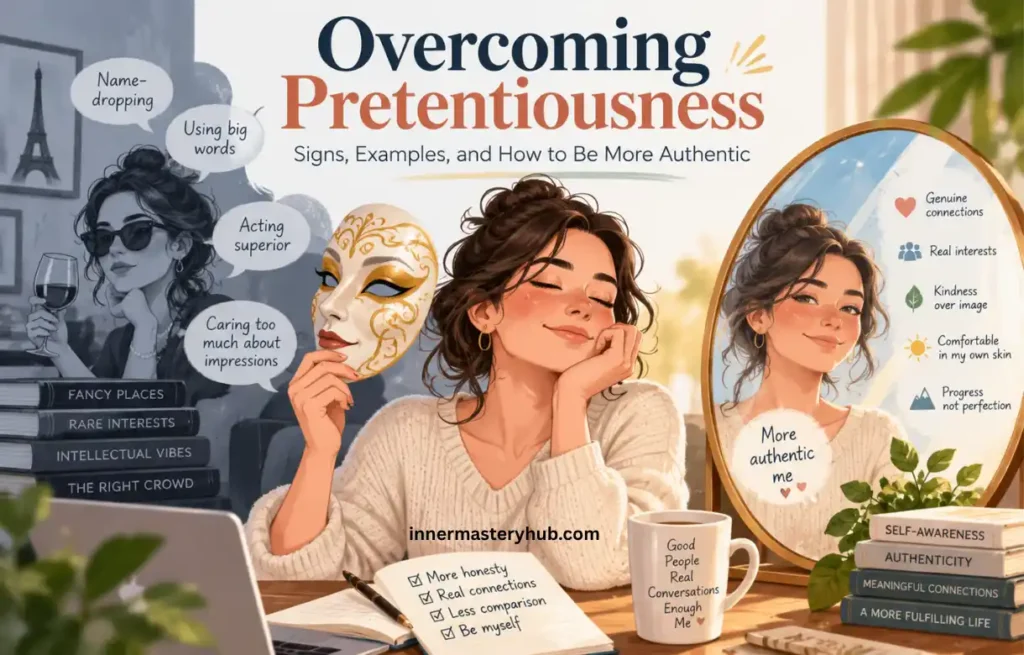
Overcoming Pretentiousness: Signs, Examples, and How to Be More Authentic


Pretentiousness is when you change the way you speak, act, or present yourself mainly to seem more impressive, knowledgeable, successful, or sophisticated. It can show up through name-dropping, using complicated language unnecessarily, exaggerating achievements, or hiding ordinary interests because you worry they will make you look less impressive. Research on impression management suggests that people often adjust how they present themselves to influence how others see them, although these efforts do not always create the impression they expect.
What Does Pretentiousness Look Like in Everyday Life?
Pretentiousness is not about liking expensive things, using big words, or having unusual interests. It shows up more clearly in the moments when you change how you speak or act because you want to look more impressive.
You might use a complicated word when a simple one would say the same thing. You mention that you know an important person even though it has little to do with the conversation. Someone talks about a popular film or hobby they enjoy, and you dismiss it because you want your own taste to sound more sophisticated.
Or you are asked about something you do not know much about, but instead of saying, “I’m not sure,” you keep talking because admitting that feels uncomfortable.
That does not automatically mean you are arrogant or insecure. Sometimes you are simply trying to fit in, avoid embarrassment, or make a good impression.
This is where emotional awareness can help. Notice what happens just before you start trying to impress someone.
Did you suddenly feel less knowledgeable than the people around you? Did you worry that an ordinary answer would make you seem less interesting? Were you hoping for approval or external validation?
For example, there is a difference between saying, “I worked with that company before,” because it adds something useful to the conversation, and mentioning the company mainly because you want the other person to notice its status.
Research on impression management suggests that people often adjust how they present themselves when they want to make a good impression. The difficulty is that these efforts do not always come across the way we expect; attempts to look knowledgeable, successful, or impressive can sometimes be read differently by the other person.1
Overcoming pretentiousness does not mean hiding your achievements or pretending to know less than you do. It means being able to say, “I don’t know,” enjoy something without defending why it is impressive, and talk about what you have achieved without turning every conversation into proof of your value.
Why Can Pretentious Behavior Feel Uncomfortable Around Other People?
Pretentious behavior can make a conversation uncomfortable when one person keeps trying to show that they know more, have better taste, or have higher status than everyone else.
You may notice it when someone corrects small details that do not matter, turns another person’s story into a chance to mention their own achievements, brings up important people they know, or laughs at an interest because they think it is too ordinary.
Imagine you tell someone about a restaurant you enjoyed. Instead of asking what you liked about it, they immediately explain that they only eat at “proper” restaurants and start listing expensive places they have visited. Nothing openly rude may have been said, but you may stop wanting to share.
The issue is not confidence or knowledge. You can be highly skilled, successful, or well-informed without making the other person feel that they are being measured against you.
Sometimes the clearest sign is what happens to the conversation afterward. People begin speaking less, stop offering their opinions, defend their choices, or change the subject because they no longer feel comfortable sharing.
If you notice yourself doing this, emotional awareness can help you catch the moment before you correct, name-drop, or turn the topic back to yourself. Ask what you were hoping would happen next: were you adding something useful, or hoping the other person would see you as more impressive?
If the urge to impress becomes stronger around certain people, it may also be useful to notice whether you are looking for external validation from them. For example, you may speak differently around a senior colleague, hide an interest you think they would judge, or mention an achievement you would not normally bring up.
Pretentiousness vs. Authenticity: What Is the Difference?
Pretentiousness often shows up when you change what you say or how you act because you want to look more knowledgeable, successful, cultured, or important than you feel in that moment.
For example, someone asks about a topic you barely know. An authentic response might be, “I haven’t read much about that.” A pretentious response would be pretending you understand, using a few technical words, and hoping no one asks another question.
The same difference can show up with interests and achievements. You can enjoy an expensive hobby, be proud of your work, or know a lot about a subject without being pretentious. It becomes worth noticing when you bring those things up mainly to impress people, hide interests you think others may judge, or change your opinion depending on who is in the room.
That is where self-awareness matters. Notice whether you speak differently around people whose approval matters to you, or whether you feel pressure to sound more impressive than you normally would.
If you often hide what you actually like, want, or believe so others will accept you, that can also overlap with self-abandonment. Not every attempt to fit in is pretentious, but repeatedly editing yourself for approval can make it harder to tell what is genuinely yours.
Examples of Pretentious Behavior in Everyday Life
Pretentious behavior often shows up in small moments where you feel pressure to look more knowledgeable, successful, or sophisticated than you actually feel.
You are talking with friends about a film you enjoyed. Someone says it is too mainstream, and you immediately agree even though you liked it. You do not want your taste to sound ordinary.
At work, someone mentions a subject you barely understand. Instead of saying, “I’m not familiar with that,” you repeat a few technical terms and hope the conversation moves on before anyone asks you to explain them.
You may also mention an influential person you once met even though they have little to do with the conversation, bring up the price of something you own when nobody asked, or turn someone else’s achievement into a story about something more impressive you have done.
Another sign is how much your behavior changes depending on who is listening. Around close friends, you speak normally. Around someone whose opinion matters to you, you suddenly use different language, hide interests you think they may judge, or make your achievements sound bigger.
Noticing that change is a form of self-awareness. Instead of asking, “Am I a pretentious person?” look at the specific moment: What did you say differently? What were you afraid the other person might think?
If you do this mainly when you want admiration, approval, or reassurance from certain people, it may also help to examine your need for external validation. Wanting to make a good impression is normal; the pattern becomes more useful to examine when you repeatedly hide, exaggerate, or change parts of yourself to get that reaction.
Why Do People Act Pretentious?
People may act pretentious when they feel pressure to impress, fit in, or avoid looking inexperienced.
Imagine you join a conversation where everyone seems to know more than you. Someone asks for your opinion, and instead of saying, “I’m still learning about that,” you speak with more certainty than you actually feel. You may use technical words, repeat something you heard elsewhere, or avoid asking a question because you do not want to look uninformed.
The same thing can happen around people whose approval matters to you. You normally enjoy a popular TV show, but call it “too basic” around a group with different tastes. You mention a qualification or an influential person you know even though neither is relevant. You agree with the most respected person in the room, then give a different opinion when you are with close friends.
Sometimes the setting encourages this. In a workplace where people constantly mention job titles, prestigious clients, expensive purchases, or who they know, you may start doing the same because that is what seems to get attention.
A useful sign is how much you change depending on who is in front of you. Self-awareness can help you notice whether you suddenly exaggerate what you know, hide something you genuinely enjoy, or find it unusually difficult to say, “I don’t know.”
If this happens most around people you want to impress, external validation may be part of the pattern. For example, one compliment from a senior colleague may make you feel relieved, while being overlooked may leave you wanting to prove yourself in the next conversation.
Past criticism or exclusion can also matter for some people. If you were regularly mocked for getting something wrong, admitting uncertainty may feel more uncomfortable now. That does not mean pretentious behavior is automatically a trauma response. It simply gives you another concrete question to consider: What feels risky about letting this person see that I do not know, own, or understand everything?
How to Respond to Pretentious People Politely
You do not have to compete with someone just because they are trying to sound impressive.
If they use language you do not understand, ask them to explain it plainly: “What does that mean?” or “Can you give me an example?” If they know the subject well, they should be able to explain it without making the conversation harder to follow.
If they keep mentioning titles, expensive things, or important people they know, you do not need to answer with your own achievements. Stay with the actual topic. If someone says, “I know the owner,” you can simply ask, “What was your experience with the place?”
If they dismiss something you like, avoid turning it into a defence of your taste. “I enjoyed it,” “It works for me,” or “We probably like different things” is enough.
You may also notice the conversation becoming one-sided. You start explaining yourself more, trying to prove that you are knowledgeable too, or feeling pressure to mention your own accomplishments. That is a useful point to stop and check your emotional awareness: What am I trying to prove right now?
If the same person repeatedly corrects you, talks down to you, or turns conversations into comparisons, you can be more direct: “I’m happy to discuss it, but I don’t want this to become a competition,” or, “I’d rather change the subject.”
The circle of control is helpful here because you cannot make another person stop showing off. You can decide whether to argue, keep explaining yourself, change the subject, limit the conversation, or leave it.
Why Can Pretentious Behavior Sometimes Seem Rewarding?
Pretentious behavior can sometimes get attention quickly, especially in places where people notice titles, confidence, money, connections, or appearance.
At a networking event, someone may speak first, list their achievements, mention a well-known client, and sound completely certain about what they do. Other people may assume they are highly experienced before they have seen any of their work.
The same thing can happen at work. One person quietly does good work, while another talks often about senior contacts, qualifications, important projects, or how busy they are. The second person may be noticed more simply because they make their achievements more visible.
Social groups can work the same way. If everyone talks about expensive restaurants, exclusive events, certain brands, or niche interests, you may start bringing those things up more often because they seem to get approval.
That does not mean pretentious behavior always succeeds. It means people often form early impressions from limited information, so someone who sounds confident or impressive may get attention before others know much about them.
The pattern becomes worth noticing when you start changing your behavior mainly because you want that reaction. You may mention achievements more often around certain people, avoid saying “I don’t know,” or hide ordinary interests because you think they will make you look less impressive.
If that happens often, external validation may be part of the pattern. Self-awareness can also help you notice whether you are sharing something because it is relevant or because you want the person in front of you to think more highly of you.
Research on self-promotion shows why this behavior can sometimes seem rewarding. Fragale and Grant (2015) found that people who promoted themselves could receive more status in some situations, although they could also be seen as less warm or likable. That helps explain why talking up your achievements may get attention in the short term without necessarily helping the quality of the interaction.2
How to Become Less Pretentious Without Making Yourself Smaller
Becoming less pretentious does not mean hiding your achievements, pretending you know less than you do, or avoiding things you genuinely enjoy.
It shows up in smaller moments.
You can say, “I don’t know,” without rushing to cover it with a guess. You can let someone finish talking without turning their story into one about your own experience. You can mention an achievement when it fits the conversation instead of finding a reason to bring it up.
You can also keep liking what you like when the people around you have different tastes. If you enjoy a popular show, an inexpensive restaurant, or a hobby someone else considers ordinary, you do not need to make it sound more sophisticated before admitting you enjoy it.
Pay attention to the moments when your behavior suddenly changes. Maybe you start speaking more formally around someone senior, exaggerate your role in a project, or agree with an opinion you would normally question. That kind of self-awareness can help you notice the change while it is happening.
If you regularly edit yourself depending on who is in the room, it may also be worth looking at external validation. For example, you may feel comfortable saying what you really think with friends but become much more concerned with sounding impressive around someone whose approval matters to you.
Being more authentic can look very ordinary: saying what you know, admitting what you do not know, enjoying what you enjoy, and letting another person have the impressive story sometimes.
FAQs about Overcoming Pretentiousness
What does overcoming pretentiousness mean?
Overcoming pretentiousness means noticing when you change how you speak or act mainly to look more impressive. That might mean exaggerating what you know, name-dropping, hiding interests you think others will judge, or avoiding the words “I don’t know.” The aim is not to make yourself smaller, but to speak and act more honestly.
How can I tell if I am being pretentious?
Look at what changes when you are around people you want to impress. Do you use more complicated language than usual, make your achievements sound bigger, agree with opinions you do not really share, or mention status and connections more often? One moment does not define you, but repeated changes like these are worth noticing.
Is pretentiousness the same as confidence?
No. Confidence can look like knowing what you are good at and speaking clearly about it. Pretentious behavior is more likely to show up when you exaggerate, compete unnecessarily, or make something sound more impressive mainly because you want a reaction from other people.
Can insecurity make someone act pretentious?
It can for some people, but it should not be assumed. You may notice yourself trying harder to impress when you feel out of place, less experienced, or worried about being judged. For someone else, the behavior may come from habit, social pressure, or a setting where status gets a lot of attention.
How can I stop sounding pretentious?
Start with small changes in conversation. Say “I don’t know” when you do not know. Use the clearest words you can rather than the most impressive ones. Let someone finish their story without immediately matching it with one of your own, and notice when you are about to mention an achievement that is not actually relevant.
How does self-awareness help with pretentious behavior?
Self-awareness helps you notice the exact moment your behavior changes. You may hear yourself speaking differently around a senior colleague, hiding a hobby around a certain group, or becoming unusually eager to mention something impressive. Catching that moment gives you a chance to respond differently.
Can the people around you encourage pretentious behavior?
Yes. In some workplaces or social groups, people may get more attention for titles, expensive tastes, influential contacts, or sounding highly knowledgeable. You may start copying that style because it seems normal in that setting. That does not mean everyone in the group is pretentious, but the environment can affect how people present themselves.
Is it normal to fall back into pretentious behavior?
Yes. You may notice old habits returning when you feel nervous, out of place, judged, or eager to make a good impression. Instead of treating that as failure, look at what happened just before it. Did you feel less knowledgeable, less important, or more concerned with external validation? That gives you something specific to work with next time.
- Sezer, O. (2022). Impression (mis)management: When what you say is not what they hear. Current Opinion in Psychology, 44, 31–37. DOI: 10.1016/j.copsyc.2021.08.025. ↩︎
- Fragale, A. R., & Grant, A. M. (2015). Busy brains, boasters’ gains: Self-promotion effectiveness depends on audiences’ cognitive resources. Journal of Experimental Social Psychology, 58, 63–76. DOI: 10.1016/j.jesp.2014.12.002. ↩︎
Written By Mehwish Qurayshi
Mehwish Qurayshi is a Trauma-Informed Emotional Wellness Counsellor trained through NICABM’s Treating Trauma Master Series, which includes NBCC-approved education in Trauma Treatment and Emotional Wellness & Emotional Intelligence – Sourcecode Academia. She has over five years of experience providing emotional wellness counselling, helping individuals heal from trauma, regulate emotions, and build healthy relationships.