
Compulsive vs Impulsive Behaviour: The Main Difference

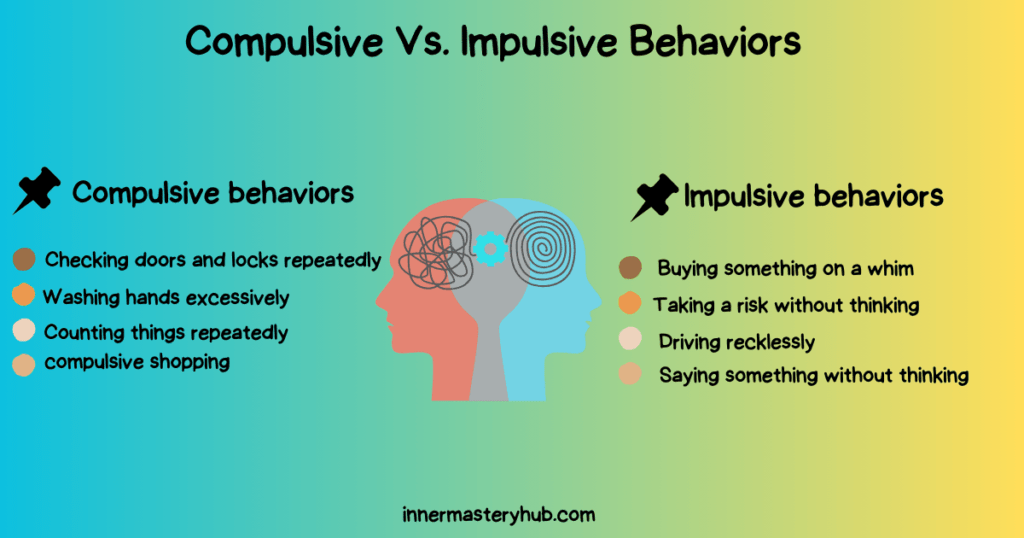
What matters is not only what someone does, but what is happening inside them just before they do it. An impulsive behaviour may come from an immediate urge for action to get relief. A compulsive behaviour may be repeated because not doing it feels difficult to tolerate. In people who have lived with prolonged stress and difficult emotional experiences, these responses can sometimes become regular ways of coping. That does not mean every impulsive or compulsive behaviour comes from trauma, but context can help explain why the pattern keeps returning.
Compulsive vs Impulsive at a Glance
Impulsive behaviour often happens in the moment. You feel the urge and act before giving yourself much time to think it through.
Compulsive behaviour tends to come back. You may repeat the same action because it settles discomfort, gives reassurance, or makes something feel finished for a while.
Sometimes the same behaviour can be impulsive in one situation and compulsive in another. Looking at what happened before the action and what changed afterward usually tells you more than the behaviour by itself.
| Feature | Impulsive behaviour may look like | Compulsive behaviour may look like |
|---|---|---|
| What comes first | A sudden urge, emotion, or pull toward action | A recurring urge, doubt, tension, or sense that something needs to be done |
| Timing | Often quick or spontaneous | Often repeated or difficult to leave unfinished |
| Thinking beforehand | Little time for reflection | The person may anticipate the action or feel pressure to repeat it |
| Internal experience | “I want to do this now” | “I feel like I need to do this” |
| What the action may provide | Reward, release, excitement, or immediate relief | Temporary relief, reassurance, certainty, or reduction in discomfort |
| Example | Buying something expensive on a sudden urge | Repeatedly checking whether the door is locked |
| What may happen afterward | Regret, satisfaction, or relief | Relief may fade, and the urge may return |
What Is Compulsive Behaviour?
A compulsive pattern often shows up as something you keep going back to.
You may check, repeat, clean, ask, or arrange something again because stopping feels difficult or because doing it settles discomfort for a while.
The behaviour can look ordinary from the outside. What makes it important is the pressure around it: the urge to do it, the relief that follows, and the difficulty of leaving it alone.
That is why repetition by itself is not enough to tell you whether something is compulsive.
Examples of Compulsive Behaviours
- checking a lock again even though you remember locking it,
- washing or cleaning repeatedly,
- counting or repeating an action until it feels finished,
- arranging objects in a particular way and feeling uncomfortable leaving them differently,
- asking for reassurance several times because the first answer did not settle the doubt,
- checking messages repeatedly because uncertainty keeps returning.
What Is Impulsive Behaviour?
You feel something strongly and act before you have fully considered what comes next.
You might click “buy” before checking your budget, send a reply while angry, agree to something without thinking it through, or cancel a plan in the middle of a difficult moment.
Sometimes the action brings excitement. Sometimes it gives quick relief from frustration or discomfort.
The useful clue is the timing: how quickly did the action follow the urge? Looking at examples of making impulsive decisions can make that difference easier to recognise.
Examples of Impulsive Behaviours
- clicking “buy” before checking your budget,
- sending a reply while you are still angry,
- saying something before deciding how you want to word it,
- sharing personal information and wishing later that you had waited,
- cancelling plans in the heat of the moment,
- agreeing to something before thinking through what it involves.
Can a Behaviour Be Both Impulsive and Compulsive?
Yes.
You might do something quickly because the urge is strong in that moment. Later, you may find yourself going back to the same action because it gives you a brief sense of relief or reassurance.
So the action may look the same, but the reason you keep doing it can change.
Habit or Compulsion: What Should You Look For?
A repeated behaviour is not automatically a compulsion.
With a habit, you may do something without much thought and still be able to skip it or change the routine.
A compulsive pattern may feel harder to leave alone. If you try to stop, delay, or leave it unfinished, you may notice more doubt, discomfort, or pressure to complete it.
A study comparing people with OCD and healthy participants found that both groups developed similar objectively measured automaticity after practising action sequences daily for one month.[1] This suggests that doing something automatically, by itself, does not tell you whether the behaviour is compulsive.
What Does Research Say About Impulsivity and Compulsivity?
When I look at these patterns in practice, I do not start by assuming that one brain area or one diagnosis explains the behaviour.
Research gives us useful clues, but the behaviour still has to be understood in context.
Impulsive behaviour is often studied in relation to rapid responding, immediate reward, and difficulty pausing before action.
Compulsive behaviour is more often studied in relation to repetition, internal pressure, and the relief or reduction in discomfort that may follow the action.
Stress can also change how easy it is to slow down. Research on acute stress suggests that it can interfere with some prefrontal functions involved in working memory and cognitive control.[2]
Neuroscience research on compulsive disorders has also examined brain systems involved in habits, decision-making, and cognitive control.[3] I would use those findings as background, not as a shortcut for explaining why one particular person behaves a certain way.

Why Do Impulsive and Compulsive Behaviours Happen?
Sometimes the action happens quickly because the feeling behind it is strong. Other times, you keep returning to the same behaviour because it gives you a brief sense of relief, reassurance, or certainty.
Instead of looking only at what you did, look at what happened just before it.
1. Strong Feelings Can Make You React Faster
When anger, frustration, excitement, embarrassment, or distress rises quickly, you may act before you have fully decided what you want to do.
That might look like:
- sending a message while angry,
- buying something without checking whether you really want it,
- interrupting because the thought feels urgent,
- cancelling plans in the middle of a difficult moment,
- or saying something you later wish you had worded differently.
This does not mean every quick reaction comes from a strong emotion. The useful clue is whether the feeling and the action happened almost back-to-back.
2. Repeating Something May Give Brief Relief
A repeated behaviour may keep showing up because something changes after you do it.
- You check the door again and feel more certain.
- You look at your phone and feel reassured for a few minutes.
- You ask the same question again because the first answer did not fully settle the doubt.
If that relief fades and you feel pulled to repeat the action, the pattern may start to make more sense.
3. Past Experiences Can Affect What Feels Hard to Sit With
Earlier experiences can sometimes make certain situations feel more loaded than they appear from the outside.
If you have often been criticised, ignored, rejected, or left unsure about what would happen next, you may notice yourself reacting strongly to similar situations now.
That does not mean trauma automatically explains the behaviour.
It may simply mean that some situations bring up more tension, uncertainty, or urgency for you than they do for someone else.
4. The Same Action Can Have a Different Reason Behind It
Two people can check their phone for completely different reasons.
One person sees a notification and opens it straight away.
Another keeps checking because waiting for a reply feels harder each time they put the phone down.
The action looks the same. The reason for repeating it is different.
A more useful question is:
“What was I hoping would change after I did this?”
Maybe you wanted relief.
Maybe you wanted certainty.
Maybe you wanted the uncomfortable feeling to stop.
That gives you more information than the behaviour alone.
Does It Feel More Like “I Want To” or “I Have To”?
Impulsive
“I WANT to do this now.”
Compulsive
“I feel like I NEED to do this.”
This is a useful memory aid, not a diagnostic test. Real behavior can be more complicated, and the two patterns can overlap.
What Can You Do When the Urge Shows Up?
The first useful moment is often the one just before the action.
Notice what is happening.
- Are you angry?
- Are you unsure whether someone has replied?
- Are you excited about buying something?
- Are you trying to stop a feeling that has become uncomfortable?
Then work with the exact behaviour rather than giving yourself a vague goal like “have more self-control.”
1. Notice What Happens Just Before
You do not need a complicated journal.
Write down three things:
- What happened?
- What did I feel or want to do?
- What did I do next?
For example:
“I saw that they had not replied. I felt uneasy. I checked the chat again.”
Or:
“I had a difficult day. I saw something online. I bought it without thinking much about it.”
After a few examples, you may notice that the same situations keep showing up.
2. Change One Part of the Usual Sequence
- If you usually act immediately, make the next step slightly harder or slower.
- If you want to send an angry message, leave it unsent for a while.
- If you want to make an unplanned purchase, leave the item in your cart and come back later.
- If you want to check something again, notice what happens when you wait before checking.
The point is to find out what happens when the action does not happen immediately.
3. Match the Response to What You Are Actually Doing
A single replacement activity will not fit every pattern.
If an impulsive purchase happens because the reward feels exciting in the moment, delaying the purchase may help you see whether you still want it later.
If repeated checking happens because uncertainty keeps returning, distracting yourself with another activity may not tell you much about the pattern. It may be more useful to notice what the uncertainty feels like and what happens when you do not check straight away.
This is why “replace the habit with something healthy” is often too simple.
The better question is:
“What does this behaviour give me, and what happens when I do not use it?”
4. Get Support When the Pattern Keeps Taking Over
Sometimes you understand the behaviour very well and still cannot interrupt it easily.
You may know why you keep checking, spending, asking for reassurance, or reacting quickly, but the pattern still takes up time or creates problems.
That is when professional support can be useful.
A therapist or counsellor can look with you at:
- what usually happens before the behaviour,
- what feeling becomes hard to tolerate,
- what the action gives you in the moment,
- and what makes it difficult to stop or delay.
Different patterns need different approaches. The aim is not to find one trick that “stops” impulsivity or compulsivity. It is to understand what keeps your particular pattern going and work from there.
How Do Impulsive and Compulsive Behaviours Relate to Mental Health Conditions?
Impulsive or compulsive behaviours can happen without a mental health diagnosis.
They can also appear as part of some conditions, but the behaviour alone is not enough to tell you which condition, if any, is present.
For example, impulsive behaviour may be seen in people with conditions such as ADHD, bipolar disorder, some substance-use disorders, or other difficulties involving rapid decision-making.
Compulsive behaviour may appear in conditions such as OCD or body dysmorphic disorder, where repeated actions can become difficult to resist or leave unfinished.
The same behaviour can also happen outside any diagnosis.
Repeated checking, quick spending, reassurance seeking, interrupting, or acting without much thought can have many different explanations.
A diagnosis depends on the wider picture: how often the behaviour happens, what is driving it, how much it interferes with daily life, and whether other symptoms are present.
If a behaviour is taking up a lot of time, creating repeated problems, or becoming difficult to control, a qualified health professional can assess what is happening more fully.
How Does Stress Affect Impulsive and Compulsive Behaviour?
Stress may make it harder to pause before acting and may also increase the pull of behaviours that bring short-term relief or reassurance.
For one person, that might mean a quick, unplanned reaction. For another, it might mean repeating a behaviour because uncertainty or discomfort feels harder to tolerate.
Stress is not the only factor, so the behaviour should be understood in context.
How to Recognize Your Own Pattern
Before You Label the Behavior, Ask:
- What happened immediately before it?
- Was the action planned or sudden?
- What feeling was I trying to change?
- Was I seeking reward or escaping discomfort?
- Has this happened repeatedly?
- What happened immediately afterward?
Free Self-Reflection Worksheet
Not sure whether a behaviour is more impulsive, compulsive, or somewhere in between?
Use the worksheet to look at:
- what happened before the urge,
- what you felt like doing,
- what you actually did,
- what changed afterward,
- and whether the urge came back.
Download the Compulsive vs Impulsive Behaviour Reflection Worksheet.
Quick Summary
- Impulsive behaviour often looks like acting before you have had much time to think: sending the message, making the purchase, or saying yes too quickly.
- Compulsive behaviour is more likely to repeat: checking again, asking for reassurance again, or returning to the same action because the first time did not settle the doubt for long.
- Stress can make these behaviours show up more often. You may react faster, check more, or find uncertainty harder to leave alone.
- Earlier experiences can affect which situations get a stronger reaction from you, especially criticism, rejection, unpredictability, or waiting without knowing what will happen.
- To understand the behaviour, look at three things: what happened just before it, what you expected the action to change, and what happened afterward.
FAQs
What can contribute to compulsive behaviour?
There is not one single reason.
You might keep checking because the first check did not settle the doubt. You might ask for reassurance again because the first answer only helped for a few minutes. You might repeat a routine because leaving it unfinished feels difficult.
Stress, earlier experiences, and repeated habits can also affect how strong the urge feels.
A useful place to look is this: what happened before the behaviour, and what changed after you did it?
How can compulsive behaviour show up in children?
A child might check something repeatedly, ask the same question many times, count, clean, or follow a routine in a very fixed way.
You may notice that they become upset if they cannot finish the action or keep asking for reassurance even after they have already received an answer.
The key is not one repeated habit. It is whether the behaviour is taking up time, causing distress, or getting in the way of school, sleep, play, or family routines.
What Is the Main Difference Between Compulsive and Impulsive Behaviour?
Impulsive behaviour often means acting quickly on an urge without fully considering what might happen next. Compulsive behaviour involves feeling driven to perform or repeat an action, sometimes because it temporarily reduces discomfort or uncertainty.
Can Someone Be Both Impulsive and Compulsive?
Yes. Impulsivity and compulsivity can overlap. Someone may act quickly in one situation but repeatedly return to a behaviour in another. The same action can also have different motivations depending on the circumstances.
- Banca, P., Herrojo Ruiz, M., González-Zalba, M. F., Biria, M., Marzuki, A. A., Piercy, T., Sule, A., Fineberg, N. A., & Robbins, T. W. (2024). Action sequence learning, habits, and automaticity in obsessive-compulsive disorder. eLife, 12, RP87346. https://doi.org/10.7554/eLife.87346 ↩︎
- Arnsten, A. F. T. (2009). Stress signalling pathways that impair prefrontal cortex structure and function. Nature Reviews Neuroscience, 10, 410–422. https://doi.org/10.1038/nrn2648 ↩︎
- Pauls, D. L., Abramovitch, A., Rauch, S. L., & Geller, D. A. (2014). Obsessive–compulsive disorder: an integrative genetic and neurobiological perspective. Nature Reviews Neuroscience, 15, 410–424. https://doi.org/10.1038/nrn3746 ↩︎
Written By Mehwish Qurayshi
Mehwish Qurayshi is a Trauma-Informed Emotional Wellness Counsellor trained through NICABM’s Treating Trauma Master Series, which includes NBCC-approved education in Trauma Treatment and Emotional Wellness & Emotional Intelligence – Sourcecode Academia. She has over five years of experience providing emotional wellness counselling, helping individuals heal from trauma, regulate emotions, and build healthy relationships.