
Clouded Judgment: Meaning, Signs, Causes and Examples

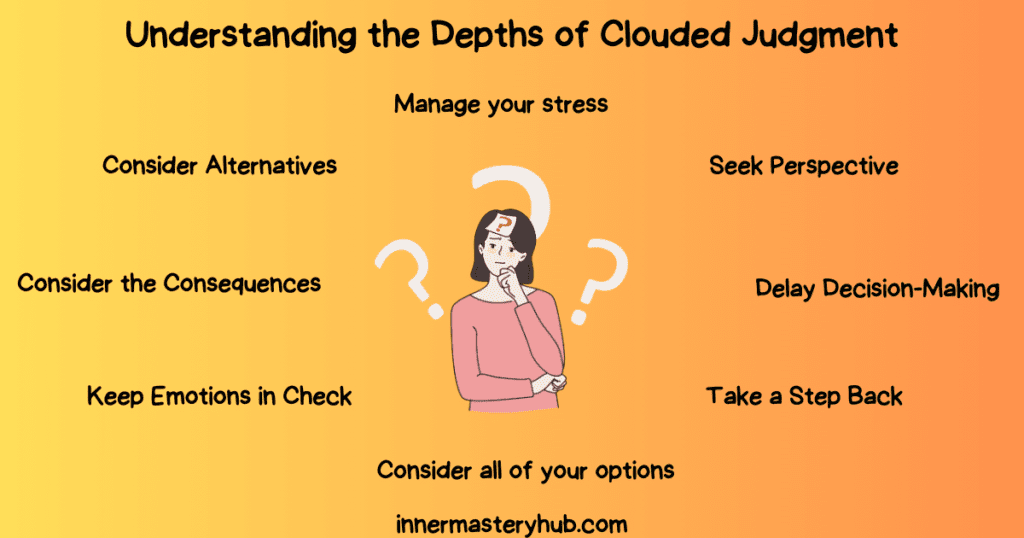
Clouded judgment means you can’t think clearly or assess a situation fairly because emotions, stress, tiredness, or personal biases influence your decisions. You may overlook important facts, react too quickly, or struggle to consider the consequences of your choices.
What Is Clouded Judgment?
Clouded judgment means having difficulty thinking clearly or making sensible decisions because stress, strong emotions, tiredness, or personal biases are affecting how you see a situation. You might ignore important facts, assume the worst about someone’s intentions, or make a decision you later regret.
For example, after a stressful day, you might misread a harmless comment as criticism and respond angrily. Or you could agree to something you don’t want because you’re worried about disappointing someone.
Research suggests that chronic stress can affect attention, working memory, and the brain functions involved in decision-making.[1] When you’re under pressure, you may focus on what feels urgent and overlook information that could change your decision.
Another common cause of clouded judgment is emotional reasoning. This happens when you treat a feeling as proof that something is true. For instance, feeling ignored by a friend might lead you to believe they no longer care about you, even though you haven’t asked why they’ve been distant.
If this sounds familiar, these examples of emotional reasoning explain why a strong feeling doesn’t always reflect what’s happening.
What Does It Mean When Something Clouds Your Judgment?
Something clouds your judgment when stress, emotions, or personal beliefs affect how you see a situation. You may jump to conclusions, ignore evidence that challenges your opinion, or make a decision before knowing the full story.
Cognitive biases are one reason this happens. With confirmation bias, you might believe a coworker dislikes you and pay attention only to their unfriendly remarks, overlooking the times they’ve been helpful. Availability bias works differently. After hearing about a plane crash, for example, you might overestimate the danger of flying because that incident is fresh in your memory.
Anxiety can affect your decisions, too. If a friend hasn’t replied to your message, you might assume you’ve upset them and send several follow-up texts. You have no evidence they’re angry, but your worry has already shaped your response. This is one way feelings can be mistaken for facts.
Research by Tversky and Kahneman (1974) describes how mental shortcuts, including availability bias, influence judgments when information is uncertain.[2]
7 Signs of Clouded Judgment
Clouded judgment can affect how you respond to people, weigh your options, and make everyday decisions. You may not notice it until you’ve said something you regret or overlooked a detail that could have changed your choice.
1. You Make Impulsive Decisions
You send an angry message without reading it twice, spend money you had planned to save, or agree to something before checking whether you have time for it. The consequences only become clear afterward. These impulsive decisions can happen when you’re caught up in the moment.
2. You Struggle to Think Clearly
You read the same email three times, lose track of what someone is saying, or forget details you normally remember. Even a straightforward decision feels difficult because you can’t concentrate long enough to compare your options.
3. You Ignore Facts or Advice
You’ve made up your mind about a business opportunity, even though the numbers don’t add up. When someone points out the risks, you defend your decision rather than consider what they’re saying. You pay attention to information that supports your opinion and dismiss the rest.
4. You React Emotionally
A coworker questions something you’ve done, and you immediately become defensive. You interrupt, raise your voice, or assume they’re trying to embarrass you. Later, you realise they were simply asking for clarification.
5. You Find It Hard to See Other Perspectives
During an argument, you’re busy preparing your next response instead of listening. You assume the other person is being unreasonable without asking why they see things differently. Sometimes, considering another person’s perspective reveals something you hadn’t considered.
6. You Constantly Second-Guess Yourself
You decide to accept a job offer, then spend the evening wondering whether you should turn it down. You ask several people for advice, compare the same options repeatedly, and still feel unsure. Every possible outcome becomes another reason to reconsider.
7. You Repeat the Same Mistakes
You lend money to someone who has never repaid you or repeatedly trust promises that haven’t been kept. Each time, you convince yourself the situation will be different. You remember what you hope will happen more clearly than what has happened before.
Research by Tversky and Kahneman (1974) shows how mental shortcuts can influence judgment when information is uncertain. Arnsten (2009) also explains how stress can interfere with brain functions involved in attention and cognitive control. These findings help explain why people sometimes overlook evidence or struggle to weigh their choices under pressure.[2]

Examples of Clouded Judgment in Everyday Life
Clouded judgment can happen during an argument, in a relationship, or at work. You may misunderstand someone’s intentions, overlook repeated behaviour, or miss an important detail because you’re tired.
During an argument: Your partner replies with a short “OK” to your message. You assume they’re angry and send another text accusing them of ignoring you. Later, you discover they were in a meeting and couldn’t respond properly. You reacted to what you thought the message meant without checking. This is an example of emotional reasoning, where a feeling is treated as evidence.
In a relationship: Someone you’re dating cancels plans for the third time in a month. They apologise and promise it won’t happen again, so you rearrange your schedule once more. You remember their promises but overlook how often they’ve let you down. Strong feelings can make it harder to recognise relationship red flags that you might notice more easily in someone else’s situation.
At work: You’ve slept only four hours a night for several days. Your manager asks you to check a client’s invoice before sending it. You skim the figures, approve the document, and discover the next morning that the total was incorrect. You were too tired to give the task your usual attention, but you didn’t notice how much your concentration had slipped.
Clouded Judgment vs. Clear Judgment
| Aspect | Clouded Judgment | Clear Judgment |
|---|---|---|
| Thinking Style | Influenced heavily by emotions, stress, or assumptions | Considers emotions, facts, and different perspectives |
| Decision-Making | May involve rushed decisions or excessive hesitation | Takes appropriate time to evaluate choices |
| Focus | Concentrates on immediate feelings or concerns | Considers both present circumstances and long-term consequences |
| Role of Facts | May overlook or selectively interpret evidence | Examines available facts, including conflicting information |
| Emotional Influence | Strong emotions may distort how a situation is perceived | Recognises emotions without allowing them to dominate decisions |
| Perspective | Struggles to consider alternative explanations | Remains open to other viewpoints and possibilities |
| Self-Awareness | May not recognise when stress or bias affects thinking | Notices personal biases and emotional reactions |
| Possible Outcomes | Greater risk of overlooking important details or consequences | More informed decisions, though mistakes are still possible |
How Emotions Cloud Your Judgment
Emotions can cloud your judgment when anger, fear, stress, or anxiety affects how you interpret situations and make decisions. You might mistake a question for criticism, turn down an opportunity without checking the facts, or respond to someone before hearing what they have to say.
- Anger: Your partner questions a decision you’ve made, and you take it as an insult. You interrupt them, raise your voice, and bring up an argument from last week. By the time they explain what they meant, you’ve already accused them of trying to control you.
- Fear: You’re offered a promotion but decline before asking about the responsibilities. You picture yourself making mistakes in meetings and disappointing your manager, even though you’ve handled similar work before.
- Stress: You’re running late for an appointment when your child asks where their schoolbag is. You snap at them and blame them for the delay, only to discover you moved the bag yourself that morning. When several things demand your attention, it’s easier to miss details and react without checking.
- Anxiety: Your friend hasn’t answered your message for several hours. You reread your conversation, check when they were last online, and wonder whether you’ve offended them. Before they reply, you’ve already convinced yourself something is wrong. This is an example of how feelings can be mistaken for facts.
A 2015 review by Lerner and colleagues found that emotions influence how people assess risks, interpret information, and make decisions. Anger and fear, for instance, can affect risk judgments differently. Feeling strongly about something doesn’t necessarily mean your decision is wrong, but it may affect which details you pay attention to.[3]
13 Thinking Traps That Can Cloud Your Judgment
Thinking traps can cloud your judgment without you noticing. You may believe something because it feels true, dismiss facts that challenge your opinion, or make a decision based on what you’re afraid might happen.
- Emotional Reasoning: A friend walks past without saying hello, and you immediately think they’re upset with you. You take your hurt feelings as proof, without considering that they may not have seen you.
- Confirmation Bias: You believe your manager doesn’t appreciate your work. You remember every critical remark but barely notice when they praise your efforts or trust you with an important task.
- Catastrophizing: You notice a mistake in a report you’ve submitted and spend the evening imagining you’ll lose your job. You haven’t spoken to your manager, but you’re already preparing for the worst.
- Overconfidence: You’ve made a few profitable investments, so you put a large amount of money into another one without checking the risks. You assume your past success means you can’t be wrong this time.
- Fear-Based Thinking: You’re offered a chance to lead a project, but you decline because you’re worried about making mistakes in front of your colleagues. You want the opportunity, yet the possibility of embarrassment determines your choice.
- Black-and-White Thinking: You receive positive feedback on most of your presentation, along with one suggestion for improvement. Instead of noticing what went well, you decide the entire presentation was a failure.
- Peer Pressure: Your friends plan an expensive holiday, and you agree to go even though you can’t afford it. You’d rather struggle with the bills afterward than tell them you need to stay within your budget.
- Stress Overload: You’re already behind on two deadlines when your supervisor gives you another assignment. Instead of explaining your workload, you agree to finish everything by Friday. You only realise later that the deadlines overlap.
- Mental Exhaustion: After working late for several nights, you skim an email and mistake the delivery date. You confirm the order without checking the details and discover the error when the client calls.
- Impulsive Thinking: Someone makes a rude comment during a disagreement, and you immediately send a message ending the friendship. By morning, you wish you’d given yourself time to respond.
- Falling in Love Blindly: Someone you’re dating keeps cancelling plans and making promises they don’t keep. You tell yourself they’re just busy, even though the same thing happens every week. You may overlook relationship warning signs because you’re hoping things will improve.
- Holding on to Old Beliefs: You’ve always handled a particular task the same way. A colleague shows you a quicker method and explains how it works, but you dismiss it without trying because you’re convinced your approach is better.
- Negative Self-Talk: You forget one important point during a meeting and spend the rest of the day calling yourself incompetent. When another chance to present comes up, you avoid it because you’ve already decided you’re not capable.
How to Avoid Clouded Judgment: Practical Steps
To avoid clouded judgment, notice when you’re about to respond without checking the facts. Anger might make you send a message you later regret, while fear could lead you to turn down an opportunity before finding out what’s involved. Here are some ways to handle those situations.
1. Notice When You’re Getting Defensive
Someone questions your decision, and you immediately start explaining why you’re right. You interrupt before they’ve finished speaking or assume they’re criticising you. If you recognise these signs of emotional flooding, tell them you need a moment before continuing.
2. Wait Before Sending an Angry Message
You’ve written a long reply to someone who upset you. Leave it in your drafts and read it again later. You may find that you’ve accused them of something they never said or included remarks that will only make the argument worse.
3. Slow Down Your Breathing
During an argument, you notice your heart racing, your shoulders tightening, or your breathing becoming shallow. Sit down and take a few slow, comfortable breaths before speaking again. You may find it easier to listen once the physical tension has eased.
4. Ask Someone Who Knows the Situation
You believe a colleague deliberately left you out of a meeting. Before confronting them, ask another team member how the meeting was arranged. You might discover the invitation list was incomplete rather than intentionally excluding you.
5. Don’t Make Major Decisions in the Middle of an Argument
You’re furious with your manager and feel like resigning immediately. Instead of sending a resignation email, wait until you’re calmer and review your options, including whether the problem can be resolved. A decision affecting your income deserves more consideration than a heated conversation allows.
6. Think About What You Could Lose
A relative asks to borrow money, but you’re already struggling with bills. Before agreeing, calculate what you’ll have left for rent, groceries, and other expenses. Looking at the real cost of everyday choices can help you notice expenses or consequences you might otherwise overlook.
7. Compare the Details, Not Just the First Impression
A new job offers a higher salary, and you’re ready to accept. Before deciding, check the working hours, commute, benefits, and contract terms. The extra money may be worthwhile, but it isn’t the only detail that matters.
8. Separate What Happened From What You Assume
Your friend cancels dinner, and you decide they’re avoiding you. What you know is that they cancelled. What you don’t know is why. Ask before treating your assumption as a fact.
9. Leave Difficult Decisions Until You’re Rested
After several nights of poor sleep, you struggle to follow an important document. If the decision isn’t urgent, review it when you’re rested. Fatigue can make it harder to notice errors or remember details.
Research suggests that sleep deprivation can affect attention and make it harder to assess information and make decisions, particularly in unfamiliar or demanding situations.[4]
10. Pay Attention to Changes in Your Behaviour Under Stress
You’ve been forgetting appointments, snapping at people, and accepting work you don’t have time to finish. Notice when these things happen and what was going on beforehand. Paying attention to these patterns is part of developing emotional awareness.
11. Avoid Making Important Decisions While Impaired
Alcohol and other impairing substances can affect how you judge risks and consequences. Don’t sign important agreements, make major purchases, or drive while impaired. If medication makes you unusually drowsy or confused, speak with your healthcare professional about its effects.
When Should You Seek Professional Help?
Consider speaking with a mental health professional if clouded judgment becomes a regular problem, affects your relationships, or makes everyday decisions difficult. For example, you may repeatedly act on anger, struggle to make simple choices, or find yourself making decisions that put your finances or safety at risk.
You may benefit from professional support if:
- Impulsive decisions are causing problems. You repeatedly spend money you can’t afford, quit jobs during disagreements, or damage relationships through angry reactions.
- Your emotions are difficult to manage. Small disagreements leave you shouting, crying, or unable to continue a conversation. These may be signs of emotional flooding, particularly when they happen frequently.
- Stress is affecting your daily responsibilities. You miss appointments, forget important tasks, or struggle to finish work because you’re constantly worried about what might go wrong.
- Confusion or difficulty concentrating keeps returning. You frequently lose track of conversations, cannot follow familiar instructions, or struggle with decisions you previously handled without difficulty.
- Your decisions are affected by ongoing mental health or substance-use concerns. Anxiety, depression, trauma-related symptoms, or substance use may be contributing to difficulties with concentration and decision-making. If past experiences still affect how you respond to situations, learning about emotional triggers may provide useful context.
- People close to you have noticed concerning changes. Family members or friends mention that you’re behaving unusually, taking risks you previously avoided, or having difficulty managing familiar responsibilities.
A therapist or counsellor can help you examine recurring emotional and behavioural patterns. A healthcare professional can also check whether sleep problems, medication effects, or other medical conditions are contributing to changes in your thinking.
Important: If confusion or impaired judgment appears suddenly, especially alongside difficulty speaking, weakness, a severe headache, or unusual drowsiness, seek emergency medical care rather than waiting for a mental health appointment.
Conclusion
Clouded judgment can lead you to send an angry message, overlook warning signs in a relationship, or make a rushed decision when you’re exhausted. Stress, fear, and personal assumptions can affect which details you notice and which ones you ignore.
Before making an important decision, check what you actually know and what you’re assuming. If you’re upset, give yourself time to reconsider. You might find that a situation looks different once you’ve heard the other person’s explanation or reviewed the facts.
Recognising these patterns is part of developing self-awareness. You won’t always make the right choice, but you can become better at noticing when your judgment needs a second look.
People Also Ask
What does clouded judgment mean?
Clouded judgment means having difficulty thinking clearly or making balanced decisions because emotions, stress, tiredness, or personal beliefs are influencing how you assess a situation. It is the British English spelling of clouded judgment.
What does it mean to cloud your judgment?
To cloud your judgment means to affect your ability to evaluate a situation fairly or make a sensible decision. For example, anger might cloud your judgment during an argument, causing you to react before considering the consequences.
Can anxiety cloud your judgment?
Yes. Anxiety can make potential threats seem more important than they are, sometimes leading to rushed decisions, avoidance, or excessive second-guessing. However, feeling anxious doesn’t automatically mean your judgment is impaired.
Does anger cloud judgment?
Yes, anger can cloud judgment when you react before understanding what happened. You might interrupt someone, assume they meant to insult you, or send a message you later regret. Anger doesn’t always lead to poor decisions, but it can affect how you interpret someone’s behaviour.
Why does exhaustion cloud mental judgment?
Exhaustion can make it harder to concentrate, remember details, and compare options. After several nights of poor sleep, you might misread an email, overlook a deadline, or agree to something without checking your schedule.
How do we not let emotions cloud judgment?
Learn to identify emotions, delay decisions, seek facts, ask for advice, and use decision-making systems to prevent emotion from clouding judgment. Blend passion with rationality and objectivity.
Can emotions override logic?
Strong emotions can affect which facts you notice and how quickly you respond. For example, fear might cause you to reject an opportunity before asking about the risks. Emotions and logical thinking aren’t opposites, but intense feelings can sometimes interfere with careful decisions.
What causes clouded judgment?
Common causes include stress, strong emotions, sleep deprivation, cognitive biases, and pressure from other people. Alcohol and certain medications can also impair judgment. The effects depend on the situation and the individual.
- Arnsten, A. F. T. (2009). Stress signalling pathways that impair prefrontal cortex structure and function. Nature Reviews Neuroscience, 10(6), 410–422. https://doi.org/10.1038/nrn2648 ↩︎
- Tversky, A., & Kahneman, D. (1974). Judgment under uncertainty: Heuristics and biases. Science, 185(4157), 1124–1131. ↩︎
- Lerner, J. S., Li, Y., Valdesolo, P., & Kassam, K. S. (2015). Emotion and decision making. Annual Review of Psychology, 66, 799–823. ↩︎
- Harrison, Y., & Horne, J. A. (2000). The impact of sleep deprivation on decision making: A review. Journal of Experimental Psychology: Applied, 6(3), 236–249. https://doi.org/10.1037/1076-898X.6.3.236 ↩︎
Written By Mehwish Qurayshi
Mehwish Qurayshi is a Trauma-Informed Emotional Wellness Counsellor trained through NICABM’s Treating Trauma Master Series, which includes NBCC-approved education in Trauma Treatment and Emotional Wellness & Emotional Intelligence – Sourcecode Academia. She has over five years of experience providing emotional wellness counselling, helping individuals heal from trauma, regulate emotions, and build healthy relationships.