
Being a Rescuer: 11 Risky Patterns Behind the Need to Fix
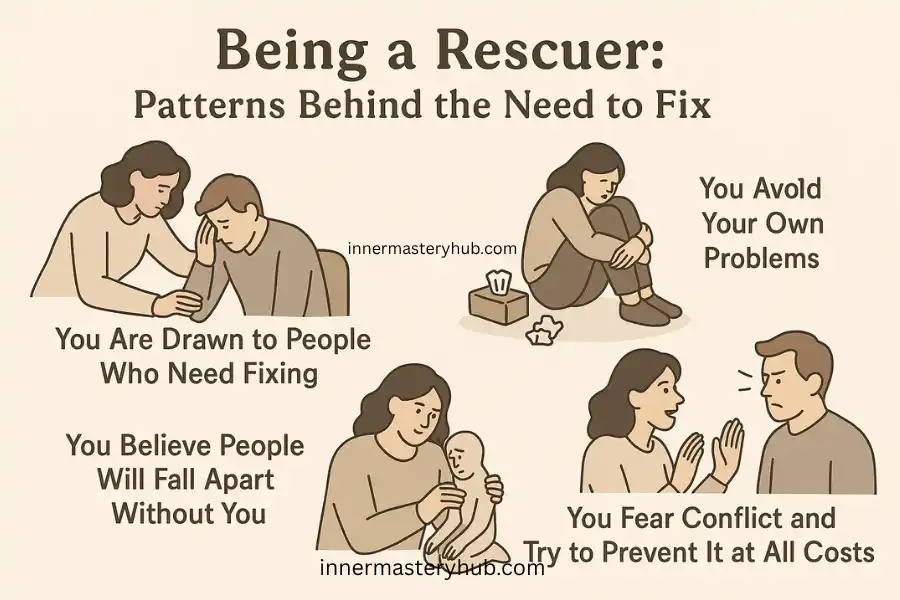
Being a rescuer is a psychological pattern where you feel responsible for solving other people’s emotional problems, often at the cost of your own well-being. It is usually driven by early attachment wounds, nervous-system Survival responses such as the fawn response, and unconscious beliefs that your worth depends on being needed. Over time, this creates burnout, resentment, and emotional exhaustion while keeping real intimacy out of reach.
If you take a careful look at being a rescuer, you might see that it manifests itself in many different aspects of your life involuntarily. You may volunteer to take on emotional burdens that aren’t yours, propose answers before anyone asks, or step in to ease tension. This initially appears responsible and compassionate, but the pattern eventually grows tiresome.
You feel worn out, undervalued, misinterpreted, or taken advantage of, and may wonder why you keep going through this pattern. Many people encounter this dynamic without understanding its root causes and how to establish more constructive and emotional boundaries.
What is the Rescuer Pattern in Psychology?
Being a rescuer is a behavioral and emotional pattern where a person feels compelled to fix, save, or manage other people’s problems, often ignoring personal boundaries. It is closely linked with codependency, trauma responses, and attachment insecurity.
This pattern is not about genuine help. Healthy help respects boundaries. Rescuing crosses them.
Definition
Being a rescuer is a role in the “drama triangle” model, in which a person unconsciously takes responsibility for others’ emotional regulation rather than their own.
Cause
- Childhood emotional neglect or inconsistency
- Parentification (acting like a caregiver too early)
- Fear of abandonment or rejection
- Nervous system fawn response
Effect
- Chronic exhaustion
- Loss of identity
- Resentment in relationships
- Anxiety when not needed
Example
A friend is upset, and instead of listening, you immediately try to solve their life. You feel uneasy until they feel better, even if it costs your own peace.
Research in attachment theory shows that early caregiving environments strongly shape adult emotional regulation patterns1.
Why Do People Become Rescuers?
People become rescuers because their nervous system has learned that emotional safety comes from being useful, needed, or responsible for others. This develops in childhood environments where emotional needs were unpredictable or conditional.
Trigger → Interpretation → Emotion → Consequence
- Trigger: Someone shows distress or emotional instability
- Interpretation: “If I don’t fix this, something bad will happen.”
- Emotion: Anxiety, guilt, urgency
- Consequence: Over-helping, over-explaining, self-sacrifice
This cycle becomes automatic.
A key factor is the fawn response, a trauma-based Survival strategy where a person appeases others to stay emotionally safe. Research on trauma responses shows that fawning is linked to chronic relational stress and attachment insecurity2.
11 Risky Patterns Behind Being a Rescuer
1. You Learned Early That Your Worth Came From Helping
If you grew up in a home where conflict was common, you may have learned to stay alert and step in to calm the situation. Research on family dynamics shows that children often assume roles, such as the peacemaker or caretaker, to maintain a predictable environment. If the adults were overwhelmed, you might have worked hard to carry responsibilities long before you were ready.
As an adult, this turns into an automatic instinct to fix everything for everyone. You feel uncomfortable when others struggle because it reminds you of old stress you never processed. When you ask yourself where you first learned to carry burdens that weren’t yours, you start noticing patterns that were formed out of Survival, not preference. To work this out, accepting this, can help you begin separating who you became out of necessity from who you want to be now.
2. You Feel Responsible for Other People’s Emotions
As a rescuer, you find it challenging to keep your own emotional experiences separate from others’. People who grow up in unpredictable households develop a heightened awareness of the moods around them. When someone is upset, you sense it in your body and feel obligated to make things right right away. If you fear you made someone uncomfortable, you might feel stressed, overthink, or replay conversations. Because you are bearing burdens no one asked you to, you become emotionally exhausted.
You can gently remind yourself that discomfort is common in relationships by taking a moment to reflect on your response. You don’t need to absorb to care. You don’t have to rush to find a solution. You can listen without rushing to solve. And you can support without apologizing for things that are not yours.
3. You’re afraid of disappointing other people, so you go overboard
You may reflexively answer “yes” even when you’re overwhelmed if saying “no” seems like rejection. Many people-pleasing behaviors stem from a fear of negative judgment and a desire for acceptance, according to social psychology research.
You can think that how helpful you are defines your worth. Because your needs remain at the bottom of your list, this anxiety usually ends in burnout. You can understand the fundamental ideas that influence your decisions by considering why failing someone seems like such a high cost. You begin to see that setting appropriate boundaries doesn’t drive people away. They help you stay grounded.
4. You Are Drawn to People Who Need Fixing
It’s not a coincidence if you constantly find yourself in friendships or relationships with people who are emotionally unavailable, suffering, or chaotic. People with anxious tendencies tend to feel most needed when the other person is unstable. You could mistake feeling loved for feeling needed. The issue is that these connections force you into a vicious cycle of giving more than you get in return.
You might continue trying to “save” the other person, hoping they will finally grant you the stability you offer. You eventually realize that the dynamic leaves you exhausted and undervalued. You can choose partnerships based on mutual respect when you consider what attracts you to those in need of rescue.
5. You Struggle to Sit With Other People’s Discomfort
As a rescuer, you often need to intervene quickly when someone is feeling anxious or depressed. Emotional strain is the source of this discomfort. Many adults suffer from stress because they were never taught how to sit with complex emotions. When you witness someone in pain, you may feel restlessness until the issue is addressed.
You remedy discomfort because it feels unsafe, not because you seek control. And try to build resilience gradually as you start to pause rather than rush in. You develop the ability to let people go through their own emotional journey without interfering. You also allow yourself to admit when you’re uncomfortable. As a result, relationships improve, and support is no longer dependent on ongoing intervention.
6. You Take Pride in Being the Strong One
As a Rescuer, you often see yourself as trustworthy, stable, and competent. These are admirable traits, but the problem arises when you feel like you have to be the strong one all the time. You may experience pressure to maintain a characteristic, even when it is detrimental to you, if it becomes essential to your identity. You may cover up your own difficulties, overwork yourself, or deal with circumstances in silence if you think that being strong means never requiring help.
Vulnerability seems dangerous, so you continue even though the expectation wears you out. You realize that strength does not mean doing everything by yourself when you return to the moments when you wished someone had helped you. Allowing others to support you is a sign of true strength.

7. Being a Rescuer You Avoid Your Own Problems by Fixing Other People’s
Rescuing can occasionally be a diversion. When you focus on the outside world, it can temporarily reduce anxiety by providing a sense of direction and purpose, and helping someone else can give relief if your own feelings are unclear or burdensome. It may seem more straightforward to solve their issue than to deal with your own anxieties, sadness, or uncertainty.
As time goes on, you might discover that while helping others gives you a sense of purpose, it also prevents you from taking care of your own needs. You start to develop emotional honesty when you take a moment to reflect on what you are avoiding. This change enables you to provide support without losing sight of your own recovery.
8. You Believe People Will Fall Apart Without You
You can underestimate other people’s capacity to cope if you were raised with excessive responsibility. Over-functioning and learnt helplessness in relationships, when one person repeatedly intervenes, the other person may never gain self-assurance or problem-solving abilities. You may feel bad about taking a step back because you worry something negative might happen.
You can feel that your participation is the only thing keeping your life stable. This is a burdensome belief that supports connections that require ongoing work. You find that people are more capable than you anticipated when you gradually let them make their own decisions. This relieves you of the burden of being the sole one keeping things together.
9. You Feel Uncomfortable Receiving Help
Being a rescuer, you feel exposed when they receive help. According to studies on reciprocity norms, giving makes people feel comfortable, but getting makes them feel exposed. When attention turns to your needs, you could feel uncomfortable or anxious about being a burden.
You end up giving far more than you let yourself get as a result of this imbalance. This eventually results in emotional loneliness and exhaustion. You broaden your sense of what you deserve by practicing letting people help you, even in small ways. You discover that compassion is reciprocal and that when others can support your well-being, they feel more connected to you.
10. You Fear Conflict and Try to Prevent It at All Costs
Because disagreements seem dangerous, as a rescuer, you try to step in before issues get out of hand. Those who experience high levels of conflict in their early years often associate disagreement with emotional harm. You may intervene swiftly to defuse the situation or offer ideas to avoid conflict. Even with the best of intentions, it usually prevents open communication.
Instead of learning how to settle disputes on their own, others could expect you to arbitrate their problems or rely on your composure. You build trust in your relationships when you start letting disagreements develop without getting involved. You let go of the belief that you must maintain peace on your own and discover that disputes do not always result in havoc.
11. You Tie Your Identity to Being a Rescuer
Among the deepest patterns is this one. After years of problem-solving, comforting, and encouraging, you might not know who you are outside of that role. People stick to positions that offer a sense of security. If being the rescuer is central to your identity, you could worry that taking a back seat will make you appear irrelevant, self-centered, or detached.
However, the number of repairs you make does not determine your value. Beyond accountability, your identity can encompass personal development, creativity, relaxation, and genuine connection. You start creating a life that includes you and the needs of those around you when you consider your goals beyond helping others.
How Being a Rescuer Affects Your Nervous System
Being a rescuer keeps the nervous system in a chronic state of hypervigilance, where emotional safety depends on monitoring and fixing others. This creates long-term stress activation and emotional fatigue.
When you constantly scan others’ emotions, your body never fully relaxes.
Effect on body and mind
- Increased cortisol (stress hormone)
- Emotional reactivity
- Sleep disturbances
- Burnout symptoms
- Reduced emotional clarity
Neuroscience research shows that chronic caregiving stress can affect emotional regulation circuits in the brain, particularly those linked to empathy and stress-response systems3.
Common Mistakes People Make When They Are Rescuers
Most rescuers mistake emotional responsibility for emotional love, leading them to over-function in relationships while under-functioning in self-care.
Mistake 1: Confusing empathy with fixing
You think understanding someone means solving their problems.
Mistake 2: Believing boundaries are selfish
You see limits as rejection instead of regulation.
Mistake 3: Avoiding emotional discomfort
You try to eliminate discomfort instead of allowing it.
Mistake 4: Ignoring reciprocity
You give more than you receive and normalize imbalance.
How Being a Rescuer Impacts Relationships
Being a rescuer often creates an imbalance in relationships, where one person gives excessively while the other unconsciously takes, leading to emotional dependency and resentment.
Relationship effects
- One-sided emotional labor
- Lack of mutual growth
- Hidden resentment
- Emotional burnout
- Attraction to dependency dynamics
This often aligns with codependency patterns, widely studied in psychological literature as an excessive emotional reliance on others for identity and validation.
Is being a rescuer the same as being codependent?
They are closely related but not identical. Codependency is a broader relational pattern, while rescuing is a specific role within it where you take responsibility for others’ emotional states and problems.
The Inner Shift: Seeing the Pattern Differently
The most important shift is realizing that being a rescuer is not about kindness gone wrong, but about an old emotional Survival strategy that no longer fits your present life.
You are not fixing people because they need you to.
You are fixing because your nervous system learned that stillness feels unsafe.
When that truth becomes visible, something softens inside.
Not because everything changes immediately, but because the pressure to over-function starts to lose its grip.
A Self-Reflection Exercise to Support Your Shift
Take a moment to ask yourself:
- What situations automatically pull me into fixing Mode?
- What emotions come up when I try to step back?
- What would support look like if I didn’t take complete responsibility?
- What small boundary can I practice this week?
The goal is not to change everything at once but to build awareness. Awareness is what gives you the power to choose instead of react.
Choosing a Healthier Path Beyond Being a Rescuer
Breaking the habit of being a rescuer does not imply a lack of compassion. Instead of always being strong, accessible, or responsible, it’s about allowing yourself to be human. You create space to develop better relationships and habits when you understand the patterns that drive your motivation to change. You learn to help people without losing yourself and to allow them to develop without taking over. Relief, equilibrium, and a more profound sense of connection with yourself and the people you care about come from this change.
FAQs
What does being a rescuer mean?
Being a rescuer means you automatically try to fix people’s emotions, problems, or situations, often without being asked. You feel responsible for everyone’s well-being, which can lead to stress and burnout. This pattern usually comes from childhood experiences, people-pleasing tendencies, or a fear of disappointing others.
Why do people become rescuers?
People become rescuers because of early family roles, emotional responsibility learned in childhood, or a belief that their value depends on helping others. It can also come from anxiety, low self-worth, or a deep need for approval. Over time, fixing others becomes an automatic Survival habit.
Why do rescuers attract emotionally needy people?
Rescuers attract emotionally needy people because they offer constant support, stability, and emotional labor. People who struggle with boundaries are often drawn to someone who overgives. This creates an uneven relationship where one person fixes and the other depends heavily on them.
What is the difference between helping and rescuing?
Helping is supportive and respectful of another person’s abilities. Rescuing takes over their responsibilities, creates dependency, and drains your energy. Helping empowers, while rescuing controls. The difference is whether you’re offering support or removing the other person’s chance to solve things themselves.
Are rescuers connected to trauma?
Yes, rescuing is often linked to emotional or relational trauma. Children in chaotic or unstable homes may become caretakers early, learning to manage others’ emotions to ensure their own safety. This childhood pattern follows them into adulthood, shaping how they connect, help, and handle stress.
How do I set boundaries as a rescuer?
Start by pausing before saying yes, expressing what you can realistically offer, and allowing others to handle their own issues. Communicate limits clearly and remind yourself that boundaries protect your well-being. You can still care without taking responsibility for everything.
- Bowlby, J. Attachment Theory (overview via APA): https://www.apa.org/pi/families/resources/attachment ↩︎
- Walker, P. (2013). Complex PTSD and Trauma Responses ↩︎
- Arnsten, A. F. T. (2009). Stress signaling pathways that impair prefrontal cortex structure and function.
https://doi.org/10.1038/nrn2648 ↩︎
Written By Mehwish Qurayshi
Mehwish Qurayshi is a Trauma-Informed Emotional Wellness Counsellor trained through NICABM’s Treating Trauma Master Series, which includes NBCC-approved education in Trauma Treatment and Emotional Wellness & Emotional Intelligence – Sourcecode Academia. She has over five years of experience providing emotional wellness counselling, helping individuals heal from trauma, regulate emotions, and build healthy relationships.