
Why Do I Hate Being Corrected? 10 Reasons It Can Feel So Personal

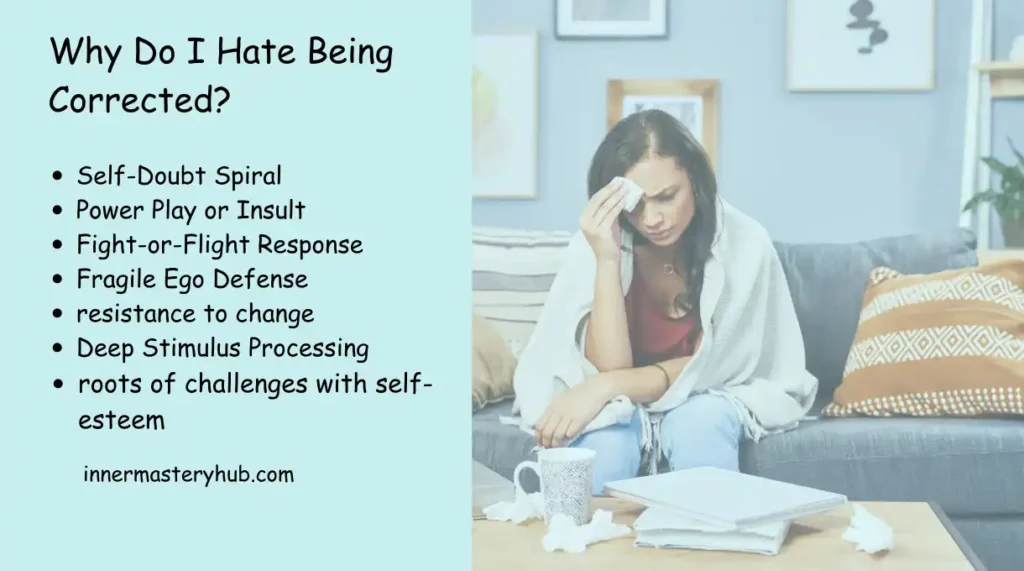
Sometimes being corrected stings even when the other person is right.
You may notice embarrassment first, then irritation. Or you may immediately want to explain yourself before you have even thought about what was said.
The reason can be different each time. A correction from a trusted friend may feel completely different from one given publicly by a boss, partner, or someone who often talks down to you.
Instead of asking, “Why am I so defensive?” try noticing what felt uncomfortable in that moment. Was it the mistake itself, the tone, the audience, or the way you felt about yourself afterward?
What Does “I Hate Being Corrected” Mean?
When you say, “I hate being corrected,” the mistake may not be the part that bothers you most.
You might feel embarrassed, annoyed, or talked down to. Being corrected in front of other people can also feel different from hearing the same thing in private.
The way feedback is given matters. In one study, people who received harsh criticism reported more anger and tension than those who received constructive criticism. They were also more likely to avoid or push back against the person giving the feedback.[1]
Other research suggests that feedback can feel harder to take when it touches something you already feel unsure about in yourself.[2]
So ask yourself:
Was I upset about being wrong, the way it was said, who said it, or what I thought the mistake meant about me?
10 Reasons Being Corrected Can Feel So Personal
There is no single reason correction bothers people. Your reaction can depend on who says it, how they say it, where it happens, and what the mistake means to you.
1. You Feel Embarrassed
Being corrected in front of other people can make you feel exposed.
You may be less bothered by the mistake itself and more bothered by the thought that other people noticed it too.
2. You Feel Talked Down To
Tone matters.
A useful correction can still feel irritating if it comes across as sarcastic, dismissive, or patronizing. Sometimes your reaction is to the way something was said, not the information itself.[1]
3. You Start Doubting Yourself
One mistake can sometimes make you question other things you were confident about.
You might think, “If I got this wrong, what else am I missing?”
That does not happen to everyone, but it can make a small correction feel bigger than it is.
4. It Feels Like a Challenge to Your Role
Being corrected can feel different when you are expected to know what you are doing.
If you are leading a meeting, teaching someone, or speaking about something you know well, a public correction may feel more uncomfortable because your competence is already on display.
5. The New Information Conflicts With What You Believed
Sometimes you are sure you are right until someone gives you information that does not fit what you already believe.
That can feel uncomfortable because you now have to reconsider something you had already accepted as true. Psychologists often describe this kind of tension as cognitive dissonance.
6. Past Criticism Still Affects How You Hear Feedback
If mistakes were often met with ridicule, anger, or harsh criticism when you were younger, correction may feel more loaded now.
That does not mean every strong reaction comes from childhood or trauma. But past experiences can affect how comfortable you feel making mistakes around other people.
Research has linked restrictive or rejecting parenting with higher self-criticism later in childhood.[3] That does not mean a strong reaction to correction always comes from childhood, but earlier experiences may shape how comfortable you feel making mistakes around other people.
7. You Want to Explain Yourself Straight Away
Sometimes your first response is:
“That’s not what I meant.”
“You don’t understand what happened.”
“Let me explain.”
You may be trying to add context, but to the other person it can sound like you are refusing to hear the correction.
8. Being Right Is Important to How You See Yourself
If you take pride in being knowledgeable, careful, or capable, mistakes can feel more personal.
Research on self-threatening feedback suggests that people process negative information differently when it challenges an important part of how they see themselves.[2] More recent work also found that feedback that strongly conflicted with a person’s self-view was associated with greater changes in self-concept.[4]
The correction may seem to challenge something you value about yourself, even when the other person is only pointing out one error.
9. You Do Not Trust the Person Correcting You
The same feedback can feel completely different depending on who gives it.
You may listen easily to someone you respect but become irritated when the correction comes from someone who often criticizes you, embarrasses you, or tries to prove you wrong.
Sometimes the relationship matters as much as the correction.
10. You React Before You Have Time to Think
You may feel annoyed immediately and only understand why later.
Instead of forcing yourself to respond perfectly in the moment, give yourself a second to notice what happened.
Ask:
“Am I bothered by the correction, the way it was said, or what I think it says about me?”
Your answer may be different depending on the situation.
Is It Normal to Hate Being Corrected?
Yes, it can be normal to feel annoyed or embarrassed when someone corrects you.
It may bother you more if it happens in front of other people, the person sounds harsh, or the mistake touches something you already feel unsure about.
In one study, people who received harsh criticism reported more anger and tension than those who received constructive feedback.[1]
Research on embarrassment also shows that worrying about how other people see you can make these moments feel worse.[5]
What matters is noticing when correction bothers you most and what made that moment feel uncomfortable.
What Is the Psychological Reason Behind This Reaction?
There is no single reason being corrected feels difficult.
Sometimes it hits a sensitive spot. If you see yourself as smart, careful, or good at something, being told you are wrong can feel uncomfortable.
You may start explaining yourself, dismiss what the other person said, or get irritated before you have really thought about the feedback.
This can happen when new information does not fit with what you already believe about yourself or the situation.
Your reaction can also change depending on who corrected you, how they said it, and whether other people were there.

What Are Common Mistakes People Make When They Hate Being Corrected?
When correction feels personal, you may react before you have fully heard what the other person is saying.
Some common reactions are:
- Interrupting or arguing straight away
- Shutting down and saying very little
- Avoiding people who often correct you
- Rejecting feedback before checking whether it is useful
- Staying annoyed with the person long after the conversation ends
These reactions can make the conversation harder than it needs to be.
You may miss useful feedback, turn a small disagreement into a bigger one, or make it harder for the other person to speak openly with you.
A better first step is to hear the correction before deciding whether you agree with it.
Why Hating Being Corrected is Wrecking Your Life More Than You Think
Let’s shake things up, as neglecting your hatred of correction could have serious implications. Imagine a coworker correcting you in front of the team. You stay quiet or lash out instead of learning.
This damages relationships, career advancement, and mental health. Psychologists say being defensive about ego threats for a long time can drive people to stop providing you feedback, leading to isolation.
A study on owning up to mistakes found that perfectionists who hate criticism have low self-esteem and are more likely to be anxious and depressed, thinking about connections. “I hate being corrected” destroys trust if you argue with your partner every time they correct you.
Social psychology studies show that defensive attitudes harm relationships and exacerbate small fights6. Very sensitive people may avoid genuine interactions or become exhausted from people-pleasing due to severe criticism. And at work? Team members hide ideas to avoid conflict, and supervisors who can’t tell them miss out on creativity. This opposition limits personal growth.
Evolutionary psychology suggests rigid mental alignments hinder adaptation and keep you stuck in outdated ideas. Responses to childhood trauma? They shoot constantly, making every modification a battleground, increasing stress.
People who use motivated reasoning may interpret or reject data in ways that support their own opinions or desired results7. Rejecting constructive criticism on a regular basis can eventually make learning more difficult and strain relationships.
Practical Ways to Handle Being Corrected Without Taking It So Personally
You do not have to learn to enjoy being corrected. A more useful goal is to notice what happens in the moment and give yourself enough space to choose how you want to respond.
1. Give yourself a moment before answering
If a correction catches you off guard, you do not need to respond immediately.
You might say:
“Let me think about that.”
“Thanks for pointing it out. I’ll check.”
“Can you explain what you mean?”
A short pause can keep the conversation from turning into an argument before you have even decided whether the feedback is useful.
2. Notice what actually bothered you
Sometimes the mistake is not the hardest part.
Maybe you were corrected in front of other people. Maybe the tone felt dismissive. Maybe you were already having a difficult day, or the mistake touched something you care about doing well.
Ask yourself:
“What part of that interaction bothered me most?”
Understanding that can be more useful than simply telling yourself to stop being defensive.
3. Separate the feedback from the delivery
Someone can make a valid point and still communicate it poorly.
Try looking at the two separately:
Is there something useful in what they said?
Did I feel respected in the way they said it?
You can accept useful feedback without convincing yourself that sarcasm, humiliation, or disrespect was acceptable.
4. Let one mistake stay one mistake
When you care about doing something well, a correction can quickly become bigger in your mind.
“This needs changing” can start to feel like “I am bad at this.”
Try bringing the situation back to its actual size. You got one detail wrong, missed something, or have something to improve. That does not automatically say anything larger about your intelligence, ability, or worth.
5. Ask for something specific
Vague criticism is hard to use.
If someone says, “This isn’t good,” you can ask:
“What would you like me to change?”
Specific feedback gives you something concrete to work with and can make the conversation feel less personal.
6. Come back to the conversation later if you need to
You may understand feedback differently once the embarrassment, irritation, or tension has settled.
That does not mean ignoring the issue. It simply means you do not have to process everything perfectly in the first few seconds.
Sometimes returning to the conversation later gives you enough distance to decide what is useful and what you disagree with.
7. Pay attention to patterns, not one uncomfortable moment
One defensive reaction does not tell you much about yourself.
Instead, notice patterns.
- Do public corrections affect you more than private ones?
- Is feedback harder to hear from certain people?
- Do particular tones or situations make you want to explain yourself immediately?
Those patterns can help you understand what you need to work on and where you may need clearer boundaries.
If reactions to criticism repeatedly feel overwhelming or connect with difficult past experiences, talking them through with a qualified professional may also be helpful.
The goal is not to become someone who never feels embarrassed, irritated, or hurt when corrected. It is to become better at noticing those feelings without letting the first reaction make every decision for you.
How Does This Behaviour Affect Your Relationships?
Hating correction can create tension in relationships by blocking open communication and learning.
Imagine this:
A colleague gives you feedback. You react defensively. They stop giving input.
Over time:
- You miss improvement opportunities
- They perceive you as difficult
- Trust decreases
According to Carol Dweck, people with a fixed mindset see correction as a threat, while those with a growth mindset see it as an opportunity for improvement.8
What Is the Difference Between Correction and Criticism?
Correction and criticism can sound similar, but they are not always the same thing.
A correction usually focuses on something specific:
“This part needs changing.”
Criticism may go further and include judgment:
“You are not very good at this.”
Of course, real conversations are not always this clear. A correction can feel critical when it is delivered with sarcasm, frustration, or embarrassment.
That is why it can help to separate what was said from how it was said.
You may decide the information is useful even if the delivery was not.
Conclusion
You began with a feeling:
“I hate being corrected.”
By now, you may have noticed that the correction itself is only part of the experience. Sometimes what hurts more is the tone, the embarrassment, the relationship, or what the mistake seems to say about you in that moment.
You do not have to force yourself to enjoy being corrected. Instead, you can become more curious about your reaction.
Ask yourself: “What am I responding to right now, the feedback, the way it was given, or the meaning I am attaching to it?”
That small pause can help you respond with more choice. You can take in useful feedback, question what does not feel fair, and still treat yourself with respect when you get something wrong.
Frequently Asked Questions
Why do I hate being corrected so much?
Being corrected may feel especially uncomfortable when the moment involves embarrassment, a harsh tone, feeling misunderstood, or something you care about being good at. Sometimes past experiences with criticism may also influence how you respond, but that will not be true for everyone. Instead of assuming there is one psychological reason, notice which kinds of correction are hardest for you and what makes those situations different.
Is it normal to hate being corrected?
Yes. Feeling annoyed, embarrassed, or uncomfortable when someone corrects you can be a common human reaction, especially when the feedback is public, harsh, or touches something you care about. What matters more than having an initial reaction is what you do with it afterward.
How Can I Handle Being Corrected Without Getting So Upset?
You do not have to make yourself enjoy being corrected. A more realistic goal is to create a little space between your first reaction and your response.
You might pause before answering, ask what the person means, or come back to the feedback when you feel less activated. Then separate two questions: Is there something useful in what they said? And was the way they said it respectful?
You can accept useful information without pretending that every delivery was appropriate.
Does hating being corrected mean I have low self-esteem?
Not necessarily. Feeling uncomfortable with correction can happen for many reasons, including embarrassment, the way feedback is delivered, the relationship involved, or how important that particular mistake feels to you.
Self-esteem may be relevant for some people, but one reaction to criticism is not enough to tell you how healthy or unhealthy your self-esteem is.
Why does being corrected sometimes feel personal?
A correction can feel personal when you hear more than the actual information being given. For example, “This number is wrong” may momentarily feel like “I am bad at my job,” even though those are very different statements.
It can help to separate what was corrected from what you believe the correction says about you. That does not mean ignoring disrespectful feedback; it simply gives you another way to understand your reaction.
How do I handle being corrected at work?
Give yourself a moment before responding, especially if the feedback catches you off guard. You can say something simple such as, “Thanks for pointing that out. Let me look at it.”
Then decide what needs action. If the correction is accurate, fix what needs fixing. If you disagree, ask for clarification rather than turning the conversation into a debate.
And if the issue is not the correction itself but repeated public embarrassment, sarcasm, or disrespect, that is a separate workplace conversation worth addressing.
Can childhood experiences affect how I respond to correction?
They can for some people. If mistakes were regularly met with ridicule, anger, humiliation, or very harsh criticism when you were younger, you may find criticism especially uncomfortable now.
But a strong reaction to correction does not automatically mean you have unresolved childhood trauma. Your current relationships, the way feedback is delivered, stress, personality, and the situation itself can all matter too.
If you notice that criticism repeatedly brings up intense or difficult feelings, exploring those patterns with a qualified professional may be helpful.
Why do I feel embarrassed when someone corrects me?
Being corrected can feel embarrassing when you become aware that other people noticed a mistake, especially in public. You may start wondering what they think of you even when the mistake itself is small.
If this happens, try to bring your attention back to what actually occurred: you made or were told about one mistake. That is much narrower than a judgment about your overall ability or worth.
How Can I Respond Better When Someone Corrects Me?
You do not need a perfect response. Start with something small:
“Thanks, I’ll check that.”
“Can you show me what you mean?”
“I need a minute to think about that.”
Once the initial emotion settles, decide whether the feedback is useful. You can accept a valid correction, disagree respectfully, or address the way it was delivered.
Being open to correction does not require agreeing with everything someone says about you.
- Baron, R. A. (1988). Negative effects of destructive criticism: Impact on conflict, self-efficacy, and task performance. Journal of Applied Psychology, 73(2), 199–207. https://doi.org/10.1037/0021-9010.73.2.199 ↩︎
- Sedikides, C., Green, J. D., Saunders, J., Skowronski, J. J., & Zengel, B. (2016). Mnemic neglect: Selective amnesia of one’s faults. European Review of Social Psychology, 27(1), 1–62. https://doi.org/10.1080/10463283.2016.1183913 ↩︎
- Koestner, R., Zuroff, D. C., & Powers, T. A. (1991). Family origins of adolescent self-criticism and its continuity into adulthood. Journal of Abnormal Psychology, 100(2), 191–197. https://doi.org/10.1037/0021-843X.100.2.191 ↩︎
- Neel, R., Lassetter, B., & Neel, A. (2024). Exploring asymmetries in self-concept change after discrepant feedback. Personality and Social Psychology Bulletin. ↩︎
- Miller, R. S. (1995). On the nature of embarrassability: Shyness, social evaluation, and social skill. Journal of Personality, 63(2), 315–339. https://doi.org/10.1111/j.1467-6494.1995.tb00812.x ↩︎
- Lannin, D. G., Bittner, K. E., & Lorenz, F. O. (2013). Longitudinal effect of defensive denial on relationship instability. Journal of Family Psychology, 27(6), 968–977. https://doi.org/10.1037/a0034694 ↩︎
- Kunda, Z. (1990). The case for motivated reasoning. Psychological Bulletin, 108(3), 480–498. DOI: 10.1037/0033-2909.108.3.480. ↩︎
- Mangels, J. A., Butterfield, B., Lamb, J., Good, C., & Dweck, C. S. (2006). https://doi.org/10.1093/scan/nsl013 ↩︎
Written By Mehwish Qurayshi
Mehwish Qurayshi is a Trauma-Informed Emotional Wellness Counsellor trained through NICABM’s Treating Trauma Master Series, which includes NBCC-approved education in Trauma Treatment and Emotional Wellness & Emotional Intelligence – Sourcecode Academia. She has over five years of experience providing emotional wellness counselling, helping individuals heal from trauma, regulate emotions, and build healthy relationships.