9 Ways To Manage Your Own Toxic Behaviours Like a Pro
Managing your own toxic behaviours means recognizing harmful patterns in your thoughts, reactions, and habits, then taking responsibility to change them. It involves self-awareness, emotional regulation, honest reflection, and consistent effort to respond in healthier, more respectful ways toward yourself and others.
You’ve probably had moments where you reacted in a way you later regretted. Maybe you snapped, shut down, overreacted, or pushed someone away. And afterwards, you wondered: Why do I keep doing this?
Managing your own toxic behaviours is not about blaming yourself. It’s about understanding what’s happening inside you. Because these behaviours are not random, they stem from struggles with emotional regulation, past conditioning, and how you interpret situations in the moment.
The real challenge isn’t just changing behaviour. It’s facing the internal struggle between who you want to be and how you actually respond under pressure.
What it really means to manage your own toxic behaviours
Managing your own toxic behaviours means recognizing harmful emotional and behavioural patterns in yourself, understanding their triggers, and responding with awareness instead of impulse.
Toxic behaviours are repeated patterns that harm your relationships, emotional health, or self-image, often driven by unmanaged emotions.
These include:
- Overreacting emotionally
- Passive-aggressiveness
- Avoidance or withdrawal
- Constant criticism or defensiveness
But here’s the truth: these behaviours are not your personality. They are learned responses.
Why do you slip into toxic behaviour even when you care
Many people slide into toxic habits because they never learned healthy ways to deal with strong feelings. When stress hits, the brain reaches for shortcuts that once felt protective: attacking first, shutting down, people-pleasing, lying, or creating drama. These may have helped you survive difficult experiences in the past, such as neglect, betrayal, or emotional abuse. Unfortunately, what once kept you safe now keeps you stuck.
Defensive strategies like constant testing, picking fights, or pulling away at the first
Another piece of the puzzle is emotion regulation, the way you handle intense feelings. Trying to push feelings down and “hold it together” (a process called suppression) creates more stress. If you usually bottle things up until they explode, you are not weak; you have not yet been taught better tools.
The hidden cost of not learning to manage your own toxic behaviours
When you do not learn to manage your own toxic behaviours, the cost shows up everywhere. Relationships become tense and unstable. People “walk on eggshells” around you or stop sharing how they really feel. You might find that you go through the same relationship ending again and again, with different people, but the same story.
Inside, the cost is even higher. There is usually a heavy mix of shame and self-criticism after each outburst or lie. Research links ongoing shame and harsh inner attacks with long-term emotional distress, while self-compassion, treating yourself with more kindness and understanding, reduces shame and supports healing. When you hate yourself for your behaviour, you actually make it harder to change because you feel too hopeless to try.

There is also the effect on your daily life. Toxic habits at work, like gossip, passive aggression, or chronic negativity, can quietly block your progress. Toxic habits with yourself, like doom-scrolling instead of resting, drinking every time you feel low, or quitting whenever something is hard, chip away at your health and confidence as time passes. These patterns are driven by the same brain loops that sustain all habits.
Habits can be reshaped. Something triggers you, you act on routine, and you get an emotional payoff (a reward), even if the payoff is only temporary relief. Once you realise this, you can start changing your routine.
9 ways to manage your own toxic behaviours
1. Name your specific patterns without sugar-coating
You cannot change what you will not name. Write down the behaviours you are worried about and want to change. Instead of “I’m just difficult,” be specific: “I raise my voice, interrupt, and bring up old fights when I feel ignored,” or “I flirt with other people to make my partner jealous,” or “I go silent for days when someone upsets me.”
When you name the patterns, it helps your brain see them as actions rather than your identity. You are not “a toxic person”; you are someone with certain behaviours that can change. Research on shame shows that when you label yourself as bad, you feel stuck, but when you label behaviour as something you can adjust, you are more likely to take helpful steps1.
A gentle self-reflection here: if someone you love saw your list, which item would hurt them the most? That is the place where change will have the most significant positive impact.
2. Track your triggers and the feelings underneath
Once you have named your patterns, start noticing what happens right before them. Is it a specific tone of voice? Being ignored? Feeling criticized? Running late? Alcohol? Social media? The trigger may be small on the surface, but it usually taps into a deep, hidden, and unconscious fear, such as “I am not enough,” “I will be abandoned,” or “I am losing control.”
You can keep a simple note on your phone: “What just happened? What did I feel in my body? What did I tell myself?” This is not about blaming anyone else. It is about learning how your nervous system reacts. When you see the same triggers repeat, your behaviour stops feeling random and starts looking like a pattern that makes sense.
Ask yourself: “What was I really needing when I acted that way?” Maybe you needed reassurance, respect, space, or honesty. You use toxic tactics to try to get a fundamental emotional need met. This insight can help you ask for what you need more directly.
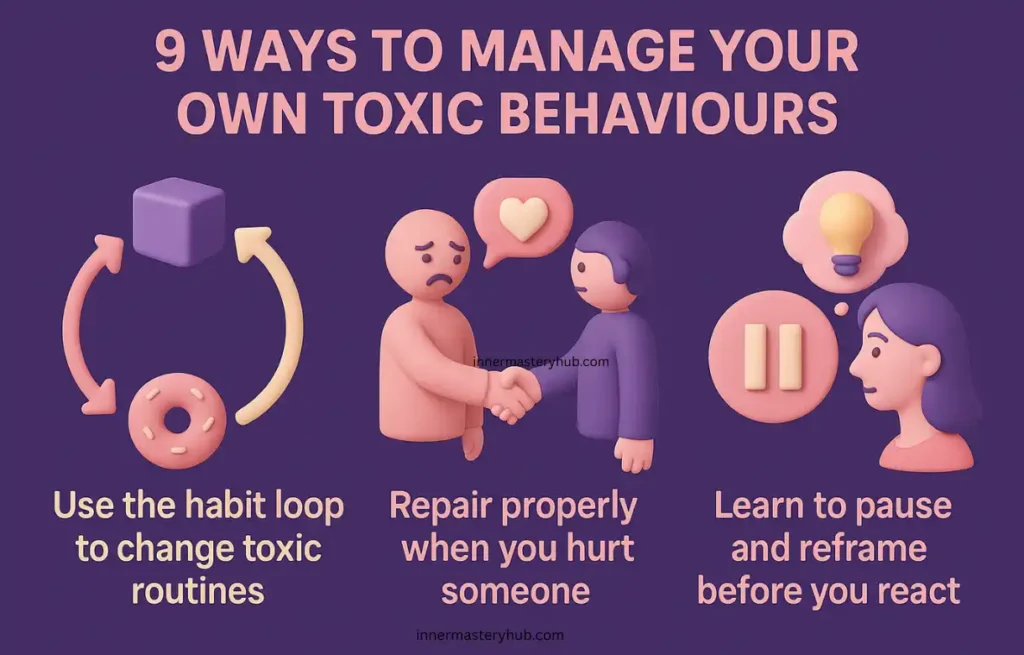
3. Learn to pause and reframe before you react
One of the most powerful skills you can build is a slight pause between trigger and action. Reframe how you see a situation, as reframing is linked with better well-being and less distress than trying to hide your feelings. For example, instead of thinking “They are disrespecting me,” you can tell yourself, “They are stressed and not thinking clearly; I can address this without attacking.”
In real life, this might look like taking three slow breaths, feeling your feet on the ground, and saying, “I need a minute to think about this,” rather than firing off a rude message or slamming a door. You are not denying your looker; you are choosing how to respond to it.
A proper reflection: remember a recent conflict. If you could replay just the first 60 seconds, what could you tell yourself differently? “This feels like past hurt, but it is not the same,” or “I can be firm without being cruel,” or “I do not need to win; I want to understand.” That one shift in meaning can change everything that follows.
4. Support your body so you are less explosive
Toxic reactions also happen when your body is flooded. Your heart races, muscles tense, and your thinking brain goes offline. When your nervous system is in that state, you are more likely to yell, blame, or shut down. Learning simple calming skills makes it easier to stay in charge of your behaviour.
You might try slow breathing, lengthening your exhale; grounding by naming five things you can see, four you can touch, three you can hear; or brief movement like a walk around the block. Being more aware of the present moment and less caught in automatic suppression is linked with better emotional well-being. You do not have to meditate for an hour a day; even a few minutes of checking in with your body can help.
You can ask yourself during the day, “Where is stress showing up in my body right now?” and “What small thing could I do in the next five minutes to help my body feel a little safer?” A calm body gives you more chances to choose a kind response.
5. Replace self-hate with self-compassion when you slip
You will not get this perfect. You will raise your voice, lie, sulk, or push someone away again. The most critical moment is what you do after that slip. Do you say, “See, I’m hopeless,” and give up? Or do you say, “This is hard, and I am learning”?
Treating yourself with warmth, understanding, and a sense of shared humanity reduces shame and harsh self-criticism and is connected to better mental health and resilience. Contrary to the fear that you will “go easy on yourself,” gentle self-talk actually makes you more willing to take responsibility and try again.
After a toxic moment, you might tell yourself, “I do not like how I behaved, but I am not beyond hope. I can own this and learn from it.” Then reflect: “What warning signs did I miss? What could I try differently next time?” This moves you from shame to growth.
6. Repair properly when you hurt someone
Managing your own toxic behaviours is not only about what happens inside you. It is also about how you clean up the mess when you hurt someone. Many people either avoid the conversation or give a vague “sorry you feel that way,” which only adds more damage. A better repair includes three parts: name it what you did, acknowledge the impact, and state how you plan to act differently next time.
For example: “Yesterday I raised my voice, interrupted you, and brought up old fights. I can see that made you feel small and unsafe with me. I am working on pausing before I react, and I will go back to therapy/ journaling/ breathing exercises to help with that.” You are not defending yourself; you are taking ownership.
Ask yourself, “If I were on the other side of this, what would I need to hear to feel that change is real?”
7. Use the habit loop to change toxic routines
Remember the cue-routine-reward loop. To manage your own toxic behaviours, you do not have to erase the cue or the noffer for relief; you only need to change the routine. For instance, the cue might be feeling rejected when your message is left unread. The old routine is to send a nasty follow-up or start an argument. The reward is a brief sense of control or attention, even if negative.
You can keep the cue and the need for connection, but build a new routine: take five minutes to breathe, write out what you are feeling, and send a calm message like, “Hey, just checking in, no rush.” Or you decide to focus on something else for 30 minutes before responding. Over time, your brain learns that this new routine also brings relief, without the wreckage.
Choose one toxic habit you want to reshape. Write down: “When I feel…, my old routine is…, and I usually get… from it. A new routine I could try instead is…” Then commit to practising this new pattern for a week. Change is often dull and repetitive, but that is how new pathways form.
8. Set boundaries and scripts for high-risk situations
Some situations almost guarantee that your worst behaviour will show up, specific topics, certain people, certain places, or certain substances. Part of managing your own toxic behaviours is setting boundaries around those high-risk zones and having simple phrases ready, so you are not improvising while triggered.
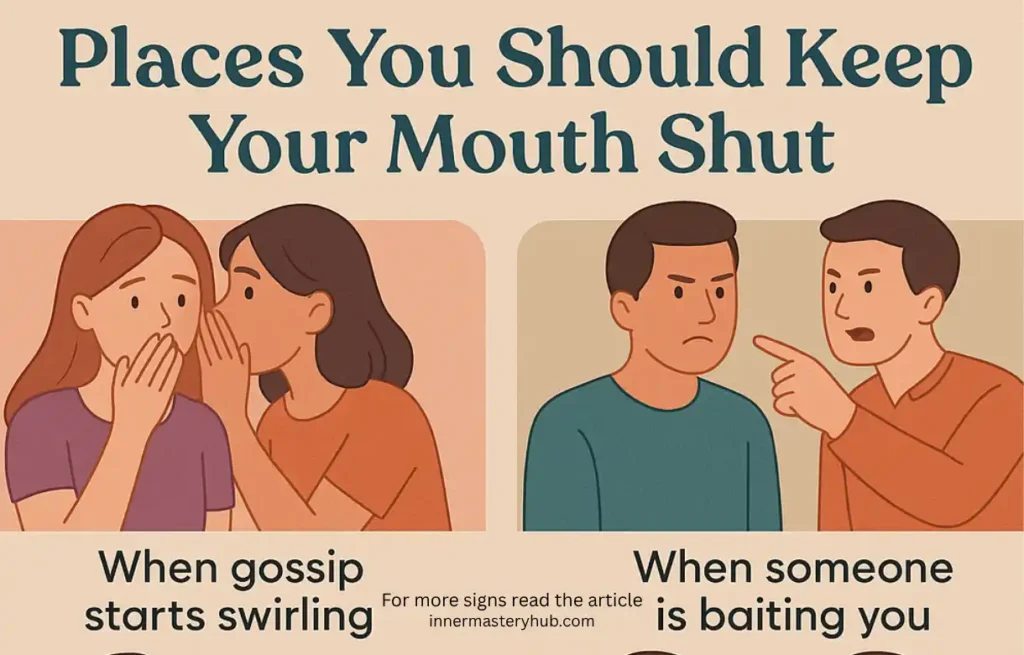
This means choosing not to discuss money when you have been drinking, or agreeing with your partner that arguments are paused after midnight and resumed the next day. It might mean limiting contact with people who bait you into old reactions, or deciding not to respond to messages when your stress is already high.
You can prepare short scripts such as “I can feel myself getting worked up; I need a little break, and I will come back to this,” or “I do not want to talk about this when I am this tired; can we schedule a time tomorrow?” Having words ready makes it easier to act differently when emotions rise.
Reflect on this: in which situations do you usually “lose it”? What boundary or script would protect you, and others, in those moments?
9. Ask for support and stay accountable
You are not meant to do this alone. Many toxic habits grew in isolation, secrecy, or families where no one talked honestly about feelings. Changing them works better with support; it can be a coach, a support group, or a trusted friend who is willing to hold you accountable with kindness.
Therapy, in particular, can help you unpack old wounds, learn emotion regulation tools, and practise new ways of relating in a safe space. Approaches that include self-compassion and mindfulness have been shown to reduce shame and support healthier coping. You do not need to wait until your life falls apart to ask for help; reaching out early is a sign of strength, not weakness.
You might tell someone you trust, “I am actively trying to manage my own toxic behaviours. Here are a few specific patterns I want to change. Can I check in with you once a week about how it is going?” Pick someone who can be honest without shaming you.
What Is the Biggest Misunderstanding About Toxic Behaviour?
The biggest misunderstanding is believing toxic behaviour is about intention, when it is actually about unprocessed emotions.
You may think:
- “I’m just a bad person”
- “I need more discipline”
But that’s not the real issue.
What’s really happening:
- Your nervous system is reacting
- Your past experiences are shaping your interpretation
- Your emotions are driving behaviour
Carl Jung once said:
“Until you make the unconscious conscious, it will direct your life and you will call it fate.”
This is exactly what toxic behaviour patterns are: unconscious loops.
How Does Internal Struggle Show Up in Daily Life?
Internal struggle shows up as a conflict between your values and your reactions.
You want to:
- Stay calm
- Be kind
- Communicate clearly
But instead, you:
- React defensively
- Shut down
- Say things you regret
This creates:
- Guilt
- Shame
- Self-doubt
And then the cycle repeats.
This struggle is not a weakness. It’s the misalignment between awareness and emotional control.
What Are Common Toxic Behaviour Patterns People Overlook?
Many toxic behaviours are subtle and socially normalised, which makes them harder to recognize.
Examples include:
- Sarcasm is used to hide anger
- Silent treatment instead of communication
- Over-explaining to seek validation
- Controlling behaviour disguised as care
These patterns come from:
- Fear of rejection
- Need for control
- Unresolved emotional pain
As Brené Brown explains:
“We don’t have to do all of it alone. We were never meant to.”
Yet toxic patterns come from trying to protect yourself alone.
Why Is Self-Awareness More Important Than Self-Control?
Self-awareness helps you understand your reactions, while self-control only suppresses them temporarily.
If you only use control:
- You bottle emotions
- Pressure builds
- You eventually explode
But with awareness:
- You notice triggers early
- You understand emotional meaning
- You respond with clarity
A study in the Journal of Personality and Social Psychology shows that self-awareness is directly linked to better emotional regulation and healthier relationships2.
A Simple Example of Toxic Behaviour Loop
A common toxic pattern begins with misinterpretation, not intention.
Suppose your partner replies late.
Internal Process:
- Trigger: Late reply
- Interpretation: “They don’t care”
- Emotion: Anxiety → Anger
- Reaction: Passive-aggressive message
Reality:
They were busy, not dismissive.
This shows:
Your reaction is not about the event. It’s about the meaning you attach to it.
What Mistakes Do People Make When Trying to Change Toxic Behaviour?
People try to fix behaviour without understanding emotions, which leads to repeated failure.
Common mistakes:
- Forcing positivity
- Ignoring triggers
- Blaming others
- Expecting instant change
But change doesn’t happen through pressure. It happens through understanding.
As Viktor Frankl said:
“Between stimulus and response there is a space. In that space is our power3.”
Most people never learn to access that space.
How Are Toxic Behaviours Connected to Emotional Needs?
Toxic behaviours reflect unmet emotional needs expressed in unhealthy ways.
For example:
- Anger → Need for respect
- Withdrawal → Need for safety
- Control → Need for certainty
When needs are unmet:
- Emotions intensify
- Behaviours become reactive
Understanding this shifts your perspective:
You’re not broken, you’re responding to something unmet.
What Does Real Change in Toxic Behaviour Actually Look Like?
Real change is not about eliminating reactions but understanding them before they control you.
You still feel:
- Anger
- Fear
- Frustration
But now:
- You recognize it sooner
- You question your interpretation
- You choose a different response
This is emotional maturity.
Conclusion
Managing your own toxic behaviours is not about becoming perfect. It’s about becoming aware.
You begin to see that your reactions are not random. They follow a pattern shaped by your emotions, interpretations, and past experiences.
And once you see that clearly, something changes.
You stop fighting yourself.
You start understanding yourself.
That’s where real change begins, not in control, but in awareness.
FAQs
What does it mean to manage your own toxic behaviours?
It means you notice the ways you hurt yourself or others and choose new actions. Instead of blaming people or past events, you take responsibility. You learn your triggers, slow down before reacting, and practise healthier ways to talk, listen, and cope with difficult feelings.
How do you know if you have toxic behaviours?
You may notice people pull away, feel scared to be honest with you, or often call you “dramatic” or “negative”. You might replay conversations and feel guilty. If the same problems keep repeating in your relationships, it is a sign to manage your own toxic behaviours.
Can you really change your own toxic behaviours, or is this just who you are?
You can change. Toxic behaviours are learned habits, not your whole identity. When you manage your own toxic behaviours with awareness, practice, and support, your brain forms new patterns. It takes time, but every small step you repeat becomes part of a healthier version of you.
Where should you start when trying to manage your own toxic behaviours?
Start by naming one or two clear patterns, such as shouting, the silent treatment, or constant criticism. Notice when they show up and what you feel just before. Write it down for a week. This simple tracking gives you insight and a clear place to start changing.
Why do you act so toxic with people you love the most?
You often feel like dropping your guard around people, so old wounds and fears come up. Stress, insecurity, and fear of abandonment can push you into toxic behaviour. When you manage your own poisonous behaviours, you protect the very relationships you care about.
How can you stop overreacting in the moment?
Learn to pause. When you feel triggered, breathe slowly, count to ten, or ask for a short break. Remind yourself you do not have to respond instantly. This pause helps you manage your own toxic behaviours and choose words that match what you really want to say.
Should you tell others that you are working on your toxic behaviours?
Yes, if it feels safe. You can say, “I know I have done X before, and I am working on it.” This shows ownership and invites gentle accountability. When you name your goal to manage your own toxic behaviours, people can notice and support your progress.
How do you apologize after acting in a toxic way?
Be specific and honest. Say what you did, how it likely felt for them, and what you will try to do differently. Avoid excuses. A genuine apology might sound uncomfortable, but it is part of learning to manage your own toxic behaviours and rebuild trust.
When should you seek professional help to manage your own toxic behaviours?
Seek help if you often lose control, feel intense shame after conflicts, or see a pattern across many relationships. A therapist can help you understand the roots of your reactions and build new skills. Support teaches you to manage your own toxic behaviours more easily and less overwhelming.
How long does it take to manage your own toxic behaviours?
There is no fixed time. Some changes happen in weeks, others take months or years. What matters is steady practice: noticing triggers, pausing, repairing, and trying again. Over time, people will feel safer with you, and you will feel more proud of how you handle challenging moments.
- Transforming Shame: The Role of Acceptance and Commitment Therapy, https://doi.org/10.1002/jclp.23810 ↩︎
- LeDoux, J. (2000). Emotion circuits in the brain. Annual Review of Neuroscience, 23, 155–184. https://doi.org/10.1146/annurev.neuro.23.1.155 ↩︎
- Frankl, V. E. (2006). Man’s Search for Meaning. Beacon Press. ↩︎