
The Real Cost of Everyday Choices With 12 Corrupt Price Tags

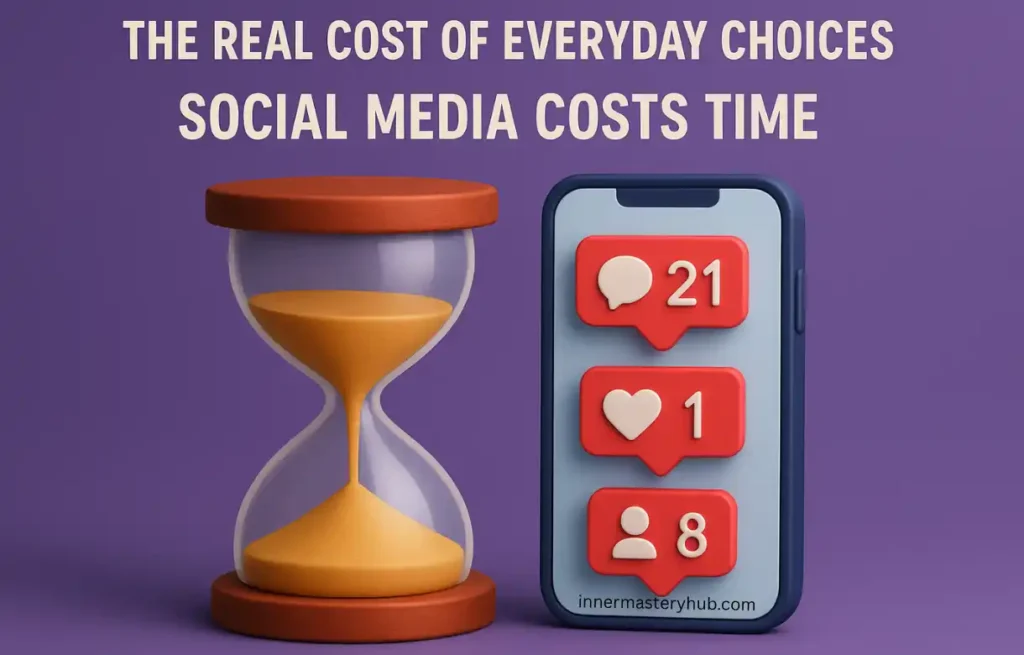
The real cost of everyday choices is the hidden emotional, financial, and psychological impact of small daily decisions that accumulate over time. While each choice feels minor, together they shape your habits, identity, and long-term outcomes in ways you often don’t consciously notice.
Every single day, you make hundreds of small decisions about what to eat, how to spend time, whom to talk to, and when to rest. Most of them seem harmless, even routine. Yet, the real cost of everyday choices often hides beneath the surface and shapes your energy, mindset, and future in ways you don’t realize.
You may think that scrolling social media for a few extra minutes or putting off a task until tomorrow doesn’t matter. But over time, these decisions quietly shape the direction of your life.
Why Do Small Daily Decisions Have Such a Big Impact?
Small decisions matter because they compound over time, shaping habits, identity, and long-term outcomes. What feels insignificant today becomes a pattern tomorrow and a life direction later.
You don’t notice the shift immediately.
Because nothing dramatic happens.
But here’s what actually unfolds:
- A trigger appears (stress, boredom, fatigue)
- You interpret it (“I deserve a break”)
- You feel relief or comfort
- You repeat the behavior
Over time, this loop becomes automatic.
This is what Charles Duhigg describes as the habit loop. But the deeper truth is:
You are not choosing once; you are reinforcing a pattern.
Example
- Ordering fast food once → harmless
- Repeating it weekly → health decline
- Long-term → chronic issues, lower energy, self-image changes
The cost wasn’t the food.
It was the repeated emotional decision behind it.
What Is the Hidden Psychological Cost Behind Everyday Choices?
The hidden psychological cost includes guilt, reduced self-trust, decision fatigue, and identity conflict. These internal effects accumulate silently, shaping how you see yourself and your capabilities.
Every time you go against your intention, something subtle happens.
Not immediately.
But gradually.
As Brené Brown emphasizes, “Integrity is choosing courage over comfort.” But most daily choices lean toward comfort.
What Happens Internally
- You promise yourself something
- You break it
- You justify it
- You feel slight discomfort
- You repeat the cycle
This creates:
- Cognitive dissonance (internal conflict)
- Emotional drain
- Lower self-confidence
Over time, you don’t just lose consistency; you lose clarity of identity.
Why Do We Keep Making Choices That Hurt Us Later?
People make harmful everyday choices because the brain prioritizes immediate rewards over long-term benefits, driven by emotional triggers and cognitive biases.
Your brain isn’t broken.
It’s wired for survival, not optimization.
As Daniel Kahneman explains in Thinking, Fast and Slow, your mind has two systems:
- Fast, emotional, automatic
- Slow, logical, deliberate
Most daily decisions come from the fast system.
What Actually Happens
- You feel stress
- Your brain seeks quick relief
- You choose comfort
- You delay consequences
This is called present bias.
You’re not weak.
You’re responding to immediate emotional signals.
12 Modern-Day Choices That Carry Hidden Costs
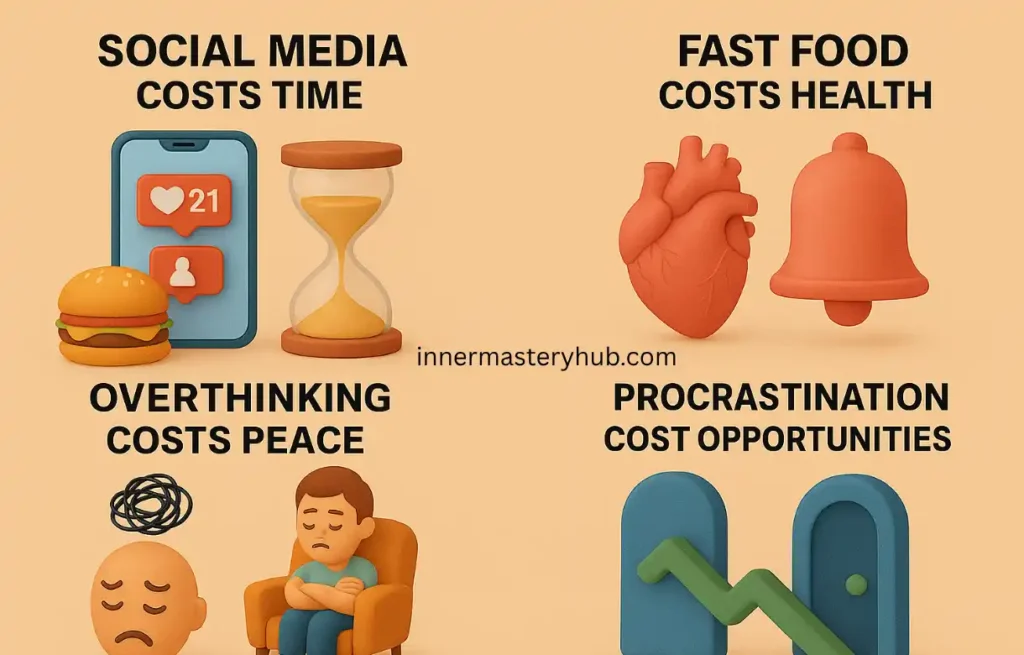
1. Social Media Costs Time
After checking one notification on your phone, you wind up wasting an hour. The purpose of social media is to capture you with continuous scrolls, likes, and comments, creating a feedback loop that gives your brain brief dopamine spikes. But the wasted moment never comes again.
The typical person spends more than two hours and thirty-one minutes per day on social media, according to Statista (2024) studies1. Almost 38 whole days a year are wasted in front of screens, time that could have been spent developing a skill, getting enough sleep, or interacting with real individuals. All day, you feel “busy,” yet at night, you realise you haven’t accomplished much.
Begin by keeping a record of your screen time. Set deliberate limits and replace aimless browsing with productive pauses like writing, a five-minute mindfulness exercise, or a walk. Don’t use social media to hide, but to connect. Taking back your minutes will feel liberating once you learn how to value them.
2. Fast Food Costs Health
Fries or a burger seem like a fast cure in a busy environment. It’s inexpensive and handy. However, that immediate gratification comes with a long-term cost of everyday choices.
Excessive intake of fast food raises the risk of diabetes, heart disease, and obesity, according to research from the American Heart Association2. In addition to weight gain, the actual cost of everyday choices like consuming processed foods is low energy, difficulty concentrating, and sluggish moods. Saving a few minutes now could mean years of dealing with the consequences.
You don’t have to become flawless or vegan overnight. Start by packing a simple homemade lunch, choosing grilled over fried foods, adding one piece of fruit to your day, and making considerate substitutions.
Think of food as fuel, not filler. The energy you gain from eating healthy compounds into better work, better sleep, and a longer life.
3. Notifications Cost Focus
When your phone buzzes, you’re working on something important. You tell yourself, a glance. One look, however, becomes ten diversions. Each notification captures your attention.
After a single interruption, it takes roughly 23 minutes to refocus properly, according to research from the University of California, Irvine3. You will understand why you feel cognitively restless if you multiply that by the number of alerts you receive each day. Your capacity to think clearly or remain in the moment is weakened by the continual dopamine rushes from notifications.
Turn off unnecessary notifications. Make time slots technology-free so you can work or relax without interruption. Your productivity is under your control when you manage your attention. More valuable than any like or message you could lose is the attention you regain.
4. Comfort Zones Cost the Future
Doing what you already know—the same job, the same routine, the same habits- feels secure. Stability comes from comfort, but growth is constrained.
Years may go by before you realise you’re stuck. Despite feeling unfulfilled, you may be too scared to make a change. A growth mentality helps people to grow, whereas a fixed attitude prevents them from taking on challenges.
Take tiny steps to push yourself: acquire a new skill, speak out in meetings, or take a risk you’ve been putting off. Growth is about going a little bit beyond what seems comfortable, not about diving into chaos. From the brink of comfort comes progress.
5. Overthinking Costs Peace
You stress about things that haven’t even happened, replay discussions, and predict every possible conclusion. Although it feels like control, it’s actually just mental chatter.
Research from the University of Michigan indicates that obsessive thinking can result in despair, anxiety, and sleeplessness. Solving imaginary problems grinds you out. You feel more helpless the more you analyse.
Begin objectively examining your thoughts. Put them in writing, take a deep breath, and ask yourself, “Am I in control of this?” Otherwise, let it go. Peace comes from choosing to move forward in the face of uncertainty rather than trying to figure everything out.
6. Procrastination Costs Opportunities
You promise yourself that you’ll begin the call, the project, and the gym tomorrow. Next week turns into next month, and tomorrow into next week.
Whether you do something or not, time passes. According to research published in the Journal of Behavioural Science,4 procrastination usually stems from fear, either of achievement or of failure. Opportunities pass undetected in the meantime. Missing out on opportunities that could have altered your course is the true cost of everyday choices to put things off.
Divide large objectives into manageable chunks. Spend five minutes getting started, even if it’s not ideal. Progress creates momentum, not perfection. Every choice you make counts as a vote for the person you wish to be.
7. Toxic People Cost Happiness
Because you’re afraid of being alone or because it feels familiar, you choose to stay with the people who drain you. Toxic relationships, however, do more than just waste time; they shape your self-perception.
Like smoke, emotional toxicity spreads. Being around negative individuals reduces immunity and raises stress levels, according to a Harvard Medical School study. You can lose delight and begin to doubt your value if you are subjected to constant drama or criticism.
Set boundaries, and surround yourself with positive people. You should not shrink in relationships; instead, you should flourish. When you put your mental well-being before approval, life feels lighter.
8. Excuses Cost Growth
You tell yourself things like, “I’m not ready,” “I don’t have time,” and “I’m too old.” Although these justifications seem plausible, they act as invisible barriers that prevent you from reaching your full potential.
Every justification is a tiny capitulation. They build up to regret over time. People regret not doing more than they regret acting, according to a study published in Psychological Science. Seeing others enjoy the life you desired is the actual cost of the everyday choices you make.
Catch your excuses in the moment to start. Use “How can I?” instead of “I can’t.” Growth begins with willingness and doesn’t require ideal circumstances. The tale you keep telling yourself is the only thing standing in the way of growth.
9. Impulse Spending Costs Stability
You can easily buy goods you don’t really need when you shop online, a “treat yourself” here, a sale there.
Those minor expenditures mount up. CNBC (2024) reports5 that the average American spends $314 a month on impulsive purchases. While the dopamine rush subsides, the financial strain persists. That money may have been used for debt repayment, travel funding, or saved over time.
Hold off for 24 hours before selecting “Buy Now.” Verify whether it fits with your long-term goals. Spending sensibly is the path to financial independence, not increasing income. One silent way to show respect for oneself is to choose stability over whims.
10. Neglecting Sleep Costs Clarity
You think you’re getting more out of your day by working late, watching shows, or skimming through content.
In reality, you’re exchanging efficiency for fatigue. Lack of sleep impairs memory, focus, and emotional equilibrium. Chronic sleep deprivation even raises the risk of depression and heart disease.
Do not compromise on rest. Add a nightly ritual that includes turning off electronics, relaxing your body, and dimming the lights.
11. Comparing Yourself Costs Confidence
You feel lost when you browse through flawless photos, believing that everyone else is leading better, quicker, and more contented lives.
Happiness is stolen by comparison. Social media frequently displays highlights rather than actual life. Anxiety and low self-esteem are more common among heavy social media users. You begin to gauge your value by others’ timelines.
Turn your attention inward. Honour your own accomplishments, no matter how minor.
12. Ignoring Mental Health Costs in Everyday Choices
You continue to tell yourself, “I’m fine,” despite your fatigue, grief, or concern. However, neglecting mental health does not cause it to go away.
According to the World Health Organisation, depression is one of the leading global causes of disability. Work, relationships, and physical health are all impacted by untreated emotional stress. Losing the ability to appreciate life is the actual cost of everyday choices that disregard mental wellness.
Consistently check in with yourself. Speak with a friend, therapist, or counsellor. Asking for advice is the true strength; requiring help is not a sign of weakness.
What Are the Most Common Mistakes People Make Daily?
Common mistakes include underestimating long-term impact, making emotion-driven decisions, ignoring patterns, and prioritizing short-term comfort over long-term well-being.
You don’t fail because of big mistakes.
You drift because of the small ones repeated.
Common Patterns
- Saying “just this once” too often
- Ignoring emotional triggers
- Confusing relief with progress
- Avoiding discomfort
Hidden Truth
You’re not choosing the action.
You’re choosing the identity that comes with it.
How Do Everyday Choices Shape Your Identity Over Time?
Every day choices reinforce beliefs about who you are. Repeated actions create identity patterns that influence confidence, habits, and long-term behavior.
You become what you repeatedly do.
Not what you intend.
As Aristotle said, “We are what we repeatedly do.”
But here’s the deeper layer:
Every action sends a signal to your brain:
- “I follow through.”
- “I quit easily.”
- “I avoid discomfort.”
Over time, these signals form identity.
Framework: Identity Loop
- Action
- Reinforcement
- Belief
- Repetition
This loop defines your life direction.
Can Emotional Regulation Change Your Daily Decisions?
Yes, emotional regulation helps you pause between a trigger and an action, allowing you to make better decisions aligned with long-term goals rather than short-term impulses.
Most people try to fix behavior.
But behavior is the result, not the cause.
The real cause is an emotional reaction.
What Changes Everything
- Noticing the trigger
- Slowing down interpretation
- Allowing discomfort
- Choosing intentionally
As Viktor Frankl wrote, “Between stimulus and response there is a space6.”
That space is where your life changes.
What Is the Real Long-Term Cost of Ignoring Small Choices?
Ignoring small choices leads to cumulative negative outcomes in health, finances, relationships, and self-identity, often becoming noticeable only after significant time has passed.
The danger is not immediate failure.
It’s a silent drift.
Long-Term Effects
- Poor health habits → chronic illness
- Financial leakage → lack of security
- Broken promises → low self-trust
- Emotional avoidance → anxiety buildup
You don’t collapse overnight.
You slowly disconnect from the life you intended.
The Hidden Ledger of Life
Cost of everyday choices that seem small, what you eat, how you think, who you let near, what you postpone. Yet, each decision adds up to a pattern. The real cost of everyday choices isn’t paid in money; it’s paid in time, energy, peace, and growth.
Ask yourself:
- Which habits steal your hours quietly?
- What kind of life are your daily decisions building?
- Are you choosing temporary comfort over long-term fulfillment?
The Real Cost of Everyday Choices Is the Life You Live Tomorrow
Although you have no control over everything, you can make a conscious choice. You can shift the course of your life each time you choose calm over overanalyzing, action over excuses, or health over hurry. Being mindful is the first step to changing the actual cost of daily decisions, which is what you give up for the life you desire.
The good news? You don’t have to change your life completely all at once. Because the decisions you make now will determine the quality of your future, you must make one better decision today and another tomorrow.
FAQs
What does the real cost of everyday choices mean?
The hidden effects of daily decisions on your time, energy, health, and future represent the actual cost of daily choices. It’s about the unspoken sacrifices you make, not just the money; every decision you make shapes your habits, contentment, and long-term success in life.
How does social media reveal the real cost of everyday choices?
The true cost of everyday choices, like scrolling through social media, is wasted focus and time. Hours spent on the internet can make you less productive and more anxious. You get clarity, make more in-person connections, and have more control over how your minutes affect your future when you limit your screen time.
actual
How does procrastination show the real cost of everyday choices?
Procrastination reveals the actual cost of daily decisions by squandering momentum and opportunities. Every delay increases regret and tension. Even if it’s not ideal, taking action today builds confidence and development. If you ignore the small choices you make now, they could become significant problems tomorrow. Reluctance always loses against consistency.
How does the real cost of everyday choices affect relationships?
The actual cost of daily decisions impacts relationships by consuming time, effort, and presence. Pleasure is sapped when one chooses diversions over connection or surrounds oneself with poisonous individuals. Spending time in supportive relationships and meaningful conversations fosters emotional development, empathy, and trust, building stronger, more enduring partnerships.
What financial lessons reveal the real cost of everyday choices?
Impulsive spending and inadequate budgeting are the actual costs of daily financial decisions. Although small purchases and subscriptions don’t seem like much, they quickly mount up. Delaying gratification and tracking spending lead to long-term security.
Why should I care about the real cost of everyday choices?
Your future outcomes are determined by the actual cost of the decisions you make daily. Even seemingly innocuous behaviours, such as scrolling or skipping sleep, deplete concentration and energy. Gaining awareness enables you to make deliberate choices each day that promote your objectives, well-being, and general health.
How can I reduce the real cost of everyday choices?
Purposeful living can lower the actual cost of daily decisions. Organise your time effectively, set objectives, and replace bad habits with ones that serve a purpose. Focus on progress rather than perfection because every modest, deliberate decision adds up to long-lasting gains in your happiness, mental clarity, and physical health.
How can I identify the real cost of everyday choices in my life?
Tracking how you use your time, money, and energy can help you determine the actual cost of the decisions you make each day. Take note of the things that drain or leave you unfulfilled. Every day, consider this: “What am I trading for this habit?” You can refocus your attention towards significant progress by being aware.
What is the real cost of everyday choices on mental health?
Daily decisions have a direct impact on mental health, leading to tension, worry, and exhaustion. Inner equilibrium is lost when one ignores feelings, overthinks, or neglects to take breaks. Resilience is strengthened by making thoughtful decisions, such as journaling, therapy, or self-care.
- Statista Research Department. (2025). Daily time spent on social networking by internet users worldwide. Statista.
https://www.statista.com/statistics/433871/daily-social-media-usage-worldwide ↩︎ - Mazidi, M., & Speakman, J. R. (2018). Association of fast-food and full-service restaurant densities with mortality from cardiovascular disease and stroke, and the prevalence of diabetes mellitus. Journal of the American Heart Association, 7(11), e007651.
https://doi.org/10.1161/JAHA.117.007651 ↩︎ - Mark, G., Gudith, D., & Klocke, U. (2008). The cost of interrupted work: More speed and stress. Proceedings of the SIGCHI Conference on Human Factors in Computing Systems (CHI ’08), 107–110. Association for Computing Machinery.
https://doi.org/10.1145/1357054.1357072 ↩︎ - Suhartono, S., & colleagues. (2020). The relationship between fear of failure and student academic achievement, with procrastination as a mediating variable. ResearchGate.
↩︎ - CNBC. (2022, August 20). Shoppers spend over $300 a month on impulse purchases despite recession fears. CNBC. ↩︎
- Frankl, V. E. (1946/2006). Man’s Search for Meaning. Beacon Press.
↩︎
Written By Mehwish Qurayshi
Mehwish Qurayshi is a Trauma-Informed Emotional Wellness Counsellor trained through NICABM’s Treating Trauma Master Series, which includes NBCC-approved education in Trauma Treatment and Emotional Wellness & Emotional Intelligence – Sourcecode Academia. She has over five years of experience providing emotional wellness counselling, helping individuals heal from trauma, regulate emotions, and build healthy relationships.