When Someone Tries to Push Your Buttons They Use 35 Uncertain Phrases
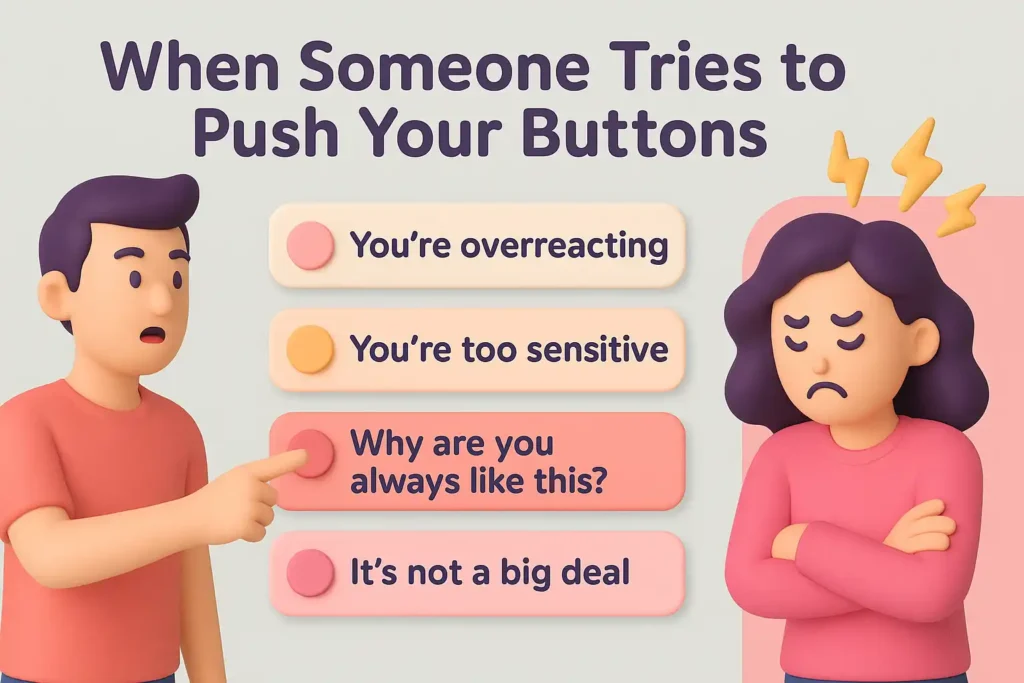
Someone tries to push your buttons if they deliberately say or do something to trigger an emotional reaction from you. Their goal is to upset, annoy, or provoke you. Staying calm and controlling your response protects your emotional balance and power.
When someone tries to irritate you, it usually begins with a familiar feeling that makes your shoulders lift, your stomach contract, and you feel as though someone is intentionally trying to agitate you. This might have happened to you at work, in relationships, or even at home. The meaning of “when someone tries to push your buttons” refers to situations in which someone uses language meant to provoke a response from you.
These sentences deplete your energy and cause you to doubt yourself, even if you may not initially recognise the pattern. The initial approach to maintain your composure and learn how to respond rather than react is to become familiar with the language that people use to trigger you.
Sometimes you just keep replaying those words without thinking why you felt so triggered. Even though you know you didn’t deserve it, something inside of you soaked it in. Those who purposefully irritate you rely on emotional pressure, even though you could later criticise yourself for not handling it better.
According to studies on interpersonal conflict, using provocative language triggers your body’s stress response, which reduces logical thought and heightens emotional responses. This implies that you are human and not “too sensitive.” You should avoid taking the
What Does “Someone Tries to Push Your Buttons” Mean?
When someone tries to push your buttons, they deliberately provoke emotional reactions like anger, frustration, or insecurity by targeting your sensitivities or past experiences.
“Pushing your buttons” refers to triggering emotional responses by exploiting psychological vulnerabilities.
This behavior connects to:
- Past emotional wounds
- Unresolved insecurities
- Learned behavioral patterns
Because your brain links current situations with past experiences, even a small comment can feel intense.
Why Do People Try to Push Your Buttons?
People push your buttons to gain control, release their own frustration, or unconsciously repeat learned behavior patterns.
Often, it’s not about you, it’s about them.
Common Reasons
- Desire for control or dominance
- Emotional immaturity
- Projection of their own insecurities
- Habitual conflict patterns
Research shows that emotional provocation can be a form of psychological displacement, where individuals redirect their emotions onto others1 (Freud, 1936).
But here’s the deeper truth:
They succeed only when your internal system reacts automatically.
What Happens Inside You When Someone Triggers You?
A trigger follows a psychological chain: event → interpretation → emotion → reaction → consequence.
This process happens fast, unconsciously.
The Inner Flow
- Trigger: Someone says something sharp
- Interpretation: “They don’t respect me”
- Emotion: Anger or hurt
- Reaction: Defensive or aggressive response
- Consequence: Conflict, regret, or stress
According to neuroscience research, the amygdala activates emotional responses before rational thinking engages2 (LeDoux, 1996).
So your reaction feels automatic, but it’s not unchangeable.
Why Does It Feel So Hard to Stay Calm?
It feels hard because your brain prioritises emotional survival over logical thinking, especially when it senses threat.
Even small social threats feel real to your brain.
Emotional Regulation Explained
Emotional regulation is the ability to manage and respond to emotional experiences in a balanced way.
But when someone pushes your buttons:
- Your nervous system activates
- Your past experiences amplify the moment
- Your control weakens
Research by Gross (1998)3 shows that poor emotional regulation leads to stronger emotional reactions and impulsive behavior.
So it’s not weakness, it’s wiring.
Common phrases you hear when someone tries to push your buttons
1. “Calm down.”
This phrase rarely calms anyone. Even when your feelings are legitimate, it tells you that your response is incorrect when someone tries to push your buttons. According to emotion experts, urging someone to “calm down” can make them feel ignored, which raises their stress levels. You could feel unreasonable when you hear this, but in reality, the other person is attempting to manipulate the situation.
2. “You’re overreacting.”
This one causes self-doubt right away when someone tries to push your buttons. You start to doubt your own perception. Those who use this expression often want you to downplay your concerns so they won’t have to deal with them. You can learn to silence yourself before speaking if you hear this again and again.
3. “You’re too sensitive.”
This is often used when someone wants you to tolerate bad behaviour. Sensitivity is not a flaw; it’s a sign of awareness. The phrase turns something neutral into something shameful, so they don’t have to take responsibility.
4. “Relax, it was just a joke.”
This is a common strategy for hiding an unpleasant comment. Humour is on purpose, used as a socially acceptable cover for resentment. Even if you were offended, you’ll likely feel compelled to smile when someone tells you it was “just a joke.”
5. “Why are you always like this?”
This phrase builds your entire identity from a single instant, when someone tries to push your buttons. Instead of addressing the subject, it turns the discourse from the problem to your character, making you feel bad about yourself. This is a tactic people use to avoid responsibility.
6. “You’re imagining things.”
This statement is a veiled instance of gaslighting. It affects confidence in your own judgement and causes you to doubt reality. This sentence probably made you feel as though you misread everything.
7. “Everyone thinks this about you.”
They want you to feel alone and unsupported when they say this. To increase the effect, they introduce fictional characters into the discussion. The intention is to make you feel outnumbered, building pressure when someone tries to push your buttons.
8. “I’m only telling you because I care.”
This sounds kind, but it’s often used to deliver criticism that isn’t constructive. You may feel obligated to accept unkind words because they’re framed as helpful. Genuine care doesn’t require emotional harm.
9. “You should be grateful.”
This statement shuts down any expression of discomfort or personal needs. Gratitude is healthy, but when weaponised, it forces you to suppress your feelings, creating guilt for wanting basic respect.
10. “You always make things difficult.”
Labelling you as “difficult” discourages you from asserting boundaries. This phrase is designed to make you back down, especially if you value harmony.
11. “It’s not a big deal.”
If it matters to you, then it’s valid. People use this phrase to minimise situations that would require effort or empathy on their part. It pressures you to shrink your feelings.
12. “Stop being dramatic.”
Drama is a convenient accusation. It paints you as irrational even when you’re expressing yourself clearly. Over time, you feel discouraged from sharing emotions because you fear being judged or when someone tries to push your buttons.
13. “Nothing is ever good enough for you.”
This creates shame around having standards. People use it when they don’t want to meet those standards or acknowledge a problem. It attempts to make you lower your expectations.
14. “You think you’re always right.”
This flips the situation by accusing you of arrogance, even when you’re simply insisting on fairness. It’s meant to make you question your confidence so the other person can maintain control.
15. “If you really cared, you’d…”
This phrase uses emotional blackmail to steer your actions. It attaches love or loyalty to compliance. Once you hear it, you may feel pressured to prove your care rather than question the unfair demand.
16. “I guess this is just who you are.”
This statement boxes you into a negative identity. It’s meant to make you feel flawed or defective, so you stop standing up for yourself. When someone tries to push your buttons with this phrase, they want you to internalise their judgment rather than question their behaviour.

17. “Here we go again.”
This phrase is designed to wear you down before you even speak. It labels any attempt to express your feelings as repetitive or annoying. You may suddenly feel guilty for bringing up something important, which is exactly what the other person wants.
18. “I don’t have time for this.”
This shuts down the conversation by implying your concerns aren’t worth discussing. People want to distance themselves emotionally when they push the burden of the problem onto you. It pressures you into silence and makes you feel like your needs are unrealistic when someone tries to push your buttons.
19. “You’re making me look bad.”
This phrase shifts blame onto you and frames your voice as a threat. Instead of addressing their actions, they make you feel responsible for their emotions. It’s a subtle way to guilt you into staying quiet.
20. “Maybe this is why people don’t like talking to you.”
This phrase is meant to hit your sense of belonging. It introduces imaginary critics to isolate you. Whether or not it’s true doesn’t matter; the intention is to make you doubt your social worth.
21. “You’re reading too much into it.”
This is used to dismiss your intuition. People who don’t want to take accountability rely on ambiguity, and this phrase convinces you to ignore your own perception. You end up second-guessing yourself instead of trusting your instincts.
22. “You just want attention.”
This accusation makes you feel selfish for expressing legitimate concerns. It’s especially useful if you value independence. It frames your emotional expression as a performance rather than genuine communication.
23. “I can’t talk to you when you’re like this.”
This phrase withdraws connection at the exact moment you need to be heard. The goal is to make you feel responsible for their distance. You may feel abandoned when someone tries to push your buttons and make you express yourself.
24. “You’re the only one who has a problem with this.”
By framing your discomfort as unusual, they imply that your standards are unreasonable. Even if others privately agree with you, this phrase makes you feel isolated and pressured to let it go.
25. “I shouldn’t have to explain myself.”
This is used to avoid accountability. Healthy communication involves clarity, but someone who doesn’t want to be questioned will say this to shut you down. It makes you feel like you’re demanding simply for wanting to be understood.
26. “You always twist things.”
This shifts the narrative by accusing you of manipulation. It’s a reversal tactic, used by people who don’t want the spotlight on their behaviour. You suddenly feel defensive even when you’ve communicated honestly.
27. “You’re being ridiculous.”
This phrase attacks your intelligence and emotional maturity. It’s meant to immediately invalidate whatever you’re saying, making you feel embarrassed for expressing yourself when someone tries to push your buttons.
28. “Why can’t you just let it go?”
This pressures you to ignore your feelings for someone else’s comfort. It implies that your desire to resolve issues is unnecessary and burdensome. The goal is to get you to drop the topic, not to heal it.
29. “You’re lucky I put up with you.”
This combines manipulation with emotional superiority. It creates fear of abandonment and makes you feel grateful for basic respect. The person uses this phrase to create a power imbalance.
30. “I didn’t do anything wrong. You’re imagining the whole thing.”
A stronger form of gaslighting. Instead of addressing your lived experience, they deny reality altogether. This can make you feel confused, overwhelmed, and unsure of your memory.
31. “You’re so dramatic about everything.”
This exaggerates your emotional response to shame you into minimising your feelings. It’s used when you’ve expressed a valid concern that the other person doesn’t want to acknowledge.
32. “This is all in your head.”
Another classic gaslighting phrase. It forces you to question your perception and distort your confidence over time. People who say this rely on making you doubt yourself.
33. “If you cared about me, you’d drop this.”
This attaches your love or loyalty to silence. It creates emotional pressure by equating compliance with affection. You may feel guilty for wanting to address an issue when someone tries to push your buttons.
34. “Why are you making this so complicated?”
This suggests you’re the one creating conflict simply by seeking clarity. It frames your desire for understanding as a needless burden.
35. “I’m not repeating myself. You should have listened.”
This blames you even when they never communicated clearly. It’s used to make you feel incompetent, discouraging you from asking questions in the future when someone tries to push your buttons.
You might find yourself thinking back to times when you were subjected to similar remarks as you read these lines. Just thinking about them may potentially cause your body to react. It’s normal to feel agitated. These words are intended to provoke. They function by upsetting your emotions and distorting your perception of reality.
However, being aware of them gives you an advantage by limiting their influence. When you understand the purpose of the words, you stop taking them personally and begin to see them as manipulative patterns.
How Does Emotional Regulation Change the Outcome?
Emotional regulation interrupts the automatic reaction cycle, allowing you to respond with awareness instead of impulse.
When you regulate emotions:
- You create space before reacting
- You observe instead of absorbing
- You choose your response
Simple Internal Shift
Instead of:
“They’re disrespecting me”
You begin to think:
“They’re acting from their own state”
How Can You Recognize When Someone Is Trying to Push Your Buttons?
You can recognize it by noticing repeated patterns of provocation, emotional discomfort, and targeted comments.
Signs
- You feel sudden emotional spikes
- The same person triggers you repeatedly
- Comments feel “personal”
- You react faster than you think
Awareness is the first shift.
What Mistakes Do People Commonly Make When Someone Tries to Push Their Buttons?
Most people react instantly, personalise the situation, and try to “win” the interaction instead of understanding it.
Common Mistakes
- Reacting instead of pausing
- Taking everything personally
- Trying to prove a point
- Escalating the conflict
- Suppressing emotions (which later explode)
These reactions reinforce the cycle.
Because every time you react strongly, you unknowingly train others on how to control you.
When you care for the person expressing these things, it makes them more challenging to handle. You feel conflicted about speaking up and remaining silent to prevent further conflict when someone tries to push your buttons. You could be concerned that defending yourself will make things worse. Still, experience teaches you that responding right away seldom works, since it gives the other person precisely what they want: your emotional energy.
Before you talk, you could start by grounding yourself. Silently identifying what’s going on, such as “This is a button-pushing tactic,” can be useful for some people. Your brain can transition from an emotional to a cognitive state when you give that behaviour a name. Label your internal experiences to reduce stress activation within seconds and reach internal stability.
It’s sufficient on its own if you were harmed. You don’t have to defend or justify your feelings. The other person’s power declines when you refuse to debate your emotional experience.
You learn from experience that boundaries are about deciding how you want to be treated, not about controlling other people. You have less need to push the power button as you grow stronger. Understand the pattern behind these sentences to set healthy boundaries. You don’t need to go into great length to articulate what behaviour is unacceptable.
You learn from experience that boundaries are about deciding how you want to be treated, not about controlling other people. You have less need to push the power button as you grow stronger.
However, some sentences cause you more anxiety than others. Because they bring back old wounds, experiences in which you felt defenceless, voiceless, or invisible. You can cure these emotional echoes by becoming aware of them. A statement loses its power to provoke you when it no longer resonates with an internal struggle, when you have made peace with that.
However, some people may unintentionally bother you because they don’t realise how their words impact other people, as they repeat the patterns they were raised with. Open communication may change the dynamic in these situations. However, they gain from throwing you off balance when they employ these expressions routinely. At that point, keeping your peace takes priority.
Maintaining your centre becomes easier the more you comprehend these patterns. You’ll see that your reaction time is slower. You won’t feel as compelled to protect yourself. Your emotional reactions will no longer be a source of power for others who previously relied on them.
In the end, you will become the person who is not easily pushed, provoked, or pulled into emotional traps. When they learn about that, you respond on your terms. You protect your energy and mental health. Each time you choose steadiness over reaction, you strengthen the inner resilience you’ve been developing all along.
The Real Shift Isn’t Outside, It’s Inside
Someone tries to push your buttons, but the real story is not about them. It’s about what happens within you.
You start to see:
- It’s not the trigger, it’s the meaning you assign
- It’s not the moment, it’s your internal pattern
- It’s not control, it’s awareness
When this understanding settles in, something changes.
You don’t become emotionless.
You become aware.
And awareness naturally creates space.
That space gives you a choice.
FAQs about when someone tries to push your buttons
What does it mean when someone tries to push your buttons?
It indicates that you are being purposefully provoked emotionally by what they are saying or doing. They want a response, take charge, or ascribe blame. They intend to encourage you, not to communicate. Being aware of the strategy keeps you composed and prevents you from giving them the desired response.
Why does someone try to push your buttons?
Someone pushes your buttons to obtain authority, they escape responsibility, or to control the situation. It might be intentional emotional control or learnt behaviour. Because it provides them with an edge, they rely on your responses. You can detach and safeguard your emotional equilibrium by knowing their motivation.
What phrases do people use when someone tries to push your buttons?
Common phrases such as “Calm down,” “Relax, it was a joke,” “You’re overreacting,” “You’re too sensitive,” and “Stop being dramatic.” These remarks trigger strong emotions and invalidate your sentiments. When you identify them, you can react clearly.
How do you stay calm when someone tries to push your buttons?
Hold off on responding. Breathe deeply, identify the situation, and remind yourself that their remarks are a reflection of their aim rather than your value. The emotional surge can be stopped by maintaining a consistent tone. Maintaining composure keeps them from taking control of the situation and safeguards your power.
How do you deal when someone tries to push your buttons or trigger you on purpose?
Limit emotional involvement, establish clear limits, and refrain from constantly explaining oneself. Remain grounded, concentrate on the facts, and respond succinctly. A distance may be required if the person persists despite your efforts. It is more vital to keep your peace than to prevail in an argument.
Is pushing someone’s buttons a form of manipulation?
When done on purpose, it becomes emotional manipulation. To manipulate your responses or divert attention from their activities, the speaker employs inflammatory language. Being aware of manipulation enables you to react intelligently rather than falling into emotional traps.
Why do certain phrases trigger strong emotions?
Words that deny your emotions trigger past traumas or emotional scars. They cause a stress reaction because your brain perceives them as dangers. You can better control your reactions and answer with confidence when you know why certain words have an impact on you.
Can you stop when someone tries to push your buttons?
You can manage your emotional triggers, but you have no control over their actions. You take away their desired reward by being aware of their strategies, being composed, and establishing boundaries. They eventually lose interest in provoking you because it is no longer effective.
What are healthy ways to respond when someone pushes your buttons?
Keep your composure, express yourself clearly, and acknowledge your emotions. Make blunt declarations such as “Let’s talk when we’re calmer” or “I’m not engaging in this.” Refrain from emotionally defending yourself. Instead of escalating the conflict, choose reactions that safeguard your peace.
How do I stop giving people emotional control over me?
Develop self-awareness, recognise your triggers, and learn to wait before acting. Develop self-assurance in your limits and refrain from taking offensive remarks personally. You regain control and lessen their impact on your emotions as soon as you stop reacting emotionally.
- Freud, A. (1936). The Ego and the Mechanisms of Defence. London: Hogarth Press. ↩︎
- LeDoux, J. (1996). The Emotional Brain. New York: Simon & Schuster. ↩︎
- Gross, J. J. (1998). The emerging field of emotion regulation: An integrative review. Review of General Psychology, 2(3), 271–299. https://doi.org/10.1037/1089-2680.2.3.271 ↩︎