11 Things You Can Fix Today for Saving a Failing Relationship
One of the most difficult emotional jobs you may face is saving a failed relationship, particularly if you still feel love, but the connection keeps evading you. You may find yourself repeating old conversations and arguing about what went wrong in the hopes that something will make sense.
When you’re there, scepticism gradually dissolves the relationship you once trusted, and the anxiety of losing what you’ve created can make every little problem seem huge. The good news is that relationships can bounce back even when they appear to be in danger, and the partnership’s overall trajectory can be changed by taking the time to address the relevant issues.
Not only does understanding what has to be done help you solve issues, but it also helps you intentionally restore trust. Relationships often recover when both parties recognise their own behaviours and commit to change, rather than waiting for the other person to make the necessary changes. If you approach a failing relationship with willingness, honesty, and consistency, you can save it.
11 Things You Can Address for Saving a Failing Relationship
1. Rebuilding Emotional Safety
Emotional safety is one of the first things to vanish from a relationship that’s falling apart. You might observe that discussions quickly turn into disputes or that you suppress your genuine emotions out of fear of being misinterpreted or condemned. This gradually distances people, making it more challenging to be vulnerable.
Emotional safety is a better predictor of long-term stability than compatibility alone. You can begin to approach talks with less defensiveness and more curiosity once you recognise how important this is. Instead of just responding to your partner’s emotions, you might show them that you are genuinely attempting to understand them. Walls that have built up over time may begin to fall with just that change.
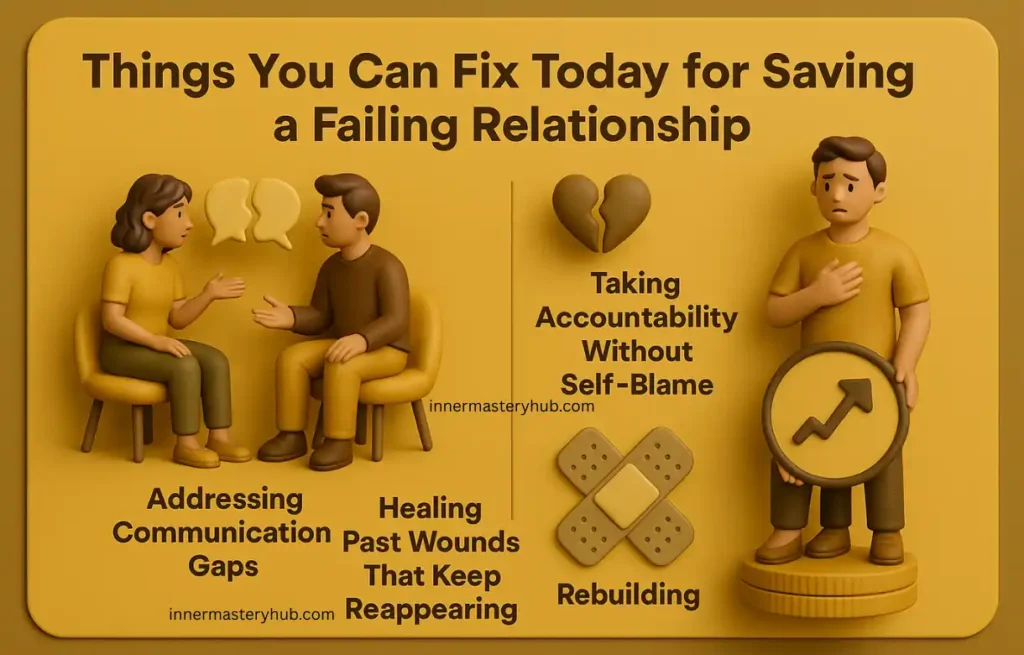
2. Addressing Communication Gaps Before They Grow
Relationship breakdown is rarely the result of a single dispute; instead, it occurs when a pattern of misunderstanding builds. Because previous traumas have influenced how each of you listens, even if you may believe you are being clear, your partner may be hearing something entirely different. You might also decide to keep quiet because you don’t want another disagreement, but doing so only leads to more serious confusion.
Early conversation resolution increases a couple’s chances of remaining together by a significant margin, according to research from The Gottman Institute. The emotional spiral can be slowed down by making little clarifications, such as asking your partner what they meant rather than assuming. To ensure that you both understand each other, practise slowing down conversations and checking in.
3. Reducing Hidden Resentment
Every relationship has minor setbacks, but if they go unaddressed for too long, they can turn into resentment. You may be clinging to times when you experienced criticism, neglect, or lack of support, and those emotions arise during fresh disagreements.
Even when something is harmless, resentment operates as a filter, making neutral behaviours feel personal and leaving you feeling disappointed. Resentment is one of the best indicators of emotional disengagement. You must identify the areas in which you and your partner may harbour resentment if you hope to keep the relationship intact.
4. Reevaluating Expectations Together
Misaligned expectations exacerbate tension in a relationship. While your partner might anticipate more space, you could expect more emotional support. While your partner feels that effort is the foundation, you may think that love should feel effortless. According to studies on marital expectations, couples who openly discuss expectations rather than assume them tend to report greater happiness and fewer conflicts.
Asking yourself what you want from your spouse now and whether you’ve ever made it clear is helpful. Then think about whether their expectations have evolved. Rethinking expectations doesn’t mean decreasing your standards; instead, it means establishing mutual understanding so that neither of you is continuously let down.
5. Repairing Trust by Showing Instead of Telling
Unless there was a profound betrayal, trust doesn’t suddenly fade. Usually, it wears down gradually due to emotional instability. Your partner may start to doubt your motives or your promises when trust is lacking. You may even feel the need to defend yourself more frequently. That’s where Actions repair trust considerably more successfully than apologies.
Rather than using words to reassure your spouse, you can start showing your dependability in regular ways, such as keeping your word on everyday tasks, being open about your intentions, and speaking honestly when anything changes. These steps eventually bring back predictability, which is the cornerstone of trust.
6. Reigniting Interest and Curiosity About Each Other
It often seems like every talk is about issues, obligations, or miscommunications when a relationship starts to fall apart. This depletes emotional energy, leaving little room for happiness and curiosity. Relationship science, however, continues to show that shared positive experiences help correct unfavourable behavioural patterns. Because the brain reacts more strongly to novel experiences than to familiar ones, engaging in novel activities together can renew feelings of closeness.
You might begin by asking your partner questions you haven’t asked in a while, such as how they’ve changed, what they value today, and what is causing them stress right now. A genuine inquiry serves as a reminder to your partner that you still see them as a person, not just a collection of troubles.

7. Managing Conflict More Gently
Whether a relationship succeeds or fails can often be determined by how conflict is handled. Both of you may feel attacked by harsh language, criticism, or bringing up past problems during fresh disputes. A push-pull cycle happens when one spouse grows more aggressive while the other shuts down when the conflict feels unsafe.
Couples who start conversations gently have considerably fewer arguments that escalate. You can work on handling arguments more composedly and on being prepared to take a break when your feelings become too intense. This doesn’t imply avoiding disagreement; instead, it means picking a pace that doesn’t weaken emotional bonds.
8. Taking Accountability Without Self-Blame
Admitting your personal contributions to the dynamic is one of the trickiest aspects of saving a failed relationship. Seeing instances where you avoided communicating or reacted inappropriately may make you uneasy. However, because it shows emotional maturity, accountability improves the connection. However, accepting responsibility does not entail placing all the blame on oneself.
Healthy patterns are produced by balanced accountability, in which each individual reflects honestly rather than either self-blame or defensiveness. You can start by deciding which behaviour you wish to modify and being honest about it. Your partner may feel more comfortable reflecting on their own behaviour just because of this.
9. Rebuilding Physical Affection Gradually
Physical intimacy generally declines when a relationship is tense. As a result, you become emotionally distant from your partner and eventually find it more challenging to communicate with them, even when you want to. Physical contact releases oxytocin, which lowers stress and strengthens bonds, according to attachment studies.
However, affection must be gradually and politely restored when tension is high. Small gestures, like a gentle touch, a closer seat, or a quick handshake, can serve as a starting point. These brief moments re-establish comfort and serve as a reminder to both of you that your connection exists despite the dispute.
10. Healing Past Wounds That Keep Reappearing
Past traumas can reappear when a relationship is failing. Something small may prompt you to respond violently because it stirs memories of an old wound. When habits continue unaltered, emotional triggers emerge.
Finding triggers helps you keep the past and present apart, which dramatically lowers conflict. You can start by asking yourself what fear or memory is connected to your emotional response when it seems more intense than the circumstances. Telling your spouse about this can make it easier for them to connect with your feelings and react more sympathetically. It takes time to heal past scars, but knowledge is the first step.
11. Rebuilding Shared Goals and Vision
When the future seems uncertain, relationships begin to fall apart. You can come to realise that long-term plans have been replaced by daily worry, or that you no longer dream together. According to studies on relationship duration, couples who set common goals are more likely to stay in touch and be motivated to work through issues.
Talking about your shared desires, whether they be practical (like travel, financial security, or creating a home) or emotional (like greater serenity and intimacy), helps rekindle optimism. Establishing common objectives gives your relationship that’s falling apart something worthwhile to strive for.
Saving a Failing Relationship Is Possible When You Approach It Intentionally
It requires work, integrity, and a readiness to examine yourself as much as you examine your spouse to save a failing relationship. Even though you feel overburdened, little, steady changes over time can change the whole scenario. Restore emotional safety by improving communication, controlling resentment, re-establishing trust, rekindling curiosity, and setting common objectives.
You allow your relationship that’s falling apart to flourish once again rather than staying mired in the past. Initially, this process could be unpleasant, but proper repair is rarely straightforward. The important thing is that you make decisions that strengthen the relationship that’s falling apart. Saving a failed relationship becomes not only possible but also incredibly important if you approach each day with patience and intention.
FAQs About Saving a Failing Relationship
Can you save a relationship that’s falling apart?
Yes, if both parties are dedicated to communication, accountability, and emotional healing, they can save a failing relationship. Dramatic gestures are not as important as small, steady changes. You may strengthen your relationship that’s falling apart by addressing the underlying problems, re-establishing trust, and forming new routines.
What are the signs of a relationship that’s falling apart?
Emotional distance, regular fights, a lack of affection, defensiveness, and a lack of desire to spend time together are common indicators. Additionally, you can feel misinterpreted, alienated, or under continual stress. Early detection of these issues enables you to resolve them before the relationship becomes more difficult to mend.
How do I fix a relationship that’s falling apart?
Start by improving your communication skills, showing empathy, and accepting accountability for your actions. Create a feeling of emotional safety, restore trust by acting consistently, and re-establish connections through shared interests. Refrain from placing blame and concentrate on doable actions that can help you get closer. Small everyday efforts lead to progress.
How long does it take to save a failing relationship?
The severity of the problems and each partner’s willingness to change determine how long it takes to heal. While some couples get results in a matter of weeks, others require months. Rather than hurrying the process, the secret is consistent work, patience, and open communication.
Can love come back once it’s gone?
Yes, after the fundamental problems are resolved, the emotional connection can resume. Love is not lost forever; instead, it is often buried under hardship or hatred. Feelings might become stronger than before when you re-establish trust, increase intimacy, and make happy memories.
What should you not do when trying to save a failing relationship?
Steer clear of assigning blame, shouting, disregarding problems, or keeping score. Avoid putting pressure on your partner, controlling their feelings, or bringing up prior transgressions regularly. These actions create more distance. Instead, concentrate on empathy, integrity, and persistent behaviour that demonstrates your desire for genuine change.
Can space help save a failing relationship?
When used purposefully, space can be beneficial. Taking brief pauses allows both parties to think, decompress, and get clarity. But rather than avoiding space, it should be accompanied by communication about expectations. An emotional reset, not a permanent disconnection, is the aim.
How do you rebuild trust after it’s broken?
Rebuilding trust requires time, openness, and consistent behaviour. Apologies are insufficient on their own; your words and deeds must be consistent every day. Be dependable, communicate honestly, and refrain from withholding facts. Emotional safety is eventually restored by consistency and honesty.
What if only one person wants to save a failing relationship?
One person can initiate positive change, but long-term success necessitates the cooperation of both partners. You can take responsibility for your actions and improve communication, but you cannot impose a connection. The relationship that’s falling apart might not totally recover if your partner doesn’t participate at all.
When should you seek therapy for save a failing relationship?
Seek counselling when emotions intensify rapidly, communication breaks down frequently, or past traumas recur often. A therapist brings resources, organisation, and objectivity. Early counselling helps both partners better understand one another and stops problems from getting worse.