Behaviors That Keep You Trapped in Misery and Slowly Drain Your Life
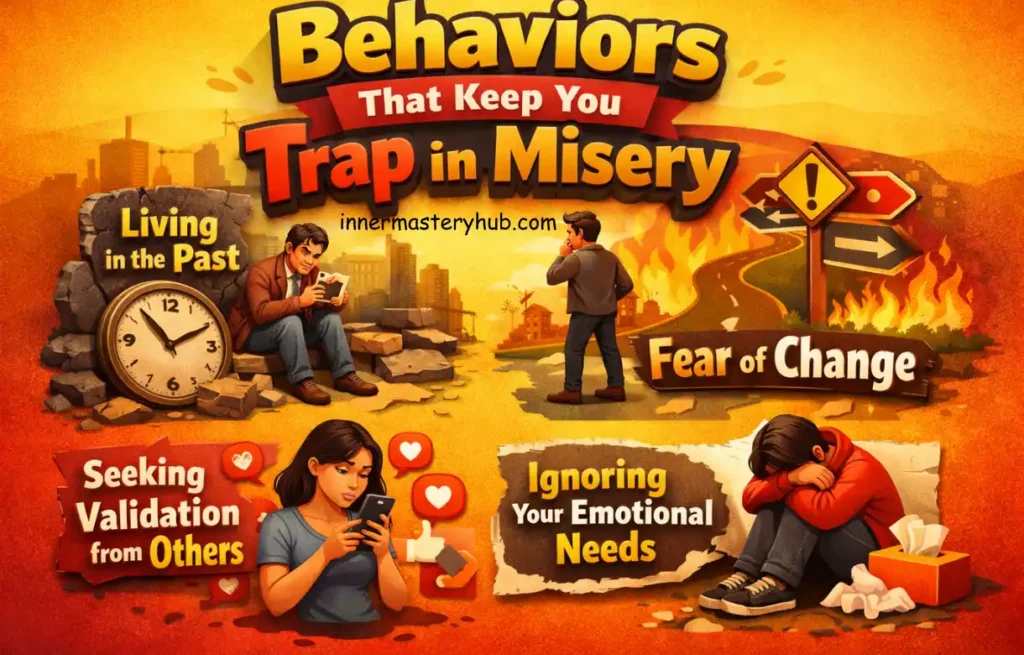
Behaviors That Keep You Trapped in Misery
Certain behaviors can keep you trapped in misery, like constant negative thinking, avoiding responsibility, blaming others, perfectionism, and dwelling on past mistakes. These habits create a cycle of unhappiness, preventing growth and fulfillment. Recognizing and addressing these behaviors can be the first step toward breaking free and finding happiness.
Behaviors that keep you trapped in misery feel normal to you because you have practised them for years. You might even think that they keep you safe in your Survival. In reality, they gradually mould your feelings, decisions, and thoughts in ways that impede self-respect, growth, and tranquillity. Many of these patterns will resonate with you, which is not a shortcoming. It’s your consciousness starting to awaken, and you can move forward once you identify what is holding you back.
What Are Behaviors That Keep You Trapped in Misery?
Behaviors that keep you trapped in misery are repeated emotional and cognitive patterns that reinforce negative feelings, limit growth, and prevent change. These include overthinking, avoidance, self-criticism, and emotional suppression.
Emotional regulation refers to the ability to monitor, evaluate, and modify emotional reactions in a healthy way1 (Gross, 1998).
These behaviors don’t look harmful at first. They feel like protection. But over time, they become invisible cages.
Why Do These Behaviors Feel So Hard to Break?
These behaviors persist because they are linked to your brain’s survival system. Your mind prefers familiar discomfort over uncertain change, reinforcing patterns through emotional memory and habit loops.
Your brain is not trying to make you happy. It is trying to keep you safe. And safety often means repeating what is known.
When a trigger appears, your mind quickly interprets it based on past experiences. This creates an emotional response. That emotion drives your behavior. And the result confirms your belief.
This cycle repeats quietly:
- A comment → feels like rejection
- Interpretation → “I’m not good enough”
- Emotion → anxiety or sadness
- Behavior → withdrawal
- Consequence → isolation, reinforcing belief
How Does Emotional Regulation Connect to Misery?
Poor emotional regulation leads to reactive behaviors, intensifies negative emotions, and prevents healthy processing, which keeps individuals stuck in cycles of distress.
When you suppress emotions, they don’t disappear. They build pressure.
Research shows that emotional suppression increases stress and reduces well-being2.
While avoiding emotions feels easier, it disconnects you from understanding what you truly need.
What Do People Get Wrong About Their Misery?
Most people believe external circumstances cause their misery, but it is their internal interpretation and emotional response that sustain it.
You think:
- “I’ll feel better when things change.”
But the truth is:
- You feel better when your relationship with your thoughts changes.
As Carl Jung said:
“Until you make the unconscious conscious, it will direct your life, and you will call it fate.”
What Is Happening Inside Your Mind? (Psychological Process)
Your mind follows a loop of trigger → interpretation → emotion → behavior, which reinforces patterns and creates long-term emotional states.
Here’s how it unfolds naturally:
A small event happens. You don’t notice it consciously. But your mind assigns meaning based on past experiences. That meaning creates an emotional reaction. That emotion drives your behavior. And the outcome strengthens the original belief.
This loop becomes automatic.
Research in cognitive psychology supports this pattern, showing how thoughts influence emotions and behaviors3 (Beck, 1976).
18 Behaviors that keep you trapped in misery
1. Constant Negative Self-Talk
Speaking harshly and bitterly to yourself is one of the biggest behaviours that keeps you stuck in pain. You call yourself mockingly, mentally replay past mistakes, and anticipate failure before you even begin. This inner voice shapes your perception of yourself and what you think you deserve over time.
Recurring negative self-talk raises tension, anxiety, and despair, according to research published by the American Psychological Association. Attacking yourself all the time keeps your mind in Survival Mode, which makes it challenging to feel positive. The first step in changing this behaviour is to pay attention to how you speak to yourself and choose fair words.
2. Avoiding Responsibility for Your Choices
It is easy to place the blame for your current situation on other people, events, or the Past when life seems overwhelming. Refusing to accept accountability for your present decisions keeps you stuck, even though many things may not have been your fault.
While this behaviour provides short-term relief, it causes long-term suffering. Your power is outside of you; thus, you lose control over where you go. Those who take
3. Living in the Past
Tightly holding onto past pain is another prevalent pattern of behaviour that keeps you stuck in unhappiness. You act as though past mistakes, strained relationships, and lost opportunities are still happening. This mental habit keeps your nervous system active and inhibits you from
Repeatedly revisiting past trauma can maintain increased stress hormones. Healing is about learning from the Past without allowing it to dictate how you behave now, not about forgetting the Past.
4. Fear of Change
You may be unhappy with your circumstances, but oppose any change. It’s generally safer to be afraid of the unknown than to be in pain. This anxiety keeps you stuck in habits that sap your hope and vitality. People are more comfortable with familiar discomfort than new possibilities.
Avoiding change prevents you from improving and growing. Making little, gradual improvements helps you gain confidence and convince yourself that discomfort is not equivalent to danger.
5. Seeking Validation from Others
You give up your emotional independence when your sense of value is based on other people’s acceptance. You might pretend to be someone you’re not, ignore your needs, or overextend yourself. According to research on self-esteem, external validation leads to erratic confidence that fluctuates with others’ opinions. Emotional suffering diminishes, and inner stability increases when you learn to value yourself according to your behaviour and beliefs.
6. Overthinking Everything
Although overanalysing seems fruitful, it frequently has no results. You examine discussions, choices, and potential results until your intellect starts to wear out. By making a lot of noise in your head, this behaviour keeps you stuck in misery. Chronic overthinking has been connected in studies to anxiety and sleep issues. Your mind can rest and regain clarity when you learn to reduce ruminating by acting or establishing mental limits.
7. Ignoring Your Emotional Needs
You might tell yourself to be strong and ignore your emotions. Although strength is essential, emotional neglect leads to intense internal conflict. Anger, anxiety, or melancholy are common later manifestations of repressed emotions. Acknowledging and expressing emotions in healthy ways enhances mental well-being, according to research on emotional health. It doesn’t make you weak to listen to your feelings; instead, it makes you conscious.
8. Staying in Toxic Relationships
One of the most painful behaviours that keeps you stuck in sorrow is continuing to be in emotionally draining relationships. You might stay because of habit, guilt, or fear. Over time, toxic relationships cause stress and diminish self-esteem. Long-term relationship stress can affect one’s physical and emotional well-being. Setting healthy limits helps you regain self-respect and safeguard your energies.
9. Comparing Yourself to Others
Continuous comparing robs people of happiness and adds needless stress. You feel inadequate or behind when you compare your life to others’ highlights. Social comparison raises feelings of discontent and depression. Growth occurs at varied rates, and every path is different. It is calming and inspiring to concentrate on your own development.

10. Avoiding Difficult Conversations
Although it may seem easier to remain silent, avoiding open communication creates animosity and miscommunication. Unspoken problems undermine relationships and self-confidence, despite your fears of conflict. Relationships and emotional well-being improve through the expression of aggression. Speaking plainly and quietly lets issues surface and be addressed.
11. Poor Sleep Habits
Emotional regulation, attention, and mood are all severely impacted by sleep deprivation. Your nervous system is pressured when you stay up late, scroll endlessly, or neglect your need for rest. Sleep is a critical component of mental health. Strengthening sleeping routines improves emotional equilibrium and lowers depressive symptoms.
12. Constantly Chasing Perfection
Despite high standards, perfectionism conceals a fear of failure. You put off taking action or punish yourself severely for little errors. Studies reveal a connection between burnout, anxiety, and perfectionism. Acknowledging progress over perfection facilitates learning and eases emotional strain.
13. Escaping Through Distractions
Pain can be momentarily numbed by binge-watching, overeating, or endless scrolling. These behaviours prevent discomfort but never make it go away. Avoidance eventually intensifies emotional discontent. Research on coping mechanisms reveals that focused problem-solving improves long-term well-being more than avoidance tactics.
14. Ignoring Physical Health
15. Holding Onto Resentment
Although it feels right, harbouring resentment contaminates your inner world. Stress and resentment are fuelled by internalised anger. According to psychological research, forgiveness increases mental health and lessens emotional discomfort. Letting go releases you from the burden of harm, but it doesn’t release you from it.
16. Saying Yes When You Mean No
People-pleasing depletes your vitality and leaves you mute. You may be afraid of disagreement or rejection, but persistent self-betrayal harms self-worth. Boundaries and emotional equilibrium are strengthened when one learns to say no politely.
17. Lack of Purpose
Every day existence feels meaningless when there is no purpose to it. Purpose enhances mental resilience and satisfaction, according to motivation research. Little objectives that align with your values can give you direction and hope; a purpose doesn’t have to be big.
18. Refuse Help
Trying to handle Everything alone may feel strong, but isolation deepens misery. Research shows social support improves mental health and coping ability. Ask for help, show courage, and self-respect.
How Can You Shift Your Understanding of Misery?
Misery is not just something happening to you; it is something being reinforced within you through patterns of thought and emotional response.
The shift is subtle but powerful:
You stop asking:
“Why is this happening to me?”
And begin asking:
“What is this showing me about how I respond?”
This shift creates awareness. And awareness changes everything.
What Are the Most Common Mistakes People Make?
People try to control outcomes instead of understanding emotions, suppress feelings instead of processing them, and seek quick fixes instead of long-term awareness.
Common mistakes include:
- Forcing positivity instead of understanding pain
- Ignoring emotional triggers
- Seeking external validation
- Expecting instant change
As Brené Brown explains:
“We cannot selectively numb emotions. When we numb the painful emotions, we also numb the positive emotions.”
When Success Doesn’t Fix the Feeling
External success does not resolve internal emotional patterns, which is why many high achievers still feel stuck in misery.
A corporate professional achieves career success. High income, recognition, stability. But internally, the same patterns remain: self-doubt, anxiety, and dissatisfaction.
Why?
Because the behaviors that keep you trapped in misery are internal. Success changes circumstances, not patterns.
Behaviors That Keep You Trapped in Misery Are Not Obvious, But They Are Changeable
You are not stuck because your life is broken. You feel stuck because certain patterns are repeating quietly.
The behaviors that keep you trapped in misery are not failures. They are learned responses. And what is learned can be understood.
Emotional regulation is not about control. It is about awareness. When you begin to see your patterns clearly, they lose their power.
FAQs on Behaviors That Keep You Trapped in Misery
What are the behaviors that keep you trapped in misery?
Behaviors that keep you trapped in misery are repeated habits like negative thinking, avoidance, self-blame, and fear of change. These patterns affect your mental health and emotional balance, making life feel heavy even when situations can improve.
Why do people stay stuck in miserable behaviors?
You feel stuck because these behaviors feel familiar and safe. Your brain prefers known pain over unknown change. Over time, habits become automatic, and without awareness, you keep repeating them even when they hurt you.
Can negative thinking really cause long-term misery?
Yes, constant negative thinking trains your brain to expect failure and danger. This increases stress, anxiety, and low self-worth. Over time, it affects decision-making, relationships, and motivation, keeping you emotionally stuck.
How does fear of change keep you unhappy?
Fear of change stops you from trying new paths that could improve your life. You remain in situations that drain you emotionally because uncertainty feels scary, even when your current reality leaves you dissatisfied every day.
Is avoiding emotions a behavior that keeps you trapped in misery?
Avoiding emotions does not remove them. Suppressed feelings return as anxiety, anger, or sadness. Facing emotions helps you understand yourself better and reduces long-term emotional pain.
Can toxic relationships get stuck in miserable behaviors?
Yes, toxic relationships create constant stress, self-doubt, and emotional exhaustion. Staying in such connections damages your self-esteem and keeps you trapped in cycles of pain instead of growth.
Why does comparing yourself to others cause you to get stuck in miserable behaviors?
Comparison makes you focus on what you lack rather than on your progress. Social media often shows only success, creating unrealistic standards that increase dissatisfaction and self-criticism.
Can overthinking really affect happiness?
Overthinking keeps your mind busy with worry and regret. It increases stress and prevents action. Instead of solving problems, it drains your energy and keeps you emotionally stuck.
How can small changes reduce miserable behaviors?
Small changes build confidence without overwhelming you. Simple habits like better sleep, honest self-talk, or setting boundaries slowly retrain your mind and create emotional stability.
Is it possible to break behaviors that keep you trapped in misery?
Yes, with awareness, patience, and consistent effort, these behaviors can change. Seeking support, practicing self-reflection, and making healthier choices help you move toward peace and balance.
What are the most common behaviors that keep you trapped in misery?
The most common behaviors that keep you trapped in misery include overthinking, self-blame, avoiding responsibility, staying in toxic relationships, and negative self-talk. These habits feel familiar and safe, but they slowly drain confidence, joy, and motivation.
- Gross, J. J. (1998). The emerging field of emotion regulation: An integrative review. Review of General Psychology, 2(3), 271–299. https://doi.org/10.1037/1089-2680.2.3.271 ↩︎
- (Gross & John, 2003). https://doi.org/10.1037/0022-3514.85.2.348 ↩︎
- Beck, A. T. (1976). Cognitive therapy and the emotional disorders. International Universities Press. ↩︎